

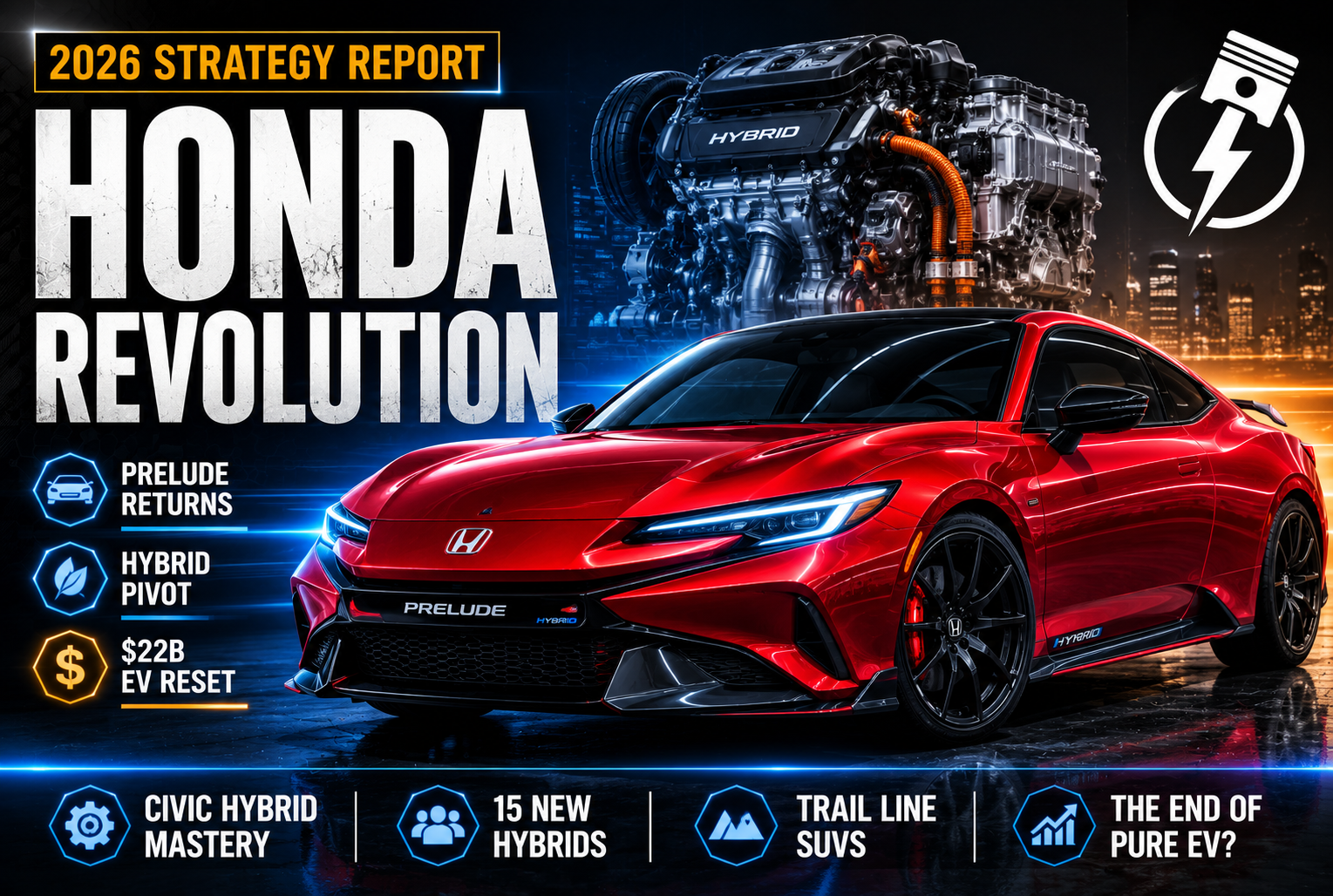
The Ultimate Guide to Honda’s 2026 Revolution: The $22 Billion EV Cancellation, the Prelude’s Hybrid Return, and Why Gas Isn’t Dead Yet (A Complete Deep Dive)
I will never forget the exact afternoon I bought my first Honda.
I spend an absolute diagnostic amount of time analyzing automotive market shifts, reading through dense corporate financial disclosures, scrutinizing battery degradation curves, and debating the future of electric vehicles. But back in my early twenties, I didn’t care about any of that. I just needed a car that would start every single morning, get incredible gas mileage, and not completely bankrupt me when it came time for routine maintenance. I bought a heavily used, mid-1990s Honda Civic with over 150,000 miles on the odometer. The paint was fading, the interior smelled vaguely of stale coffee, and the radio barely worked. But I drove that car into the ground for another six years, and it never left me stranded. Not once.
Let’s just be honest about something first: Honda is the undisputed, heavyweight champion of practical, bulletproof, unpretentious reliability. For decades, if a friend, a family member, or a coworker asked you what car they should buy on a tight budget, the default answer was always a Honda Civic or a Honda Accord. You didn’t even have to think about it. It was automotive gospel.
But over the last few years, the automotive landscape has become incredibly chaotic, and the gospel has been rewritten. The entire industry was aggressively forced into a pure Electric Vehicle (EV) arms race. Legacy automakers like Honda suddenly found themselves struggling to compete with massive tech-first startups, shifting government regulations, and a deeply unpredictable global supply chain. We were promised a completely electrified future. We were told the internal combustion engine was dead.
Heading into 2026, however, the internet has been completely flooded with shocking, almost unbelievable headlines about Honda’s future. We are seeing massive, multi-billion dollar EV project cancellations. We are seeing the highly anticipated resurrection of legendary 1990s sports car nameplates. And most importantly, we are witnessing a massive, aggressive corporate pivot back toward hybrid technology.
Because navigating these corporate strategy shifts, reading through financial earnings reports, and deciphering new model rollouts can be incredibly overwhelming for the average car buyer, I wanted to create a single, definitive pillar of content for you. No confusing corporate PR spin, no gatekeeping mechanic jargon, and no EV fanboy bias.
This is your complete, deeply human guide to exactly what Honda is doing in 2026. We are going to break down why they just took a multi-billion dollar financial hit to cancel their electric future, why the highly anticipated Prelude is coming back as a hybrid, how the new Civic Hybrid is completely changing the compact car game, and why Honda is quietly walking back their massive EV promises to give you the cars you actually want to buy.
Grab a cup of extremely strong coffee, settle in, and let’s break down the most important, dramatic year in modern Honda history.
Part 1: The $22 Billion Reality Check (Why Honda Just Killed Its EV Future)
If you read the automotive news in early 2026, you likely saw a massive, shocking headline: Honda officially announced the cancellation of three major EV models that were planned for production and launch in the North American market.
For a company that previously stood on stage and boldly stated they wanted to achieve complete carbon neutrality by the year 2050, scrapping three massive EV projects feels like a total, embarrassing retreat. But if you actually look under the hood of the global automotive market, it isn’t a retreat at all—it is a brilliant, ruthless survival strategy.
The Canceled Projects: What Are We Losing?
To understand the magnitude of this shift, you have to look at what Honda just threw in the trash.
- The Zero Series (Honda 0 Saloon & 0 SUV): Unveiled to massive fanfare at CES in Las Vegas, these were supposed to be Honda’s futuristic, next-generation 800-volt flagship EVs. They featured wild aerodynamics and advanced autonomous driving tech. They are now dead.
- The Acura RSX EV: A highly anticipated all-electric revival of the beloved Acura sport compact. Canceled.
- The Honda Prologue’s Execution Date: The current Honda Prologue EV (which is actually just a Chevrolet Blazer EV wearing a Honda suit, built on GM’s Ultium platform) is officially being cut off. Production is slated to end in late 2026.
The Brutal Math: Why Did They Do It?
Honda didn’t do this lightly. According to their corporate financial disclosures, this massive reversal in strategy is going to result in a staggering write-down—resulting in a forecasted loss of tens of billions of dollars (specifically citing a $22.5 billion AUD impairment loss due to the failed electric strategy). You do not take a financial hit of that magnitude unless the alternative is absolute bankruptcy.
Here are the three massive, unavoidable factors that forced Honda to pull the plug:
1. The Federal Tax Credit Cliff and Waning US Demand
The reality is that pure EV sales in the United States have severely cooled down. The early adopters and wealthy tech enthusiasts already bought their Teslas and Rivians. The mass market is currently terrified of “range anxiety,” deeply frustrated by poor public charging infrastructure, and unwilling to pay the massive upfront premium for battery-electric vehicles. Furthermore, changes to the 2025 federal tax credits completely gutted the $7,500 incentive for many vehicles. Without that government subsidy, a $60,000 electric Honda simply makes zero financial sense to the average American family.
2. The Chinese Software-Defined Vehicle (SDV) Invasion
While the US market is stalling, the Chinese market is accelerating at a terrifying pace. Chinese EV manufacturers (like BYD and NIO) are building cars faster and cheaper than anyone else on the planet. But more importantly, Chinese consumers no longer care about traditional automotive hardware (like suspension geometry or cabin space). They view cars as rolling smartphones. They want “Software-Defined Vehicles” featuring advanced driver-assistance systems (ADAS) and constant over-the-air software updates. Honda explicitly admitted in their press release that they simply could not match the rapid software development cycles of the newer Chinese tech companies, resulting in a massive decline in global competitiveness.
3. Crippling Tariff Policies
The geopolitical landscape is a nightmare for automakers right now. Newly imposed US tariff policies heavily impacted the profitability of importing vehicles and battery components, costing Honda billions in the last fiscal year alone.
Faced with a slowing US market, unbeatable Chinese software, and massive tariffs, Honda executives looked at the math and pulled the emergency brake. They are reallocating an estimated 0.8 trillion yen away from EVs and pouring a massive 4.4 trillion yen directly into gasoline and hybrid vehicle development.
They realized that customers don’t necessarily want to deal with broken public charging stations—they just want to spend less money at the gas pump. And that realization brings us to the most exciting vehicle in their 2026 lineup.
Part 2: The Return of the Legend: The 2026 Honda Prelude
If you grew up in the late 1980s or 1990s, the Honda Prelude was an absolute, undeniable icon.
Before the era of massive SUVs and heavy crossovers, the Prelude was the car you bought when you wanted to have fun but still needed to get to work on Monday. It was a sleek, affordable, front-wheel-drive sports coupe. It gave us legendary automotive quirks like pop-up headlights and mechanical four-wheel steering. It proved that you didn’t need a massive, gas-guzzling V8 engine to have an absolute blast carving up a winding mountain road.
Honda quietly killed the Prelude nameplate in 2001, and automotive enthusiasts have been begging for its return ever since. After a quarter-century of waiting, the 2026 Honda Prelude is officially back. But it isn’t returning with a high-revving, naturally aspirated VTEC engine, and thankfully, it isn’t returning as a heavy, soulless, pure EV.
The 2026 Honda Prelude is returning as a highly advanced, fiercely engineered hybrid-electric grand touring coupe.
The Hybrid Powertrain: Efficiency Meets Aggression
At the heart of the new Prelude is a masterclass in hybrid engineering. Honda has paired a 2.0-liter Atkinson-cycle four-cylinder gasoline engine with an advanced two-motor hybrid-electric system (featuring an AC synchronous permanent-magnet electric drive motor).
- Total System Output: 200 horsepower (combined).
- Torque: 232 lb-ft of torque available instantly from 0 to 2,000 rpm.
While 200 horsepower might not sound like supercar territory in 2026, you have to look at the torque figure. Because electric motors provide instant twisting force the millisecond you press the accelerator, the new Prelude will launch off the line with a punchy, aggressive urgency that the old 1990s VTEC engines simply could never produce at low RPMs. It is designed to be a grand tourer—a car that is effortlessly fast, incredibly smooth, and comfortably capable of crushing a four-hour road trip while sipping fuel at an estimated 44 MPG combined.
The Civic Type R Chassis Hardware
This is the part that has automotive journalists completely losing their minds. Honda didn’t just drop a hybrid engine into a boring commuter chassis. The 2026 Prelude is the brand’s very first hybrid model to inherit actual, high-performance hardware directly from the legendary Civic Type R track car.
- Dual-Axis Strut Front Suspension: High-horsepower, front-wheel-drive cars notoriously suffer from “torque steer”—a terrifying phenomenon where aggressively pressing the gas pedal causes the steering wheel to violently jerk to one side. The dual-axis strut suspension (pulled straight from the Type R) physically separates the steering knuckle from the suspension strut, almost entirely eliminating torque steer and providing laser-precise cornering.
- Brembo Brakes: To bring the hybrid coupe to a halt, Honda equipped the Prelude with massive 13.8-inch front rotors clamped by aggressive Brembo 4-piston aluminum calipers.
- Adaptive Damper System: The suspension electronically adjusts in milliseconds, allowing the car to ride smoothly over broken city pavement in “Comfort” mode, and stiffen up aggressively when you switch to “Sport” mode on a canyon road.
The “Honda S+ Shift” Technology: Saving the CVT
Let’s address the elephant in the room. The absolute biggest complaint car enthusiasts have about modern hybrid vehicles is the transmission. Most hybrids use a Direct Drive or Continuously Variable Transmission (CVT). A CVT has no actual, physical gears. It operates using a complex system of belts and pulleys, which means when you floor the gas pedal, the engine just revs up to a single, high RPM and stays there, sounding like a droning, angry vacuum cleaner.
To fix this and inject some actual soul back into the driving experience, Honda is debuting their brand-new Honda S+ Shift control technology on the 2026 Prelude.
This is an incredibly advanced software system designed to actively simulate the visceral feel of a high-performance geared transmission. When you pull the metal paddle shifters mounted behind the steering wheel, the software momentarily cuts the electric torque and modulates the gasoline engine RPMs to simulate the physical “jolt” and sound of shifting a real gear. It features Active Sound Control to pump enhanced engine acoustics into the cabin. It is Honda’s way of proving that electrified cars don’t have to be boring, lifeless appliances. You can have 44 MPG and still smile when you hit an on-ramp.
Design, Cabin, and Pricing
The Prelude is a true 2+2 coupe. It has two highly bolstered, leather-trimmed sport seats in the front, and two very small seats in the back (mostly reserved for luggage, small children, or incredibly forgiving friends).
The interior is heavily modernized, featuring a 10.2-inch digital gauge cluster, a 9-inch HD touchscreen with Google built-in, wireless Apple CarPlay, and an 8-speaker Bose premium audio system. It also comes standard with the full Honda Sensing safety suite (Adaptive Cruise Control, Lane Keep Assist, and Automated Emergency Braking).
- Expected Starting Price: Roughly $42,000 to $43,195.
- Release Date: Expected to arrive at US dealerships in late fall 2025 as a 2026 model year vehicle.
Part 3: The 2026 Civic Hybrid (The Volume King)
While the Prelude is the flashy halo car designed to get people into the showrooms, the Honda Civic is the vehicle that keeps the lights on at the corporate headquarters.
For 2026, Honda hasn’t just updated the exterior styling of their best-selling compact car; they have fundamentally changed how the vehicle lineup operates by heavily pushing the Civic Sport Hybrid to the forefront. If you are shopping for a reliable commuter car this year, you need to understand exactly why the hybrid is the only version you should actually consider buying.
The Death of the 1.5T
In previous years, if you bought a top-tier Honda Civic Touring, you received a 1.5-liter turbocharged gasoline engine. For 2026, that engine is essentially dead for the standard Civic lineup.
Honda has completely streamlined their offerings:
- The Base Gas Trims (LX & Sport): These utilize a very simple, naturally aspirated 2.0-liter engine producing a modest 150 horsepower. They are reliable, but incredibly slow.
- The Hybrid Trims (Sport Hybrid & Sport Touring Hybrid): These utilize the exact same 200-horsepower, 232 lb-ft dual-motor hybrid system found in the new Prelude.
Why the Hybrid is the Ultimate Daily Driver
The pricing gap between the standard gas Civic and the Civic Sport Hybrid is shockingly small (often a difference of just a few thousand dollars). But the performance gap is absolutely massive.
Because of the instant torque from the electric motors, the Civic Hybrid hits 60 mph in roughly 6.1 seconds. It is quicker than the old 1.5T engine, and remarkably, it is almost as fast as the enthusiast-focused Civic Si. But unlike the Civic Si (which requires premium fuel and only comes with a manual transmission), the Civic Hybrid gets an astonishing 50 MPG in the city.
It is the ultimate automotive cheat code. You get the acceleration of a hot hatch, the fuel economy of a Prius, and the legendary reliability of a Honda, all wrapped in a subtle, handsome four-door package starting around $28,000 to $30,000. It is, without a doubt, the smartest automotive purchase you can make in 2026.
Part 4: The Ripple Effect (CR-V, Accord, and 15 New Hybrids)
The hybrid push doesn’t stop with the Prelude and the Civic. Remember that $7 billion Honda reallocated away from pure EVs? They are using it to completely hybridize their entire global fleet.
In their financial disclosures, Honda stated they plan to launch 15 next-generation hybrid models globally by 2030.
If you walk onto a Honda lot today, you will see this strategy already in full effect. The Honda Accord and the Honda CR-V—two of the best-selling vehicles in North American history—have been completely dominated by their hybrid trims. Honda expects hybrid sales to represent over 50% of the total sales mix for both of those nameplates.
By utilizing the exact same 2.0-liter dual-motor hybrid architecture across the Civic, Accord, CR-V, and Prelude, Honda achieves massive economies of scale. They can manufacture millions of these identical hybrid powertrains at their converted plants in Ohio, driving down the cost of production, completely dodging international tariffs, and passing those savings onto the consumer. It is a masterful stroke of supply chain logistics.
Part 5: The Trail Line and The Great Outdoors
While Honda is dominating the pavement with their new hybrids, they have also acutely realized they are missing out on a massive, highly profitable slice of the automotive market: the outdoor lifestyle segment.
Over the last few years, millions of Americans have taken up camping, overlanding, and outdoor adventuring. Brands like Subaru have made absolute fortunes selling their lifted, ruggedized “Wilderness” trims, and Toyota cannot build enough TRD Pro Tacomas. Honda has historically built phenomenal, reliable SUVs, but they always looked like they belonged in a suburban mall parking lot rather than a muddy forest trail.
That changes in 2026.
Enter the “Trail Line”
At recent auto shows, Honda officially unveiled a massive new vehicle classification strategy featuring the “Trail Line.”
You can expect upcoming mid-size and large SUVs, specifically the heavily refreshed 2026/2027 Honda Passport and Honda Pilot, to receive aggressive Trail Line variants. These are not just cosmetic sticker packages. The Trail Line vehicles will feature legitimately increased ground clearance, upgraded off-road-tuned suspension systems, heavy-duty underbody steel skid plates to protect the oil pan, and aggressive all-terrain tires straight from the factory.
Honda is finally giving buyers a reason to take their incredibly reliable V6 SUVs off the pavement.
The Honda Base Station
To further cement their commitment to the outdoor lifestyle, Honda’s US R&D team recently unveiled a prototype known as the Honda Base Station.
This is a completely unexpected move from an automaker. The Base Station is a futuristic, lightweight, towable travel trailer. It features modular interiors, integrated smart tech, and solar panels, designed specifically to be effortlessly towed by a Honda Passport or a Honda Ridgeline pickup truck.
While it is currently just a prototype concept, it signals a massive, fascinating shift in corporate thinking. Honda doesn’t just want to sell you the car that takes you to the campsite; they want to build the entire integrated outdoor ecosystem. They want to own your entire weekend.
Part 6: The Verdict: Should You Buy a 2026 Honda?
If you are currently driving an older vehicle, staring at an expensive repair bill, and wondering if you should pull the trigger on a 2026 Honda, the answer is incredibly clear.
Yes. Absolutely.
Honda’s massive, multi-billion dollar pivot away from pure EVs might look like a failure on a corporate spreadsheet, but for you, the consumer, it is the greatest thing that could have possibly happened.
The industry tried to force a purely electric future onto a public that simply wasn’t ready for it, hindered by high prices and broken charging infrastructure. Honda had the humility and the ruthless business acumen to read the room, take the financial hit, and course-correct.
By abandoning their aggressive EV strategy and focusing heavily on perfecting their hybrid powertrains, they are giving consumers exactly what they actually want: incredibly reliable cars that are genuinely fun to drive, produce massive low-end torque, and get phenomenal gas mileage without the sheer, panic-inducing headache of trying to find a working public charging station during a holiday road trip.
The 2026 Civic Sport Hybrid is shaping up to be the absolute best daily commuter car on the global market. The 2026 Accord and CR-V hybrids offer unmatched family utility. And the glorious return of the Prelude proves that Honda hasn’t forgotten how to build a car with actual, visceral character.
Honda’s legendary “Sports DNA” is officially back, their hybrid technology is virtually bulletproof, and the automotive industry is significantly better because they decided to stop chasing Elon Musk and get back to doing what Honda does best: building cars that simply work, every single time you turn the key.
Frequently Asked Questions (FAQs) About the 2026 Honda Lineup
Because Honda’s massive corporate restructuring, model rollouts, and powertrain shifts involve a lot of complex, moving parts, we have compiled the absolute most common questions buyers are asking regarding the 2026 lineup to ensure you have all the facts in one place before heading to a dealership.
Q: Did Honda completely stop making Electric Vehicles (EVs) forever?
A: No, but they have drastically scaled back their timeline and financial commitments. While they canceled three massive planned North American EV models (including the Zero Series) to mitigate financial losses, they are still honoring the production of the current all-electric Honda Prologue SUV until late 2026. Going forward, they will focus heavily on hybrids for the US market, while restricting EV development primarily to tiny “kei cars” for the Japanese domestic market.
Q: Is the new 2026 Honda Prelude a fully electric car?
A: No. Despite early internet rumors that it would be a pure EV to rival the Tesla Model 3, Honda officially confirmed that the 2026 Prelude will feature an advanced 200-horsepower hybrid-electric powertrain. This allows it to maintain the lightweight, agile handling characteristics of a sports coupe without the massive, agility-killing weight penalty of a giant EV lithium-ion battery.
Q: How much will the 2026 Honda Prelude cost?
A: Official pricing is subject to slight dealership destination charges, but automotive authorities estimate the 2026 Honda Prelude will have a starting MSRP in the low-to-mid $40,000 range (approximately $42,000 to $43,195).
Q: What is the difference between the 2026 Civic LX and the Civic Sport Hybrid?
A: The LX and Sport trims are the base models utilizing a traditional, naturally aspirated 150-horsepower, 2.0-liter gasoline engine. The Sport Hybrid and Sport Touring Hybrid trims utilize a highly advanced powertrain featuring two electric motors combined with a gas engine to produce 200 horsepower. The Hybrid is significantly faster (0-60 in 6.1s), gets much better fuel economy (50 MPG), and drives infinitely smoother.
Q: What exactly is Honda “S+ Shift” technology?
A: It is a newly developed software feature debuting on the 2026 Prelude (and slated for future Civic Hybrid RS models). Because hybrid Continuously Variable Transmissions (CVTs) don’t have physical gears, they can feel boring to drive. The S+ Shift technology artificially simulates the feeling of a traditional, shifting performance transmission (complete with simulated engine sounds, RPM drops, and punchy gear changes via paddle shifters) to make driving a hybrid feel more engaging on a canyon road.
Q: Where are the new Honda hybrids actually being built?
A: To avoid the massive international tariffs that crushed their profitability in 2025, Honda is heavily investing in local US manufacturing. They are converting excess capacity at their massive auto plants in Ohio to focus almost exclusively on producing gasoline and hybrid vehicles for the North American market, aiming to source components locally and protect their supply chain.
Q: Can I still buy a Honda Civic with a manual transmission in 2026?
A: Yes, but your options are incredibly limited and strictly reserved for enthusiasts. You cannot get a standard Civic or a Civic Hybrid with a manual transmission. If you want a traditional stick shift, you have to step up to the high-performance, gas-only enthusiast models: the 200-hp Civic Si or the 315-hp, track-focused Civic Type R.
Q: What is an “Atkinson-cycle” engine?
A: Most gasoline engines use the traditional “Otto cycle.” The hybrid 2.0-liter engine in the Civic and Prelude uses an “Atkinson cycle,” which keeps the intake valve open slightly longer during the compression stroke. This slightly reduces raw horsepower but massively increases thermal fuel efficiency. Honda then uses the powerful electric motors to make up for the lost horsepower, resulting in an incredibly fast but highly fuel-efficient car.
Q: What is the Honda Trail Line?
A: Unveiled recently at international auto shows, it is a newly announced series of off-road-focused production trims that will be applied to future Honda SUVs and trucks (like the Passport and Pilot). Similar to Subaru’s “Wilderness” or Ford’s “Tremor” trims, the Trail Line will feature ruggedized exterior styling, factory-installed all-terrain tires, increased ground clearance, and suspension tweaks designed for overlanding and outdoor adventuring.
Q: Why does Honda care about Chinese software companies?
A: The automotive market in China (the largest in the world) has shifted. Consumers there prioritize “Software-Defined Vehicles” (SDVs)—cars that act like advanced computers with continuous over-the-air updates and autonomous driving features—over traditional hardware. Newer Chinese EV startups build these SDVs significantly faster and cheaper than legacy brands. Honda canceled their US EV plans partly because they acknowledged they need more time to develop competitive software to survive against this new wave of tech-first automakers.




Leave a Reply