
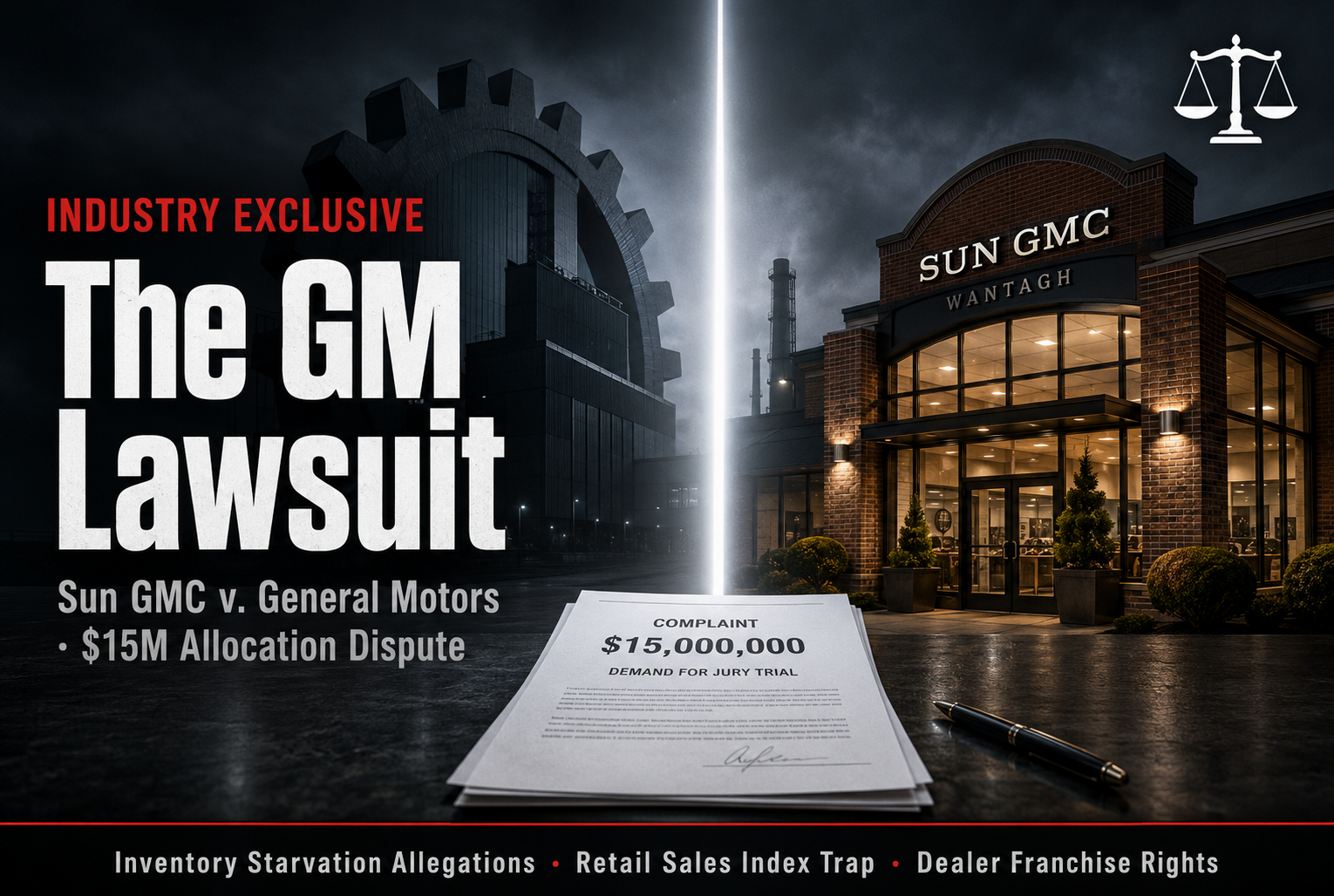
The David vs. Goliath Battle of Wantagh: Why Sun GMC is Suing General Motors for $15 Million
I vividly remember the first time I walked into an old-school, family-owned car dealership.
I dedicate a borderline unhealthy amount of time to analyzing automotive industry trends, reading through complex legal filings, and debating the future of vehicle retail. You walk into those places and there is a specific, tangible atmosphere—the smell of freshly brewed coffee in the waiting area, the framed photos of the owner’s family on the wall, and the feeling that you are dealing with a human being, not a faceless corporate entity. It’s the absolute bedrock of the American retail experience.
So, when the news broke earlier this month (June 2026) that Sun GMC, a legendary dealership in Wantagh, New York, had officially filed a massive $15 million lawsuit against General Motors, it sent a shockwave through the entire automotive industry. This isn’t just another boring contract dispute over service bays or signage. This is a story about the absolute power imbalance between a massive, multi-billion-dollar global manufacturer and the local, independent business owner who acts as the face of that brand in your neighborhood.
Let’s just be completely real for a second: the relationship between a car manufacturer (the OEM) and the local dealership is inherently dysfunctional. We often think of dealerships as the manufacturer, but they are completely separate businesses. They buy the cars from GM and resell them to you. But they are trapped in a franchise system where they have effectively zero control over what the manufacturer decides to send them, how many they get, or even how those vehicles are marketed.
If you have ever walked onto a lot and wondered why there are thirty SUVs and zero pickup trucks, or why the salesperson seemed desperate to sell you a specific model, you were likely looking at the “secret sauce” of allocation. And according to Sun GMC, that sauce is being used to systematically starve them to death.
Because the legal filings in this case provide a rare, terrifying, and deeply human look behind the curtain of the multi-billion-dollar car business, I wanted to create a single, definitive pillar of content for you. No corporate PR spin, no gatekeeping legal jargon, and no bias. This is your complete, deeply human guide to exactly what is happening in the Sun GMC Inc. v. General Motors LLC lawsuit, how the “Retail Sales Index” (RSI) is being used as a weapon, and why this case could completely change the way you buy your next vehicle.
Grab a cup of coffee, settle in, and let’s break down the most significant dealership battle of the decade.
Part 1: The Heart of the Complaint: “Starving the Beast”
The core allegation in Sun GMC’s $15 million lawsuit is as blunt as it is terrifying: General Motors is deliberately starving the dealership of inventory in a calculated attempt to drive it out of business.
Sun GMC has been a staple in Wantagh, New York, for decades. The dealership owner, Patrick Cassino, has been a part of the GM franchise system since 1986. He isn’t some fly-by-night operator; he is a veteran who knows the back-end of the business as well as the front.
But according to the lawsuit filed on June 3, 2026, in the U.S. District Court for the Eastern District of New York, for the last several years, the “pipe” carrying inventory from GM to Sun GMC has been slowly clamped shut.
The Empty Lot Syndrome
When you drive past a car dealership, your brain subconsciously performs a quick inventory check. If you see a crowded lot, you assume the business is healthy and thriving. If you see an empty lot, you assume they are failing, that they have “given up,” or that they are about to close their doors.
Sun GMC claims that GM’s allocation practices have left their large outdoor lots effectively empty. At times, the dealership has been forced to put used vehicles on the showroom floor simply to fill the visual void so that potential customers don’t drive by and think the business is closed.
“Customers drive by and think there’s something wrong,” said Leonard Bellavia, the dealership’s attorney. “And there is something wrong, but it’s not of his doing. He looks like he’s about to soap the windows.”
Sun GMC alleges that while GM set an internal goal for the dealership to sell over 1,000 vehicles last year, they only supplied half that number. For the past six months, the dealership has received fewer than 20 new vehicles per month on average. You cannot hit a sales target of 1,000 when you are only provided with 240 units to sell. It is a rigged game, and the lawsuit claims it is part of an orchestrated “end-game” tactic to force the dealer into economic submission—ultimately pressuring them to sell the franchise, relocate, or perform a wildly expensive facility renovation that the dealer can’t afford.
Part 2: The “Secret Sauce”: Deconstructing the Allocation Trap
This is the part that actually impacts you, the consumer. If you have ever walked into a dealership and been baffled by their inventory or their sales tactics, it is likely because of the systems described in this lawsuit.
1. The Retail Sales Index (RSI) Trap
GM uses a performance metric called the Retail Sales Index (RSI). It is a statewide, average-based standard that GM uses to determine which dealerships are “performing well” and which are “underperforming.”
If your RSI is low, GM punishes you by cutting your future vehicle allocations. But as the lawsuit correctly points out, this is a circular death trap:
- The Lawsuit argues: “Sun’s RSI ratings are directly affected by Defendant’s allocation decisions. Such materially reduced inventory levels limit Plaintiff’s ability to meet performance thresholds established by Defendant’s own metrics.”
It is a “catch-22” designed to keep dealers on their toes. If GM doesn’t give you the cars you need to sell, your sales numbers drop, your RSI drops, and then GM uses that low RSI score as an excuse to give you even fewer cars in the future. It’s an automated system of economic decline.
2. The STMI Discretionary Pool
Beyond the automated RSI metrics, the lawsuit points to a shadowy, discretionary pool of vehicles called the Strategic Targeted Market Initiative (STMI).
The lawsuit alleges that regional managers have the power to distribute these vehicles to whatever dealerships they choose. According to the complaint, this pool is being used to reward “favored” dealers, while leaving Sun GMC without its fair share. This is the “secret sauce” that the dealership is now asking the federal court to force GM to reveal. They want to know exactly who is getting the hot-selling Sierra and Yukon models, and exactly why they are being cut out of the loop.
Part 3: The Power Imbalance: Why Dealerships Are Not “Small Business Owners”
We like to think of local car dealerships as the quintessential American small business. But the franchise system is a massive, highly regulated, and deeply unequal power structure.
When you sign a franchise agreement with a manufacturer like General Motors, you aren’t just signing a business contract—you are signing a restrictive covenant that gives them massive, often unilateral, power over your operations.
- They dictate how the building must look (The “Image Programs”).
- They dictate what inventory you must stock (The “Allocation Mix”).
- They dictate the customer satisfaction goals you must hit (The “CSI Surveys”).
If a manufacturer decides they no longer want you as a partner, they can make your life miserable without ever saying a word. They don’t have to fire you; they just stop sending you the product that makes you money.
This lawsuit is a rare, brave, and incredibly high-stakes attempt by a dealer to break the seal on these private manufacturer practices. If Sun GMC wins, or even if they successfully move to the discovery phase, they could force General Motors to reveal exactly how they allocate vehicles to thousands of dealerships across the country. This could potentially trigger a tidal wave of similar lawsuits from other independent dealers who feel they have been discriminated against for years.
Part 4: The Ripple Effects on the Consumer
You might be asking, “Why do I care about a dispute between a billionaire corporation and a dealership owner?”
The answer is simple: Competition.
Car dealerships, even those that represent the same brand, are supposed to compete with one another. If Sun GMC is being shorted product by GM, it doesn’t just hurt the dealership; it hurts the consumer in Wantagh and the surrounding areas. If the local dealership doesn’t have the inventory, it can’t compete on price. This gives other, larger GMC dealers leverage to charge more because you have fewer local options to shop around.
When you have one fewer local dealership that can actually compete on price and inventory, the consumer is the ultimate loser. You lose the ability to negotiate a lower price, and you lose the local service connection that you rely on when your truck breaks down.
Part 5: Final Thoughts: The Cost of the Franchise System
The Sun GMC Inc. v. General Motors LLC case is currently in its very early stages in the Eastern District of New York. General Motors has not yet responded to the allegations in court, and as is standard practice, a spokesperson for the company told the media that they “do not comment on pending litigation.”
But the facts outlined in the complaint tell a story that should concern every single person who buys a car.
If the manufacturer is allowed to pick winners and losers in the retail space by hoarding inventory, it kills the competitive spirit of the market. It means you, the consumer, might be forced to drive an extra twenty miles to a “favored” dealership to get the specific truck you want, while the local dealer who has served your community for thirty years is forced out of business by a corporate algorithm.
We will be watching the docket for this case closely over the next year. It is a David vs. Goliath story, a test of the federal dealer franchise laws, and, fundamentally, a look at what happens when the massive, faceless machine of global corporate logistics grinds a local, family-owned business into the dirt.
Frequently Asked Questions (FAQs) About the Sun GMC Lawsuit
Because the legal system is notoriously complex and these dealership allocation practices are usually kept strictly behind closed doors, we have compiled the absolute most common questions regarding the Sun GMC vs. GM lawsuit to ensure you have the facts.
Q: What is a “franchise agreement” in the car industry? A: A franchise agreement is a legally binding contract between a manufacturer (like GM) and a local dealership. It grants the dealership the right to sell the manufacturer’s products, but in exchange, the dealership must follow strict corporate guidelines regarding facility appearance, customer service ratings, and inventory requirements. The manufacturer generally holds the upper hand, as they control the supply of the product.
Q: How do automakers decide which dealers get which cars? A: It is a complex “secret sauce.” Automakers use a mix of automated performance metrics (like the Retail Sales Index) and discretionary pools (like the Strategic Targeted Market Initiative). These systems reward dealers who hit specific, often high-pressure sales targets. The lawsuit alleges that GM uses these metrics to discriminate against dealers they want to see exit the business.
Q: Can General Motors just decide to close a dealership? A: No. State laws are very strict about protecting franchise dealers. An automaker cannot simply “cancel” a franchise without a very specific legal justification (such as the dealer failing to meet performance standards for a long period). However, they can engage in “attrition” tactics—slowly strangling the dealer’s ability to turn a profit by cutting their inventory, eventually forcing the dealer to close their own doors.
Q: What is the “Retail Sales Index” (RSI) that the lawsuit mentions? A: The RSI is a mathematical formula that compares a specific dealership’s performance to the statewide average. It is a benchmark of “how well you should be doing.” The lawsuit argues this metric is a “trap” because it doesn’t account for GM’s own failure to supply the right mix of vehicles, making it impossible for the dealer to meet the threshold.
Q: What is Sun GMC asking for in this lawsuit? A: Sun GMC is seeking $15 million in compensatory damages. More importantly, they are asking the court for a declaratory judgment to strike down GM’s current allocation policies as discriminatory, and they are seeking a court order that would force GM to supply the dealership with a sufficient and fair quantity and mix of inventory.
Q: Will this case affect my ability to buy a car? A: Not in the short term. However, the outcome could be historic. If Sun GMC wins, it could force General Motors (and potentially other automakers) to make their “secret” allocation algorithms transparent. This would lead to a more fair, competitive market for dealerships, which in turn benefits you by ensuring your local dealer actually has the vehicles you want to see.
Q: Does GM really “starve” dealers? A: That is the central question for the jury. Sun GMC claims this is a calculated tactic to force them out of business. General Motors will almost certainly argue that their allocation system is a neutral, data-driven process designed to maximize global sales efficiency. The courtroom discovery process will be the first time the public ever sees the internal data proving or disproving this.
Q: How long will this lawsuit take? A: Lawsuits of this magnitude typically take years. The filing was made on June 3, 2026. After the initial motions to dismiss, the “discovery” phase (where GM must hand over internal documents and data) will be the most critical part of the process. Expect this case to be in the headlines well into 2027 and potentially 2028.









Leave a Reply