

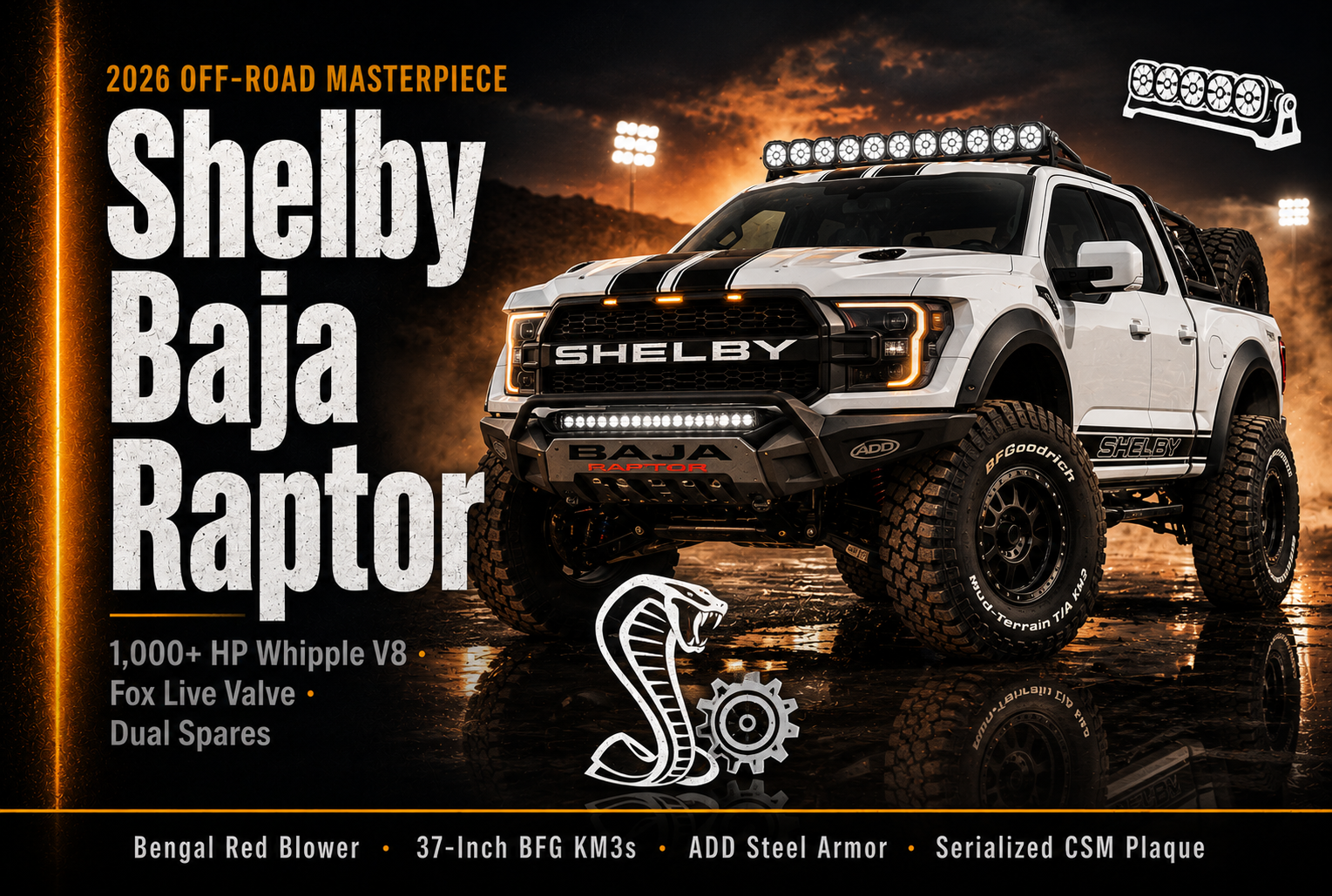
The 1,000-Horsepower Desert Missile: Why the 2026 Shelby Ford Baja Raptor is Peak Automotive Insanity
I vividly remember the exact afternoon I stood in the pit area of a desert racing event in Nevada, feeling the ground literally shake before I ever saw the truck that was causing the tremor.
I spend a borderline unhealthy amount of time deep-diving into automotive engineering, analyzing forced-induction torque curves, and debating the precise point at which a street-legal vehicle crosses the line from “high performance” into “absolute, unadulterated madness.” For years, the factory Ford F-150 Raptor was the gold standard. It was the truck you bought when you wanted to hit a speed bump at 60 mph and not spill your coffee. Then came the Raptor R, which dropped a Shelby GT500 engine into a pickup truck and made everyone question reality.
But apparently, 720 horsepower wasn’t enough for the engineers in Bristol, Indiana.
Let’s just be completely real for a second: the automotive industry is currently obsessed with efficiency, battery ranges, and autonomous driving algorithms. But in the middle of all that quiet, calculated electrification, Shelby American just kicked the door off the hinges and threw a massive, supercharged V8 grenade into the room.
If you have been looking at the luxury off-road market, you need to pay attention right now. The 2026 shelby ford baja raptor has officially arrived, and it is entirely rewriting the rulebook on what a production-based truck can do. We aren’t just talking about a lift kit and some fancy stickers. We are talking about a limited-production, four-digit-horsepower leviathan that costs nearly $200,000 and is designed to cruise the highway in absolute luxury before tearing across the Mojave Desert at speeds that would make a low-flying Cessna pilot nervous.
Because the specs on this truck are so overwhelming—and because the legacy of the Shelby name demands a closer look—I wanted to create a single, definitive guide for you. No generic dealership brochures, no recycled press releases, and no fluff. This is your complete, deeply human, gearhead-level breakdown of exactly what makes the 2026 Shelby Baja Raptor the most terrifyingly brilliant truck on the market. We are going to dissect the 1,000-horsepower engine architecture, the physics-defying suspension technology, the aggressive exterior armor, and the brutal economics of owning one.
Grab a strong cup of coffee, settle in, and let’s pull the cover off the ultimate apex predator of the dirt.
Part 1: The Two Flavors of Madness (EcoBoost vs. Carnivore V8)
When Shelby American decided to build the 2026 Baja Raptor, they knew they had to cater to two very different types of buyers. Therefore, the truck comes in two distinct configurations. Choosing between them is basically deciding whether you want a highly capable tactical strike vehicle, or an apocalyptic weapon of mass destruction.
The “Sensible” Choice: The EcoBoost V6
The standard 2026 Shelby Baja Raptor starts its life as a factory 3.5-liter twin-turbocharged EcoBoost V6 Raptor. In factory form, this is an incredibly capable engine. But Shelby doesn’t do “factory.”
They rip out the stock intake and replace it with a high-flow, open-air performance intake system protected by a massive, one-piece thermal heat shield. They install a performance aluminum intercooler to drastically drop the charge-air temperatures, and they bolt on a custom, Shelby-tuned Borla exhaust system that minimizes backpressure and completely changes the acoustic profile of the V6. Finally, they flash the ECU with a proprietary performance calibration.
The result? The V6 gets bumped up to a highly respectable 555 horsepower. It’s sharp, it’s responsive, and it sounds incredibly angry. For a starting price of $146,795, you get a truck that can handle 99% of the off-road trails in the world without breaking a sweat.
The Weapon of Mass Destruction: The Baja Raptor R
But then there is the other option. If you are the type of person who looks at a 720-horsepower factory Raptor R and thinks, “Yeah, it’s okay, but I wish it had 300 more horsepower,” Shelby has your back.
The 2026 Shelby Baja Raptor R starts with Ford’s 5.2-liter “Carnivore” V8. Shelby immediately removes the factory supercharger and replaces it with a gargantuan 3.8-liter Whipple supercharger. To put that in perspective, the supercharger alone has a larger displacement than the entire engine in a modern sports car.
They powder-coat the blower and the custom intake manifold in a striking “Bengal Red,” making the engine bay look like a custom hot rod. They add a high-velocity billet throttle body, a dual-core dual-pass intercooler system, and the high-flow Borla exhaust.
When you run this monster on 93-octane pump gas, it generates over 1,000 horsepower.
Let that sink in. A street-legal, air-conditioned, leather-wrapped pickup truck that produces four-digit horsepower. It is a mechanical absurdity, and it is absolutely glorious. This is the trim that pushes the price tag to an eye-watering $194,795.
Part 2: The Thermodynamics of 1,000 Horsepower
Let’s get nerdy for a minute, because building a 1,000-horsepower engine is easy; keeping a 1,000-horsepower engine alive while doing 80 mph across the scorching desert sand is an engineering nightmare.
The enemy of horsepower is heat. When you compress air with a massive 3.8-liter Whipple supercharger, you are creating an immense amount of thermal energy. If that hot air enters the combustion chamber, you get detonation (engine knock), the ECU pulls timing, and your 1,000-hp truck suddenly feels like a golf cart. Even worse, sustained heat will literally melt the engine’s internals.
Shelby didn’t just bolt on a bigger blower and call it a day. The 2026 shelby ford baja raptor is a masterclass in thermal management.
The Dual-Core, Dual-Pass Intercooler
To combat the heat, Shelby engineered a dual-core, dual-pass intercooler system. Unlike a standard intercooler where the air flows through a single radiator core once, a dual-pass system forces the compressed, hot air to travel through the cooling fins, turn around, and travel through them again before entering the engine. This drastically lowers the Intake Air Temperature (IAT), ensuring that the air entering the 5.2L Carnivore V8 is dense, cold, and packed with oxygen.
The Functional Air-Induction Hood
Take a look at the hood of the Baja Raptor. It looks incredibly aggressive, but those massive scoops aren’t just for show. It is a fully functional ram-air induction hood equipped with heat-extraction vents. As the truck moves forward, cold air is forcefully rammed into the engine bay and directly into the high-flow intake, while the extraction vents pull the stagnant, boiling air away from the exhaust manifolds and out over the windshield.
It is a complete aerodynamic cooling loop designed specifically to keep that Bengal Red supercharger from turning into a molten lump of aluminum during sustained high-speed off-road runs.
Part 3: Defying Gravity (The Suspension and Stance)
You cannot put 1,000 horsepower into a 6,000-pound truck and leave the suspension alone. If you did, hitting a rut at highway speeds would launch the truck into low-earth orbit. The physics of off-road racing dictate that your suspension is actually more important than your engine.
Shelby worked with industry leaders to ensure the 2026 Baja Raptor has the stance, the clearance, and the damping capacity to handle its own massive power.
The Shocks: Fox Dual-Live Valve Technology
The foundation of the truck relies on Ford’s factory-installed Fox Racing shocks, but these aren’t the shocks you find on a normal pickup. These are position-sensitive, dual-live internal bypass shocks with state-of-the-art electronic control technology.
What does that mean in human English? It means the truck’s computer is reading the terrain hundreds of times a second. If the sensors detect that the truck is airborne, the shocks instantly stiffen to maximum compression damping before the tires even touch the ground, preventing the truck from “bottoming out” and destroying the frame. They provide upward of 1,000 pounds of damping per corner. It is active, intelligent suspension.
The Shelby BDS Lift and Premium Springs
Shelby takes this incredible Fox foundation and adds premium lift springs and a specialized lift kit in collaboration with BDS Suspension. This raises the truck’s center of gravity, but more importantly, it drastically improves the approach, departure, and breakover angles. You can crawl over massive boulders without tearing the oil pan out of the bottom of the truck.
The Footwear: 37-Inch BFGoodrich KM3s
A truck is only as good as the rubber connecting it to the dirt. Shelby outfits the 2026 Baja Raptor with massive 37-inch BFGoodrich KM3 mud-terrain tires mounted on bespoke 18-inch two-tone Shelby off-road forged wheels.
The KM3 is a legendary tire in the Baja racing community. It features massive, aggressive tread blocks designed to bite into loose sand and thick mud, while the reinforced sidewalls prevent punctures from sharp rocks. And because Shelby knows that desert racing demands redundancy, they don’t just give you one spare tire. The truck comes equipped with two full-size, matching spare wheel-and-tire assemblies mounted in the bed. If you blow a tire in the middle of nowhere, you have a backup. If you blow two, you still make it home.
Because of the massive tire upgrade, Shelby also recalibrates the tire sensors and the speedometer at their factory in Indiana, ensuring that the truck’s computer systems perfectly match the new rolling diameter.
Part 4: Armor and Illumination (The Baja Aesthetic)
When you buy a Shelby, you are buying a vehicle that demands attention. The 2026 Shelby Baja Raptor looks like it was designed by a military contractor for a post-apocalyptic action movie. The exterior upgrades are brutal, functional, and visually staggering.
The Addictive Desert Designs Bumpers
The factory plastic bumpers are thrown in the trash. In their place, Shelby installs high-clearance, heavy-duty steel bumpers manufactured by Addictive Desert Designs (ADD).
The front bumper is a minimalist, flat-black steel structure that drastically exposes the front tires (allowing them to grab onto rocks or ledges before the bumper hits). It features integrated, heavy-duty recovery anchor points (in case you somehow manage to get a 1,000-hp truck stuck) and massive airflow vents designed to funnel air directly into the upgraded intercoolers.
The rear bumper is similarly armored and features a pair of 10-inch Vision X LED reverse lights, ensuring that you can see exactly what is behind you when backing up in the pitch black of the desert.
The Lighting Package: Turning Night into Day
Speaking of pitch black, you cannot drive fast off-road at night with factory headlights. You will “out-drive” your lights, meaning by the time your headlights illuminate an obstacle, you are already hitting it.
To solve this, Shelby integrates a staggering array of Vision X LED lighting. The front bumper houses a curved 30-inch LED light bar along with dual SAE/DOT driving lights. But the party piece is in the bed.
Shelby installs a custom steel “Chase Rack” behind the cab. This rack holds the two massive spare tires, but it also houses an incredible power-actuated nine-pod LED light bar. From inside the cabin, you can press a button and motorized actuators will raise the massive light bar above the roofline, flooding the desert ahead with thousands of lumens of daylight-mimicking light. When you get back to the highway, press the button again, and the light bar retracts behind the cab to reduce wind resistance and whistling. It is a brilliantly over-the-top piece of engineering.
The Signature Shelby Details
Of course, it wouldn’t be a Shelby without the signature styling cues. The truck features painted smooth fender flares, a custom painted grille, and power-deployable XL running boards equipped with rock guards and entry lights. Finally, the truck is wrapped in full-body Le Mans-style rally stripes and Shelby Baja bedside graphics, available in high-contrast gloss colors like Blue, Red, Silver, or Matte Black.
Part 5: The Cockpit (Where Luxury Meets the Mud)
For all of its rugged, dirt-throwing exterior capability, the interior of the 2026 Shelby Baja Raptor is a stark contrast. It is a premium, highly tailored environment that feels more like a luxury grand tourer than a desert race truck.
Shelby rips out the factory Ford seating surfaces and recovers the seats in exclusive, Shelby-designed top-grain leather with red accents and intricate “Shelby Baja Raptor” embroidery. The touchpoints are immaculate.
They replace the standard dashboard trim with a full carbon-fiber aesthetic interior kit, giving the cabin a dark, technical, race-inspired vibe. Down in the footwell, you’ll find custom billet aluminum racing pedals. The floors are protected by thick, embroidered carpet floor mats.
The Shelby Registry: The Ultimate Flex
But the most important part of the interior isn’t the leather or the carbon fiber. It is the small, unassuming metal plaque bolted to the center console.
Every single 2026 Shelby Baja Raptor is assigned a unique CSM (Carroll Shelby Manufacturing) serial number. This number is etched onto a plaque on the console, with a matching plaque riveted into the engine bay.
When you buy this truck, your name and your specific CSM number are permanently entered into the official Shelby American Registry. This is the exact same registry that tracks the original 1960s Shelby Cobras and the classic GT350 Mustangs. You aren’t just buying a modified Ford F-150; you are buying a documented, serialized piece of American automotive history. This documentation is why Shelby vehicles hold their resale value better than almost any other modified vehicle on the planet.
Part 6: The Economics of Insanity (Who Buys a $200k Truck?)
We have to talk about the price. At $146,795 for the EcoBoost V6 model and $194,795 for the 1,000-hp V8 Raptor R model, the 2026 shelby ford baja raptor costs more than a brand-new Porsche 911 GT3 or an Aston Martin Vantage. It is an astronomical amount of money for a pickup truck.
So, who is the target audience for this?
- The Ultra-Wealthy Off-Road Enthusiast: There is a growing demographic of high-net-worth individuals who want the absolute pinnacle of off-road performance but do not want the hassle of building a custom “prerunner” from scratch. They want a truck that has a warranty (Shelby offers a 3-year/36,000-mile limited warranty for the original owner), can be serviced at a dealership, and starts with the push of a button every single morning.
- The Collector: Because of the CSM serial numbers and the extremely limited production run, Shelby vehicles are highly coveted by collectors. Many buyers purchase these trucks, drive them sparingly, and view them as depreciating at a much slower curve than a standard luxury vehicle, relying on the Shelby brand cachet to hold the value up.
- The Adrenaline Junkie CEO: This is the person who runs a successful business, wears a suit all week, and wants a weekend toy that is louder, faster, and more obnoxious than anything their neighbors own. The psychological appeal of knowing you have 1,000 horsepower under your right foot is an intoxicating drug, and Shelby is the premier dealer.
Part 7: The Legacy of Carroll Shelby
It is easy to look at a 6,000-pound, lifted truck and wonder what Carroll Shelby—the man who won Le Mans in a tiny, lightweight Ford GT40—would think of it.
But if you look at the history of Shelby American, this truck makes perfect sense. Carroll Shelby was a Texas chicken farmer who built a career on putting ridiculously oversized engines into vehicles that had no business going that fast. He was a master of excess. He believed in brute force, aggressive styling, and leaving the competition in the dust.
As Brock Patterson, Shelby Performance Director of Sales, noted in the 2026 press releases, the directive has always been to build the ultimate runner that is still fun to drive on the street. With almost double the horsepower of the original 2013 Shelby Raptor, it is safe to say that Carroll’s philosophy of “too much horsepower is almost enough” is alive and well in Bristol, Indiana.
Final Thoughts: The Pinnacle of the Internal Combustion Era
As we sit here in 2026, looking down the barrel of a future dominated by silent, electric motors and highly regulated emission standards, the 2026 Shelby Ford Baja Raptor feels like a glorious, defiant middle finger to the concept of moderation.
It is loud. It is thirsty. It is completely, wonderfully unnecessary.
But that is exactly why it is so special. In a world where vehicles are becoming increasingly sterilized and homogenized, this truck is a fire-breathing monster. It represents the absolute pinnacle of what automotive engineers can achieve when you take the leash off and tell them to build the most extreme machine possible.
If you have the means, and if you have a patch of desert that needs conquering, the Shelby Baja Raptor is waiting. Just make sure you hold on tight—1,000 horsepower hits a lot harder than you think.
Frequently Asked Questions (FAQs) About the 2026 Shelby Baja Raptor
Because a vehicle of this magnitude generates a lot of questions, rumors, and awe, I’ve compiled the absolute most common inquiries about the 2026 Shelby Baja Raptor to ensure you have the hard facts.
Q: Can I take my current Ford F-150 Raptor and send it to Shelby to be converted? A: Yes, in many cases, Shelby American operates as a “post-title” modifier. This means you can purchase a factory 2025 or 2026 Ford F-150 Raptor or Raptor R from a local Ford dealership, take the title, and then ship the vehicle to Shelby’s facility in Indiana to have the Baja Raptor package installed. However, the package alone costs tens of thousands of dollars on top of the base truck price.
Q: Is a 1,000-horsepower truck actually street legal? A: Surprisingly, yes. Despite producing more power than modern hypercars, the Shelby Baja Raptor R retains all necessary emissions equipment (like catalytic converters) and safety features. It is fully street legal in the United States, though the 555-hp EcoBoost upgrade notes state it may not be available for sale in certain “green states” (like California) depending on specific CARB compliance updates.
Q: What kind of fuel does the Baja Raptor R require? A: To achieve the advertised 1,000+ horsepower rating from the 3.8L Whipple supercharger, the truck must be run on premium 93-octane pump gas. Putting lower-grade 87-octane fuel in a highly supercharged engine will cause the computer to pull timing to prevent engine knock, drastically reducing the horsepower output.
Q: Does modifying the truck to 1,000 horsepower void my Ford warranty? A: This is the beauty of buying a licensed Shelby product. While massive modifications usually void a factory powertrain warranty, Shelby American provides their own 3-year / 36,000-mile limited warranty (for the original owner) that covers the Shelby-installed components, including the supercharger and upgraded engine parts. You get the peace of mind that comes with professional engineering.
Q: How much does the motorized light bar cost to replace if it breaks? A: The power-actuated 50-inch light bar assembly on the custom chase rack is a proprietary Shelby/Vision X setup. While individual pod lights can be replaced relatively affordably, repairing the motorized actuator system is expensive. Fortunately, it is designed to be ruggedized for high-impact desert racing and is covered under the Shelby warranty.
Q: Why does the truck have two spare tires instead of one? A: In long-distance desert endurance racing (like the Baja 1000), a single flat tire is a minor inconvenience, but blowing a second tire means you are stranded hundreds of miles from civilization. Carrying two full-size spare tires on the bed-mounted chase rack is a hallmark of authentic “prerunner” off-road trucks, providing maximum redundancy for extreme environments.
Q: Can I get the Shelby Baja Raptor in a SuperCab (extended cab) configuration? A: No. Ford currently only produces the F-150 Raptor and Raptor R in the SuperCrew (full four-door) configuration with the 5.5-foot short bed. Therefore, the Shelby Baja Raptor is exclusively available in this crew-cab body style.
Q: What is the difference between the Shelby Baja Raptor and the Shelby Super Snake F-150? A: They serve two entirely different purposes. The Baja Raptor is a lifted, off-road focused desert runner with long-travel suspension and 37-inch mud tires. The Shelby Super Snake F-150 is a street-focused, lowered performance truck designed for the pavement. The Super Snake features a massive front air dam, street tires, and a suspension tuned for cornering and drag racing, not jumping sand dunes.
Q: Is the 3.8L Whipple supercharger loud? A: Yes. While modern superchargers are incredibly refined, a blower displacing 3.8 liters of air generates a very distinct, high-pitched “supercharger whine” under heavy acceleration. When combined with the deep, guttural roar of the Shelby-tuned Borla exhaust, the auditory experience of the Baja Raptor R is violently loud and absolutely thrilling.
Q: How long does it take to get one once I order it? A: Because these trucks are built in limited production numbers and the conversion process is highly labor-intensive (involving custom painting, engine teardowns, and interior recovering), the wait time can range from a few months to over half a year, depending on Shelby’s current backlog and the availability of donor trucks from Ford.










ExoWatts
Great content! Keep up the good work!