


Behind the Headlines: Analyzing Motor1’s Perspective on the Kia Telluride Safety Recalls
I spend an absolute diagnostic amount of time reading automotive journalism. Whenever I am trying to figure out if a vehicle is actually worth parking in my driveway, or if a recent piece of industry news is a genuine crisis or just a temporary storm in a teacup, I inevitably find myself pulling up Motor1. They have built an incredible reputation for breaking down complex manufacturing data, federal regulatory filings, and sudden safety notices into clear, digestible analysis that matters to regular car owners. Lately, their coverage has been heavily focused on a topic that hits close to home for anyone managing a busy suburban carpool: the sudden, consecutive wave of safety recalls striking the highly popular Kia Telluride platform.
When a premier outlet like Motor1 starts dedicating significant space to component defects on a flagship family crossover, the wider automotive market stops to pay close attention. The Telluride has spent years sitting comfortably on top of the three-row crossover kingdom, widely praised for offering an expansive cabin, a commanding road presence, and premium highway dynamics at an incredibly accessible price point. But as the publication’s investigative reporting frequently reminds us, even the most celebrated industry darlings are not immune to major quality control hurdles. Looking at the situation through the lens of seasoned automotive journalists gives us a much clearer picture of what went wrong on the assembly lines, how global logistical pressures filter down to our local dealerships, and how everyday owners can protect their families without panicking.
The reality of owning a modern vehicle is that you are essentially driving a rolling computer packed with thousands of mechanical and electronic sub-assemblies. When a recall hits a core safety system like an occupant restraint harness, it naturally triggers a defensive reaction from consumers. Nobody wants to imagine their primary family cruiser suffering from a compromised defensive system during a highway emergency. By dissecting the industrial realities behind these headlines, we can strip away the sensationalism often found on social media forums and focus entirely on the mechanical facts, the targeted production timelines, and the structured engineering remedies required to keep our vehicles running safely.
The Supply Chain Reality Behind the Seatbelt System Defects
What I appreciate most about professional automotive reporting is the ability to connect a frustrating individual component failure to the broader global economic machine. When news broke about the driver-side seatbelt emergency locking retractor freezing up on the newest combustion and hybrid models, casual observers were quick to point fingers directly at the vehicle manufacturer’s main engineering offices. However, deep-dive analytical updates quickly clarified that the true root of the problem traced back to a specific component subcontractor facility operating down in Mexico. A simple technical mistake on an automated component assembly line resulted in an incorrect internal sensor being dropped into over six thousand individual driver restraint mechanisms before the error was fully identified by factory quality checkers.
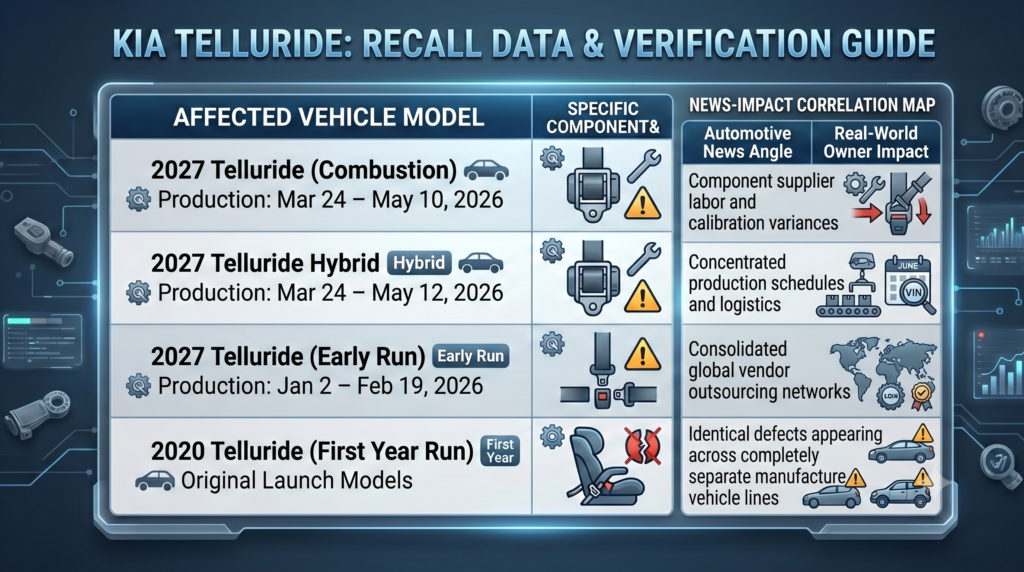
Seeing these fine technical details laid out in print changes the entire conversation for an anxious vehicle owner. It shifts the narrative from a vague, terrifying rumor that your entire vehicle is structurally flawed to a very precise, manageable mechanical reality: a single sub-assembly needs to be unbolted and swapped out by a certified dealership technician. The publication's tracking of past safety campaigns, such as the earlier spring recall involving faulty third-row center buckle latches, reveals a distinct pattern of modern manufacturing. In an era where automotive conglomerates rely on an intricate, hyper-connected web of global parts suppliers, a single minor calibration error by a tier-one vendor can instantly trigger a massive safety campaign affecting thousands of families across North America.This reliance on tier-one and tier-two suppliers means that car companies are essentially functioning as master integrators. They design the exterior body lines, engineer the underlying powertrain logic, and style the leather-trimmed cabins, but the actual physical components that protect you—from the airbags to the seatbelt pre-tensioners—are delivered to the factory floor in massive crates from third-party industrial operations. When an error occurs at a facility like Samsong Mexico, it does not just impact one specific trim line; it bleeds into every vehicle that passed through the assembly lane during that exact manufacturing window. Understanding this distribution system helps consumers realize that recalls are often a failure of third-party component verification rather than a fundamental flaw in the vehicle’s core structural architecture.
Why Quality Control Vulnerabilities are Dominating the Automotive Industry
If you scroll through the broader news feeds on any major automotive enthusiast site right now, you will quickly realize that this family crossover is definitely not sailing through these rough waters alone. The editorial teams frequently remind us that the entire automotive sector is battling an absolute epidemic of quality control regressions. We are seeing massive legacy operations pull back hundreds of thousands of vehicles for everything from loose structural frame welds to critical software glitches that cause digital instrument clusters to randomly go completely dark while traveling at highway velocities. The complexity of modern engineering has created a landscape where the statistical probability of a minor oversight making its way to the consumer has scaled up exponentially.
This context is incredibly important because it prevents us from unfairly isolating one specific brand or assumption. When premium, high-end European luxury brands are forcing their wealthy clientele back into service bays because their seatbelt anchorage brackets were left un-torqued from the factory, it highlights a systemic vulnerability in how modern vehicles are built and brought to market. The pressure to scale up production, meet intense global consumer demand for the latest hybrid powertrains, and maintain razor-thin profit margins has placed an unprecedented amount of stress on factory workers and automated systems alike. When a vehicle is treated less like a traditional mechanical machine and more like a high-tech platform packed with independent electronic control modules, the margins for error shrink down to near zero.
Consider the sheer scale of modern vehicle assembly. A typical assembly plant turns out hundreds of vehicles per shift. On an active line, a vehicle moves past a assembly station in a matter of minutes. If a parts bin contains a batch of sensors with a microscopic structural deviation, hundreds of vehicles will be outfitted with that component before a random quality audit flags the issue. Independent automotive journalists track these structural anomalies across the entire industry, illustrating that the race to implement advanced driver assistance systems, digital dashboard arrays, and eco-friendly manufacturing materials has occasionally outpaced the legacy quality assurance protocols that kept older, simpler vehicles free from recurring factory bulletins.
Reading the Watchdog Data and Planning Your Next Step
For a regular person who just wants to get their kids to school safely or complete a long-distance highway commute without a safety scare, the most useful service an automotive news outlet provides is a clear, actionable roadmap. The investigative reporting underscores a critical consumer message: a recall notice is not an invitation to panic, but an explicit instruction to check your status methodically. You do not have to wait around for a first-class notification letter to sit on your kitchen counter for weeks while you worry about the integrity of your safety systems. By locating your seventeen-character Vehicle Identification Number and running it through public safety databases, you can instantly find out if your individual vehicle requires an immediate trip to the local service bay.
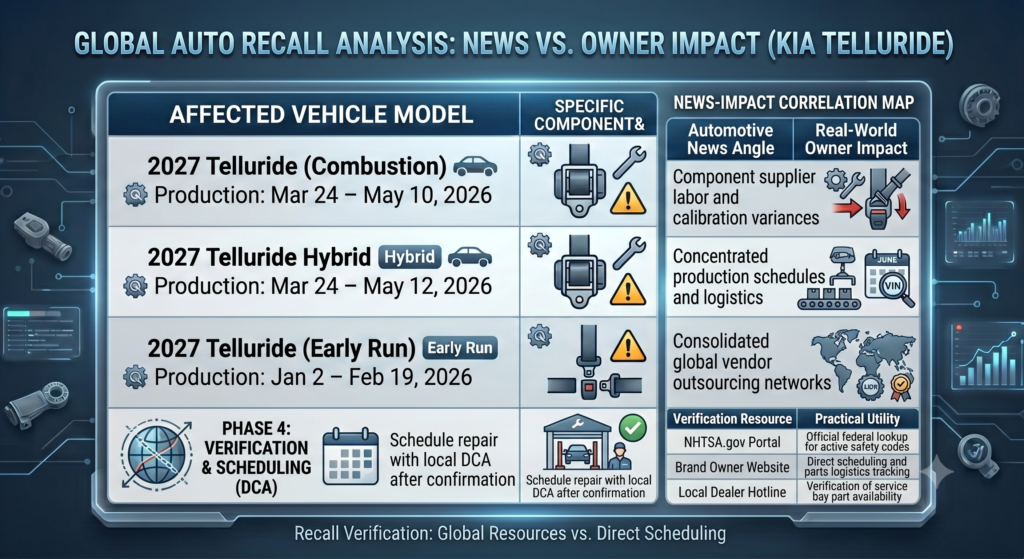
As the digital tracking infrastructure continues to update throughout the year, staying informed through reputable automotive channels ensures you will not miss critical safety milestones or leave your vehicle unprotected. If your vehicle flashes an active campaign code for a seatbelt retractor or an anchor buckle mechanism, you can confidently call your local dealership service manager, reference the official factory bulletin numbers, and secure a prioritized service appointment. It is a brilliant example of how independent automotive journalism serves as a vital bridge between massive corporate manufacturing entities and the everyday consumers who rely on those machines to protect their loved ones every single day.Taking action early also helps clear out the logjams that naturally occur at local dealership service centers whenever a major campaign is announced. When thousands of identical crossovers are flagged for a component swap, the demand for replacement parts and open service bays sky-rockets. By tracking the news updates early, executing your online lookup, and initiating contact with your service advisor before the mass mailing campaigns hit the general public, you can position yourself at the front of the line. This proactive approach minimizes the amount of time your vehicle spends sitting in a dealership parking lot and ensures your family’s primary transportation is restored to peak safety compliance with minimal disruption to your daily routine.
Examining the Mechanics of the Emergency Locking Retractor Defect
To understand why safety regulators step in so aggressively when a seatbelt issue is flagged, you have to look closely at the mechanical physics of how modern occupant restraints protect the human body during a sudden deceleration event. A modern safety harness is not a static piece of heavy nylon webbing. It relies on a highly specialized mechanism known as an Emergency Locking Retractor, or ELR. Under normal driving conditions, the ELR allows the webbing to extend and retract freely, giving the driver the ability to lean forward, adjust comfort settings, or check blind spots without feeling restricted. However, the moment the vehicle experiences a sharp impact, an abrupt stop, or a sudden change in angular rotation, an internal sensor inside the retractor is designed to instantly lock the spool, pinning the occupant securely against the seatback and preventing them from colliding with the steering column or windshield structure.
The manufacturing defect identified in the recent safety bulletin involves an incorrect vehicle sensor being installed directly inside this delicate retractor module. In the real world, this component mismatch causes the directional locking mechanism to misinterpret normal cabin movements or standard strap pulling as an imminent collision event. When an owner attempts to pull the safety harness across their lap to lock it into the center console buckle, the internal gear mechanism flags a false positive and completely locks the spool in place. The strap refuses to extend even a fraction of an inch, leaving the driver completely unable to secure themselves before pulling out of their driveway.
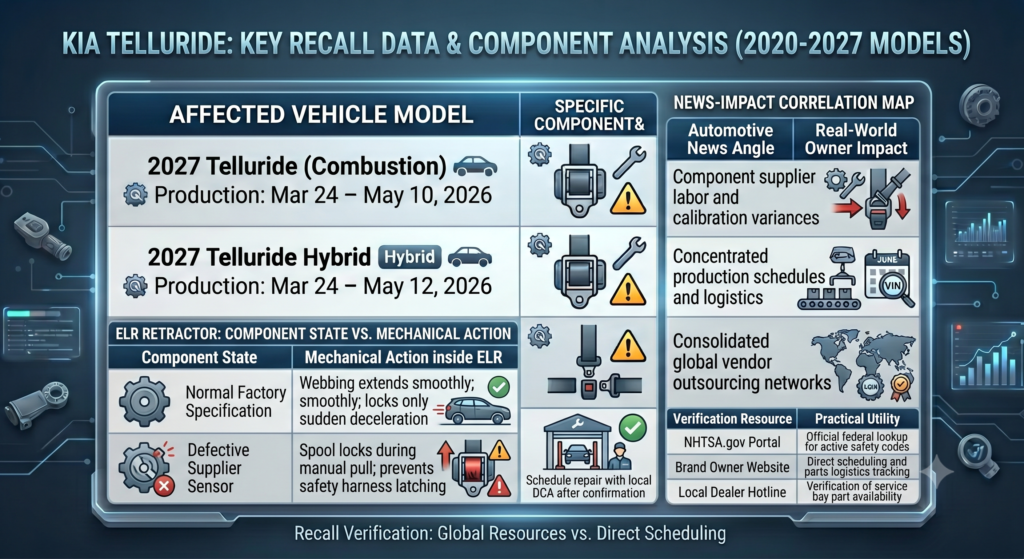
This structural failure creates an immediate, severe safety exposure. If a driver becomes frustrated by a stubborn, constantly locking seatbelt mechanism during a chaotic morning commute, there is a very high probability that they will make the dangerous decision to complete their trip without wearing their seatbelt at all. Driving an unbelted vehicle completely invalidates all the secondary safety systems built into the cabin. The advanced front airbags, side-curtain deployment shields, and crumple zones are all engineered around the assumption that the driver remains securely anchored in their seat during an impact. If the occupant is thrown forward due to an unusable safety harness, the deployment force of a high-speed airbag can actually cause more harm than protection, making the resolution of this specific retractor defect an absolute, non-negotiable priority for anyone tracking the longevity and safety of their vehicle.Tracing the Evolution of Occupant Restraint System Campaigns
This is certainly not the first time that safety compliance campaigns have forced major adjustments to this specific vehicle platform’s interior cabin setup. If you track the historical safety records of this flagship crossover all the way back to its initial market debut, you will find that managing occupant restraint system performance has been a recurring theme for quality assurance engineers. During the initial first-year production run of the original launch models, federal regulators noticed a compliance variance involving the automatic locking retractors designed to secure heavy child safety seats. In those early models, certain interior belt configurations failed to tightly lock down child restraint anchors during sharp cornering maneuvers, requiring a swift, system-wide dealership retrofitting campaign to ensure infant carriers remained completely stable.
+-------------------+--------------------+------------------------+
| Model Year Focus  | Restraint Issue    | Corrective Field Action|
+-------------------+--------------------+------------------------+
| 2020 Initial      | Child seat anchor  | Inspection and swap of |
| Launch Vehicles   | retractor stability| rear seatbelt systems  |
+-------------------+--------------------+------------------------+
| 2025 Mid-Cycle    | Front seatback     | Complete replacement of|
| Production Run    | frame weld voids   | structural metal frames|
+-------------------+--------------------+------------------------+
| 2027 Combustion   | Driver-side ELR    | Installation of correct|
| & Hybrid Models   | sensor false locks | sensor module housings |
+-------------------+--------------------+------------------------+
As the platform evolved through its mid-cycle updates and introduced highly advanced new hybrid powertrains, the physical architecture inside the cabin shifted as well. These design changes occasionally introduce entirely new structural variables that are difficult to stress-test completely until hundreds of thousands of units are navigating real-world environmental extremes over thousands of miles. The earlier spring campaign regarding weak structural welds on the front power seatback frames is a perfect illustration of how interior updates can inadvertently create hidden safety challenges. If a structural weld contains a microscopic pocket of trapped air or a void in the metal bonding, it may hold up perfectly fine during standard highway cruising, but fail catastrophically under the intense G-forces of a severe rear-end collision.
By analyzing these historical service campaigns sequentially, we can see that the modern automotive safety ecosystem relies heavily on continuous field monitoring. The process of keeping a vehicle line safe does not end the moment the car rolls off the transport truck and onto a dealership showroom floor. Instead, consumer safety groups, independent automotive news centers, and corporate field engineers continuously track warranty data, repair shop receipts, and accident reports to spot statistical deviations. When a specific component part number shows an unusually high rate of premature replacement or customer complaints, the investigative machinery grinds into motion to determine if a formal safety campaign is required to protect the motoring public.
Navigating the Logistical Realities of the Dealership Service Desk
Once you have verified that your individual vehicle identification number is actively flagged for an open safety campaign, the process of transition from an anxious owner to a fully repaired consumer relies entirely on how smoothly you manage your interaction with the local dealership service center. It is an unfortunate reality of the automotive world that communication gaps between corporate manufacturing offices, federal regulatory bodies, and local independently owned franchise dealerships can occasionally create immense confusion for the average consumer. An owner might read an online article detailing a newly published safety campaign, walk into their local service lobby the following morning, and find that the service advisors at the front desk have not received the official technical service bulletins or the necessary replacement component inventory yet.
To protect your time and save yourself from an unnecessary, frustrating cross-town trip, you must approach the scheduling process with a precise strategy. Never simply pull into a dealership service drive unannounced and expect them to perform a recall swap on the spot. Your first action should be to place a direct phone call to the service department’s specialized intake coordinator. The absolute moment they answer the line, clearly state that you are calling regarding an open, safety-related manufacturer recall campaign. Immediately provide them with the specific corporate campaign code numbers—referencing code SC372 for the driver-side locking retractor issue or code SC364 for the third-row center buckle latch failure.
+-----------------------------------+-----------------------------------+
| Owner Communication Step          | Operational Objective             |
+-----------------------------------+-----------------------------------+
| Provide precise campaign code     | Eliminates internal dealership    |
| (SC372 / SC364)                   | database tracking confusion       |
+-----------------------------------+-----------------------------------+
| Request physical inventory check  | Ensures replacement parts are on  |
| of the exact component part number| the shelf before you arrive       |
+-----------------------------------+-----------------------------------+
| Confirm loaner vehicle or drop-off| Manages family schedule changes   |
| logistics up-front                | during extensive shop backlogs    |
+-----------------------------------+-----------------------------------+
By providing these exact codes, you instantly bypass any entry-level confusion and allow the advisor to look up the exact technical documentation issued by factory engineers. This documentation details the precise diagnostic steps required, the exact tools needed for the job, and the specific replacement part numbers that must be billed to the manufacturer’s warranty account. Once they have verified the details, ask the advisor to perform a physical inventory count on their parts room shelves to guarantee that the upgraded seatbelt assembly housings are physically present in the building. If the parts are currently on backorder due to the massive regional demand created by the safety announcement, request that they place a formal hold on a component set under your VIN and call you back the moment the shipping crate arrives at their loading dock.
Furthermore, make sure to clarify the expected duration of the service visit up-front. While the physical labor involved in unscrewing a seatbelt housing and clicking a fresh mechanism into place takes under an hour of active tool time, the administrative realities of a modern dealership service center can easily turn a short job into an all-day event. Your car has to be logged into the computer system, assigned to a specialized technician certified to work on occupant safety restraints, driven into an open bay, repaired, quality-checked by a shop foreman, washed, and processed through the billing department. If you cannot afford to leave your primary family vehicle at the shop for a full morning or afternoon, ask if the dealership provides a complimentary shuttle service, or see if your specific campaign criteria authorize the distribution of a temporary dealer loaner vehicle while your crossover is being serviced.
Understanding the Financial Protections and Reimbursement Policies
One of the most persistent areas of concern for everyday consumers dealing with an unexpected vehicle safety notification centers around the financial implications of the repair process. With inflation driving up the cost of everyday goods and unexpected automotive maintenance bills regularly reaching into the thousands of dollars, it is completely natural to feel a sense of dread when a piece of mail arrives notifying you of a mechanical defect. However, the legal protections surrounding safety campaigns are incredibly robust, and as a consumer, you hold complete immunity from any operational costs associated with resolving a verified factory error.
+-----------------------------------+-----------------------------------+
| Covered Operational Expense       | Uncovered Operational Expense     |
+-----------------------------------+-----------------------------------+
| Full cost of upgraded factory-    | Upgraded aftermarket accessories  |
| certified replacement components  | or non-recall styling adjustments |
+-----------------------------------+-----------------------------------+
| Complete certified technician     | Unrelated routine maintenance,    |
| shop labor and diagnostic fees    | like oil changes or tire rotations|
+-----------------------------------+-----------------------------------+
| Valid out-of-pocket expenses for  | Independent repair work completed |
| prior identical component fixes   | without official receipt copies   |
+-----------------------------------+-----------------------------------+
The underlying federal framework explicitly dictates that the vehicle manufacturer must absorb the entire financial burden of the remedy campaign. This means that when you receive your final invoice at the dealership service counter after the seatbelt swap is completed, the balance line must read exactly zero dollars. The dealership is completely prohibited from charging you for diagnostic troubleshooting time, shop supplies, hazardous material disposal fees, or any secondary labor costs linked directly to the recall execution. If a aggressive service writer attempts to pressure you into paying a hidden fee or insists that you must cover a portion of the labor costs because your vehicle is past its standard bumper-to-bumper warranty period, immediately request to speak with the general manager or contact the corporate consumer relations hotline to have the unauthorized charges instantly erased.
The financial protections also extend backward in time to protect early adopters who took proactive steps to repair a malfunctioning safety component before the official corporate recall was formally acknowledged and filed with safety regulators. If you were driving your family crossover last autumn and noticed that the driver-side seatbelt was constantly freezing up, and you paid an independent neighborhood mechanic three hundred dollars to install a new retractor assembly out of pocket, you are fully entitled to receive that money back. The manufacturer operates a comprehensive General Reimbursement Plan that is filed directly alongside their official safety recall reports to federal watchdogs.
To successfully secure your financial reimbursement, you must compile a structured, comprehensive packet of physical and digital documentation to submit to the corporate warranty processing center. This packet must include a copy of the original independent repair shop order showing your vehicle’s exact VIN, the specific mileage on the odometer on the day the work was completed, a detailed breakdown of the exact part numbers and components that were installed, and a valid credit card statement or cancelled check proving that the bill was paid in full. Once corporate auditors verify that the independent work directly aligns with the mechanical scope of the safety campaign, they will authorize a direct reimbursement check to return those funds to your bank account, ensuring that proactive owners are not financially penalized for prioritizing their family’s immediate safety on the open road.
Maintaining Emotional Balance and Long-Term Value Assessment
When you are deep in the trenches of tracking vehicle identification numbers, scheduling early morning service appointments, and reading through dry federal safety reports, it is incredibly easy to lose perspective and develop a sense of deep frustration with your vehicle investment. You start to look at your gleaming, high-tech family crossover sitting in the driveway not as a source of pride or a comfortable sanctuary for long road trips, but as a stressful liability that could fail your family when you need protection most. This emotional weariness is completely valid, but it helps immensely to take a step back and analyze how these safety events factor into the long-term lifecycle and value retention of modern automobiles.
+-----------------------------------+-----------------------------------+
| Immediate Reaction (Frustration)  | Objective Reality (Reassurance)   |
+-----------------------------------+-----------------------------------+
| "My vehicle is unsafe and poorly  | "A specific vendor component error|
| engineered by the manufacturer."  | was identified and is being fixed."|
+-----------------------------------+-----------------------------------+
| "This recall will permanently ruin| "Completed safety recalls show a  |
| my SUV's resale value."           | clean, responsible service history."|
+-----------------------------------+-----------------------------------+
| "The manufacturer is trying to    | "Federal watchdogs and consumer   |
| hide these factory mistakes."     | groups are successfully protecting us."|
+-----------------------------------+-----------------------------------+
A common misconception among casual car buyers is that a safety recall will permanently destroy a vehicle’s resale value or leave a dark stain on its history report that will scare away future buyers on the used car market. In reality, the exact opposite is true. When a savvy pre-owned vehicle shopper or a professional dealership appraiser pulls a Carfax or Autocheck history report on a used crossover, seeing a list of completed manufacturer recalls is actually a highly reassuring sign. It proves that the previous owner was a responsible, attentive caretaker who took the time to bring the vehicle in for factory-authorized updates whenever a safety alert was issued. A vehicle with zero open recalls and a documented history of swift, completed factory service adjustments signals a well-maintained machine that is fully ready to protect its next ownership group.
We also have to recognize that the absolute presence of a safety campaign is proof that the extensive consumer protection framework built over decades of regulatory struggle is operating exactly the way it is supposed to. In the older eras of the automotive industry, before independent news outlets, federal watchdogs, and consumer advocacy groups held massive corporations accountable, manufacturing defects were frequently hidden away or ignored until severe public pressure forced action. Today, the moment a statistical spike in component failures is identified, the information is dragged into the bright light of public transparency, forcing multi-billion-dollar entities to execute free, nationwide repair networks to protect everyday citizens.
So, as you wait for your official first-class letters to land in your mailbox later this summer, take control of the situation with calm, methodical logic. Keep a close eye on how your seatbelts behave whenever you secure your passengers, run your VIN through the official NHTSA database after the mid-June digital updates go live, and book an early service slot with a trusted local dealership team. By transforming your anxiety into a structured plan of action, you can protect your investment, ensure your family remains completely secure inside the cabin, and continue to enjoy everything that makes your flagship crossover an incredible partner for all your life’s upcoming road-trip adventures.
Frequently Asked Questions
What exactly is the root cause of the latest driver-side seatbelt recall?
The issue is traced back to a specific manufacturing mistake committed by a third-party component vendor called Samsong Mexico. During the assembly process, factory workers accidentally installed an incorrect internal vehicle sensor inside the driver-side front seatbelt mechanism. This component error causes the emergency locking retractor to trigger falsely under completely normal driving conditions, causing the seatbelt webbing to freeze in place and preventing the driver from pulling the strap across their chest to buckle it.
How can I verify if my individual crossover is included in these safety notices?
To check your exact status, locate your unique seventeen-character Vehicle Identification Number (VIN) printed on the small metal plate at the lower base of your driver-side windshield or on the safety compliance sticker inside your driver-side door jamb. Take this code and input it directly into the public recall search engine at NHTSA.gov/recalls. Note that individual VIN tracking for the driver-side retractor campaign will not become completely searchable online until June 16.
Will I be charged any money for the diagnostic or physical repair work at the shop?
No, you will never have to pay any money out of pocket for an official safety recall repair. Under federal automotive regulations, all parts, diagnostic labor, and shop supplies associated with correcting an active safety defect must be covered entirely by the vehicle manufacturer, resulting in a total bill of exactly zero dollars at the service counter.
What should I do if my seatbelt actively jams before the official notification letters are mailed?
If your occupant restraint system begins actively malfunctioning, freezing up, or failing to latch securely before the official first-class owner notification letters are mailed out on July 31, you should not wait to take action. Contact your local dealership service department immediately, inform the service advisor that your primary safety harness is completely unusable, and request an expedited inspection or a corporate loaner vehicle to protect your daily safety.
How long does the physical replacement procedure take to complete?
The actual physical labor involved in unbolting a faulty seatbelt housing and installing an upgraded, factory-certified assembly takes a trained technician under an hour to complete. However, due to administrative processing times, vehicle intake queues, and general shop backlogs, you should expect your vehicle to remain at the dealership service center for at least a few hours, and always call ahead to confirm that the specific replacement part numbers are physically sitting on their inventory shelves before driving down.






Leave a Reply