
The Ultimate Guide to the 2026 24 Hours of Le Mans: Toyota’s Revenge, Heartbreaks, and Everything You Missed (A Complete Deep Dive)
I will never forget the exact moment the sun started to rise over the Circuit de la Sarthe on Sunday morning.
I spend an absolute diagnostic amount of time consuming motorsport. Whether it is waking up at 4:00 AM to watch a Formula 1 practice session, analyzing tire degradation charts on Reddit, or spending way too much money on sim racing equipment, racing is effectively my second language. So, when the 94th edition of the 24 Hours of Le Mans kicked off this past weekend (June 13-14, 2026), I did what any completely unhinged endurance racing fan does: I stocked my fridge with an incredibly unhealthy amount of energy drinks, closed the blinds, and strapped in to watch the entire twice-around-the-clock marathon.
Let’s just be honest about something first: staying awake for 24 straight hours to watch cars drive in circles sounds like absolute torture to a normal person. But Le Mans isn’t just a race. It is a grueling, mechanical war of attrition. It is a 3,000-mile sprint where multi-million-dollar, hyper-advanced spaceships on wheels are pushed to the absolute breaking point. One tiny mistake from a driver who has been awake for 20 hours, or one microscopic failure of a hybrid system, and an entire year of engineering preparation goes completely up in smoke.
Heading into the 2026 race, the storyline was dominated by one massive question: Could anyone actually stop Ferrari? The Prancing Horse had absolutely dominated the previous three years, leaving everyone else in the dust on the Mulsanne Straight. Toyota, the former kings of the hybrid era, looked like they were on the back foot, having qualified a dismal 14th. BMW was looking incredibly fast but hadn’t proven their reliability. And the new kids on the block, Genesis Magma Racing and Aston Martin THOR Team, were massive wildcards.
What actually unfolded over those 24 hours was one of the most tense, strategic, and emotionally exhausting races in the history of the World Endurance Championship (WEC). We saw a masterclass in alternate pit strategy, an absolutely devastating mechanical failure for a fan-favorite driver, and a guy who won his class with literal stitches still in his arm from a recent surgery.
Because the broadcast of a 24-hour race is inherently chaotic and it is impossible to catch every single storyline while you are fighting off sleep deprivation, I wanted to create a single, definitive pillar of content for you. No confusing technical rulebook jargon, no gatekeeping. This is your complete, deeply human guide to exactly what happened at the 2026 24 Hours of Le Mans, who won, who had their hearts broken, and why this specific race is going to be talked about for years.
Grab a cup of coffee (or a Red Bull, if you are still recovering your sleep schedule), settle in, and let’s break down the greatest race on earth.
The Hypercar Battle: Toyota’s Tactical Masterpiece
If you only pay attention to one thing in WEC, it is the Hypercar class. These are the absolute pinnacle of closed-cockpit racing—hybrid monsters pushing near 700 horsepower, designed by the biggest automotive manufacturers on the planet.
For the last three years, Ferrari has been the undisputed heavyweight champion of La Sarthe. But the 2026 race completely flipped the script, and it did so through pure, unadulterated strategic brilliance by Toyota Racing.
The #7 Toyota’s Impossible Comeback
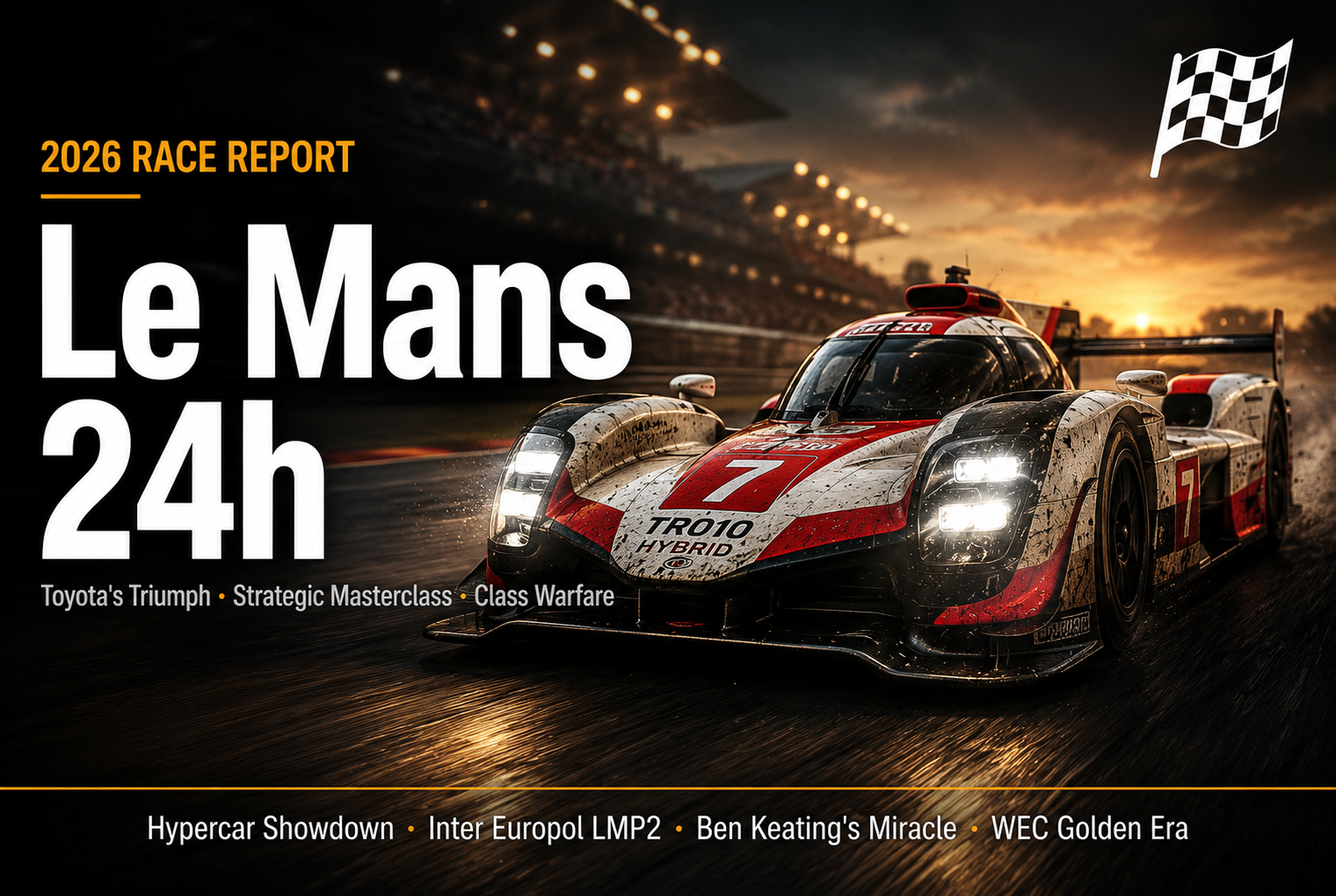
Let me paint a picture for you: The #7 Toyota TR010 Hybrid—driven by Kamui Kobayashi, Mike Conway, and former F1 driver Nyck de Vries—had an absolutely miserable qualifying session. They started all the way back in 14th place. In a sprint race, that is a death sentence. But in a 24-hour race, it is just a minor inconvenience if you have the right engineers on the pit wall.
Instead of trying to aggressively dive-bomb their way through the hypercar traffic on the opening laps and risking a catastrophic crash, Toyota decided to play chess while everyone else was playing checkers. They ran an entirely different, heavily offset pit stop strategy compared to the leading BMWs, Cadillacs, and Ferraris. By stopping completely out of sync with the leaders, they found themselves running in clean, unbothered air for massive chunks of the race.
By the time the sun came up on Sunday morning, the entire paddock realized what Toyota had done. The #7 car had quietly, methodically carved its way through the entire field and was sitting right at the front.
The Final Hours: A Tense Sprint to the Flag
You would think that after 20 hours of racing, the cars would be separated by massive, multi-lap margins. They were not. Entering the final hours, the top three cars were separated by just seven seconds.
The #20 BMW M Team WRT (driven by Robin Frijns, René Rast, and Sheldon van der Linde) was incredibly fast on the straights, actively hunting down the Toyota. But the BMW was battling massive fuel consumption issues. In the final stints, the #20 BMW crew was forced into aggressive “lift and coast” fuel-saving measures, desperately trying to stretch their tank to the end.
Kamui Kobayashi, who is arguably one of the greatest prototype drivers of his generation, took the wheel of the #7 Toyota for the final push. He didn’t blink. He crossed the finish line to take the overall victory by a razor-thin margin of just 10.9 seconds over the BMW, ending Ferrari’s three-year winning streak and securing Toyota’s sixth overall Le Mans victory (tying them with the legendary Bentley marque). The sister #8 Toyota rounded out the podium in third.
When Kamui keyed his radio after crossing the line, he was in literal tears. “I need a beer,” he told his pit wall. Honestly, after executing a comeback from 14th place, the man deserved an entire keg.
What Happened to Ferrari and Cadillac?
If Toyota was the hero of the story, Ferrari and Cadillac were the tragic figures.
Ferrari got completely neutralized by the Balance of Performance (BoP) adjustments this year, losing their terrifying straight-line speed advantage. The #50 Ferrari DNF’d completely, and the #51 car could only muster a 5th place finish, finishing over two minutes behind the leaders.
Cadillac looked incredibly strong early on, with the #12 Hertz Team Jota car actually leading the race going into the night. But a massively ill-timed Full Course Yellow completely destroyed their strategy, forcing them into an unscheduled pit stop that wiped out their advantage. They had the pace, but Le Mans requires luck, and Cadillac simply ran out of it.
LMP2: Inter Europol’s Dominance and Doriane Pin’s Heartbreak
While the Hypercars get all the mainstream media attention, the hardcore endurance nerds know that the LMP2 class is often where the actual, chaotic, wheel-to-wheel racing happens. Because every team in LMP2 is running the exact same Oreca 07-Gibson chassis, it is a pure spec series. You cannot buy a faster car; you can only have better drivers and better mechanics.
The Polish Powerhouse Strikes Again
The Polish-based Inter Europol Competition team absolutely dominated the class, proving that their victory a few years ago was not a fluke. The #43 car—driven by Tom Dillmann, Nick Yelloly, and Jakub Śmiechowski—ran a flawless race through the night, capitalizing on the mistakes of others to lock down first place. They were incredibly fast, perfectly reliable, and essentially managed a 1-2 finish for the team for large portions of the race before the #343 sister car settled into second.
The Most Devastating DNF of the Weekend
However, the story of the LMP2 class wasn’t just about who won; it was about who didn’t.
If you follow modern motorsport, you know the name Doriane Pin. The young French driver is an absolute phenom, a rising star in the F1 Academy, and fiercely fast in endurance prototypes. She put her #30 Duqueine Team Oreca on pole position in qualifying, and for the vast majority of the race, that car completely controlled the LMP2 narrative. They led for hours. They survived the night. They looked utterly untouchable.
And then, with just three and a half hours left on the clock—after racing for over 20 straight hours—disaster struck. The #30 car suffered a catastrophic brake failure. In endurance racing, if your brakes explode on a track where you are hitting 200 mph multiple times a lap, your race is instantly over. The car was retired to the garage. Seeing Doriane and her teammates (Julien Andlauer and Richard Verschoor) utterly devastated in the pits was the most heartbreaking moment of the entire 2026 broadcast. Le Mans is an incredibly cruel mistress; she doesn’t care how fast you are if she decides your mechanical components have reached their limit.
LMGT3: The Medical Miracle and the Corvette Triumph
With the death of the old GTE-Pro class, 2026 marked a massive year for the heavily populated LMGT3 category. These are cars that actually look like the sports cars you see on the street—Ferraris, Aston Martins, McLarens, Lexus, and Corvettes, all heavily modified for war.
The LMGT3 class mandates that each car must have a Bronze-rated (amateur) driver in the lineup. The battle in this class is usually decided by whose amateur driver makes the fewest mistakes. But this year, the Bronze driver for the winning team didn’t just survive his stints; he put on an absolute masterclass while physically injured.
Ben Keating’s Bionic Elbow
American Bronze driver Ben Keating is an absolute legend in the endurance racing community. He is a Texas car dealership magnate who just happens to be incredibly fast in a race car.
Just nine weeks prior to the 2026 Le Mans, Keating was involved in a serious bicycle accident that required massive surgery on his elbow. His doctors explicitly told him that there was absolutely no way he would be physically healed enough to endure the G-forces of a 24-hour motor race. But the Monday before the race, he essentially bullied his medical team into clearing him.
Driving the #33 TF Sport Corvette Z06 LMGT3.R alongside pros Nicky Catsburg and Jonny Edgar, Keating started the race from a dismal 17th position. TF Sport ran a wild strategy: they put Keating in the car early, essentially forcing him to grind through his mandatory minimum drive time while his arm was still relatively fresh, battling against significantly higher-graded professional drivers.
Despite visible stitches on his elbow and immense physical discomfort, Keating kept the Corvette perfectly in contention, avoiding penalties and staying off the barriers. When he handed the car over to his pro drivers, they went to work. Jonny Edgar drove five absolutely blistering, flawless stints at the very end of the race to drag the Corvette to the front of the pack, holding off the incredibly fast #78 Akkodis ASP Lexus to secure the class victory.
Winning Le Mans is the pinnacle of a racing career. Winning Le Mans starting from 17th place is insane. Winning Le Mans from 17th place nine weeks after having your elbow surgically reconstructed is the stuff of absolute legend.
Why the 2026 Race Changes Everything
As the podium celebrations wrapped up and the exhausted mechanics finally collapsed onto the floors of their garages, the overarching narrative of the 2026 24 Hours of Le Mans became incredibly clear: WEC is currently in a golden age, and the hypercar parity is very, very real.
For the first time in a long time, we didn’t just have one manufacturer running away with the trophy by five laps. We had Toyota, BMW, Cadillac, and Ferrari all completely capable of winning the race at different points during the 24 hours. The engineering reliability of these hypercars is now so incredibly high that Le Mans is no longer an endurance race where you nurse the car to the finish; it is a 24-hour, flat-out sprint race where the “tortoise and the hare” metaphor is completely dead. You have to be the hare for 381 consecutive laps.
Furthermore, the introduction of massive brands like McLaren into the GT ranks, and the highly anticipated arrival of Ford’s Hypercar program slated for 2027, proves that the series is experiencing a massive boom in popularity. The younger F1 audience is flocking to endurance racing because the regulations are allowing for fiercely tight, unpredictable competition.
If you missed the race this year, do not make the same mistake in 2027. Set an alarm, buy some extremely strong coffee, and witness the absolute pinnacle of human engineering and sheer stubborn willpower.
Frequently Asked Questions (FAQs) About the 2026 24 Hours of Le Mans
Because endurance racing features a wildly complex set of rules, multiple classes racing at the same time, and strategies that span across a full day and night, we have compiled the absolute most common questions new fans ask regarding the 2026 race.
Q: Who won the overall 2026 24 Hours of Le Mans?
A: The overall victory was claimed by the #7 Toyota Racing TR010 Hybrid, driven by Mike Conway (GBR), Kamui Kobayashi (JPN), and Nyck de Vries (NED). They completed 381 laps, finishing just 10.9 seconds ahead of the second-place BMW.
Q: Why didn’t Ferrari win again this year?
A: After winning three years in a row, the Ferrari 499P was heavily penalized by the Balance of Performance (BoP) regulations heading into the 2026 race. The BoP artificially adds weight or reduces power to ensure all cars are competitive. This stripped Ferrari of their massive straight-line speed advantage, resulting in the #50 car failing to finish (DNF) and the #51 car finishing over two minutes off the lead in 5th place.
Q: What is the “offset strategy” that Toyota used to win?
A: Because the #7 Toyota qualified poorly (14th place), they decided not to pit at the exact same time as the leading pack. By pitting earlier or later than their rivals (offsetting their pit window), they ensured that when they returned to the track, they were not fighting in heavy traffic. This allowed them to run faster, cleaner lap times in open air, slowly leapfrogging the leaders during the pit stop cycles.
Q: Did any former Formula 1 drivers race at Le Mans in 2026?
A: Yes, an astonishing 16 former F1 drivers competed in the 2026 event. The overall winning car featured Kamui Kobayashi (formerly of Sauber/Caterham) and Nyck de Vries (formerly of AlphaTauri). Other notable F1 alumni included Sébastien Buemi, Brendon Hartley, Romain Grosjean, Antonio Giovinazzi, Robert Kubica, Stoffel Vandoorne, and Kevin Magnussen.
Q: What happened to Doriane Pin’s car?
A: Doriane Pin’s #30 Duqueine Team Oreca was the heavy favorite to win the LMP2 class after claiming pole position and leading for the vast majority of the race. However, with approximately 3.5 hours remaining, the car suffered a catastrophic brake failure and was forced to permanently retire from the race.
Q: How does the LMGT3 class work with amateur drivers?
A: In the LMGT3 class, WEC rules mandate that every three-person driver lineup must include at least one Bronze-rated (amateur) driver, and they must drive a minimum number of hours during the race. This ensures the class remains true to the spirit of “gentleman drivers.” This year, the winning #33 Corvette was piloted by amateur Ben Keating, who remarkably drove a flawless race despite recently undergoing major elbow surgery.
Q: Why do they race for 24 hours straight? Don’t the drivers sleep?
A: The 24 Hours of Le Mans is designed to be the ultimate test of automotive reliability and human endurance. The race does not stop for the night. However, a single driver does not drive for 24 hours. Teams consist of three drivers per car who rotate in shifts (stints). When a driver is not in the car, they sleep in motorhomes or cots located behind the garages, receive massages, eat, and prepare for their next rotation.
Q: Where can I watch the World Endurance Championship (WEC)?
A: The FIA WEC races, including Le Mans, are officially streamed live and on-demand worldwide through the FIAWEC+ app and website. Depending on your region, it is also frequently broadcast on platforms like MotorTrend TV (in the US) or Eurosport (in Europe).









Leave a Reply