

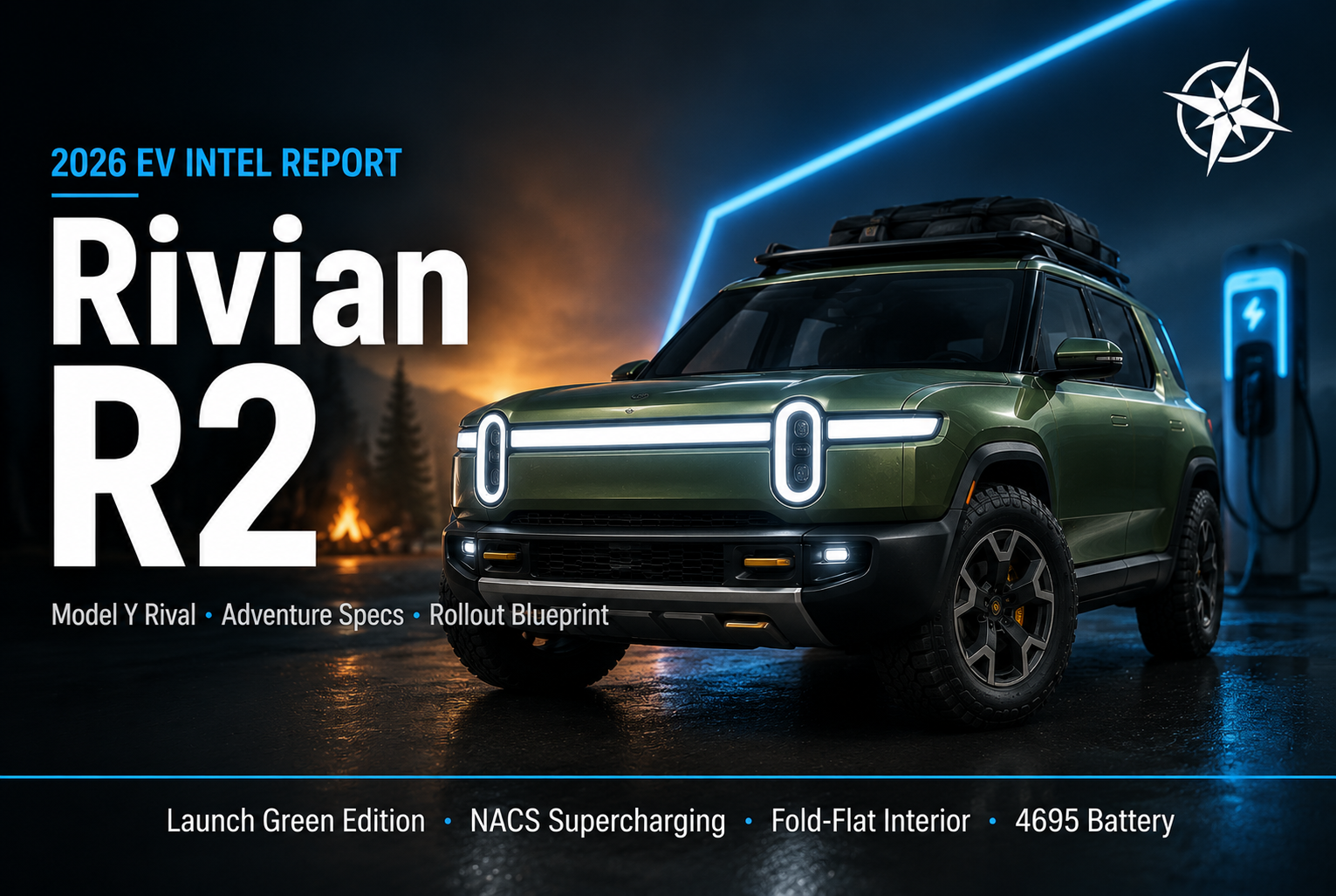
The Ultimate Guide to the 2026 Rivian R2: The SUV That Is Actually Making Tesla Sweat (A Complete Deep Dive)
I will never forget the exact afternoon I saw my first Rivian in the wild.
I spend an absolute diagnostic amount of time test-driving electric vehicles, scrolling through automotive spy-shot forums, and tracking the rollercoaster that is the modern EV market. A few years ago, when the massive, flagship Rivian R1T pickup truck and R1S SUV finally started hitting the streets, I was completely mesmerized. They looked like futuristic lunar rovers designed by a high-end outdoor gear company. They had literal flashlights hidden in the doors, a massive gear tunnel, and an aesthetic that perfectly blended Silicon Valley tech with Pacific Northwest campfire vibes.
But there was a massive, glaring problem: the price tag. With the R1 lineup pushing $80,000 to over $100,000, Rivian had built a phenomenal vehicle that 95% of normal human beings could simply never afford. We all looked at it, drooled over it, and then quietly went back to shopping for a standard Tesla Model Y or a Toyota RAV4 Hybrid.
Let’s just be honest about something first: the electric vehicle market has been desperate for a cool, capable, off-road-oriented mid-size SUV that doesn’t require a second mortgage to purchase. For years, Elon Musk has had a complete, undisputed monopoly on the $45,000 to $55,000 electric crossover segment with the Model Y. Other automakers tried to compete with boring, uninspired blobs of wind-tunnel-optimized plastic. None of them had a soul. None of them made you want to pack up a tent, strap a kayak to the roof, and disappear into the woods for the weekend.
Then, in March 2024, Rivian CEO RJ Scaringe walked onto a stage and pulled the sheet off the Rivian R2.
The internet completely lost its mind. In the first 24 hours alone, the company received over 68,000 reservations. It looked exactly like a shrunken-down version of the beloved R1S. It had the iconic pill-shaped headlights, the rugged stance, and a proposed starting price of just $45,000. It was the electric vehicle promised land.
Fast forward to today—June 2026. The wait is officially over. As of June 9th, the very first Rivian R2s have rolled off the assembly line at their plant in Normal, Illinois, and are officially arriving in driveways across America. The launch editions are hitting the streets, the demo drives have begun, and the automotive landscape has fundamentally shifted.
Because buying a new electric vehicle requires navigating a confusing maze of battery chemistries, trim levels, software subscriptions, and delivery timelines, I wanted to create a single, definitive pillar of content for you. No confusing dealership jargon, no gatekeeping. This is your complete, deeply human guide to everything you need to know about the 2026 Rivian R2—from the brutal truth about the pricing rollout to the hidden interior easter eggs, and whether it can actually dethrone the Tesla Model Y.
Grab a cup of coffee, settle in, and let’s take a deep dive into the most important EV of the year.
The Hype vs. Reality: The June 2026 Rollout
When a startup automaker promises a “$45,000 electric SUV,” you always have to read the fine print. Rivian is not immune to the realities of automotive manufacturing economics. To survive and achieve profitability, companies have to sell their most expensive, highly-specced versions first before rolling out the cheaper base models.
So, while the headline starting price is roughly $45,000, that is not the car you are seeing on the road right now.
Phase 1: The Performance Launch Edition (Available Now)
As of June 2026, the only vehicles Rivian is delivering to early reservation holders are the top-tier R2 Performance models equipped with the limited “Launch Package.” This dual-motor, all-wheel-drive monster starts at $57,990.
If you held an early reservation and selected this configuration, your order invitation likely just arrived in your inbox, and you can expect delivery within two to six weeks. This Launch Edition is fully loaded. It comes with the exclusive “Launch Green” exterior color option, a special Rivian Green anodized Key Fob, the Tow Package (capable of hauling 4,400 lbs), and—crucially—lifetime access to the Autonomy+ software (Rivian’s advanced hands-free driving system).
Phase 2: The Premium Trim (Arriving Late 2026)
If $58,000 is too steep, you are going to have to wait a few more months. Slated for late 2026, Rivian will begin shipping the R2 Premium. Starting at $53,990, this is also a dual-motor AWD setup, but it produces slightly less horsepower than the Performance model. It keeps the incredible interior luxuries but strips away the semi-active suspension and the specialized off-road driving modes like “Rally” and “Soft Sand.”
Phase 3: The Standard Trims (2027)
This is where the mass market lives. The R2 Standard will officially begin deliveries in the first half of 2027. Starting at $48,490, this version utilizes a single-motor, Rear-Wheel Drive (RWD) layout with a Long Range battery pack.
And finally, what about that legendary $45,000 price point? That absolute entry-level version, featuring a slightly smaller battery pack and fewer luxury amenities, is not slated to arrive until late 2027 (starting around $44,990 to $46,495 depending on the final destination fees).
The reality is that if you want an R2 today, you are buying a premium luxury SUV. If you want the budget-friendly R2, you are going to have to practice some serious patience.
The Design Philosophy: Honey, I Shrunk the R1S
To understand the R2, you have to understand Rivian’s core design philosophy. They refuse to build “appliances.” While competitors design their cars in wind tunnels to squeeze out every single microscopic drop of aerodynamic efficiency—resulting in cars that look like squashed jellybeans—Rivian prioritizes character.
The Exterior: A Box With a Soul
The R2 retains the incredibly recognizable front fascia of the Rivian brand: the massive horizontal light bar interrupted by two vertical, pill-shaped “stadium” headlights. It is completely iconic. If you see it in your rearview mirror from half a mile away, you instantly know what it is.
Dimension-wise, the R2 is significantly smaller than its older sibling. It is 185.9 inches long, roughly 15 inches shorter than the massive R1S, and it sits about ten inches lower. This makes it an absolute dream for parallel parking in tight urban environments or squeezing down narrow, overgrown forest trails. Yet, despite being smaller, it doesn’t look frail. It maintains a best-in-class stance with 9.6 inches of ground clearance, a 25-degree approach angle, and a 26-degree departure angle. This isn’t just a grocery-getter playing dress-up; it is a legitimate off-roader.
Rivian also introduced some breathtaking new colorways for this platform. While you can still get the standard Glacier White or Midnight black, the standout is Catalina Cove—a gorgeous metallic finish that shifts dynamically between blue and green tones depending on the sunlight.
The Ultimate Party Trick: The Rear Drop Glass
If there is one single feature that has people obsessed with the R2’s exterior, it is the rear window. In an homage to classic 1990s SUVs like the Toyota 4Runner, the rear tailgate glass on the R2 is fully motorized and drops entirely down into the tailgate itself.
When you combine this with the roll-down side windows and the massive panoramic glass roof, you can create a completely open-air driving experience that rivals a Jeep Wrangler or a Ford Bronco, but without the headache of physically unbolting roof panels. It also allows you to easily hang long items like surfboards or lumber out the back without driving around with your entire trunk wide open.
Inside the Cabin: The Swiss Army Knife of Interiors
Getting into the Rivian R2 feels completely different from sitting in a traditional legacy automaker’s car. There is no fake chrome. There is no cheap, glossy “piano black” plastic that attracts fingerprints and scratches if you look at it wrong.
Rivian’s interior design is centered around what they call “warm minimalism.” They use beautiful, sustainable materials that feel like they belong in a high-end architectural digest rather than a dealership lot. The new Black Crater Signature interior, available on the Premium and Performance trims, utilizes upcycled birch wood trim that runs across the entire dashboard, paired with incredibly durable textile accents. It feels rugged but distinctly luxurious.
The “Fold-Flat” Revolution
The true genius of the R2 interior, however, lies in its utility.
Every single automaker brags about folding rear seats, but Rivian took it a step further. In the R2, the first-row driver and passenger seats fold completely flat. When combined with the folding second row, the entire interior cabin transforms into a perfectly flat, level surface. You can throw an air mattress back there and comfortably sleep two fully grown adults.
If you are a camper, a road-tripper, or someone who hates paying for cheap motel rooms during cross-country drives, this feature alone completely justifies the purchase of the car. It turns the vehicle into a mobile, climate-controlled steel tent.
Storage: Finding Space Where None Existed
Electric vehicles inherently have better packaging than gas cars because there is no massive engine block or transmission tunnel. Rivian has weaponized this space.
- The Frunk: Lift the hood, and you are greeted by a massive front trunk. It is completely sealed from the weather and large enough to swallow multiple carry-on suitcases, a massive grocery haul, or wet, muddy hiking boots that you don’t want stinking up the cabin.
- The Dual Gloveboxes: In the R1 models, Rivian controversially removed the passenger glovebox entirely. People absolutely hated it. Rivian listened to the feedback, and in the R2, they didn’t just add one glovebox—they added two independent, massive storage bins directly into the dashboard.
- The Hidden Flashlight: Yes, the iconic Rivian Torch is still here. Built directly into the driver’s side door is a high-powered, rechargeable LED flashlight that pops out when you push it. It is the coolest, most unnecessarily brilliant gimmick in the automotive industry, and I am so glad they kept it for the smaller car.
All told, between the frunk and the rear cargo area (with the seats folded), the R2 offers a cavernous 90.1 cubic feet of total storage. You can pack five suitcases, a stroller, three backpacks, and a cooler without even breaking a sweat.
Powertrain and Battery Tech: The Secret Sauce
You can wrap a car in beautiful birch wood and drop-down windows all you want, but if the electric powertrain underneath is flawed, the car is dead on arrival. Thankfully, Rivian has spent the last five years perfecting their electric architecture, and the R2 benefits heavily from those lessons.
The New LG 4695 Battery Cells
Underneath the floorboards of the R2 lies a completely redesigned structural battery pack. Instead of using the older 2170 cylindrical cells found in the R1 vehicles, Rivian inked a massive deal with LG Energy Solution to supply their new 4695 cylindrical cells.
What does this string of numbers actually mean for you? It means everything. These new cells are 46 millimeters in diameter and 95 millimeters tall. They are substantially larger than older EV batteries, offering roughly six times the energy capacity per individual cell. This massive increase in energy density allows Rivian to pack a roughly 94 kWh (gross) battery into a significantly smaller vehicle footprint. Furthermore, because these cells run cooler and are managed better thermally, the car is far more efficient.
Performance and Range Specs
Let’s talk raw numbers, because the spec sheet on this car is absolutely unhinged.
- R2 Performance (Available Now): This dual-motor AWD variant cranks out a staggering 656 horsepower. It will catapult this mid-size SUV from 0 to 60 mph in a terrifyingly fast 3.6 seconds. Highway passing acceleration from 50 to 70 mph takes just 1.55 seconds. Despite this supercar-level speed, it still boasts an EPA-estimated range of up to 330 miles on a single charge.
- R2 Premium (Late 2026): Also dual-motor AWD, but dialed back to 450 horsepower and 537 lb-ft of torque. It hits 60 mph in 4.6 seconds and retains the 330-mile range.
- R2 Standard Long Range (2027): The single-motor, rear-wheel-drive efficiency king. It still produces a very respectable 350 horsepower (0-60 in 5.9 seconds), but because it is only spinning two wheels, it stretches the Rivian-estimated range up to an incredible 345 miles.
The NACS Charging Revolution
This is arguably the most important technological shift for the R2.
For the last decade, non-Tesla EVs in North America have suffered from terrible, broken, unreliable public charging infrastructure using the CCS standard. You would pull up to an Electrify America station, swipe your card, and pray that the screen didn’t freeze.
The Rivian R2 officially marks the end of that dark era. Every single R2 rolls off the assembly line with a native NACS (North American Charging Standard) charge port built right into the body. No clunky adapters, no dongles, no stress. You can pull this vehicle directly into any of the 21,000+ Tesla Superchargers across the United States and Canada, plug the cable directly into the car, and it just works.
The vehicle runs on a 400-volt architecture, allowing it to pull up to 210 kW at a DC fast charger. This means you can charge the battery from 10% to 80% in just under 29 minutes while you grab a coffee and use the restroom. The range anxiety is officially dead.
Software and Autonomy: The R2 Brain
Automakers are no longer just building cars; they are building computers on wheels. Rivian’s software interface has always been incredibly clean, using Unreal Engine graphics to render a beautiful, responsive 3D model of your car on the massive center screen. But the R2 takes the hardware suite to a completely new level.
The Sensor Suite and Autonomy+
The R2 is absolutely plastered with advanced sensors. It utilizes a massive array of 11 cameras and 5 high-resolution radars to map the world around it. It can detect objects from incredibly long distances, even in complete pitch darkness or blinding rainstorms.
Rivian is using this hardware to power Autonomy+. This is their Level 2+ advanced driver-assistance system. Similar to GM’s Super Cruise or Ford’s BlueCruise, Autonomy+ allows for genuinely hands-free driving on mapped highways. If you commute an hour each way in stop-and-go interstate traffic, this system will completely change your quality of life. The car handles the steering, the braking, the lane changes, and the spacing.
For buyers of the early Launch Edition, this software comes completely unlocked for the lifetime of the vehicle. For later buyers of the Premium and Standard trims, you will have to pay for it via a one-time unlock fee or a monthly subscription.
Dynamic Adventure Lighting
The headlights aren’t just there to look cool. The Premium and Performance trims feature state-of-the-art Matrix LED headlights with “Dynamic Adventure Lighting.” The car’s computer actively monitors oncoming traffic and uses individual LED pixels to “carve out” dark spots around oncoming cars, allowing you to effectively leave your high beams on 100% of the time without blinding the drivers in the opposite lane. It makes driving down pitch-black mountain roads incredibly safe and profoundly stress-free.
The Elephant in the Room: R2 vs. Tesla Model Y
If you are reading this, you are probably agonizing over the exact same question millions of other buyers are facing right now: Should I just buy the Tesla Model Y instead?
The Tesla Model Y is an absolute juggernaut. It was the best-selling car in the world for a reason. It is incredibly efficient, it has access to the Supercharger network, and Tesla has mastered the art of mass-manufacturing it, allowing them to drop the price incredibly low.
So why choose the Rivian R2?
It comes down to what you want your car to say about you, and how you actually use it.
Buy the Tesla Model Y if: You want a sleek, jellybean-shaped urban commuter car. You want absolute minimalist interior design, and you want to pay the lowest absolute baseline price right this very second without waiting until 2027.
Buy the Rivian R2 if: You want a vehicle with genuine personality. You want a car that actually has 9.6 inches of ground clearance so you don’t scrape your battery pack when you drive down a rutted dirt road to a campsite. You want the utility of folding the front seats flat to sleep in the cabin, rolling down the rear window to let the ocean breeze in, and utilizing a massive frunk for your gear. You want a beautiful wood interior, physical steering wheel stalks, a driver-side dashboard screen (which the Model Y famously lacks), and a car that looks like an aggressive adventure vehicle rather than an aerodynamic egg.
With the R2 adopting the Tesla NACS charging port, the single biggest advantage the Model Y had over the competition (the Supercharger network) has been completely neutralized. It is now a fair fight based purely on the merits of the vehicle itself. And in terms of utility, charm, and sheer capability, the Rivian absolutely destroys it.
Final Thoughts: The Make-or-Break Moment
The automotive industry is brutal, and scaling an electric vehicle company is notoriously one of the hardest business endeavors on the planet. Rivian bled billions of dollars getting the R1 platform off the ground. The R2 is not just a new model for them; it is their make-or-break moment. This is the vehicle that must bring them to mass-market profitability.
Based on what is rolling out of the Normal, Illinois plant this month, they have absolutely nailed it.
They took the undeniable magic, capability, and charm of their $80,000 flagship SUV, shrunk it down to fit in a standard garage, modernized the battery tech, adopted the best charging standard in the world, and priced it aggressively. The only real downside to the Rivian R2 right now is the massive waiting list. If you want the budget-friendly $45,000 version, you are going to be waiting until late 2027.
But if you have the patience, or if you have the budget to spring for the currently available Performance trim, you are looking at the absolute best mid-size electric SUV on the market today. It is rugged, it is incredibly fast, and it is a massive breath of fresh air in an industry that desperately needed one.
The Model Y killer is finally here. And it has a flashlight in the door.
Frequently Asked Questions (FAQs) About the Rivian R2
Because navigating the staggered release dates, pricing tiers, and technological features of a new EV can be incredibly confusing, we have compiled the absolute most common questions regarding the 2026 Rivian R2 to ensure you have all the facts in one place.
Q: How much does the Rivian R2 actually cost? A: The pricing depends entirely on the trim and when you are buying it. The current Performance Launch Edition (available as of June 2026) starts at $57,990. The Premium trim (late 2026) starts at $53,990. The Standard Long Range (first half of 2027) starts at $48,490. The absolute base model Standard trim (late 2027) is projected to start around $44,990 to $46,495.
Q: Is the Rivian R2 currently available to purchase? A: Yes and no. As of June 9, 2026, Rivian officially began delivering the top-tier R2 Performance Launch Editions to early reservation holders. If you place a brand new reservation today for a lower trim level, you will be placed on a waiting list for 2027 production.
Q: What is the exact range of the Rivian R2? A: Range varies based on the battery pack and the number of motors. The single-motor Standard Long Range boasts an estimated 345 miles. The dual-motor Premium and Performance models feature an EPA-estimated range of 330 miles (though outfitting the car with heavy all-terrain tires will reduce this number). The entry-level Standard battery (coming late 2027) will offer roughly 275+ miles.
Q: Do the front seats of the R2 really fold completely flat? A: Yes! This is one of the most highly anticipated features. Both the first-row driver and passenger seats, as well as the 40/20/40 split second-row seats, fold completely flat, turning the entire cabin into a level platform ideal for car camping or hauling extremely long cargo.
Q: Does the Rivian R2 use a Tesla charger? A: Yes. The R2 is natively built with the NACS (North American Charging Standard) port. You do not need a clunky adapter to charge. You can pull directly up to any of the 21,000+ Tesla Superchargers in the US and Canada and plug the cable directly into the vehicle.
Q: How fast does the R2 charge? A: Using its 400-volt architecture, the R2 can accept DC fast-charging speeds up to 210 kW. Under optimal conditions, this allows the battery to charge from 10% to 80% in approximately 29 minutes.
Q: What is the difference between the R1S and the R2? A: The R1S is Rivian’s flagship, luxury full-size SUV. It features three rows of seating (up to 7 passengers), an incredibly complex quad-motor option, adjustable air suspension, and a massive footprint, starting around $75,000+. The R2 is the mid-size sibling. It is strictly a two-row, 5-passenger vehicle. It is roughly 15 inches shorter, uses traditional coil-spring suspension, and is designed to be vastly more affordable and city-friendly while retaining impressive off-road geometry.
Q: Will the R2 be available in Europe? A: Yes. Unlike the R1 series, which was strictly a North American endeavor, the R2 is built on Rivian’s new Midsize Platform (MSP) and is specifically designed to be a global vehicle. It will eventually serve as Rivian’s official entry into the European and global markets.
Q: How do I test drive a Rivian R2? A: As of June 2026, R2 demo vehicles have begun arriving at official “Rivian Spaces” (their retail showroom locations) across the country. You can book a demo drive directly through the Rivian website, though priority is currently being given to existing reservation holders who have been invited to configure their orders.







Leave a Reply