
The Ultimate Guide to the 2026 Ford Engine Recalls: The EcoBoost Fire Risk, the Focus Stalls, and What You Need to Know (A Complete Deep Dive)
I will never forget the exact afternoon I had my first true automotive panic attack.
I spend an absolute diagnostic amount of time looking at car engines, reading technical service bulletins, and advising friends on what vehicles they should buy. A few years ago, I was driving a turbocharged four-cylinder crossover down a busy interstate, cruising comfortably in the fast lane at about 75 miles per hour. Without any warning, the dashboard lit up like a Christmas tree. The throttle pedal went completely dead. The engine sputtered, the tachometer violently dropped to zero, and I suddenly found myself wrestling a 4,000-pound piece of metal across three lanes of angry, speeding traffic with no power steering and no brake assist.
Let’s just be honest about something first: having your engine completely shut off while you are driving is one of the most terrifying experiences you can have in a machine. You are completely helpless.
When you buy a brand-new car—especially from a legacy, blue-collar American brand like Ford—you are paying for peace of mind. You expect to put the key in the ignition (or press the start button), drop it into drive, and simply arrive at your destination. But over the last few months, bridging the gap between late 2025 and the summer of 2026, the headlines surrounding Ford Motor Company have been absolutely dominated by the dreaded “R” word: Recall.
If you are currently driving a Ford, or if you have a 2026 model year vehicle sitting on order at your local dealership, your news feed has probably been flooded with terrifying phrases like “EcoBoost Engine Fire Risk,” “Loss of Motive Power,” and “Unexpected Stalling.” It is completely exhausting, and it is incredibly anxiety-inducing to wonder if the vehicle sitting in your driveway is a ticking time bomb.
Because automotive recall notices are notoriously written in dense, confusing legal jargon that is designed to protect the manufacturer from lawsuits rather than actually inform the consumer, I wanted to create a single, definitive pillar of content for you. No confusing mechanic-speak, no corporate spin.
This is your complete, deeply human guide to exactly what is happening with Ford’s engine recalls in 2026. We are going to break down the “Big Three” current engine crises, explain the actual, physical engineering flaws behind the headlines, tell you exactly which models are affected, and give you a battle plan for how to deal with the dealership service department without completely losing your mind.
Grab a cup of coffee, have your 17-digit Vehicle Identification Number (VIN) handy, and let’s pull the engine cover off and see what is really going on.
The Modern Car Problem: Why Are We Seeing So Many Recalls?
Before we dive into the specific Ford engine issues, we have to address the massive elephant in the room. Why does it feel like cars are being recalled constantly right now? Did Ford just suddenly forget how to build engines? After all, their old motto used to be “Quality is Job 1.”
The reality of the modern automotive industry is that today’s cars and trucks are infinitely more complex than the vehicles our parents drove. A pickup truck from 1995 was essentially a steel box with a massive, lazy iron V8 engine, a carburetor or basic fuel injection, and a steering wheel. If something broke, you could usually fix it in your driveway with a socket wrench and a hammer.
Today’s vehicles, like the 2026 Ford Mustang or the Ford Explorer, are essentially incredibly fast rolling supercomputers. In the relentless pursuit of better fuel economy and higher horsepower, automakers have turned to forced induction (turbocharging). Ford’s wildly popular EcoBoost engine lineup utilizes massive amounts of internal pressure, complex direct-injection fuel systems, and incredibly tight manufacturing tolerances to squeeze V8 power out of small four-cylinder engine blocks.
When you are mass-producing millions of these highly complex engines on a global assembly line, the margin for error is microscopic. A single, tiny manufacturing defect at a third-party supplier factory halfway across the world—a bolt torqued a fraction of a millimeter too loose, a software line written incorrectly, or a tiny plug missing from a cylinder head—can result in catastrophic engine failure.
Ford has unfortunately been leading the industry in total recall numbers for the past few years. CEO Jim Farley has publicly acknowledged this quality control crisis, stating that fixing Ford’s initial quality is his absolute top priority, completely overhauling how they inspect vehicles as they leave the plant. But for the vehicles that already slipped through the cracks, the recall system is the only safety net we have.
Let’s break down the three massive engine issues currently plaguing the Ford lineup right now.
Recall #1: The 2026 EcoBoost Fire Risk (The “Missing Plug” Fiasco)
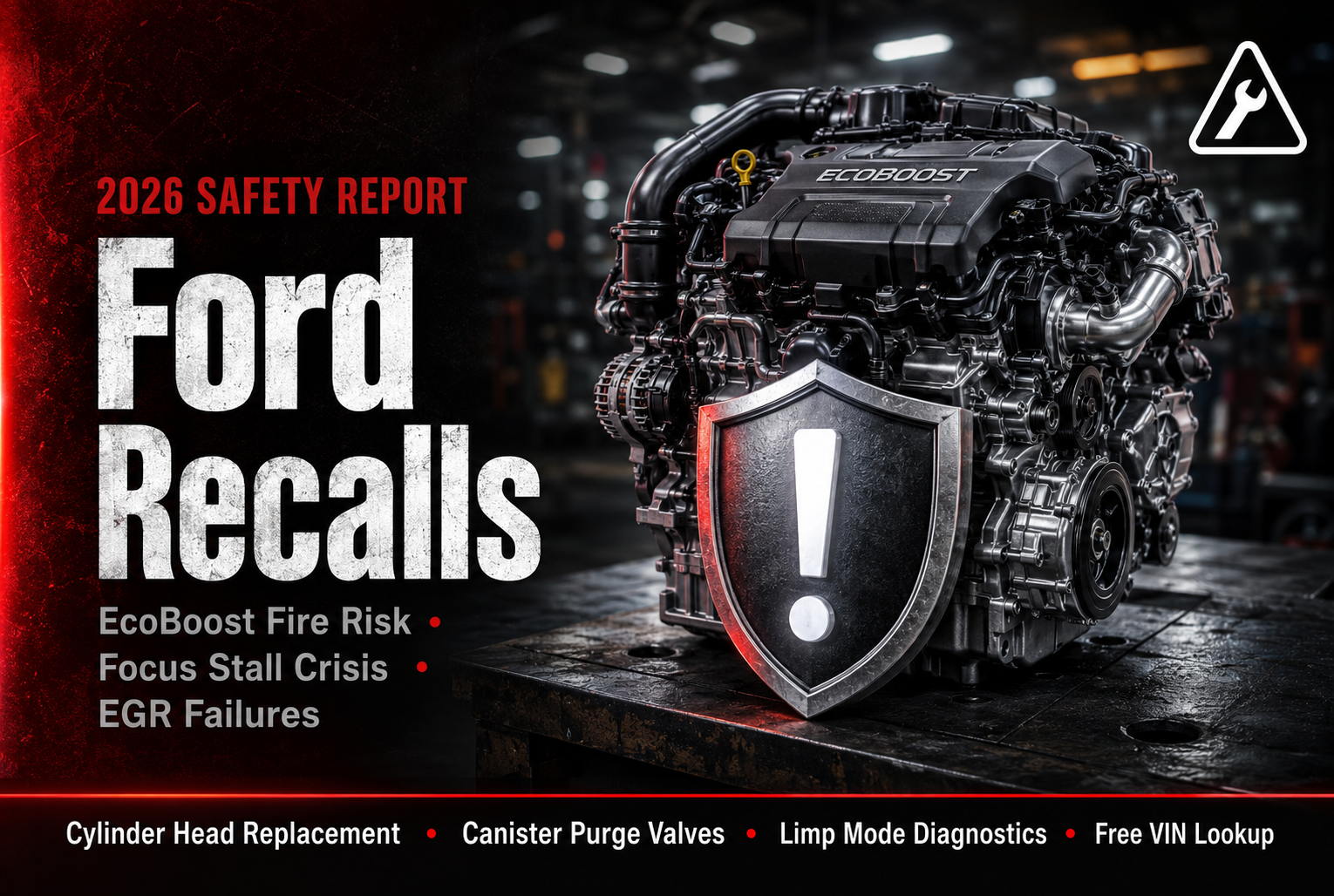
This is arguably the scariest recall currently on the books, and it involves some of Ford’s most popular, brand-new 2026 models. In late 2025, Ford issued an urgent safety recall and an immediate “stop-sale” order for certain vehicles equipped with the 2.0-liter and 2.3-liter EcoBoost four-cylinder engines.
The Affected Vehicles
If you were shopping for a brand new car this year, these are the heavy hitters:
- 2026 Ford Mustang (Specifically the base models with the 2.3L EcoBoost, not the 5.0L V8 GTs)
- 2026 Ford Explorer
- 2026 Lincoln Corsair
- 2025 Ford Maverick
What Actually Went Wrong?
To understand this recall, you have to understand how an engine keeps itself lubricated. Inside your engine block, oil is pumped at incredibly high pressure through a complex maze of tiny veins and galleries to keep the fast-moving metal parts from grinding each other into dust.
When an engine block and a cylinder head are manufactured at a casting plant, the machines have to drill straight holes into the metal to create these oil passages. Because you cannot drill a curved hole, these passages often intersect. To seal up the outside ends of these drilled holes so the oil doesn’t just shoot out onto the ground, the factory presses in a tiny, specialized piece of metal called a ball plug.
According to documents filed with the National Highway Traffic Safety Administration (NHTSA), a manufacturing error occurred at the supplier level. A specific batch of engine cylinder heads was produced, and the machines completely missed installing a crucial ball plug on the intake face of the cylinder head. Even worse, the quality control sensors that were supposed to reject these defective heads failed, and the heads were mated to complete engines and dropped into vehicles on the assembly line.
The Danger: Why It Causes a Fire
If that ball plug is missing, pressurized engine oil will aggressively leak out of the cylinder head the second you start the car.
An oil leak alone will eventually drain the engine and cause the internal metal components to seize up, destroying the motor. But in an EcoBoost engine, the situation is much more dangerous. The exhaust manifold and the turbocharger downpipe on these engines routinely reach temperatures exceeding 1,000 degrees Fahrenheit. If that leaking engine oil drips down onto those glowing hot exhaust components, it will instantly ignite. It creates a massive, catastrophic under-hood engine fire.
The Good News and The Fix
The silver lining to this terrifying manufacturing fumble is that Ford’s internal quality control team actually caught the leak on a 2026 Explorer at the Chicago assembly plant before the vast majority of these vehicles were ever shipped to paying customers.
Because of this, the issue primarily impacted dealership inventory. Ford issued a strict stop-sale, meaning a dealer was legally forbidden from selling you one of these cars until it was fixed.
The remedy is absolutely massive. Ford is not instructing its mechanics to simply shove a missing plug into the hole. Because they cannot guarantee the structural integrity of that specific batch, Ford is forcing dealerships to completely replace the entire cylinder head assembly. This is a major, invasive engine surgery that takes hours of labor. If you bought one of these vehicles right as they launched, you need to check your VIN immediately, because driving with a missing oil plug is a literal roll of the dice.
Recall #2: The 250,000 Ford Focus Stalling Crisis (The Ghost of Recalls Past)
While the EcoBoost fire risk affects brand new cars, Ford’s second massive engine recall of 2026 targets vehicles that are nearly a decade old. In June 2026, Ford announced they were recalling over 250,000 older Ford Focus models because the engines were unexpectedly stalling out while driving at highway speeds.
The Affected Vehicles
- 2012 to 2018 Ford Focus (A massive chunk of the third-generation production run)
The “Recall of a Recall”
What makes this specific situation incredibly frustrating for owners is that this is actually a “recall of a recall.”
Back in 2018, Ford issued a massive safety campaign to fix a component in the Ford Focus called the Canister Purge Valve (CPV). The original fix involved replacing the valve and updating the car’s Powertrain Control Module (PCM) software. However, fast forward to 2026, and Ford realized that the software update they pushed to dealerships years ago was fundamentally flawed. It didn’t actually fix the root problem, leaving a quarter of a million drivers at risk.
The Engineering: What Does a Canister Purge Valve Do?
To understand why these cars are stalling, we have to talk about emissions. When gasoline sits in your fuel tank, it constantly evaporates into toxic vapor. In the old days, cars just vented this vapor straight into the atmosphere. Modern environmental laws require cars to trap that vapor in a charcoal canister.
The Canister Purge Valve is a small electronic gateway that opens and closes, allowing the engine to safely suck those trapped fuel vapors out of the charcoal canister and burn them in the engine combustion chamber.
The problem with the 2012-2018 Ford Focus is that this valve has a nasty habit of breaking and getting completely stuck in the “open” position.
The Danger: The Vacuum of Death
When the valve gets stuck open, the engine acts like a massive vacuum cleaner, constantly sucking on the fuel tank. This creates an extreme, negative pressure vacuum inside the plastic gas tank. If you drive like this for long enough, the vacuum pressure gets so strong that it literally deforms the gas tank, causing it to collapse inward like a crushed plastic water bottle.
When the gas tank deforms, the fuel pump inside the tank gets crushed. The engine suddenly stops receiving gasoline, and just like that—whether you are pulling out of a driveway or doing 70 mph on the interstate—the engine violently stalls. You instantly lose your power steering, making the wheel incredibly heavy, and you lose the vacuum assist to your brakes, meaning you have to stand on the pedal with all your body weight just to stop the car.
The Fix
Because the original software fix was botched, Ford is mailing out notifications to over 250,000 owners starting in July 2026. Dealerships will have to apply a brand-new, corrected software update to the powertrain module that correctly identifies when the valve gets stuck open and prevents the extreme vacuum from forming. Furthermore, if the valve itself is found to be faulty, they will replace it free of charge. If you drive an older Focus, do not ignore this letter. A stall at highway speeds is an incredibly dangerous scenario that can easily result in a severe rear-end collision.
Recall #3: The 2025/2026 EGR Valve Power Loss
Rounding out the “Big Three” of Ford’s current engine woes is a widespread recall announced in March 2026 regarding a sudden loss of motive power due to a failing emission control component.
The Affected Vehicles
This issue casts a massive net over almost 48,000 vehicles, specifically targeting the 2025 model year:
- 2025 Ford Bronco
- 2025 Ford Bronco Sport
- 2025 Ford Escape
- 2025 Ford Explorer
- 2025 Ford Maverick
- 2025 Ford Mustang
- 2025 Ford Ranger
- 2025 Lincoln Corsair
- 2025 Lincoln Nautilus
The Engineering: What is an EGR Valve?
Internal combustion engines burn incredibly hot. When the temperatures inside the cylinder get too high, the engine starts producing Nitrogen Oxides (NOx), which are terrible for the environment and a major component of smog.
To cool the combustion temperatures down, engineers use an Exhaust Gas Recirculation (EGR) Valve. This mechanical valve takes a small amount of the inert, oxygen-depleted exhaust gas that just left the engine, loops it back around, and dumps it right back into the engine’s fresh air intake. Because this recycled exhaust gas won’t burn, it effectively dilutes the air/fuel mixture, significantly lowering the internal combustion temperature and preventing toxic emissions.
The Danger: Limp Mode
In these specific 2025 vehicles, a defect at the manufacturing level causes the EGR valve to fail completely. When the valve breaks, the engine computer (ECU) instantly realizes that the combustion temperatures are no longer being safely regulated.
To prevent the engine block from overheating and melting its internal components, the computer will instantly trigger a massive check engine light and throw the vehicle into a defensive state known as “Limp Mode.”
When a Ford goes into limp mode, the computer drastically cuts fuel and closes the electronic throttle body. You will press the accelerator pedal to the floor, and the car will refuse to go any faster than perhaps 15 or 20 miles per hour. While this “Loss of Motive Power” prevents the engine from destroying itself, it is incredibly dangerous if it happens while you are merging onto a busy, high-speed highway or crossing a major intersection.
The Fix
Just like the other recalls, Ford is taking this very seriously. Dealerships are instructed to inspect the EGR valve assembly and, if it falls within the defective batch numbers, replace the entire mechanical unit free of charge.
The Dealership Reality: How to Navigate a Major Engine Recall Without Losing Your Mind
Reading about engine fires, stalling, and limp modes is enough to make anyone want to trade in their car for a bicycle. But if you own an affected vehicle, panicking won’t fix the metal in your driveway. You have to deal with the dealership.
Having navigated massive automotive recalls myself, here is the absolute best, battle-tested advice for getting your Ford fixed without losing your mind.
Step 1: Check Your VIN Relentlessly
Do not wait for a letter in the mail. The postal service is slow, and Ford often sends notifications out in waves over several months to prevent dealerships from being overwhelmed.
Look at the driver’s side corner of your windshield from the outside, or open your driver’s door and look at the sticker on the door jamb. Write down your 17-digit Vehicle Identification Number (VIN). Go directly to the NHTSA.gov/recalls website or the Ford Owner Support page and type it in. This database is updated daily. If your car needs an engine fix, it will show up in bright red letters.
Step 2: The “Parts Not Available” Purgatory
If your car is under an active recall, you might call the dealership only for the service advisor to tell you, “Yes, your car is recalled, but Ford hasn’t shipped us the replacement parts yet.”
This is incredibly common, especially with massive hardware replacements like the EcoBoost cylinder heads. Supply chains take months to manufacture hundreds of thousands of new, redesigned engine parts. During this waiting period, ask the service advisor directly: “Is the car safe to drive?” If it is a software issue, they might say yes. If it is the missing oil plug fire risk, they will likely tell you to park the vehicle immediately.
Step 3: Demand a Loaner Vehicle
If Ford tells you that your $45,000 Explorer is too dangerous to drive because it might catch fire, or if it stalls out due to the Focus CPV issue, you cannot simply be expected to walk to work for three months while they manufacture a new part.
When you schedule your recall appointment, immediately inquire about a loaner vehicle. Ford corporate has specific programs in place to reimburse dealerships for putting affected customers into loaner cars or rental vehicles (like an Enterprise rental) during major safety recalls. Do not let a service advisor brush you off. Be polite, be firm, and escalate to the service manager if necessary. You bought a vehicle to get you to work; if their manufacturing defect prevents that, they owe you alternate transportation until the defect is remedied.
Step 4: The Mobile Service Option
In an effort to ease the massive backlog at dealership service centers, Ford has heavily invested in a Mobile Service fleet. If your vehicle requires a simple software flash (like the 2012-2018 Ford Focus purge valve update), you do not necessarily have to go sit in a dealership waiting room for four hours drinking stale coffee.
When you call to schedule, ask if the recall can be completed via Ford Mobile Service. They will literally send a specialized Ford Transit van to your driveway or your office parking lot, plug a laptop into your dashboard, flash the new software, and leave. It is the most painless way to handle a software-based recall in existence.
Final Thoughts: The Cost of Complexity
The sheer volume of safety recalls hitting the automotive industry right now is a bitter pill to swallow. We all want cars that are endlessly reliable, but we also demand cars that get 30 miles to the gallon, produce 300 horsepower, feature massive touchscreens, and run on incredibly tight emission standards.
When you push the absolute boundaries of mechanical and software engineering on a global scale, things are inevitably going to break.
The 2026 EcoBoost engine fire risks, the massive Focus stalling software bugs, and the EGR valve failures are stark reminders of exactly how complicated the machine sitting in your garage actually is. Ford is currently paying billions of dollars to clean up these mistakes, completely redesigning their internal quality control metrics in the hopes that the vehicles rolling off the assembly line next year won’t suffer the same fate.
If your vehicle is on these lists, take it seriously. A missing ball plug or a stuck purge valve is not something you can ignore or put off until your next oil change. Check your VIN, call your local service department, demand a loaner car if the parts are delayed, and let the mechanics tear into the engine block.
It is inconvenient, it is frustrating, but getting it fixed is the only way to ensure that the next time you merge onto the highway, your engine does exactly what it was designed to do: keep running.
Frequently Asked Questions (FAQs) About Ford Engine Recalls
Because automotive recalls are inherently confusing and stressful, we have compiled the absolute most common questions owners are asking regarding the 2025/2026 Ford engine crises to ensure you have all the facts in one place.
Q: Does a safety recall cost me any money to fix?
A: Absolutely not. Under federal law, repairs for safety recalls mandated by the NHTSA and issued by the manufacturer must be completed completely free of charge to the consumer. This includes the cost of the replacement parts and the dealership labor hours. You will never see a bill for a recall repair.
Q: My Ford Focus is out of warranty. Will Ford still fix the canister purge valve for free?
A: Yes. Safety recalls are entirely completely independent of your standard bumper-to-bumper or powertrain warranty. Even if your 2012 Ford Focus has 150,000 miles on it and hasn’t been under warranty for a decade, Ford is legally obligated to perform the recall repair (the software update and potential valve replacement) for free.
Q: I have a 2026 Mustang with the 5.0L V8. Am I affected by the engine fire recall?
A: No. The major late-2025/2026 engine fire recall specifically targets vehicles equipped with the 2.0-liter and 2.3-liter four-cylinder EcoBoost engines due to the missing ball plug in the cylinder head. The 5.0-liter “Coyote” V8 engine block is manufactured differently and is not impacted by this specific defect.
Q: What is a “Stop-Sale” order?
A: A stop-sale order is a federal directive that legally prevents any authorized dealership from selling a specific vehicle to a customer. When Ford discovered the EcoBoost missing plug issue, they issued a stop-sale. This means if a dealership has an affected 2026 Explorer sitting on their lot, they cannot sell it, lease it, or even allow you to test drive it until the cylinder head has been fully replaced.
Q: My car is on the recall list, but it is driving perfectly fine right now. Should I still take it in?
A: Yes, immediately. Automotive defects are completely unpredictable. Your Canister Purge Valve or EGR Valve may be functioning fine today, but the mechanical defect means it is statistically highly likely to fail in the future. Engine fires and sudden stalling happen without warning. Do not wait for the catastrophic failure to occur before seeking the remedy.
Q: If I already paid an independent mechanic to fix my engine before the recall was announced, can I get my money back?
A: In many cases, yes. If you previously experienced an issue directly related to a newly announced recall (such as paying out of pocket to replace a failed EGR valve or Canister Purge Valve) before Ford officially acknowledged the defect, Ford usually offers a reimbursement program. You will need to submit your original repair receipts and invoices to Ford Customer Service to prove the work was done to address the specific defect outlined in the recall.
Q: How do I know if my vehicle was already fixed by the previous owner?
A: If you buy a used car, it can be terrifying not knowing its history. The easiest way to verify is to input the vehicle’s VIN into the official NHTSA recall lookup tool or the Ford Owner website. The database tracks the specific VIN. If the recall status says “Incomplete,” the repair has not been performed. If it says “Complete,” the dealership has already registered that the engine was fixed.






Leave a Reply