

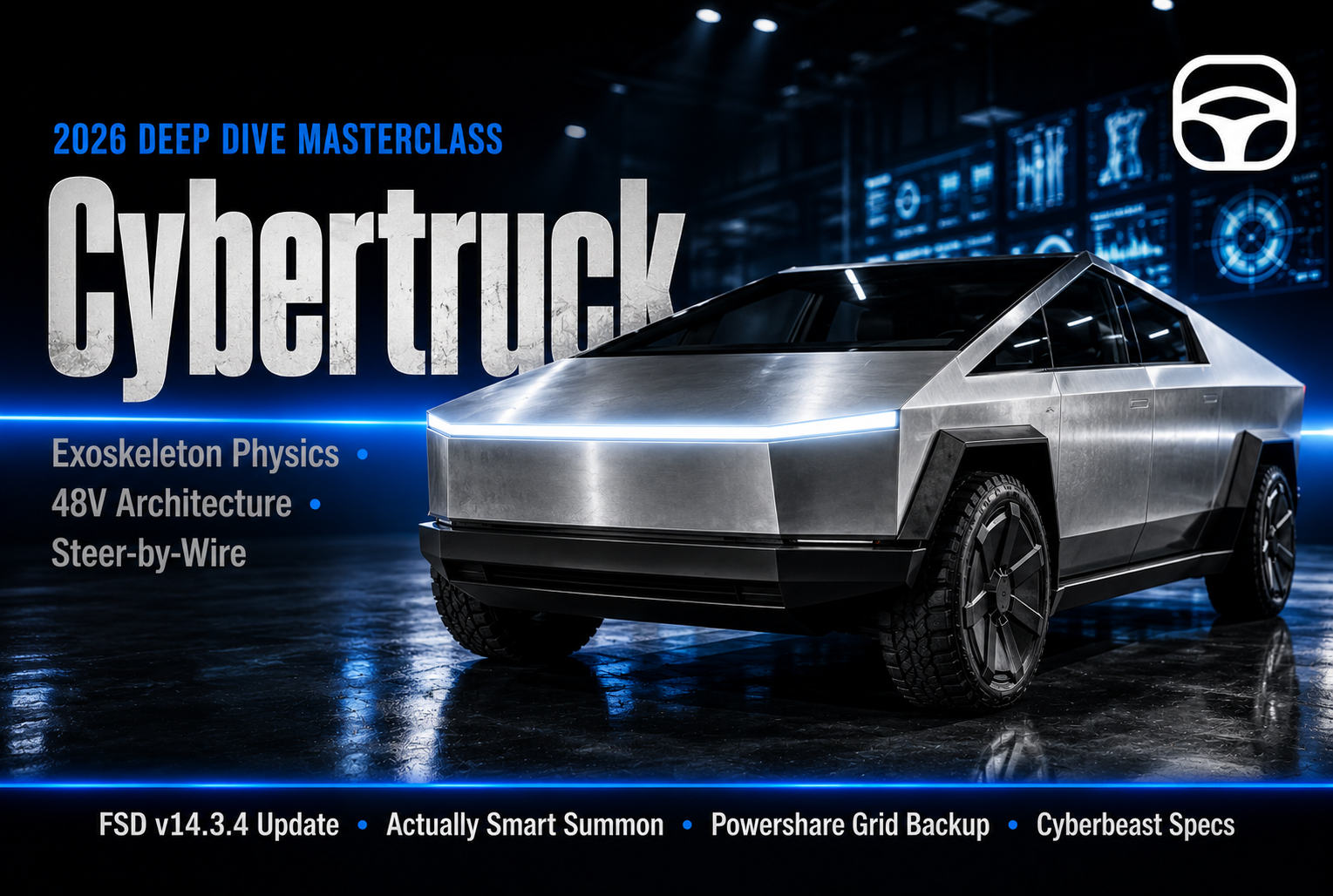
The Ultimate Guide to the 2026 Tesla Cybertruck: The Stainless-Steel Beast That Actually Changed Everything (A Complete Deep Dive)
I will never forget the exact afternoon I saw my first Cybertruck in the wild.
I spend an absolute diagnostic amount of time talking about electric vehicles, analyzing battery degradation curves, and debating the future of automotive design. But absolutely nothing prepares you for the sheer, jarring reality of seeing a Tesla Cybertruck pull up next to you at a red light. It was late afternoon, the sun was hitting the unpainted, brushed stainless-steel panels, and it genuinely looked like a low-poly rendering glitch had somehow escaped from a 1990s video game and materialized in the physical world. I stared. The guy in the Honda Civic next to me stared. People on the sidewalk physically stopped walking to take pictures.
Let’s just be honest about something first: the Tesla Cybertruck is the most polarizing vehicle manufactured in the last century. When Elon Musk debuted the concept back in 2019, complete with the infamous shattered-window presentation, half the world laughed, and the other half immediately placed a $100 pre-order.
For years, critics insisted it was vaporware. They said it would never pass pedestrian crash safety standards. They said mass-producing cold-rolled stainless steel was impossible.
But here we are in 2026. The Cybertruck isn’t just real; it is officially roaming the streets in massive numbers, getting major over-the-air software updates like “Actually Smart Summon,” and fundamentally rewriting the engineering rulebook for how pickup trucks are built.
Because the Cybertruck is surrounded by so much hype, misinformation, and absolute internet chaos, I wanted to create a single, definitive pillar of content for you. No fanboy spin, no relentless hating. This is your complete, deeply human guide to exactly what it is like to live with a 2026 Tesla Cybertruck, the insane engineering witchcraft hidden under the steel plates, the breakdown of the massive new software updates, and whether you should actually drop $80,000 to drive a dystopian spaceship.
Grab a cup of extremely strong coffee, settle in, and let’s break down the most controversial vehicle on the planet.
The Exoskeleton: Why It Looks Like a Refrigerator
To understand the Cybertruck, you have to completely throw away everything you know about how traditional cars are made.
Since the dawn of the automotive industry, trucks have been built using a “body-on-frame” method. You build a heavy steel ladder frame, and then you drop a thin, stamped-steel cabin and cargo bed on top of it. Those exterior body panels are incredibly fragile; if a rogue shopping cart taps your Ford F-150 in the grocery store parking lot, you get a massive, expensive dent.
Tesla completely threw that manufacturing playbook into a literal shredder.
The Cybertruck utilizes an exoskeleton architecture. The exterior skin of the truck is the structural frame. To achieve this, Tesla uses an ultra-hard 30X cold-rolled stainless-steel alloy.
This material is so dense and so incredibly stiff that traditional automotive stamping presses physically cannot bend it. If they try to stamp it into complex, curvy shapes, the steel simply breaks the stamping machine. That is why the Cybertruck consists almost entirely of straight, aggressive, origami-like folds. The design wasn’t just an aesthetic choice by Franz von Holzhausen to look cool; it was an absolute engineering necessity dictated by the physics of the metal.
The Bullet-Resistant Reality
Because the exterior panels are up to 3mm thick, the truck is practically invincible to daily wear and tear. You can hit the doors with a sledgehammer, and the hammer will simply bounce off without leaving a dent. Tesla famously proved the door panels are resistant to 9mm handgun rounds. You don’t have to worry about door dings, rock chips, or hail storms.
Furthermore, there is zero paint on a factory Cybertruck. Because stainless steel doesn’t rust like normal iron, the truck is delivered in a raw, bare-metal finish. If you get a scratch on it, you literally just use a stainless-steel abrasive pad (like you would use on a kitchen sink) to buff it out in your driveway. If you want it to be black, matte green, or white, you have to pay a third-party company to wrap the truck in vinyl.
The 2026 Lineup: Trims, Power, and The Beast
If you placed a reservation years ago and are finally configuring your truck in 2026, the lineup has settled into a very distinct, three-tier hierarchy.
1. The RWD / Long Range (The Entry Level)
Initially promised as a $39,900 pipe dream, the reality of inflation and manufacturing costs hit hard. The current entry-level single-motor Rear-Wheel Drive model (often rebranded and adjusted by Tesla’s shifting pricing) sits around the $60,000 to $69,000 mark.
- Range: Up to 350 miles.
- Performance: 0 to 60 mph in about 6.2 seconds.
- The Vibe: This is for the buyer who simply wants the aesthetic of the Cybertruck without paying for supercar acceleration. It handles daily driving effortlessly, but lacks the mind-bending punch of the upper trims.
2. The Dual Motor All-Wheel Drive (The Sweet Spot)
This is the workhorse. Starting around $79,990, the Dual Motor AWD variant is what the vast majority of buyers are actually taking delivery of right now.
- Power: 600 horsepower and 743 lb-ft of torque.
- Performance: 0 to 60 mph in a blindingly fast 4.1 seconds.
- Towing: 11,000 pounds.
- Range: An EPA-estimated 340 miles.
3. The Cyberbeast (The Supercar Slayer)
If you hate the fact that Lamborghinis and Ferraris exist and you want to embarrass them at traffic lights while carrying 50 bags of mulch in your trunk, you buy the Cyberbeast. Starting around $99,990, this tri-motor monstrosity is an engineering marvel.
- Power: A completely unhinged 845 horsepower and over 1,000 lb-ft of torque.
- Performance: 0 to 60 mph in 2.6 seconds. Let that sink in. This is a 6,900-pound steel triangle that accelerates faster than a Porsche 911 Turbo.
- Range: 320 miles.
The Hidden Engineering Witchcraft: Why the Industry is Panicking
The stainless steel is just a distraction. The real reason legacy automakers like Ford, GM, and Toyota are deeply terrified of the Cybertruck is hidden underneath the metal panels. Tesla completely redesigned the fundamental nervous system of the automobile.
1. The 48-Volt Architecture
For over 70 years, every single car on the road has operated on a 12-volt electrical system. From your headlights to your power windows, everything runs on 12V.
The Cybertruck is the first mass-production vehicle to completely rip out the 12V system and replace it with a 48-volt architecture. Why does this matter? Because of high school physics ($P = V \times I$). By quadrupling the voltage, Tesla can run the exact same amount of power through wires that are four times smaller. This massive reduction in wire thickness saved hundreds of pounds of heavy copper wiring, drastically cutting weight, cost, and manufacturing complexity. Elon Musk even sent a free “How to Build a 48V Car” instruction manual to the CEOs of rival car companies just to flex on them.
2. Steer-by-Wire
When you turn the steering wheel in a Cybertruck, there is no physical steering column connecting your hands to the front wheels. None.
Instead, it uses a fully redundant, aviation-grade Steer-by-Wire system. The steering wheel (which is shaped like a squircle) simply sends a digital electronic signal to electric motors mounted on the steering rack.
Because it is entirely digital, the steering ratio is infinitely variable.
- If you are driving 80 mph on the highway, making a small movement of the wheel barely turns the tires, making the truck feel incredibly stable and safe.
- If you are going 5 mph in a tight parking lot, turning the steering wheel just 170 degrees (less than half a full rotation) will turn the front wheels to full lock. You never have to cross your arms or do the hand-over-hand shuffle ever again.
3. Rear-Wheel Steering
To further improve maneuverability, the Cybertruck features active rear-wheel steering. At low speeds, the rear wheels turn in the opposite direction of the front wheels. Despite being almost 19 feet long, the Cybertruck has a tighter turning radius than a standard Tesla Model S sedan. It is absolute black magic when you experience it for the first time.
2026 Software Updates: The Arrival of “Actually Smart Summon”
Because it is a Tesla, the Cybertruck gets better while it sits in your driveway. While early adopters in 2024 dealt with some missing features, the summer of 2026 has brought absolutely massive over-the-air (OTA) software updates.
With the rollout of FSD v14.3.4 (software version 2026.14.6.10), Cybertruck owners finally gained access to the legendary Actually Smart Summon (ASS).
If it is pouring rain outside, you can stand under the awning of the grocery store, pull out your iPhone, open the Tesla app, and press a button. The Cybertruck will physically turn itself on, pull out of its parking space, navigate around shopping carts and pedestrians, and drive completely autonomously to pick you up at the curb.
The update also introduced deeply refined destination parking UI. As you approach a destination set in the navigation system, a pop-up appears on the massive 18.5-inch center screen asking: “At Destination: Park or Pull Over?” The truck will autonomously find an empty parking space and slot its 80-inch-wide body perfectly between the lines without you ever touching the steering wheel.
Utility: Is it Actually a Good Truck?
It looks like a prop from Blade Runner, but can it actually do truck stuff?
The Vault
Tesla refuses to call the cargo bed a “bed.” They call it the Vault. It is 6 feet long and constructed entirely out of a rugged composite material that doesn’t require a spray-in bed liner.
It features a fully motorized, lockable tonneau cover that rolls up seamlessly behind the rear seats. When it is closed, the bed is completely secure and highly weather-resistant. In fact, closing the tonneau cover actually improves the aerodynamic efficiency of the truck, adding roughly 13 miles of total driving range on a long highway trip.
Powershare: The Rolling Generator
If the power goes out at your house, or if you are running heavy machinery at a remote job site, the Cybertruck is effectively a massive, rolling diesel generator—without the diesel.
The truck features Powershare capabilities, drawing directly from the massive 123 kWh high-voltage battery pack. In the cabin, there are two standard 120V outlets. In the Vault, there are two more 120V outlets, plus a massive 240V, 40-amp outlet (NEMA 14-50). You can literally plug an arc welder, a heavy-duty air compressor, or a massive RV directly into the tailgate.
If you install the proper Tesla Powershare Gateway hardware at your house, the Cybertruck can power your entire home during a grid blackout for over three days. It can even charge another electric vehicle stranded on the side of the road, adding about 30 miles of range per hour to the dead car.
The NACS Charging Advantage
In the EV world, charging infrastructure is everything. Because it is a Tesla, the Cybertruck has native access to the undisputed king of charging: the Supercharger Network.
Utilizing the new high-voltage V4 Superchargers, the Cybertruck can accept peak DC fast-charging speeds. Even if you pull up to an older V3 station, you can add up to 135 miles of range in just 15 minutes of charging. While Rivian and Ford owners are currently buying adapters to use the network, the Cybertruck natively integrates perfectly, automatically pre-conditioning the battery as you navigate to the charger to ensure the fastest possible speeds.
The Verdict: Should You Buy a Cybertruck?
If you are currently holding a reservation or debating jumping into the used market, deciding to buy a Cybertruck is not a logical, spreadsheet-driven decision.
Buy a Rivian R1T or Ford F-150 Lightning if: You want a traditional pickup truck experience. If you want your neighbors to think you are a normal, rational human being. If you want an interior filled with warm wood trim (Rivian) or physical climate control buttons (Ford).
Buy the Tesla Cybertruck if: You want to drive the future.
There is simply nothing else on the road that commands this level of attention. It is loud (visually, not audibly), it is obnoxious, and it is a staggering feat of engineering. The steer-by-wire system and the 48-volt architecture make every other truck on the market feel like an antiquated relic from the 2010s. The stainless-steel body makes you completely immune to the anxieties of scratching your paint. And the sheer, brutal acceleration of the Dual Motor and Cyberbeast trims will leave you laughing hysterically every time you merge onto a highway.
It isn’t just a pickup truck. It is a cultural statement, a technological sledgehammer, and the wildest vehicle currently legally allowed on public roads.
Frequently Asked Questions (FAQs) About the 2026 Tesla Cybertruck
Because the Cybertruck is entirely unique and deeply misunderstood, we have compiled the absolute most common questions regarding the 2026 model year to ensure you have the facts.
Q: Does the Cybertruck actually rust?
A: The massive internet panic about “rusting Cybertrucks” is largely a myth. Because the truck has no clear coat, tiny metallic particles from the road, brake dust, or railway transport can land on the bare stainless steel and oxidize, creating tiny orange specks on the surface of the metal. The truck itself isn’t rusting; the dust on the truck is. It easily wipes away with a stainless-steel cleaner like Bar Keepers Friend.
Q: Can you take the Cybertruck through an automatic car wash?
A: Yes, but Tesla strongly recommends putting the vehicle into “Car Wash Mode” via the center touchscreen first. This rolls up all windows, disables the automatic windshield wipers, locks the charge port, and disables the auto-presenting door handles to ensure the high-pressure brushes don’t damage the electronics. Tesla also recommends touchless car washes to prevent deep scratching of the raw steel.
Q: How do you open the doors? There are no handles.
A: There are no physical, protruding door handles. There is a small, flush electronic button located on the B-pillar and C-pillar just above the window line. You press the button, and the heavy steel door electronically pops open about two inches, allowing you to grab the edge and swing it wide.
Q: What is the true real-world range of the Cybertruck?
A: While the EPA estimate for the Dual Motor AWD is 340 miles, real-world range depends heavily on how you drive. If you are doing 80 mph on the highway in freezing weather with heavy all-terrain tires, expect that range to drop closer to 260-280 miles. If you attach a massive 8,000-pound box trailer to the back, your range will easily be cut in half, dropping to roughly 150 miles per charge.
Q: Does it have Apple CarPlay or Android Auto?
A: No. Like all Tesla vehicles, the Cybertruck utilizes Tesla’s proprietary, vertically integrated software ecosystem on its massive 18.5-inch center screen. However, it does feature built-in Spotify, Apple Music, Netflix, and highly advanced route-planning navigation.
Q: What is the “Actually Smart Summon” feature?
A: Released in software update version 2026.14.6.10 (FSD v14.3.4), Actually Smart Summon allows the Cybertruck to autonomously navigate through a complex parking lot to pick you up at your exact GPS location using the Tesla app on your smartphone, completely avoiding pedestrians and other vehicles.
Q: Is the Cybertruck bulletproof?
A: The stainless-steel door panels are highly bullet-resistant. Tesla has demonstrated them successfully stopping multiple rounds from a 9mm handgun and a Tommy gun. However, the standard armored glass windows are not bulletproof; they are designed to be “shatter-resistant” against rocks or blunt impacts.
Q: Can it actually off-road?
A: Yes. The Cybertruck features a highly advanced adaptive air suspension system that can provide up to 16 inches of ground clearance in “Extract Mode.” Combined with the locking differentials in the AWD and Cyberbeast models, a completely flat underbody, and zero low-hanging exhaust pipes, it is highly capable on trails and rock-crawling scenarios.





Leave a Reply