

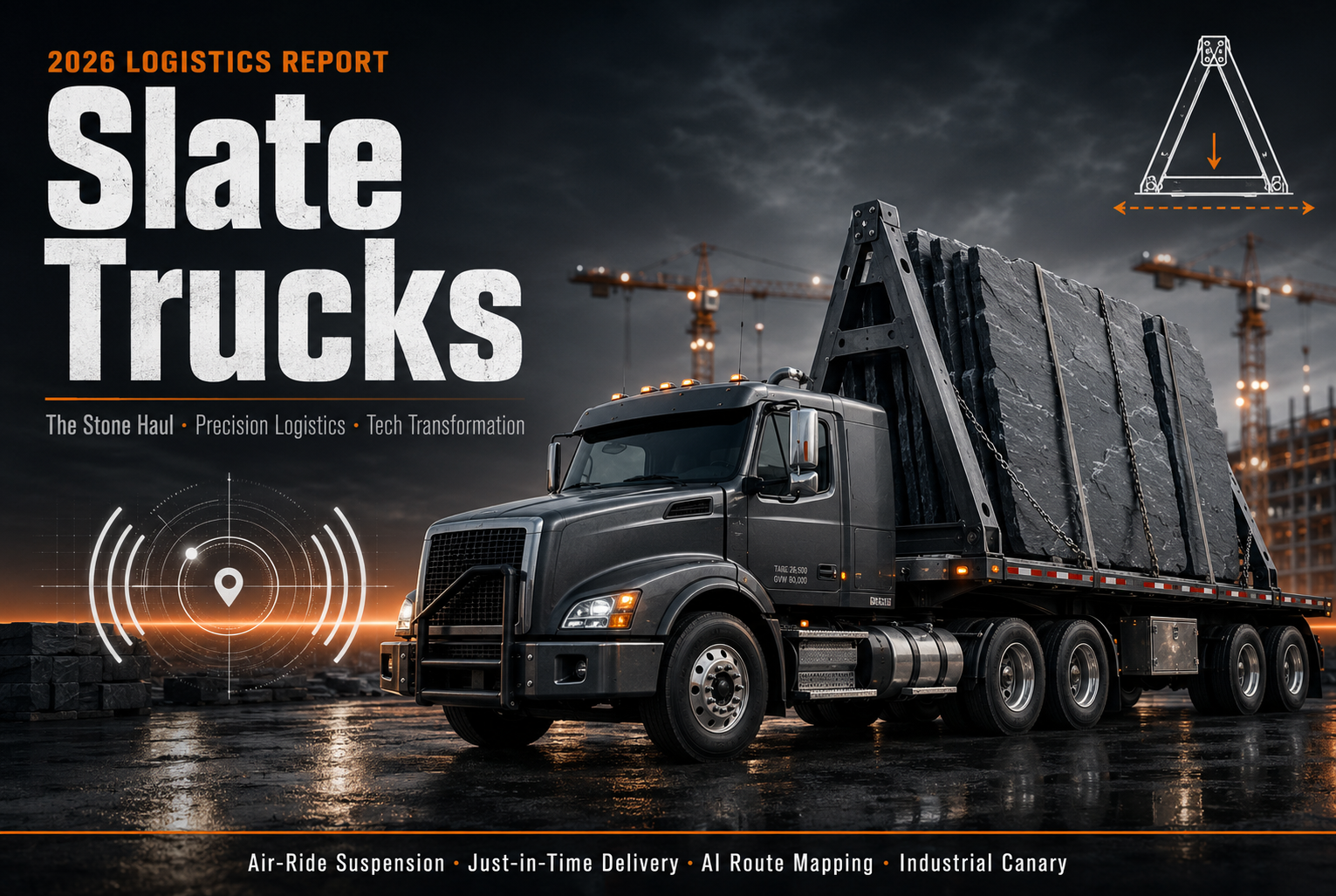
The Slate Truck Revolution: Why the Construction Industry is Quietly Rebranding
I vividly remember the exact afternoon I stood on a job site in Northern Virginia, watching a specialized transport truck pull into the mud-slicked entrance.
I dedicate a borderline unhealthy amount of time to analyzing heavy machinery logistics, supply chain efficiency, and the slow, grinding evolution of the construction industry. Most people look at a construction site and see a blur of activity. I look at it and see a massive, multi-billion-dollar puzzle of timing, inventory, and material movement. On that day, watching the crew unload pallets of heavy, brittle slate, I realized how much of our modern infrastructure hinges on the most overlooked workhorses of the road: the slate truck.
For years, the “slate truck”—or more accurately, the flatbed transport rigged specifically for natural stone and roofing materials—was just a footnote in the heavy haulage world. It was a utilitarian box on wheels. But in 2026, the game has changed. With the rise of high-end, sustainable architectural trends and the increasing precision required for luxury commercial projects, the humble slate transporter has become the centerpiece of a high-stakes, technology-driven logistics chain.
Let’s be completely real for a second: you aren’t reading this because you’re a trucking enthusiast. You’re reading this because you want to understand the invisible infrastructure that fuels our world. You’re reading this because you want to know why the cost of your home renovation is tied to the efficiency of these specific rigs, or why construction project managers are losing sleep over “slate logistics.”
Because the world of stone transportation is often shrouded in industry-specific jargon and outdated logistics manuals, I wanted to create a single, definitive guide for you. No corporate industry reports, no gatekeeping from logistics companies, and no fluff. This is your complete, deeply human guide to exactly how the slate transport industry works in 2026, why the technology behind these trucks is shifting toward automation and precision, and how this quiet corner of the transit world is actually mirroring the health of the entire global construction market.
Grab a coffee, settle in, and let’s break down why the “slate truck” is suddenly the most important vehicle on the job site.
Part 1: The Anatomy of a High-Stakes Haul
If you’ve never seen a slate truck up close, you’re missing out on a masterclass in tension and balance. Slate is heavy. It’s brittle. And it’s incredibly expensive. Transporting it isn’t just about getting from Point A to Point B; it’s about managing a ticking time bomb of structural integrity.
The Physics of the “Stone Slab”
When you load slate onto a transport deck, you aren’t loading a pile of wood. You are loading thousands of pounds of compressed metamorphic rock that acts like glass under the right conditions. One sharp bump, one improper tensioning of a strap, and you’re turning a $20,000 shipment into $20,000 worth of driveway gravel.
The modern slate truck—the ones you see on the road in mid-2026—isn’t just a flatbed. They are heavily modified, often featuring:
- Air-Ride Suspension Systems: This is no longer an “extra.” It’s a requirement. To keep the stone from fracturing during transit, the suspension has to absorb the vibration before it ever reaches the cargo bed.
- A-Frame Racking: This is the industry standard for 2026. Instead of laying slabs flat, the modern slate truck uses an “A-frame” rack that leans the heavy stone at a specific, engineered angle. This keeps the center of gravity low and ensures that the structural load is distributed across the sturdiest part of the slate.
Part 2: The “Just-in-Time” Logistics Shift
Why does this matter in 2026? Because the construction industry has entered the “Just-in-Time” era.
Five years ago, a construction site would take an entire shipment of slate at once, dump it in a corner of the lot, and let it sit there for weeks. That’s a nightmare. It takes up space, it risks damage, and it ties up thousands of dollars in capital.
Today, the “slate truck” logistics model has flipped. Now, project managers use real-time GPS tracking integrated into the truck’s onboard telematics. They demand that the slate arrives exactly when the masons are ready to install it. If the truck is two hours late, the crew stands around doing nothing, burning through thousands of dollars in labor costs. If it’s two hours early, it sits in the way of the concrete mixers.
This shift has turned the slate transport driver from a “delivery person” into a “logistics architect.” The driver is now expected to use real-time routing apps that account for bridge height clearances (essential for heavy slate loads) and live traffic congestion.
Part 3: The Tech-Stack of 2026
If you peek into the cab of a state-of-the-art slate transport in 2026, you won’t just see a CB radio. You’ll see a dashboard that looks more like a flight deck.
AI-Driven Route Optimization
The modern transporter is feeding data into an AI model that calculates the safest path for heavy loads. Why? Because slate trucks are notorious for their “tipping profile.” A heavy, uneven load of stone on a sharp, banked turn is a recipe for disaster.
The software in these trucks analyzes the weight distribution of the current haul and cross-references it with the local topography. If a route is too steep or the curves are too sharp for a specific load-weight ratio, the system flags it and suggests a safer, albeit slightly longer, path. It’s about saving the load, not just saving time.
The Rise of Electric-Assist Bedding
In late 2025 and moving into 2026, we’ve seen the introduction of the first battery-electric assist systems for heavy stone unloading. Slate is incredibly dense; it’s a nightmare for manual lifting. New transport models are integrating hydraulic, battery-powered arms directly into the A-frame racking. This means a driver can now unload a multi-ton shipment with the precision of a jeweler, minimizing the risk of a corner-chip—the bane of every slate supplier’s existence.
Part 4: The Human Element (The Driver’s Reality)
I’ve spent plenty of time chatting with these guys in diners off the interstate. They are the salt of the earth, and they are incredibly tired of the “automated truck” headlines that suggest their jobs are going to vanish tomorrow.
The job of a slate truck driver is a human job. A robot can drive a straight line. A robot cannot look at a load of slate that has shifted two degrees to the left during a heavy rainstorm and decide exactly how much tension to release on a strap to stabilize it without causing the whole thing to crack.
That is an intuitive, physical skill that you learn over decades. When we talk about “logistics,” we often lose sight of the fact that this is a highly skilled trade. Being a professional stone hauler requires an understanding of physics, a deep knowledge of road conditions, and the mechanical empathy to know exactly how hard you can push your rig before you hit the limit.
Part 5: Economic Indicators and the Slate Market
Why should you care about the business of slate trucks? Because it’s a canary in the coal mine for the economy.
When you see a lot of slate trucks on the road, it means two things:
- Commercial construction is booming. Slate is almost exclusively a luxury commercial or high-end residential material. When the market is sluggish, architects switch to cheaper synthetic siding. When you see slate, you see money.
- Infrastructure is active. These trucks are moving materials for monuments, government buildings, and luxury urban centers. They are the silent movers of our civilization’s vanity projects.
Watching the trends for this specific niche market in 2026 gives us a clearer picture of the construction sector than most of the reports on Wall Street. It’s granular, it’s physical, and it’s unvarnished.
Part 6: Navigating the Future of the Slate Truck
As we head into the second half of 2026, the industry is bracing for a massive consolidation. Smaller, owner-operator firms are struggling to keep up with the tech requirements of big, multi-billion-dollar commercial contracts. To work on the “big jobs” now, you need the telematics, the air-ride, and the digital compliance logs.
For the driver, this is both a curse and a blessing. It’s harder to get into the business, but the professionals who are in it are more valuable than ever before.
If you are thinking of getting into the specialized haulage game, don’t look at the generic long-haul options. Look at the specialized niches. Look at the material that takes real skill to move. Stone, glass, high-end electronics—that’s where the industry is going. The “dumb haul” is a race to the bottom, but the “smart haul” of specialized materials? That’s where the future is.
Part 7: Final Thoughts (The Invisible Workhorse)
The next time you’re driving down the highway and you see a flatbed truck with an A-frame rack carrying slabs of grey-black stone, don’t just see a truck. See a piece of engineering. See a piece of a high-end luxury hotel or a government monument being built across the country. See the driver who spent three hours meticulously tensioning those straps so that not a single piece would break.
The slate truck is an invisible workhorse, but it is one that holds up our world. It’s messy, it’s dangerous, and it’s absolutely essential. And in 2026, it’s more advanced and more important than it has ever been.
So, here’s to the haulers. Here’s to the stone. And here’s to the people who ensure that, despite the weight and the risk, it all makes it there in one piece.
Frequently Asked Questions (FAQs)
Q: Is “slate truck” a specific brand or type of vehicle? A: No, it’s a colloquial term used in the construction and logistics industry to describe flatbed trucks rigged with A-frame racking specifically for transporting natural stone and large-format roofing slates.
Q: Why is slate so difficult to transport? A: Slate is a metamorphic rock that is highly prone to fracturing along its grain. It isn’t just about weight; it’s about structural vulnerability. If you transport it flat without proper support, it will crack under its own weight or the slightest vibration.
Q: What is the biggest innovation in these trucks in 2026? A: Telematics and AI-driven route optimization. Because slate is such a high-value and high-risk cargo, the ability to monitor the load’s vibration and the truck’s exact stress level on turns is revolutionizing how these companies bid for contracts.
Q: Can these trucks be automated? A: We are nowhere near fully automated slate transport. The load is too dynamic, and the risks (both to the driver and the expensive cargo) are too high for a machine to handle. This remains a deeply human-driven industry.
Q: Why has the cost of slate transport gone up? A: It’s a combination of rising fuel prices, the higher cost of “high-tech” trucks (like those with air-ride and hydraulic unloading systems), and the increasing demand for specialized, skilled drivers who have the insurance-approved experience to handle natural stone.
Q: What does an “A-frame” rack do? A: It allows the stone to lean at a stable angle. By leaning the slabs rather than lying them flat, you distribute the weight and minimize the chance of the slate cracking from road bumps or vibrations.
Q: Is the slate industry dying? A: Far from it. While synthetic alternatives exist, high-end commercial architecture and luxury residential construction are seeing a massive resurgence in the use of natural, sustainable stone. Natural slate is currently having a “renaissance” as a green, durable building material.
Q: Can a regular flatbed driver haul slate? A: Theoretically, yes, but no construction firm would hire them. Hauling stone is a specialized skill. It requires specific insurance certifications and, more importantly, the “mechanical feel” to secure a load that is both brittle and heavy. It’s one of the highest-rated categories of flatbed haulage.
Q: What is the “Just-in-Time” logistics model? A: It’s a strategy where materials arrive on the job site at the exact moment they are needed. It eliminates the need for large storage yards on site and reduces the risk of material damage. However, it requires a high degree of precision in truck timing.
Q: Where is most of the slate coming from in 2026? A: Natural slate is still being sourced globally, with major high-end quarries in Spain, Wales, and Vermont. The logistical challenge in 2026 is moving this stone from these remote quarries to the high-density urban job sites efficiently.












Leave a Reply