
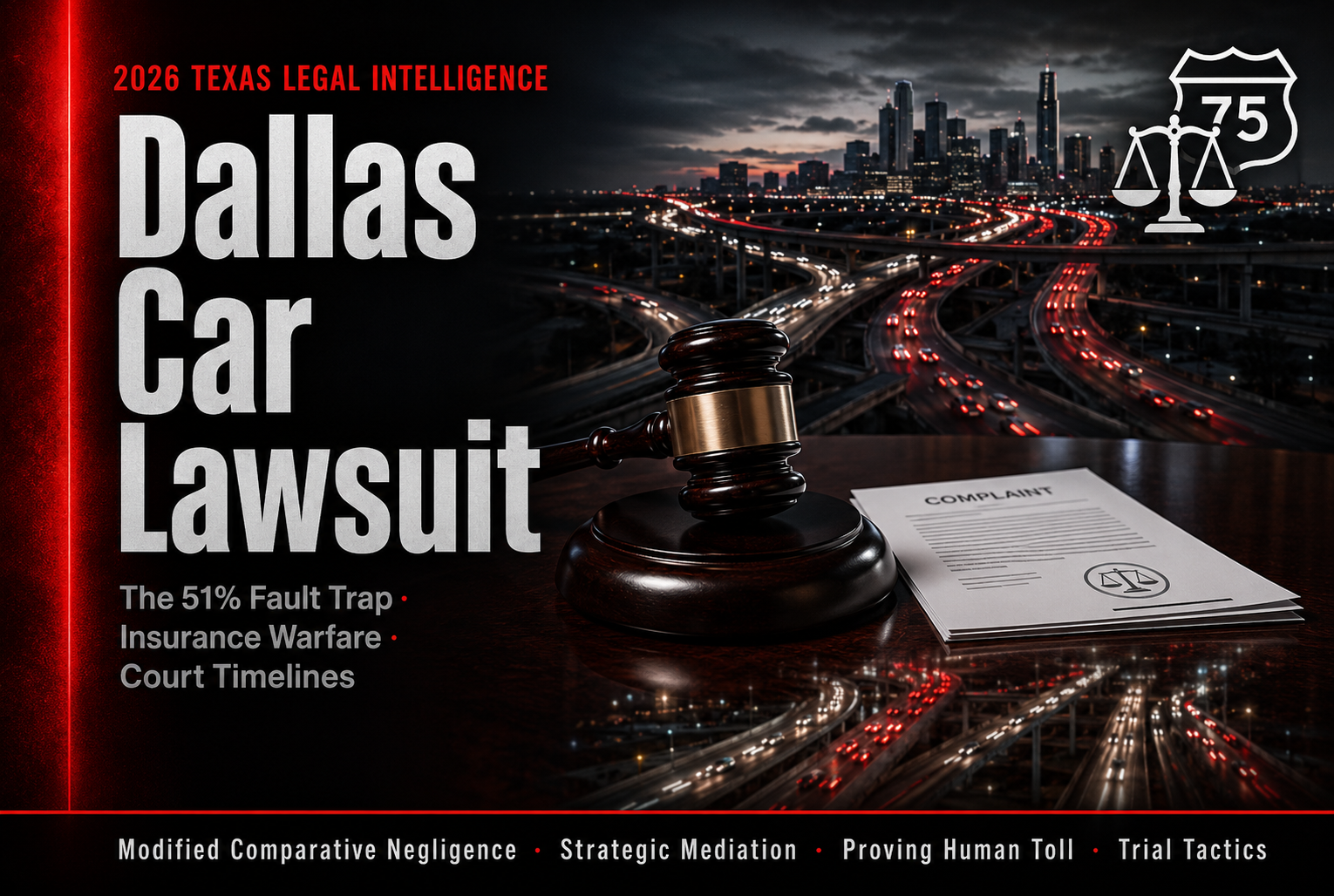
The Dallas Highway Nightmare: Your Uncensored Guide to Surviving a Dallas Automobile Accident Lawsuit in 2026
I vividly remember the exact afternoon I had to sit in a sterile, overly air-conditioned hospital room near the Medical District with a family member who had just been rear-ended on US-75.
I spend a borderline unhealthy amount of time deep-diving into the mechanics of personal injury law, tearing apart the tactics used by massive insurance conglomerates, and trying to stay two steps ahead of a legal system that often feels like it was designed to crush the average person. But when you are sitting in a trauma center, listening to the beep of a heart monitor, and watching someone you love panic about how they are going to pay their rent because their car is a crumpled cube of metal… all that theoretical legal knowledge suddenly gets very real, very fast.
Let’s just be completely real for a second: driving in Dallas is a contact sport. Between the endless construction on I-35E, the terrifying merging lanes of the High Five Interchange, and the absolute chaos of the Dallas North Tollway during rush hour, our roads are high-pressure environments. We all know the unspoken rule of DFW traffic—you have to drive defensively, aggressively, and prayerfully all at the same time.
But what happens when your luck runs out? What happens when a distracted driver texting their way down LBJ Freeway slams into your bumper at 70 miles per hour?
If you are currently sitting at your kitchen table, staring at a stack of mounting medical bills, dealing with a neck that won’t stop aching, and Googling the phrase “Dallas automobile accident lawsuit,” you are probably standing at the edge of a massive, bureaucratic cliff. You’re hearing terrifying legal terms like “modified comparative negligence,” “statute of limitations,” and “insurance bad faith.” Your phone won’t stop ringing with adjusters who sound suspiciously friendly but are desperately trying to get you to sign away your rights for pennies on the dollar.
Because the reality of navigating the Texas civil justice system is so overwhelming, and because the internet is flooded with hollow, billboard-lawyer marketing fluff, I wanted to create a single, definitive guide for you. No corporate legal gobbledygook. No condescending advice. No sugar-coating the truth.
This is your complete, deeply human, and fiercely uncensored guide to exactly what happens when you file a Dallas automobile accident lawsuit in 2026. We are going to break down the psychological warfare waged by insurance companies, the brutal math of Texas liability laws, the hidden evidence you need to secure right this second, and the step-by-step reality of taking a car crash case all the way to a Dallas County courtroom.
Grab a coffee, take a deep breath, and let’s pull back the curtain on the fight for your life, your health, and your financial future.
Part 1: The Concrete Jungle (Why Dallas Crashes Are Different)
To truly understand how a Dallas automobile accident lawsuit works, you first have to understand the specific environment of the DFW metroplex. A car crash in a quiet suburb of another state is a completely different beast than a high-speed collision on a Texas superhighway.
The Speed and Scale of DFW
Everything is bigger in Texas, and unfortunately, that includes the speed and severity of our car wrecks. Dallas is dominated by massive, multi-lane highways with speed limits that are often treated as mere suggestions. When an accident happens on the George Bush Turnpike or the loop around downtown, it rarely involves just a tapped bumper. It involves massive kinetic energy, multiple vehicles, and devastating physical injuries.
Furthermore, Dallas is an enormous logistical hub. This means our highways are absolutely choked with commercial 18-wheelers, delivery vans, and heavy-duty contractor trucks. Getting hit by a 4,000-pound sedan is bad; getting sideswiped by an 80,000-pound commercial semi-truck is a life-altering catastrophe. The sheer volume of heavy commercial traffic in Dallas fundamentally changes the landscape of personal injury lawsuits, because commercial policies carry massive limits and corporations fight tooth and nail to protect their bottom line.
The “Venue” Factor
In the legal world, where you file your lawsuit matters just as much as why you file it. This is called “venue.” If your accident happened in Dallas County, you are dealing with a jury pool that is historically a bit more diverse and sometimes more sympathetic to plaintiffs than the highly conservative jury pools you might find in neighboring Collin or Denton counties. Insurance companies know this. Their defense attorneys map out exactly which courthouse your case will land in, and they adjust their settlement offers based on the political and social makeup of the local judges and juries. It’s a game of localized chess, and you are the king on the board.
Part 2: The Brutal Math of Texas Law (The 51% Trap)
If there is only one section of this entire guide that you read, make it this one. The fate of your entire Dallas automobile accident lawsuit hinges on a specific Texas law called Modified Comparative Negligence (often referred to as proportionate responsibility).
This is the hidden trap door of the Texas legal system.
How Proportionate Responsibility Works
In some states, if someone hits you, their insurance pays for your damages. It’s simple. Texas is not simple. In Texas, when a lawsuit goes to trial, a jury is asked to look at the accident and assign a percentage of blame to every single person involved, including you, until it adds up to 100%.
Let’s say you were speeding slightly (going 70 in a 65 zone) on Central Expressway, and someone blows through a yield sign on an on-ramp and T-bones you. The jury might say the other driver is 80% at fault for ignoring the sign, but you are 20% at fault because you were speeding.
If your total damages (medical bills, lost wages, pain and suffering) equal $100,000, you will not get $100,000. The court will subtract your 20% of the blame, and you will walk away with $80,000.
The 51% Death Blow
Here is where it gets terrifying. Under Texas law, if you are found to be more than 50% at fault for the accident, you are legally barred from recovering a single dime.
If the jury decides you are 51% responsible and the other guy is 49% responsible? You get zero. Nothing. You are left to pay your own hospital bills and fix your own car.
This law is exactly why insurance adjusters are so aggressive the minute you report a claim. When they call you the day after the wreck, acting like your best friend and asking “just a few quick questions” to get your recorded statement, they are laying a trap. They are desperately trying to get you to admit to anything—looking away for a second, adjusting the radio, braking a little late—that they can use to push your percentage of fault over that magical 51% line.
They don’t have to prove their client was innocent. They just have to prove you were slightly more guilty.
Part 3: The Invisible War (You vs. The Insurance Adjuster)
You pay your insurance premiums every month. You follow the law. You assume that when disaster strikes, the safety net you bought will catch you.
I need you to throw that assumption out the window right now. Insurance companies are massive, publicly traded corporations. Their primary fiduciary duty is not to your health; it is to their shareholders’ profit margins. Every dollar they pay you for your injuries is a dollar they lose from their bottom line.
When you initiate a Dallas automobile accident lawsuit, you are effectively declaring war on a billion-dollar machine designed to exhaust you into submission.
Tactics of the Adjuster
- The Fast, Lowball Offer: Within a week or two of the crash, you might get an offer. It might be $2,000 or $5,000, plus they promise to cover your immediate hospital visit. To a person who just missed a week of work and needs a rental car, this looks like a lifeline. It’s not. It’s an anchor. Once you sign that check, you sign a “release of liability.” If you discover three months later that you have a herniated disc requiring a $40,000 spinal fusion surgery, the insurance company will simply ignore your calls. You signed away your rights. Never take the first offer.
- The Delay Game: If they can’t get you to accept a lowball offer, they switch to the delay strategy. They will ask for medical records from ten years ago. They will claim they haven’t received the police report. They will lose your paperwork. They know that you are likely hurting financially, burning through your savings while you can’t work. They are betting that if they starve you out long enough, you will eventually accept a fraction of what your case is worth just to stop the bleeding.
- The “Pre-Existing Condition” Myth: If you have ever been to a chiropractor, ever complained of back pain to your primary care doctor, or ever had a sports injury in college, the insurance company will find it. They will argue that the violent car crash didn’t cause your back pain; your high school football injury from a decade ago caused it.
This is why having an attorney is not a luxury in a Dallas car crash case; it is a fundamental necessity. You are bringing a knife to a gunfight if you try to negotiate with an insurance defense team on your own.
Part 4: The Anatomy of a Lawsuit (What Actually Happens)
People hear the word “lawsuit” and immediately picture themselves sitting on a witness stand in a dramatic courtroom, screaming “You can’t handle the truth!” at a judge.
The reality of a civil lawsuit in Dallas is much slower, much more methodical, and largely happens behind closed doors. Here is the actual timeline of how a Dallas automobile accident lawsuit unfolds.
Phase 1: The Investigation and “Maximum Medical Improvement”
Before your lawyer even files a piece of paper with the court, they have to figure out how badly you are hurt. You cannot settle a case while you are still undergoing major treatments. Why? Because you don’t know the final bill yet.
Your legal team will wait until your doctors declare you have reached “Maximum Medical Improvement” (MMI). This means you have recovered as much as you ever will. Once you hit MMI, your lawyer gathers every single bill, every diagnostic scan, and every police report, and builds a “Demand Package.” This is a massive binder sent to the insurance company that essentially says, “Here is exactly how much you owe us, and here is the proof.”
Phase 2: Filing the Petition
If the insurance company rejects the demand (which they almost always do initially), the gloves come off. Your attorney files an “Original Petition” in a Dallas County or surrounding county civil court. This is the official start of the lawsuit. The at-fault driver (the defendant) is officially served with papers, and their insurance company hires a defense firm to fight you.
Phase 3: The Discovery Phase (The Grinding Gears)
This is the longest, most frustrating part of the lawsuit. Both sides are legally required to share evidence.
- Interrogatories: You will have to answer pages and pages of written questions under oath.
- Document Production: They will demand your medical history, your employment records, and your tax returns to verify your lost wages.
- The Deposition: This is the big one. You will sit in a conference room with your lawyer and the insurance company’s defense lawyer. The defense lawyer will interrogate you for hours under oath. They will ask about the crash, your pain, your history, and your daily life. They are looking for inconsistencies. They are looking to see if you get angry. They are testing how you will perform in front of a jury.
Phase 4: Mediation
In Texas, judges almost always order both parties to attend mediation before they will allow a trial to begin. You, your lawyer, the defense lawyer, and a neutral “mediator” (usually a retired judge) will sit in an office building. You go into one room, the defense goes into another, and the mediator shuttles back and forth trying to find a financial middle ground. A huge majority of Dallas automobile accident lawsuits end right here. If a settlement is reached, the lawsuit is over.
Phase 5: Trial
If mediation fails because the insurance company is being unreasonable, you go to trial. This means selecting a jury of twelve Dallas County residents, presenting witnesses, bringing in medical experts to testify about your spine or brain injury, and leaving your fate in the hands of the public. Trials are expensive, unpredictable, and highly stressful, but sometimes they are the only way to force a massive corporation to pay what is fair.
Part 5: Valuing the Human Toll (What Are You Suing For?)
When you file a lawsuit, you aren’t just pulling a random number out of thin air. Texas law allows you to seek specific types of “damages” to make you whole. Understanding how these are calculated is the key to understanding your case.
1. Economic Damages (The Hard Math)
These are the measurable, out-of-pocket losses.
- Past and Future Medical Bills: This includes the ambulance ride, the ER visit, surgeries, physical therapy, and any future surgeries a doctor says you will need in ten years because of this crash.
- Lost Wages and Earning Capacity: If you missed three months of work, they owe you that salary. If your injuries are so severe that you can no longer work in your chosen profession (e.g., a construction worker who shatters his spine), the lawsuit seeks to recover the lifetime of income you just lost.
- Property Damage: The cost to replace or repair your vehicle.
2. Non-Economic Damages (The Human Cost)
This is the battleground. How do you put a price tag on a ruined life?
- Pain and Suffering: The physical agony of surgeries and chronic pain.
- Mental Anguish: The PTSD of the crash, the anxiety of getting back in a car, the depression of losing your mobility.
- Loss of Consortium: If your injuries have severely damaged your relationship with your spouse (loss of companionship, intimacy, or ability to help run a household).
To win non-economic damages in a Dallas courtroom in 2026, you cannot just complain. You must paint a vivid picture. You have to show the jury that before the crash, you ran 5Ks every weekend and played on the floor with your kids, and now you can barely stand long enough to wash the dishes. The lawsuit is about translating your physical loss into a financial penalty.
Part 6: The “First 72 Hours” Survival Guide
If you are reading this while standing on the shoulder of the LBJ Freeway waiting for a tow truck, or sitting in an urgent care waiting room the day after a crash, the actions you take right now will make or break your future lawsuit.
Here is your battle plan:
Step 1: Do Not Say “I’m Fine” Adrenaline masks pain. You might feel okay at the scene, only to wake up the next morning unable to turn your neck. If the police or EMTs ask if you are hurt, the only correct answer is, “I am shaken up and I need to be evaluated by a doctor.” Never admit you are uninjured at the scene.
Step 2: Become a Crime Scene Photographer Do not rely on the Dallas Police Department to take photos. They are busy trying to clear the highway to prevent a secondary pile-up. Take out your phone and photograph everything. The damage to your car, the damage to their car, the license plates, the skid marks on the road, and the position of the vehicles before they are moved to the shoulder.
Step 3: Hunt Down the Witnesses In a city of millions, witnesses evaporate into the ether the second they drive away. If someone pulls over to make sure you are okay, physically hand them your phone and ask them to type in their name and number. A single independent witness saying “the other guy ran the red light” is worth its weight in gold in a lawsuit.
Step 4: Go to the Doctor IMMEDIATELY Even if you think it’s just a minor ache, go to an ER or an urgent care clinic within 24 hours. The insurance company’s favorite defense is the “gap in treatment.” If you wait two weeks to see a doctor because you were hoping the pain would just go away, the defense attorney will stand in front of a jury and say, “If they were really hurt in this crash, why didn’t they see a doctor for fourteen days?” Go immediately. Create the medical baseline.
Step 5: Shut Down Your Social Media Insurance defense investigators will immediately look up your Facebook, Instagram, and TikTok. If you claim you have a devastating back injury, but you post a photo of yourself smiling at a Dallas Cowboys tailgate party three weeks later, they will blow that photo up to poster size and show it to the jury. Go entirely dark on social media until your case is closed.
Part 7: Choosing the Right Warrior for the Arena
Dallas is saturated with personal injury lawyers. You can’t drive down I-30 without seeing fifty billboards promising you millions of dollars. But choosing the wrong lawyer will tank your Dallas automobile accident lawsuit before it even begins.
When you are interviewing law firms (and you should interview them), ask these brutal questions:
- “What is your trial record?” If the lawyer stammers, look elsewhere. You need a trial lawyer, not a settlement mill. Insurance companies track which lawyers actually take cases to a verdict and which ones always fold at mediation. If your lawyer has a reputation for never going to court, the insurance company will never offer top dollar.
- “Who will actually handle my case?” Many of the “billboard lawyers” run massive call centers. You hire the guy on the TV, but your case is handed off to a junior associate who passed the bar exam three months ago, and you can never get them on the phone. Demand to know exactly who will be returning your calls.
- “How are case expenses handled?” Personal injury lawyers work on a contingency fee (usually taking 33% to 40% of the settlement). But lawsuits cost money to run—filing fees, paying doctors to testify, hiring accident reconstruction experts. Ensure your contract clearly states that if you lose the case, you are not on the hook for those out-of-pocket expenses.
Final Thoughts: Taking Your Life Back
At the end of the day, a Dallas automobile accident lawsuit is an exhausting, emotional, and grueling marathon. It is not a lottery ticket. It is not a quick, painless payday. It is a deeply adversarial fight to be made “whole” again after a devastating, life-altering event that you did not ask for.
When you get hit by a careless driver on the Dallas North Tollway, you lose your physical health, your peace of mind, and your financial security in an instant. The legal system, for all its terrifying complexity, delays, and frustrations, is the only weapon you have to take those things back.
Do not let an insurance adjuster treat you like a line item on a spreadsheet. Do not let the intimidation of the legal process stop you from demanding exactly what you are owed. You have rights, you have a voice, and you have the ability to hold the responsible party accountable for shattering your daily life.
Stay fiercely vigilant, keep meticulous records, trust your gut, and most importantly, prioritize your physical recovery above all else. The legal system will still be grinding away in a month; your health, however, is a fragile, non-renewable resource. Choose your legal team wisely, brace yourself for the long haul, and never settle for less than what your life is truly worth.
Frequently Asked Questions (FAQs) About Dallas Automobile Accident Lawsuits
Because the Texas legal system is notoriously complex, we have compiled the absolute most common questions victims ask when facing a lawsuit in the DFW area.
Q: How much is my Dallas car accident lawsuit actually worth? A: There is absolutely no “magic calculator.” The value of your lawsuit depends on three volatile factors: the severity and permanence of your physical injuries, the maximum limit of the at-fault driver’s insurance policy, and how clearly you can prove they were at fault. Be deeply suspicious of any lawyer who promises you a specific dollar amount during your first phone call.
Q: Do I really need to file a lawsuit, or can I just settle with the insurance company myself? A: While the majority of cases do settle without ever seeing a courtroom, filing a formal lawsuit is often the only leverage you have to force a multi-billion-dollar insurance company to take your claim seriously. Without the looming threat of a jury trial and a judge’s verdict, an insurance company has absolutely no incentive to offer you anything close to a fair settlement.
Q: What if the police report says I was partially at fault for the crash? A: Do not panic. A police report is just an officer’s opinion; it is not the final word of law. Under Texas’s “modified comparative negligence” rule, you can still sue and recover financial damages as long as you are 50% or less at fault for the accident. Your final payout will simply be reduced by your assigned percentage of the blame.
Q: What is the statute of limitations for a car accident in Texas? A: Generally speaking, you have exactly two years from the specific date of the accident to file a formal lawsuit in the state of Texas. If you miss this deadline by even a single day, the courts will permanently bar you from seeking compensation. Do not wait until the 23rd month to start looking for a lawyer.
Q: Will I have to stand up in a courtroom and testify? A: It is highly unlikely, but not impossible. Over 90% of personal injury lawsuits reach a settlement agreement during the discovery phase or at mediation long before a trial ever happens. However, you should always operate under the assumption that your case could go to trial, which keeps the pressure on the defense to settle fairly.
Q: Should I give a recorded statement to the other driver’s insurance company? A: Absolutely not. Never, under any circumstances, give a recorded statement to the opposing insurance adjuster without your lawyer present. They are highly trained interrogators whose sole job is to trick you into phrasing something poorly so they can use the recording against you later to prove you were at fault or not truly injured.
Q: What happens if the driver who hit me doesn’t have any car insurance? A: This is a massive problem in Dallas. If the at-fault driver is uninsured, your lawyer will file a claim against your own “Uninsured/Underinsured Motorist” (UM/UIM) coverage, assuming you opted into it on your policy. If you do not have UM/UIM coverage, you may have to attempt to sue the driver personally, which is incredibly difficult if they have no personal assets to seize.
Q: How do I pay my medical bills while I am waiting for the lawsuit to settle? A: If you have health insurance, use it. Your health insurance will cover your care, and your lawyer will later reimburse them out of your final settlement (this is called subrogation). If you do not have health insurance, a good Dallas personal injury lawyer can often connect you with doctors and surgeons who will treat you under a “Letter of Protection” (LOP), which means the doctor agrees to wait to be paid until your lawsuit is won.
Q: Is it expensive to hire a high-quality Dallas personal injury lawyer? A: No. Almost all reputable personal injury attorneys in Dallas work strictly on a “contingency fee” basis. This means they do not charge you a single penny upfront, nor do they charge an hourly rate. They take on all the financial risk of building the case, and they only get paid a percentage of the final settlement or jury verdict. If you lose the lawsuit, you owe them nothing for their time.
Q: How long will this entire lawsuit process take? A: It is a marathon, not a sprint. A relatively simple case with clear liability might settle in 6 to 12 months. However, a complex case involving catastrophic injuries, disputed fault, and stubborn insurance companies can easily drag on for 18 to 24 months or more as it navigates the backlogged Dallas County court system. Patience is essential.












Leave a Reply