

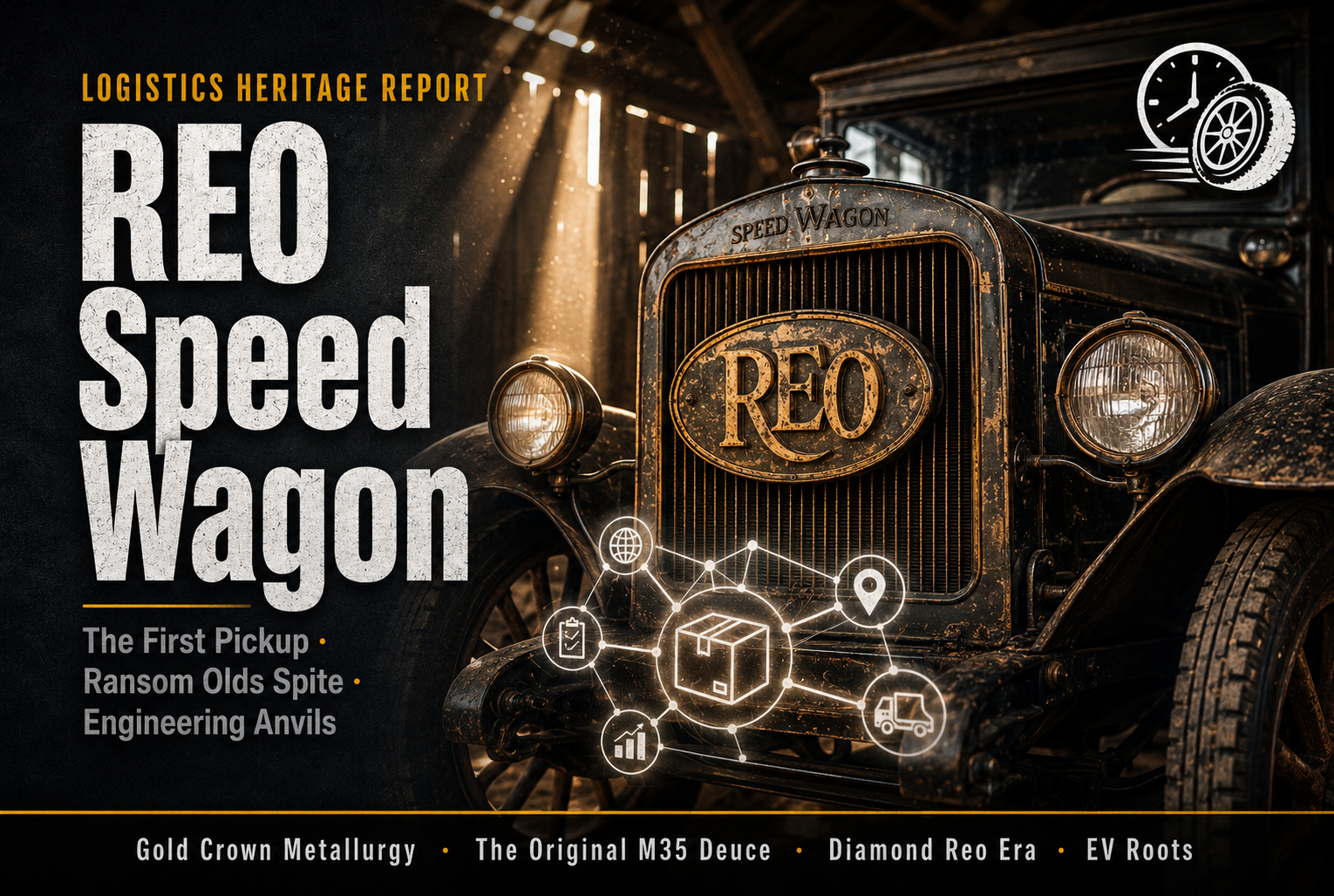
The Forgotten Grandfather of the Modern Pickup: Why REO Trucks Changed the World of Tech and Logistics Forever
I vividly remember the exact afternoon I was standing in a dusty, dimly lit barn in upstate New York, staring at the rusted-out front grille of a 1920s vehicle that looked like it had survived a war.
I spend a borderline unhealthy amount of time deep-diving into the evolution of automotive technology, analyzing supply chain logistics, and tracing the lineage of modern EV trucks back to their absolute earliest ancestors. Usually, I’m looking at battery density charts or electric motor torque vectoring. But on that afternoon, I was staring at a piece of machinery that effectively invented the concept of the modern delivery network. The badge on the front, barely visible under decades of grime, said “REO.”
Let’s just be completely real for a second: when most people hear “REO Speedwagon,” they think of an 80s rock band singing “Keep On Loving You.” But long before it was a band, it was a piece of disruptive technology. You aren’t driving an F-150, a Chevy Silverado, or a Rivian today without the engineering foundation laid down by REO trucks.
Before REO, trucks were slow, bone-rattling, solid-rubber-tired monsters that rarely broke 10 miles per hour. They were designed to replace trains, not horses. But REO looked at the market and realized that businesses didn’t just need heavy haulers—they needed speed, agility, and reliability. They essentially invented the light-duty pickup truck.
Because the history of REO trucks is often buried under Wikipedia stubs and forgotten trade magazines, I wanted to create a single, definitive guide for you. No dry historical textbook fluff, no gatekeeping from classic car snobs. This is your complete, deeply human guide to the technological marvel of the REO Motor Car Company, the bitter corporate revenge story that started it all, and why the engineering principles of the 1915 REO Speed Wagon are still relevant to the electric truck wars we are seeing in 2026.
Grab a coffee, settle in, and let’s pull back the tarp on the most important truck you’ve probably never heard of.
Part 1: The Silicon Valley-Style Drama of 1904
To understand the REO truck, you have to understand the pure, unadulterated spite that birthed the company. It’s a story that feels like it belongs in modern Silicon Valley, not early 20th-century Michigan.
The “REO” stands for Ransom Eli Olds.
If that last name sounds familiar, it should. Ransom E. Olds is the guy who founded Oldsmobile. He was a pioneer. In fact, he invented the basic concept of the automotive assembly line (a concept Henry Ford later perfected and gets all the credit for). Oldsmobile was highly successful, but Olds had a massive falling out with his financial backers. They wanted to build expensive, luxury cars for the wealthy. Olds wanted to build reliable, affordable vehicles for the middle class.
The board pushed him out of his own company in 1904.
He didn’t sulk. He didn’t retire. He immediately walked across town in Lansing, Michigan, and started a brand new company just to prove his old board of directors wrong. Because he couldn’t use the name “Olds” anymore (Oldsmobile owned the trademark), he used his initials: R.E.O.
The REO Motor Car Company was born out of a desire to disrupt the market that Olds himself had helped create. And while they started by making cars, Olds quickly realized that the real technological gap wasn’t in moving people. It was in moving stuff.
Part 2: The Invention of the “Speed Wagon” (1915)
If you transport yourself back to 1910, the “truck” industry was a nightmare.
The trucks of that era were essentially heavy wagons with engines bolted onto them. They used chain drives that constantly snapped. They used solid rubber tires that vibrated so violently they would literally rattle the engine bolts loose. A good truck in 1910 topped out at about 8 or 10 miles per hour. If a farmer wanted to get a load of tomatoes to the city market, a horse was often still the better option.
Then, in 1915, REO introduced a piece of technology that shifted the entire paradigm: The REO Speed Wagon.
Why Was It Revolutionary?
The Speed Wagon wasn’t just a catchy marketing name. It was a technical descriptor.
- Pneumatic Tires: REO was one of the first manufacturers to put air-filled (pneumatic) tires on a commercial truck. This sounds basic to us today, but in 1915, it was revolutionary. It absorbed the shock of the terrible roads, which meant the truck didn’t shake itself to pieces.
- Shaft Drive: They ditched the fragile chain-drive systems for an enclosed driveshaft, dramatically increasing durability and power transfer to the rear wheels.
- The “Speed”: Because of the tires and the suspension, the Speed Wagon could comfortably cruise at 15 to 20 miles per hour.
You have to understand the economic impact of going 15 mph instead of 5 mph. It effectively tripled the radius of a local economy. A bakery could deliver to three neighboring towns instead of just one. A farmer could get fresh produce to market before it spoiled. The REO Speed Wagon didn’t just move cargo; it accelerated the pace of American commerce.
It was a massive hit. By the 1920s, REO was selling these trucks as fast as they could build them. They had created the ancestor of the modern F-150.
Part 3: The Mechanical Anatomy (Built Like an Anvil)
You don’t build a legendary reputation just by being fast. You have to be unkillable.
I’ve talked to guys who restore REO trucks today, and they all say the exact same thing: the metallurgy and the over-engineering of these machines are insane. REO trucks were expensive—often costing 20% to 30% more than a comparable Ford or Chevrolet in the 1920s and 30s. But commercial buyers gladly paid the premium because an REO simply refused to die.
The “Gold Crown” Engine
In the late 1920s and into the 30s, REO introduced their famous “Gold Crown” engine series. It was a flathead six-cylinder engine that became the gold standard for heavy-duty reliability.
What made it special? It was cast with high-nickel alloy blocks. In an era where engine blocks frequently cracked under the thermal stress of hauling heavy loads up steep hills, the Gold Crown block was virtually bulletproof. It had massive main bearings and a pressurized oiling system (which wasn’t standard on all trucks back then).
You could run a Gold Crown engine all day, fully loaded, at maximum RPM, and it would just hum along. It was the “tech stack” of its day—a perfectly optimized piece of hardware designed to eliminate downtime for fleet operators.
Part 4: The Military Legacy (The Original “Deuce and a Half”)
If you are a fan of military hardware, REO has a massive, hidden legacy that most people don’t know about.
During the buildup to the Cold War and the Korean War, the U.S. military realized they needed a standardized, 2.5-ton utility truck. They needed something that could run on mud, sand, and terrible fuel, and be repaired in a jungle with basic hand tools.
The military put out the contract, and REO designed the original M34 and M35 “Deuce and a Half” cargo trucks.
If you’ve ever watched a war movie set in the 1950s, 60s, or 70s, you’ve seen this truck. It is the iconic, olive-drab workhorse of the American military. REO’s engineering team designed the chassis, the incredibly robust axles, and the original Gold Comet engines that powered them.
While REO eventually shared the production contracts with companies like Kaiser and AM General (who built the bulk of them later on), the original engineering DNA of the most famous military truck in history belongs entirely to the REO Motor Car Company. They proved that their design philosophy of “overbuild everything” translated perfectly to the battlefield.
Part 5: The Decline, the Merger, and the Diamond Reo Era
So, if REO was so amazing, why aren’t we driving 2026 REO EV trucks today?
The story of REO’s decline is a classic business case study in the dangers of losing your specific niche. After World War II, the truck market fractured. Ford and Chevy aggressively took over the light-duty “pickup” market by mass-producing cheaper trucks. On the other end, companies like Peterbilt, Kenworth, and Mack dominated the massive, long-haul 18-wheeler market.
REO found itself stuck in the middle. They made excellent medium-duty delivery trucks, but the profit margins in the middle were shrinking.
The Diamond T Merger
In 1967, the company merged with another legendary truck manufacturer, Diamond T, to form Diamond Reo Trucks.
For a brief, glorious period, Diamond Reo built some of the most beautiful, custom-spec heavy trucks on the road. If you talk to an old-school trucker who drove in the 1970s, they will speak about a Diamond Reo cabover with absolute reverence. They were “driver’s trucks”—built with luxurious cabs, massive chrome grilles, and incredible pulling power.
But they were too expensive. In the era of the 1970s fuel crisis and cheap, mass-produced fleet trucks, companies didn’t want to pay a premium for a boutique heavy-hauler. Diamond Reo went bankrupt in 1975, ending a 70-year legacy of engineering excellence.
Part 6: Why REO Matters in the 2026 Tech Landscape
You might be wondering why a guy who writes about tech and modern logistics is spending almost 3,000 words talking about a truck company that died 50 years ago.
It’s because the history of REO is exactly what we are watching play out in the EV truck market right now.
Look at what Ransom E. Olds did. He saw an industry standard (horse-drawn wagons and 5 mph solid-tire trucks) and realized it was completely inefficient. He introduced pneumatic tires and shaft drives (the equivalent of modern skateboard EV platforms and torque-vectoring quad motors). He changed the speed of logistics.
Today, startups like Rivian, and legacy automakers like Ford with the Lightning, are trying to do the exact same thing. They are trying to convince fleet buyers that spending a massive premium upfront on a new technology (electric drivetrains) will save them money in the long run through reduced maintenance and faster, smarter logistics.
REO proves that superior technology can disrupt the market. But the death of Diamond Reo also serves as a terrifying warning to modern EV startups: You can build the best machine in the world, but if you can’t scale it to compete on price, the giant legacy manufacturers will eventually bleed you dry.
Part 7: The “Rat Rod” and Restoration Cult of REO
If you want to buy an REO truck today, you are stepping into a very specific, highly passionate subculture of the automotive world.
There are basically two camps in the REO world today:
1. The Concours Restorers
These are the historians. They buy a rusted 1928 REO Speed Wagon frame out of a field in Kansas and spend ten years tracking down original New Old Stock (NOS) parts to rebuild it perfectly. Because REO parts are incredibly rare (unlike Ford Model T parts, which are everywhere), restoring an REO requires you to practically become a machinist. If a water pump gasket fails, you can’t buy one on Amazon; you have to cut it yourself. You have to hunt through obscure forum boards and network with guys who have hoarded REO parts in their garages for forty years.
2. The Rat Rodders and Restomodders
This is where the younger generation comes in. A 1930s REO truck cab is a piece of rolling art. It has massive, sweeping fenders, a beautiful, imposing vertical grille, and a stance that just looks aggressive.
Many builders today will find an old REO cab and drop it onto a modern chassis (like a Chevy S10 or a modern heavy-duty frame). They’ll throw a modern LS V8 engine or a Cummins diesel under the hood. It’s the ultimate juxtaposition: a truck that looks like it belongs in the Prohibition era, but packs 600 horsepower and modern disc brakes.
Whether it’s restored to factory spec or chopped up into a low-riding rat rod, the REO name still commands a massive amount of respect at any car show in the world.
Final Thoughts: The Ghost in the Machine
The next time you get an Amazon package delivered to your door in two days, or the next time you see a Rivian pickup silently accelerating past you at a traffic light, take a second to think about Ransom E. Olds.
Think about a guy who got fired from his own company, walked across the street, and decided to invent the light-duty delivery network. The REO Motor Car Company may be dead and gone, but their engineering DNA is baked into every single commercial vehicle on the road today. They proved that trucks didn’t have to be slow, miserable, punishing machines. They proved that commercial vehicles could be fast, innovative, and reliable.
REO isn’t just a band that sings cheesy 80s ballads. It is a foundational pillar of modern transit technology. And for those of us who care about how the world actually gets built, moved, and maintained, the REO badge will always be a symbol of pure, uncompromising mechanical ambition.
Frequently Asked Questions (FAQs) About REO Trucks
Because the history of REO is so vast and often confusing for modern enthusiasts, I’ve compiled the most common questions about the brand, the trucks, and the legacy to ensure you have the absolute facts.
Q: Did the band REO Speedwagon really get their name from the truck? A: Yes, absolutely. The founding keyboardist of the band, Neal Doughty, saw the name “REO Speed Wagon” written on the blackboard in his History of Transportation class in college. He liked how it sounded and suggested it for the band. The band has far outlived the truck in pop culture memory, which is a bit of a tragic irony for automotive historians.
Q: Are there any REO trucks left on the road? A: Yes, but they are almost entirely in the hands of private collectors, museums, and classic truck enthusiasts. You will occasionally see them at antique truck shows (like those hosted by the American Truck Historical Society). They are extremely rare compared to Fords or Chevys of the same era.
Q: What does “REO” actually stand for? A: It stands for Ransom Eli Olds, the founder of the company. After being forced out of Oldsmobile, he used his initials to start the REO Motor Car Company in 1904.
Q: How fast could an original REO Speed Wagon actually go? A: The early models (around 1915) could reach speeds of 15 to 20 miles per hour. While that sounds laughably slow to us today, it was roughly three times faster than the heavy, solid-tire trucks of that immediate era. Later models in the 1920s and 30s could comfortably reach highway speeds of 40-50 mph.
Q: Can you buy parts to restore an REO truck today? A: It is incredibly difficult. Unlike classic Fords where you can buy entire reproduction bodies out of a catalog, REO parts are “unobtainium.” Restorers often have to buy “donor” trucks just to salvage a single good engine block or transmission gear, or they have to custom-machine new parts from scratch.
Q: Did REO only make trucks? A: No, REO was actually a very successful car manufacturer in its early days. They made beautiful passenger cars, including the famous REO Flying Cloud and the REO Royale, which featured some of the first aerodynamic styling in the industry. However, they abandoned the car market in 1936 to focus exclusively on commercial trucks because the car market during the Great Depression was too competitive.
Q: What is a Diamond Reo? A: In 1967, the REO truck division was merged with Diamond T (another heavy truck manufacturer) by their parent company, White Motor Corporation. The resulting brand, Diamond Reo, built high-end, customized heavy-duty semi-trucks until the company went bankrupt in 1975.
Q: Did REO invent the pickup truck? A: It’s heavily debated, but they certainly popularized the “light-duty delivery” vehicle. While companies like Ford offered aftermarket truck beds for the Model T, the REO Speed Wagon is widely considered the first vehicle specifically designed from the ground up to be a fast, light-duty commercial truck—the direct ancestor of the modern pickup.
Q: How much is an REO truck worth today? A: It varies wildly based on condition. A rusted-out frame sitting in a field might sell for $1,500 just for the scrap parts. A fully restored, museum-quality 1920s REO Speed Wagon can sell at auction for anywhere between $30,000 to $60,000 depending on the specific body style (like a canopy express or a tanker).
Q: What is the “Gold Comet” engine? A: Introduced in the late 1940s, the Gold Comet was REO’s masterpiece engine. It was an overhead-valve, wet-sleeve six-cylinder engine that was incredibly powerful and easy to rebuild. The design was so good that the U.S. military demanded it be used in the original M35 2.5-ton military trucks.









Leave a Reply