

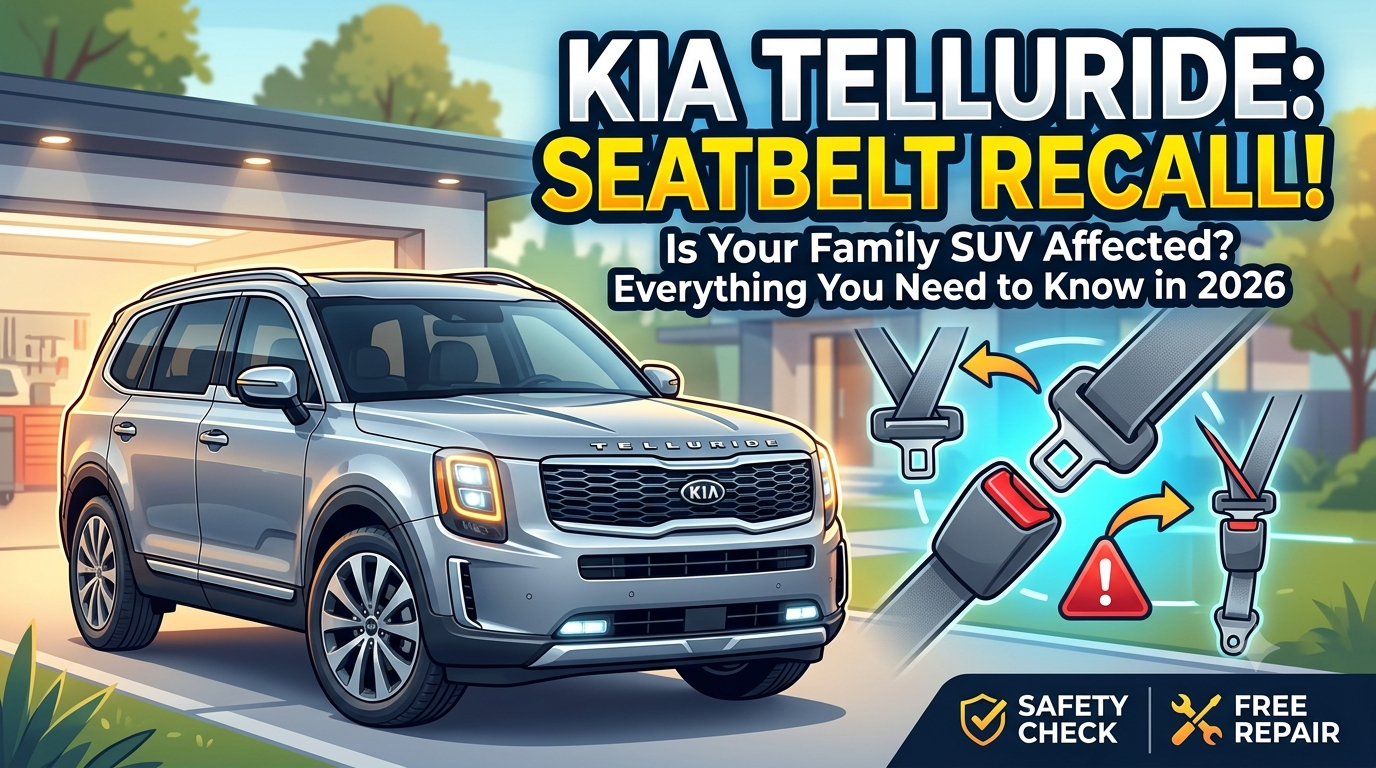
Safety First: The Ultimate Guide to the Kia Telluride Seatbelt Recalls
I have always had an immense amount of respect for what Kia pulled off with the Telluride. When it first burst onto the automotive scene a few years back, it completely rewrote the rulebook for three-row family crossovers. Up until that point, if you wanted a vehicle that could comfortably haul a large family, carry a weekend’s worth of luggage, and not look like a completely depressing, soul-crushing minivan, you had to spend an absolute fortune on a premium European luxury brand. Kia swooped in and delivered an SUV with bold, rugged styling, an incredibly expansive interior cabin, and near-luxury highway comfort at a price point that regular hard-working suburban families could actually afford. It became an instant, runaway sales blockbuster, and for good reason. I have recommended it to countless friends who needed a dependable road-trip cruiser to manage their daily carpools and chaotic weekend sports schedules.
But if we are going to be completely honest with ourselves as car enthusiasts and practical consumers, even the most beloved automotive success stories eventually run into some highly frustrating bumps in the road. Lately, if you have been monitoring the major automotive news channels or scanning your social media feeds, you have probably noticed that this incredibly popular family champion has been making headlines for reasons that are less than ideal. Specifically, the vehicle has been hit with a string of significant safety recalls involving its occupant restraint systems and seatbelt assemblies. For a vehicle that built its entire reputation on being the ultimate, protective sanctuary for growing families, hearing the word recall tied to its seatbelts is enough to make any parent’s stomach drop.
Dealing with a vehicle safety notice is an incredibly annoying, stressful experience that completely throws a wrench into your busy weekly routine. You do research for months, read endless safety ratings, and invest a massive chunk of your hard-earned money into a modern vehicle specifically to ensure that your kids are as safe as humanly possible whenever you pull onto the highway. Then, a piece of paper arrives in your mailbox from a corporate headquarters, or an alert pops up on your phone, notifying you that a critical safety component might fail to protect your passengers in a crash. Over the last several months, a couple of distinct seatbelt complications have surfaced, leaving a lot of owners feeling deeply confused about whether their specific SUV is still safe to drive to school tomorrow morning. My goal with this comprehensive, deep-dive guide is to break down the exact mechanical details of these recent safety notices, identify exactly which model years and specific vehicle batches are sitting in the danger zone, and provide you with a clear, stress-free blueprint to get your vehicle repaired without spending a single dollar of your own money.
Sifting Through the Specific Defects Affecting Different Production Batches
The most critical thing to understand about the current situation is that there is not just one solitary problem plaguing every single vehicle on the road. Instead, a few separate manufacturing oversights have occurred at different supplier factories, resulting in entirely unique defects that impact specific groups of vehicles in completely different ways. If you want to handle this situation correctly, you have to look at the exact dates your vehicle was built and figure out which specific component is under investigation.
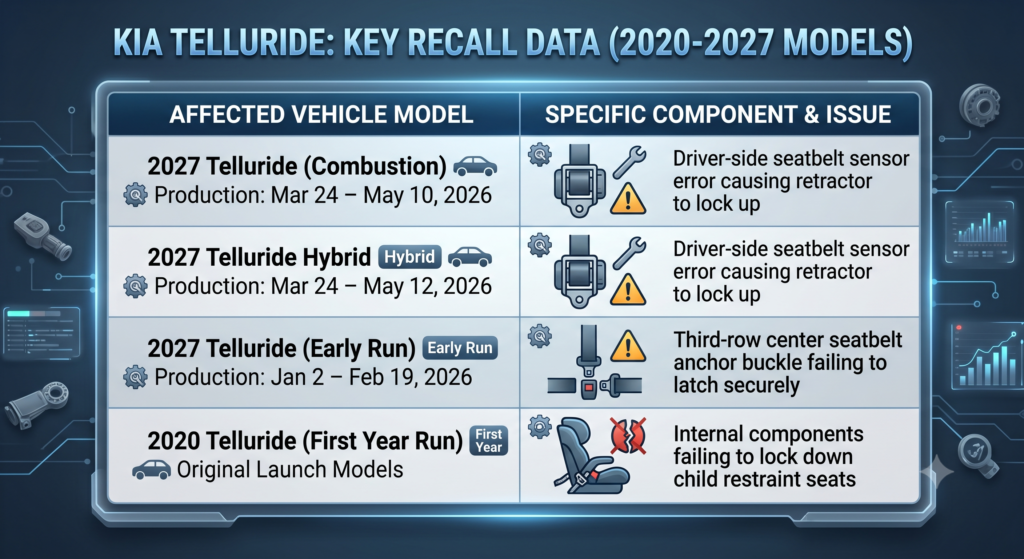
The absolute freshest headache currently dominating the news cycle is a safety campaign cataloged under official NHTSA Recall Number 26V356. This specific issue involves a manufacturing blunder with the driver-side front seatbelt assembly. According to the detailed safety reports submitted to federal regulators, an external parts supplier named Samsong Mexico accidentally installed an incorrect internal vehicle sensor during the assembly process. This tiny component error has a massive, highly frustrating consequence in the real world: under completely normal driving and cabin conditions, the emergency locking retractor can become confused and activate prematurely. When this happens, the seatbelt strap completely freezes in place when you try to pull it across your chest to click it into the buckle.I actually ran across a highly relatable story from an owner on a community forum who described the exact reality of living with this defect before the official notice was even published. They described the absolute agony of sitting in their driveway for three to four minutes every single morning, gently teasing and twisting the seatbelt strap just to get it to extend far enough to click into place. On a couple of occasions, they were in such a massive rush to get to work that they simply gave up and drove down the road completely unrestrained, which eventually resulted in them getting pulled over by a local police officer. That story perfectly illustrates why this is a genuine safety crisis. A seatbelt assembly that locks up and refuses to extend becomes completely unusable as a passenger restraint, and if an unbelted driver gets involved in a sudden, high-speed collision, the lack of protection dramatically increases the risk of severe, life-threatening injuries.
This specific driver-side retractor issue is tightly constrained to a very precise production window for the newly arrived models, encompassing 6,264 total vehicles. Specifically, it impacts 4,367 units of the highly anticipated new hybrid variants built between March 24 and May 12, along with 1,897 units of the standard gasoline-powered models manufactured between March 24 and May 10. If you happen to be an early adopter who proudly drove one of these brand-new units home from the dealership lot over the last couple of months, this is a situation that requires your immediate attention.
However, if you own a slightly older version of the vehicle, you are not necessarily completely out of the woods, because this is actually the second major seatbelt issue to strike the platform recently. Earlier this spring, the manufacturer had to issue a completely separate safety notice, designated as Recall Number 26V135, which focused on a dangerous flaw in the very back of the vehicle. In a batch of nearly fifteen thousand vehicles manufactured earlier in the production run, quality control engineers discovered that the third-row center seatbelt anchor buckle was built with improper internal tolerances. This defect prevents the metal tongue of the seatbelt from clicking and latching securely into the buckle mechanism. The terrifying aspect of this flaw is that a child or an adult riding in the third row might push the belt in, hear a faint click, and assume they are perfectly protected, but a sudden stop or a sharp corner could cause the buckle to instantly release, leaving that passenger completely loose inside the cabin during an accident.
The Broader Reality of Global Automotive Supply Chains and Quality Control
When you sit down and look at these repetitive service bulletins hitting your favorite vehicle, it is incredibly easy to feel completely cynical about the state of modern automotive engineering. You start to wonder if any manufacturer is actually capable of building a reliable, high-quality machine anymore, or if corporate executives are simply cutting corners at every turn to maximize their quarterly profits. It feels like every single time you check a news app, another massive automotive conglomerate is recalling hundreds of thousands of vehicles for exploding airbags, failing brakes, steering wheel glitches, or sudden electrical fires.
To give credit where it is due, we have to look at the broader industry context to understand why these mistakes happen so frequently. Earlier this same year, this same manufacturer had to execute a massive safety campaign affecting over eighty-five thousand older models because the structural frames inside the front power seats were improperly welded, meaning the seatbacks could literally collapse backward during a severe rear-end collision. At the exact same time, ultra-premium European luxury brands that cost triple the price were forcing their own wealthy clients back into dealership service bays because their seatbelt anchorage bolts were leaving the factory completely loose. When you see similar mechanical and structural failures striking budget brands and high-end luxury icons simultaneously, it reveals that the entire global automotive supply chain is stretched to its absolute breaking point.
Modern vehicles are no longer built entirely under one single roof by a single company. Instead, a major brand acts more like a master coordinator, designing the overall aesthetic and engineering structure while outsourcing the creation of thousands of individual sub-components to third-party factories scattered across the globe. A single seatbelt assembly contains dozens of tiny plastic gears, springs, metal brackets, and electronic sensors that are stamped out in automated facilities thousands of miles away from the main vehicle assembly plant. When a subcontractor experiences a minor labor shortage, a sudden machine calibration error, or a simple logistical mix-up on a factory floor in Central America, those flawed components get packed into crates, shipped across borders, and bolted directly into thousands of vehicles before anyone realizes a mistake was made. It is a highly complex, incredibly fragile web, and when one tiny gear fails, the ripple effect eventually lands right in your suburban driveway.
A Clear Step-by-Step Guide to Verifying Your Vehicle’s Recall Status
If you are currently driving a Telluride and you feel a sudden wave of anxiety washing over you, please take a deep breath and relax. The absolute worst thing you can do in this situation is simply worry blindly or ignore the issue because you are afraid of dealing with a complicated repair process. The modern automotive safety regulatory system has made it incredibly fast and painless to discover exactly where your specific vehicle stands without ever having to pick up a phone or argue with a dealership receptionist.
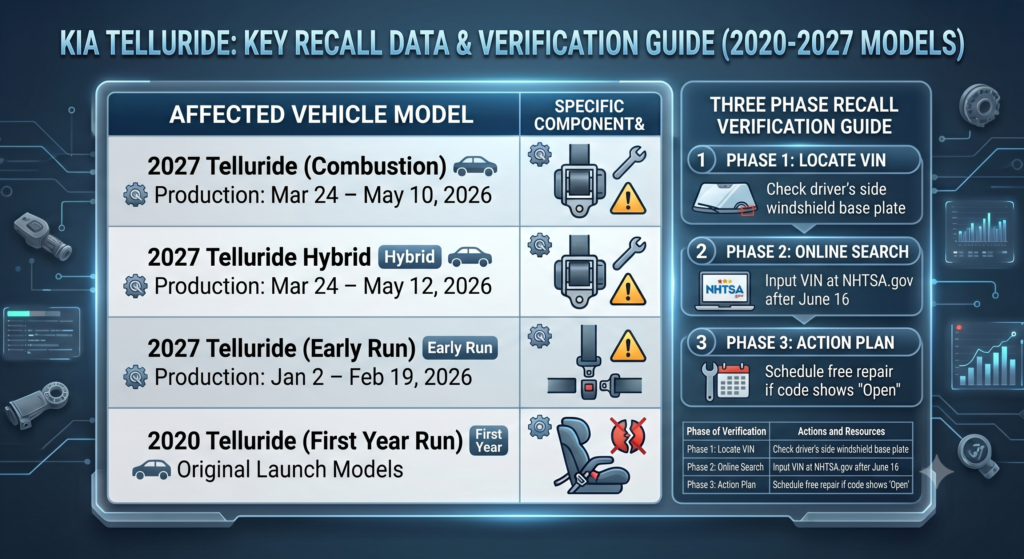
Your absolute first step is to locate your vehicle’s unique digital fingerprint, which is known as the Vehicle Identification Number, or VIN. This is a highly specific seventeen-character string of capital letters and numbers that belongs exclusively to your individual vehicle. You do not need to dig through a messy pile of paperwork in your filing cabinet to find it. Simply walk outside to your parked vehicle and look through the bottom driver-side corner of the front windshield from the outside. You will see a small, riveted metal plate with the code stamped clearly into it. Alternatively, you can open the driver’s door and look at the thick pillar where the door latches closed; there will be a silver or black safety compliance sticker that lists your VIN directly above the tire pressure recommendations.
Once you have that seventeen-character code carefully written down on a piece of paper or saved in your phone, the rest of the process takes less than two minutes. Open up your favorite web browser and navigate directly to the official National Highway Traffic Safety Administration recall database website at NHTSA.gov/recalls. You can also use the dedicated online owner portal provided on the official Kia website. Simply paste your unique VIN into the secure search box and hit enter. The system will instantly cross-reference your specific vehicle fingerprint against every active safety campaign in the country. If your vehicle was built outside the danger windows, the screen will flash a clean bill of health. If your vehicle is affected, it will display an active notice showing that you have an open, unrepaired safety campaign tied to your registration.
There is one highly critical detail you must keep in mind regarding the timing of this specific search. For the latest driver-side retractor locking issue, the manufacturer is still actively updating their digital master databases. According to their official regulatory filings, individual vehicle identification numbers will not become fully searchable on the public federal website until June 16. If you run your numbers before that specific date, the system might mistakenly show that your vehicle has zero issues simply because the data has not been uploaded yet. If you are reading this before that mid-June window, make sure to set a quick recurring reminder on your smartphone calendar to run your VIN one more time after the database officially goes live.
Coordinating with the Dealership Service Bay for a Smooth, Free Fix
If your online search reveals that your family cruiser is officially part of an active safety campaign, your next step is to coordinate a service visit with a local authorized dealership. The most important, non-negotiable rule that you must absolutely remember throughout this entire process is that you should never, under any circumstances, pay a single penny out of your own wallet for a manufacturer safety recall repair. Federal transportation laws are incredibly strict on this point: when an automotive company admits to a safety defect that violates federal motor vehicle safety standards, they are completely required by law to foot the entire bill for the necessary replacement parts, the shop supplies, and the certified technician’s hourly labor.
When you prepare to call the dealership’s service department to book your appointment, do not just call blindly and say you heard about a problem on the internet. Make sure you have your specific safety campaign number written down right in front of you. For the driver-side seatbelt retractor defect, the manufacturer’s internal campaign code is SC372, while the older third-row center buckle defect is cataloged under code SC364. Giving this exact code to the service advisor over the phone allows them to instantly pull up the official factory service bulletin on their computer screen. This ensures that they can check their physical parts inventory shelves and verify that they actually have the newly redesigned, factory-certified seatbelt assemblies or anchor buckles sitting in stock before you take the time to drive all the way down to the facility.
The actual physical work required to resolve these seatbelt issues is fortunately a relatively simple, non-invasive procedure for a professional mechanic. The technician will simply use specialized tools to unbolt the defective, supplier-flawed seatbelt retractor assembly from the interior b-pillar wall or remove the faulty anchor buckle from the third-row seat structure. They will then drop in a completely fresh, redesigned factory component that features the correct internal sensors and proper latching tolerances, torque the mounting bolts back down to factory safety specifications, and verify that the system operates perfectly.
In a perfect world, the actual wrench-turning labor takes less than forty-five minutes to finish. However, as anyone who has ever visited a busy dealership service center knows, you should always prepare for the reality of shop backlogs. Even if a job only takes thirty minutes of actual physical work, your vehicle might sit in a queue for a couple of hours before a technician frees up their bay. I always highly recommend scheduling your appointment for the earliest possible slot in the morning, right when the doors open, so you can jump to the front of the line. If you can manage it, arrange for a friend or family member to follow you to the dealership so you can drop the vehicle off and go about your day, rather than spending a long, miserable morning sitting in a loud waiting room staring at a broken vending machine.
It is also worth noting that if you happen to be an owner who already experienced these exact seatbelt malfunctions months ago—long before the official corporate recall was formally announced to the public—and you paid real money out of your own pocket to have an independent mechanic swap out the parts, you are eligible to get that cash back. The manufacturer has a formal, legally binding General Reimbursement Plan in place for these campaigns. You will just need to provide the dealership or corporate customer care center with your original, itemized repair orders, part numbers, and credit card receipts to prove that you resolved the exact defect covered by the safety notice, and they will process a check to return your funds in full.
Navigating the Waiting Period and Keeping Your Family Safe on the Road
One of the most frustrating aspects of the latest driver-side retractor recall is the massive lag time built into the corporate communication schedule. While dealership service departments were formally updated about the defect on June 3, the manufacturer is not scheduled to begin mailing out the official first-class notification letters to individual registered owners until July 31. This creates an incredibly awkward, anxiety-inducing two-month gap where thousands of owners are fully aware that their driver-side seatbelt might have a defective internal sensor, but the official corporate remedy campaign is still ramping up production on the replacement parts.
If you find yourself stuck in this waiting window, you need to exercise some basic, common-sense caution whenever you get behind the wheel of your vehicle. Pay extremely close attention to how your driver-side seatbelt behaves every single time you buckle up for a drive. If you pull the strap and feel it sticking, ratcheting aggressively, or completely locking up halfway across your chest, do not attempt to force it, twist it into a weird position, or clear the jam yourself. Most importantly, never make the incredibly dangerous choice to drive down the road with an unlatched seatbelt just because the mechanism is acting frustrated and stubborn.
If your vehicle’s seatbelt is actively malfunctioning right now and preventing you from securely restraining yourself, you do not have to sit around and wait for that July owner letter to arrive. Call your local dealership service manager immediately, explain that your primary driver restraint system is actively broken and unusable, and ask them to expedite a vehicle inspection. In cases where a critical safety component is actively broken and rendering a vehicle completely unsafe to operate, a reputable dealership will often prioritize your vehicle, provide you with a complimentary loaner car, or work directly with corporate channels to source an early replacement part to ensure your family stays completely protected.
At the end of the day, try not to let these types of safety notices completely ruin your love for your vehicle. It is easy to get angry at a brand when these mistakes occur, but it helps to reframe the entire situation. A safety recall is not proof that a company is lazy or building junk; it is proof that the consumer safety watchdog systems and federal oversight programs are actually working exactly the way they were designed to. When a manufacturer identifies a flaw, takes accountability for a supplier error, and sets up a transparent system to fix it for free, it ultimately makes our public highways a much safer environment for every single driver on the road.
Frequently Asked Questions
What is the core reason behind the driver’s seatbelt recall on the newest models?
The primary issue is a manufacturing error committed by an external component supplier called Samsong Mexico. The supplier accidentally installed an incorrect internal vehicle sensor inside the driver-side front seatbelt assembly. This improper sensor causes the emergency locking retractor to trigger prematurely under normal conditions, causing the seatbelt strap to freeze in place and preventing the driver from extending the belt to latch it securely.
How do I find out if my specific family SUV is included in this safety campaign?
The most reliable method is to locate your vehicle’s seventeen-character Vehicle Identification Number (VIN) on the lower driver-side corner of your windshield or on the door jamb sticker. Once you have the code, enter it directly into the recall lookup tool on the official NHTSA.gov website. Keep in mind that individual numbers for the latest seatbelt defect will not become completely searchable in the master digital database until June 16.
Will I have to pay any out-of-pocket money to get these safety defects resolved?
No, you will never have to pay any money out of pocket for an official manufacturer safety recall. Federal transportation laws require the automotive manufacturer to cover the complete cost of all replacement parts, required shop supplies, and dealership technician labor needed to completely fix the safety issue.
Can I continue to drive my vehicle while I wait for the official notification letter?
If your driver-side seatbelt and rear buckles are currently functioning completely normally, extending smoothly, and clicking tightly into place every time you travel, you can generally continue to operate your vehicle safely while you wait to schedule your dealership appointment. However, if any seatbelt actively jams or refuses to latch securely, that seat should remain completely empty until a certified mechanic replaces the component.
How long will my vehicle need to sit in the dealership service bay for the fix?
The physical process of unbolting a faulty seatbelt retractor or anchor buckle and dropping in a brand-new factory-certified assembly is a very straightforward task that typically takes a trained mechanic less than an hour to finish. However, because dealership service departments manage a heavy daily queue of vehicles, you should always call ahead to confirm parts availability and plan to leave your vehicle at the shop for a few hours to accommodate their daily workflow.




Leave a Reply