
The Small-Scale Masterpiece: Why ‘A Knight of the Seven Kingdoms’ Is the Best Thing to Happen to Westeros in Years
I vividly remember the exact moment the trailer for A Knight of the Seven Kingdoms dropped.
I dedicate a borderline unhealthy amount of time to analyzing the lore of Westeros, dissecting the political machinations of the Targaryens, and debating whether a show’s production value actually compensates for a lack of narrative heart. After years of dragons, massive armies, and continent-spanning wars, I—like many of you—was feeling a bit of “Westeros fatigue.” We’d seen kings fall, cities burn, and empires collapse. It all started to feel a bit… loud.
Then came Dunk. And Egg.
Let’s be completely real for a second: HBO needed this pivot. After the spectacle of House of the Dragon, we needed to be reminded that the world of George R. R. Martin isn’t just about the Iron Throne. It’s about the people who live in the shadows of the giants. It’s about the hedge knights, the squires, and the quiet, muddy reality of a continent that hasn’t yet descended into total chaos.
Now that the first season has concluded its six-episode run as of early 2026, it’s time to talk about why this show didn’t just meet our expectations—it redefined the “Game of Thrones” brand.
Part 1: The “Small-Scale” Revolution
If you walked into A Knight of the Seven Kingdoms expecting another grand-scale war, you were probably confused for the first twenty minutes. This show is the antithesis of the “Big Event” television we’ve grown accustomed to.
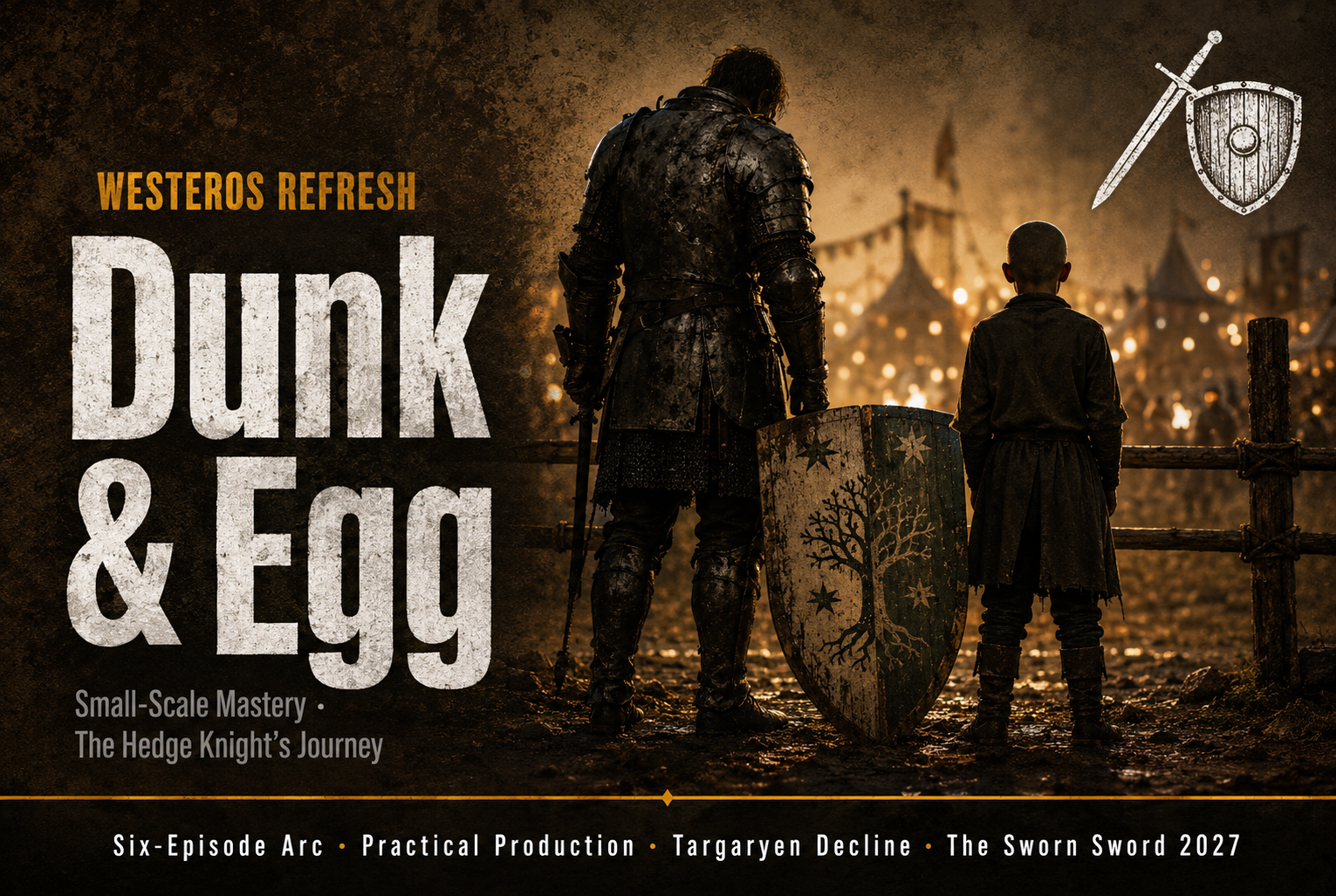
Instead of an army of 10,000 soldiers, we have a man who is too tall for his own armor and a boy with a shaved head.
That shift in scale is exactly why the show works. By narrowing the lens, HBO gave us room to actually care about the characters again. Ser Duncan “Dunk” the Tall (played with perfect, bumbling honor by Peter Claffey) isn’t a hero in the traditional sense. He’s a guy who just wants to do the right thing in a world that rarely rewards it.
Why the “Hedge Knight” matters
In the main Game of Thrones universe, honor is usually a death sentence. Ned Stark? Dead. Brienne of Tarth? Constantly fighting for her life. Dunk, however, is a different breed. He isn’t a lord or a high-born knight. He’s a hedge knight—a mercenary for hire who literally lives in the hedges. He is the ultimate “outsider” looking at the rigid, corrupt structures of Westerosi nobility. And because he doesn’t know the rules, he keeps breaking them in the best possible way.
Part 2: Egg—The Targaryen You’ve Never Seen
We’ve spent decades watching the Targaryens be “fire and blood” monsters. We’ve seen them burning cities and riding dragons. But Egg? Egg (Dexter Sol Ansell) is different.
The brilliance of the show is the dynamic between the lowborn giant and the highborn prince. Watching a young, bratty, yet secretly incredibly intelligent Targaryen prince learn what it means to be a commoner is a masterclass in character development.
This is the target audience’s dream: a coming-of-age story that feels grounded. You aren’t watching a king-to-be; you’re watching a kid who just wants to see the world, and a giant knight who is doing his best to keep that kid from getting them both killed.
Part 3: The Tech Behind the Mud and Steel
I know what you’re thinking: “It’s a fantasy show, how much ‘tech’ can there be?”
Actually, the technical production of this series in 2026 was a massive leap for HBO. They moved away from the massive, sprawling CGI vistas and focused heavily on practical location shooting and advanced lighting integration.
The show feels “muddy” because it is muddy. They used actual, physical sets combined with high-end LED Volume stages (the same tech used in The Mandalorian) to simulate the weather and lighting of the Ashford tournament grounds. You don’t get that “clean” video game look that plagued some of the later seasons of Game of Thrones. You get the grit, the heat, and the texture of actual Westeros.
The audio design also deserves a shoutout. The clatter of armor, the thud of horses, and the ambient noise of a medieval fete—it’s mixed with such intimacy that you feel like you’re standing right there in the mud with Dunk. It’s a sensory experience that reminded me why I fell in love with this franchise in the first place.
Part 4: Why This Is the Best Pacing in Years
Six episodes. That’s it.
After years of 10-episode slogs that often felt like they were padding for time, HBO finally leaned into a tighter, punchier format. Each episode of A Knight of the Seven Kingdoms feels like a self-contained story.
You have a beginning, a middle, and an end, all tied into the larger, slow-burn arc of Dunk and Egg’s relationship. It respects your time. It doesn’t have five different “B-plots” running in the background while you wait for the main character to show up. It is a focused, laser-like narrative.
For the modern streaming audience—the “Target Audience” of 2026—this is perfect. We have shorter attention spans, and we’re tired of “filler.” A Knight of the Seven Kingdoms is pure “killer, no filler.”
Part 5: The “Anti-Spectacle” Strategy
Look, I’m as much a fan of the dragon battles as anyone else. But after three seasons of “will the dragons burn the city or won’t they?”, seeing two men simply talk while cleaning their swords is revolutionary.
The showrunners understood something fundamental: the tension in George R. R. Martin’s world comes from the choices people make, not just the fire that incinerates them.
The contrast between the Targaryens and Dunk is the engine of the show. We see the decline of the dynasty—not through massive battles, but through the small, petty, and often cruel choices of the nobles. It feels like the world is slowly crumbling, and Dunk is the only one trying to pick up the pieces, one honest choice at a time.
Part 6: What’s Next? (The Sworn Sword and Beyond)
With Season 1 in the books, we already know Season 2 is greenlit for 2027. It’s going to adapt The Sworn Sword, which is a much darker, much grittier story.
If Season 1 was the “meeting cute” of a hedge knight and a prince, Season 2 is going to be the test. The politics get nastier, the borders of the kingdom get blurred, and the cost of being “honorable” in a dying world gets a lot higher.
If you’re a fan who has been disappointed by the last few years of “Game of Thrones” content, I am here to tell you: you can come back now. The magic is still there, it’s just gone back to its roots.
Final Thoughts: Why We Still Need Westeros
At the end of the day, A Knight of the Seven Kingdoms is a reminder that you don’t need the biggest budget in the world to tell a story that hits hard. You just need a tall knight, a smart squire, and a world that feels lived-in and real.
We don’t need a dragon in every scene to feel the stakes. Sometimes, the stakes are just a man’s reputation, a squire’s loyalty, and a promise to do better.
It’s the most human show HBO has made in ages. It’s charming, it’s heartbreaking, and it’s finally something in the Game of Thrones universe that I can recommend to anyone—even my friends who were totally burnt out by the ending of the original series.
Go watch it. But maybe grab a coffee first. It’s a bit of a slow burn, and you’re going to want to savor every minute.
Frequently Asked Questions (FAQs)
Q: Wait, is this the same timeline as Game of Thrones?
A: Yes, but it’s set about 90 years before Daenerys and Jon Snow. It’s a prequel, so you don’t need to know anything about the main series to follow the story. It’s a completely fresh start.
Q: Do I need to read the “Dunk and Egg” books first?
A: Absolutely not. The show does a fantastic job of explaining the world. The books are a great read, but the show stands perfectly on its own.
Q: Is it really just 6 episodes?
A: For the first season, yes. And honestly? It’s perfect. It’s a tight, focused story that doesn’t waste a single frame.
Q: Is it going to be as violent as Game of Thrones?
A: There is combat, and it’s gritty, but it’s not the same level of “torture-porn” style violence we saw in the later seasons of Game of Thrones. It’s more personal, more grounded in the reality of medieval life.
Q: When is Season 2 coming out?
A: Season 2 is expected in 2027. HBO has already confirmed it will adapt the second novella, The Sworn Sword.
Q: Why does the show look so different from House of the Dragon?
A: That was a creative choice. The showrunners wanted a more “grounded” aesthetic to fit the story of a hedge knight. They used a lot of practical locations and focused on natural lighting to keep the show feeling like it could actually exist in our own world’s history.
Q: Can I watch this with someone who hates dragons?
A: Actually, yes! That’s the selling point. There are basically no dragons in this series. It’s all about the political and social reality of Westeros without the high-fantasy spectacle getting in the way.
Q: Where can I watch it?
A: It’s an HBO original series, so it’s available on Max (or your local HBO partner). All six episodes of the first season are currently available to binge.
Q: Is Ser Duncan “the Tall” really as tall as they say?
A: In the books, he’s nearly seven feet tall. The actor, Peter Claffey, does a great job of physically embodying that imposing, slightly awkward presence that makes everyone in the room look small by comparison.
Q: What is the “Targaryen decline” mentioned in the show?
A: During this time period, the Targaryen dynasty is firmly in charge, but the cracks are starting to show. You see the internal rot, the arguments between brothers, and the blindness of the nobility to the needs of the smallfolk—all of which set the stage for the downfall you see in the main series 90 years later.







Leave a Reply