

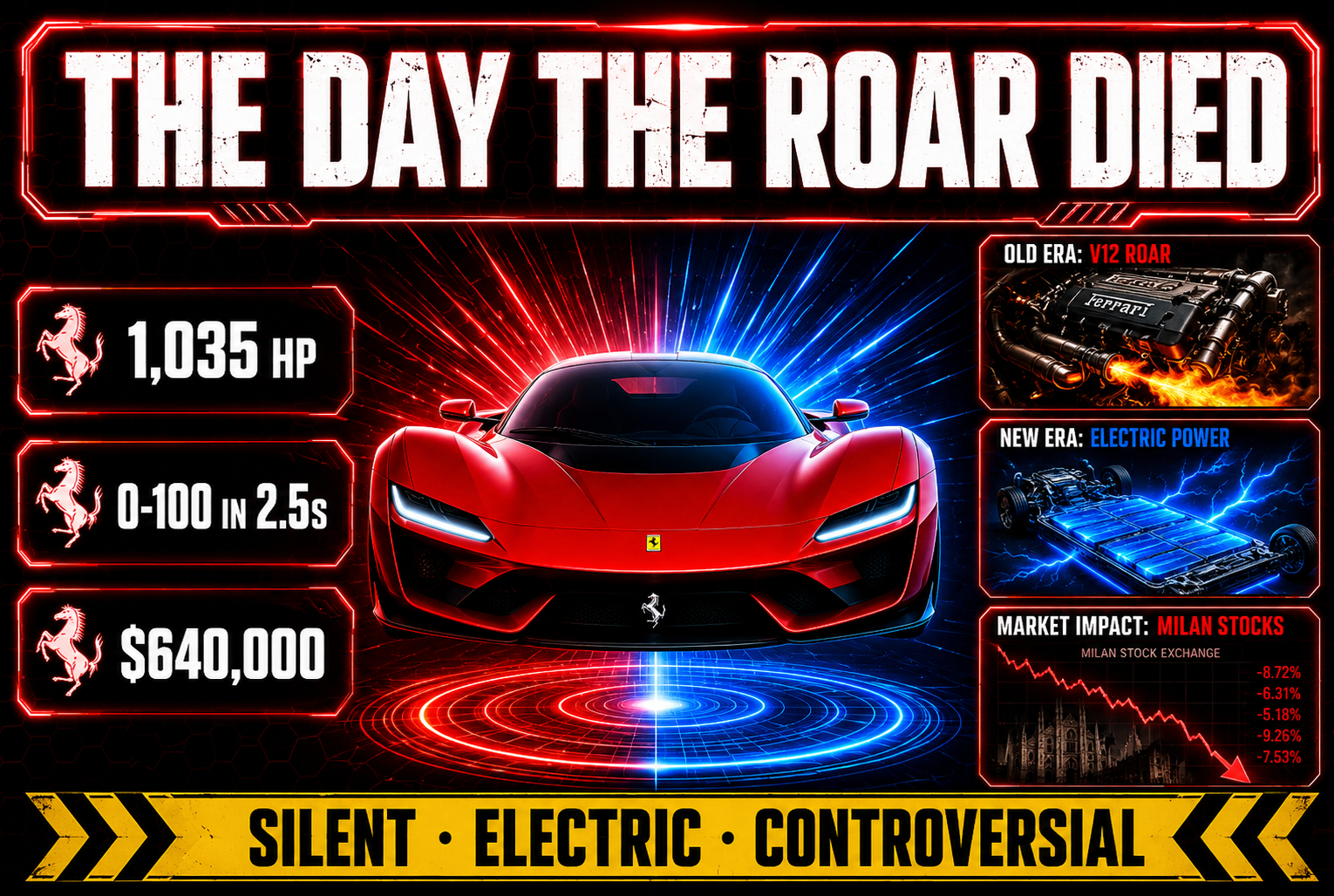
The Day the Roar Died: A Brutally Honest Deep Dive into the Ferrari Luce
Let’s be completely honest with each other: nobody in the automotive world was truly prepared for what went down on May 25, 2026. For nearly eight decades, Ferrari didn’t just build cars; they forged rolling, screaming, gas-spitting metal deities that defined the very limits of human automotive passion. So, when the sheets finally came off the all-electric Ferrari Luce in Rome, the collective gasp from the global car community wasn’t just a reaction to a new vehicle—it felt like a massive cultural earthquake. Suddenly, the legendary prancing horse wasn’t fueled by high-octane gasoline and mechanical explosions, but by silent electrons flowing through a massive floor-mounted lithium-ion battery network. This isn’t just a standard mechanical shift or a routine update to keep up with changing times; it is a total, head-spinning rewrite of Maranello’s entire philosophical identity. If you listen closely to the internet forums, luxury dealership floors, and elite collector garages right now, you won’t hear a unified chorus of celebration. Instead, you’ll hear a fierce, deeply emotional civil war breaking out over whether a completely silent machine can ever truly earn the right to wear that sacred yellow badge.
We need to look past the corporate press releases and flashy marketing jargon to see this launch for what it actually is: a massive, terrifyingly expensive corporate gamble. Ferrari is attempting to skate on a razor-thin edge where aggressive international environmental mandates smash directly into decades of deeply emotional, uncompromising brand loyalty. We are living through an era where luxury car builders are being pushed into a corner by zero-emission regulations, but trying to force-feed a sterile electric future to traditional gearheads is an incredibly dangerous game. The Luce isn’t some low-volume compliance car hidden away in a corner of the factory to satisfy European bureaucrats; it is a full-blown, 1,035-horsepower manifesto meant to lead the brand into the next century. But the immediate, incredibly harsh reaction from both die-hard fans and Wall Street investors proves that when you alter a legendary, time-tested formula, the world doesn’t always clap. By unpacking the layers of this fascinating, highly polarizing debut, we can uncover a wild narrative of corporate risk, aesthetic rebellion, extreme financial vulnerability, and the enduring power of raw automotive soul.
Maranello’s High-Stakes Gamble on Silence
This monumental leap into pure electrification has been quietly discussed in the secret corridors of Maranello for years, but the official arrival of the Luce represents a total, unapologetic departure from the brand’s historic playbook. For generations of car lovers, the mechanical heartbeat of a Ferrari was an incredibly physical, full-body experience that shook your teeth, vibrated through your spine, and echoed off canyon walls from miles away. Stepping boldly into this quiet new era requires a complete, ground-up rethinking of how a high-performance supercar connects with the primitive, thrill-seeking senses of a driver. The executive leadership at Ferrari knew from day one that releasing a generic, soulless electric appliance would immediately vaporize the brand’s hard-earned mystique and exclusive luxury status. This entire project is a high-stakes play to prove that a battery-powered grand tourer can somehow replicate the chaotic, emotional magic of a high-revving, naturally aspirated internal combustion engine.
Making a clean break from fossil fuels is a massive psychological hurdle for an exotic car manufacturer whose legendary founder, Enzo Ferrari, famously boasted that he sold people engines and threw the rest of the car in for free. The Luce is a direct, calculated counterattack against a fast-moving global landscape where zero-emission zones are rapidly transforming from a distant political threat into an immediate, real-world marketplace barrier. Ferrari’s dedicated engineering squads didn’t just throw parts together; they spent several years locking down more than sixty brand-new patents specifically for this bespoke electric platform to ensure it didn’t feel like anything else on the road. We are witnessing the dawn of an entirely new chapter where complex lines of software code, instant torque vectoring, and cutting-edge thermal management must carry the heavy weight of an iconic motorsport crown. Whether this silent revolution will successfully capture the imaginations of a new generation of eco-conscious tech billionaires or permanently alienate the old-school collectors who keep the company alive remains the single most important automotive question of our time.
Behind the Curtain of the Rome Unveiling
The world premiere of the Luce went down against the highly cinematic, ancient backdrop of the Vela di Calatrava, Città dello Sport in Rome—a setting that intentionally mirrored Ferrari’s attempt to blend historic heritage with radical futurism. The choice of location was deeply calculated, screaming to the world that while the high-tech, battery-powered heart of the machine belongs to tomorrow, its artistic soul is still firmly rooted in Italian culture. High-rolling clients, international media, and automotive power players gathered under intense security, whispering in anticipation as they waited to get their first look at the €550,000 (roughly $640,000) grand tourer. When the heavy silk cover was finally pulled back, it revealed a long, low silhouette that looked radically alien compared to any vehicle that had ever exited the historic Maranello factory doors. The energy in the room shifted instantly from eager excitement to collective bewilderment as the audience tried to process a four-door, five-seat layout that completely shattered traditional sports car proportions.
The official media presentation quickly turned into an aggressive damage-control masterclass as top executives leaned heavily into the vehicle’s mind-boggling performance data to dominate the initial headlines. They kept pounding home the car’s jaw-dropping ability to rocket from a dead stop to 100 kilometers per hour in a blinding 2.5 seconds, a figure that easily matches modern multi-million-dollar hypercars while carrying five full-sized adults in total comfort. The engineering team explained in immense detail how they managed to bolt the massive 122-kilowatt-hour battery pack directly into the structural floor to drop the center of gravity into the asphalt. Yet, despite the incredible numbers flashing across the massive LED screens, you could literally feel a thick, awkward tension hanging over the traditional auto journalists in the crowd. The complete physical lack of an exhaust system and the introduction of such an unfamiliar, cab-forward shape left many seasoned veterans wondering if Ferrari had pushed the envelope way too far this time.
Forgetting Enzo’s Sacred V12 Gospel
To truly understand why this technological shift has caused such massive shockwaves, you have to understand the almost religious worship surrounding Ferrari’s traditional internal combustion powerplants. The classic V12 engine isn’t just a cold piece of metal composed of cylinders, pistons, and spark plugs; it is the physical soul of Maranello, producing a wild, operatic scream that has defined automotive passion since 1947. Walking away from this heritage means replacing a deeply sensory, mechanical experience with a world governed by silent electrons moving through copper motor windings. To a real automotive purist, an electric motor is inherently missing a piece of its soul because it doesn’t breathe, it doesn’t have a temperamental power band that rewards a skilled driver, and it lacks the beautiful, mechanical imperfections of an engine. Ferrari’s choice to bypass its classic internal combustion heritage for its brand-new flagship represents a massive gamble that digital code can somehow replace old-school mechanical romance.
“The V12 engine is the very heartbeat of Maranello. Stripping away the internal combustion process is like asking a master violinist to perform on a digital synthesizer—the notes might be perfectly precise, but the raw human passion is incredibly difficult to replicate.” — Michael Field, Automotive Historian
This massive corporate pivot forces us to rethink what we actually care about in an exotic car when crazy, neck-snapping speed has become a cheap commodity in the modern EV era. In a world where a standard electric family crossover can deliver zero-to-sixty times that pull your face back, Ferrari can’t just rely on straight-line acceleration to justify a astronomical $640,000 price tag. The real battle is creating a distinctive, living driving dynamic that feels highly communicative, alive, and unexplainably Italian without the acoustic drama of burning fuel. Engineers have had to invent completely new software mappings to deliver electric torque progressively, trying to mimic the natural, addictive build-up of power that makes a gas engine so thrilling to push on a racetrack. By stepping away from the V12 gospel, Ferrari is trying to carve out a strange new world where emotional driver engagement is generated by advanced chassis electronics rather than the combustion of fossil fuels.
Inside Jony Ive’s Polarizing Masterpiece
The radical visual look of the Ferrari Luce is the result of an unprecedented, highly controversial partnership with LoveFrom, the creative agency led by legendary former Apple design boss Sir Jony Ive and industrial designer Marc Newson. Famous across the planet for his clean, uncompromised minimalist style that completely revolutionized consumer electronics, Ive brought a totally clean-slate perspective to the high-end automotive space. The whole point of the collaboration was to blend the fluid, organic design language of premium tech with the brutal, high-speed aerodynamic needs of a Ferrari supercar. The exterior they came up with is an incredibly smooth, almost seamless skin that completely deletes the traditional aggressive intakes, sharp creases, and muscular lines that have defined modern sports cars for decades. This extreme minimalism has created a polarizing piece of industrial art that looks less like a traditional race-bred machine and more like a fluid object carved smoothly by continuous airflow.
Inside the cabin, the heavy hand of LoveFrom is even more obvious, offering a beautiful, rebellious middle finger to the massive, ugly touchscreens that currently ruin almost every modern electric vehicle on the market. Ive and Newson focused heavily on real, tactile honesty, using premium materials like recycled anodized aluminum, heavy Corning Gorilla Glass, and high-end Italian leather to build a space that feels incredibly intentional. The dashboard setup organizes information into clear, focused zones, ensuring that the driver can keep their eyes glued to the pavement without digital distractions or notification overload. Every single physical button, dial, toggle, and switch was custom engineered to give a highly satisfying, mechanical click, preserving a sense of human craftsmanship in an ultra-futuristic machine. It is an interior layout that openly fights against the tech-heavy, screen-obsessed status quo of the current EV world, proving that true luxury comes from restraint, tactile feedback, and material purity.
When Cupertino Design Language Meets Italian Heritage
When the clean, ultra-functional style of Apple’s most famous gadgets collides head-on with the raw, emotional violence of Ferrari, you get a genuinely fascinating cultural wreck. Sir Jony Ive’s entire design philosophy has always been about making technology completely disappear, creating tools that feel totally natural, seamless, and empty of unnecessary visual clutter. Bringing that exact same style to an exotic Italian supercar meant stripping away all the visual noise, fake cooling vents, and wild wings that usually scream for attention on the street. The Luce embraces a highly unusual cab-forward design where the front glass canopy flows smoothly out of the front hood, creating a single, unbroken line that shatters old-school sports car layout rules. This intersection of Silicon Valley minimalism and Italian racing heritage represents a brave, controversial direction that tries to define automotive luxury as a quiet, confident whisper instead of an aggressive shout.
This unique aesthetic mashup is hidden in the tiniest, most complex details of the car, like the transparent front and rear light bars that melt completely into the bodywork when you turn the car off. The entire vehicle looks like it was carefully machined out of a single solid block of aerospace material, showing off incredibly tight shutlines and hidden wiper blades that tuck completely away when not in use. Even the traditional ignition key was completely redesigned as a gorgeous, heavy piece of sculpted glass that features a built-in E Ink display showing the car’s charge level in real time. While hard-core design nerds are praising this look as the ultimate expression of modern industrial art, old-school car guys are genuinely worried that the vehicle has lost its mean, predatory supercar stance. This partnership exposes a fundamental conflict: can a machine truly feel like a genuine Ferrari if it looks like it was thought up in Cupertino rather than hammered together by hand in Maranello?
Dismantling the Bubbly Glass Canopy
The absolute eye of the storm when it comes to the visual backlash against the Ferrari Luce is its unique glass house—a smooth, continuous, dome-like canopy that forms the entire upper passenger section. This massive glass bubble extends incredibly far down past the traditional shoulders of the car, giving the passengers crazy panoramic views and creating an incredibly bright, open space inside. By allowing the front and rear aerodynamic body wings to float completely independent of this central glass dome, the engineering team scored an insanely low drag coefficient, making this the slickest road car Ferrari has ever put into production. But this engineering win came at a massive visual cost, as the rounded, bulbous roofline completely ruins the sharp, mean, low-slung stance that people expect from an exotic machine. The visual weight of the car is thrown far forward, resulting in an unconventional shape that feels totally bizarre to anyone raised on long-hooded, front-engine sports cars.
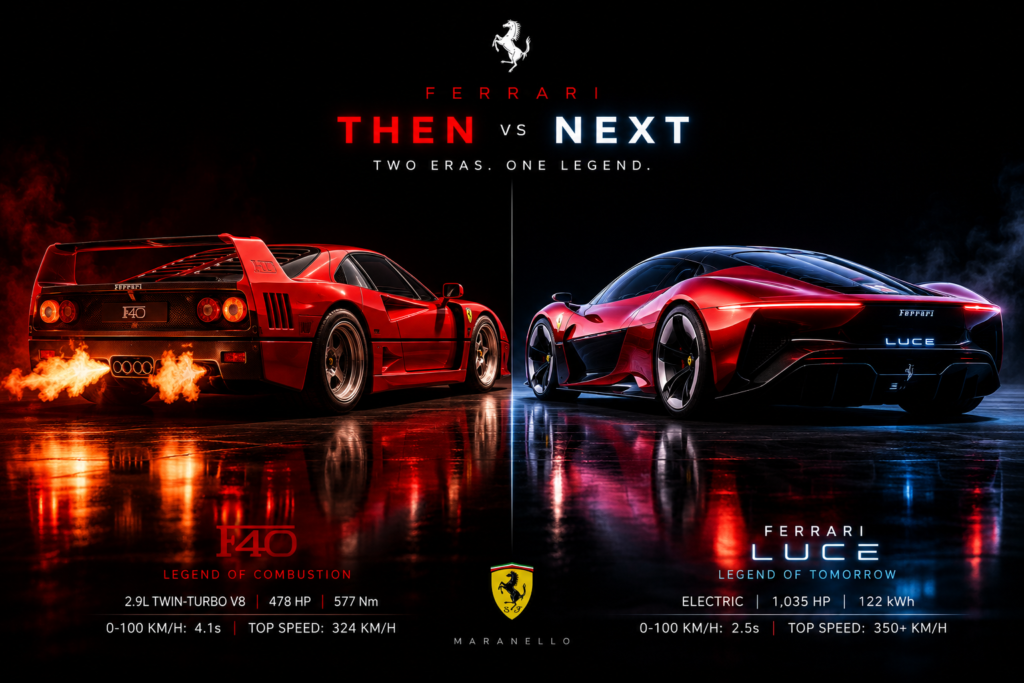
This wild break from old-school design rules was a very intentional choice by the LoveFrom team to take full advantage of the packaging freedom you get with a dedicated electric car platform. Without a giant, heavy internal combustion engine taking up space in the front or a massive transmission hump slicing through the center of the interior, the designers could put human space and clean aerodynamics first. The perfectly smooth, uninterrupted body surfaces allow air to slide over the car with zero effort, wiping out wind turbulence and noticeably boosting the vehicle’s highway driving range. But the car community doesn’t buy vehicles based on wind-tunnel numbers; they buy them based on raw, visceral emotion, and many argue that prioritizing aerodynamic efficiency over jaw-dropping beauty is a massive betrayal of identity. This bubbly glass canopy is a loud reminder that in the electric era, chasing mathematical engineering perfection can easily lead to shapes that make people uncomfortable.
The Brutal Internet Meme Avalanche
Within mere seconds of the official high-res photos hitting the internet, social media platforms exploded into a toxic wave of ruthless mockery and non-stop criticism targeting the car’s unusual looks. Car spotters, collectors, and casual internet users began weaponizing photoshop, dropping hilariously cruel comparisons that claimed this $640,000 supercar looked way too much like a Nissan Leaf or a rounded commuter pod. Memes tore across platforms like X and Instagram at terrifying speed, with people comparing the perfectly smooth, bulbous shape to a high-end robotic vacuum cleaner, an expensive computer mouse, or a piece of plastic footwear. This viral wave of internet hate completely choked out Ferrari’s carefully planned, multi-million-dollar marketing campaign, proving that the digital court of public opinion can destroy you when you drift too far from your roots. The sheer speed and volume of the negative backlash highlighted a massive, unbridgeable gulf between the high-brow design world of Jony Ive and the gritty, visceral expectations of everyday car enthusiasts.
Dissecting the Concept of “Design Hate”
When you look deeply at this phenomenon, this sudden explosion of “design hate” isn’t just people being internet trolls; it reveals a deep psychological barrier that luxury brands face when they try to go green. Supercars are fundamentally irrational purchases that people buy to make themselves feel powerful, dangerous, and connected to a loud history of racing glory. When a brand like Ferrari cleans up its act too much, presenting a smooth, friendly, completely sanitized shape that lacks any visual threat, it triggers an immediate defensive reaction from the community. People feel like something sacred is being stolen from them, and that anger manifests as intense, unyielding criticism of the styling. This design backlash proves that in the ultra-luxury tier, consumers don’t want clean, sensible, logical transportation; they want an aggressive, beautifully flawed monster that scares them just a little bit when they step on the gas.
The Raw Engineering Under the Controversial Skin
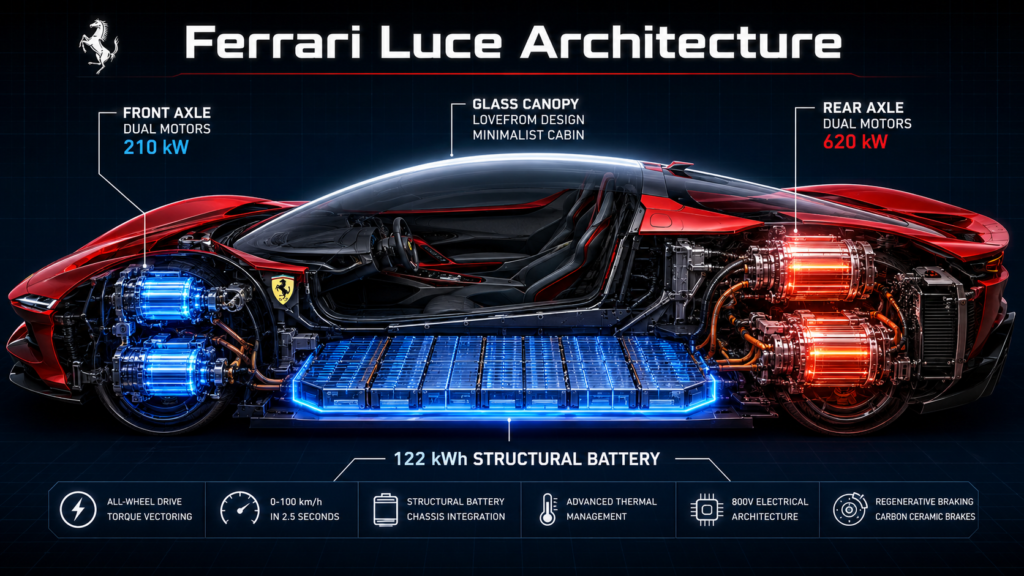
If you can manage to look past the incredibly controversial body styling, you’ll find a mind-blowing masterclass in high-end engineering that proves Maranello has absolutely not lost its ability to innovate at the absolute highest level. The Ferrari Luce is built on top of a highly advanced, proprietary electric skateboard platform that is constructed out of 75% recycled aluminum alloys, dropping production-level carbon emissions by a massive 70%. Instead of taking the easy route and buying electric motors from outside suppliers, Ferrari made the hard, incredibly expensive choice to design, wind, and build its permanent-magnet synchronous engines entirely in-house. The engineering team worked day and night to squeeze every drop of thermal efficiency and energy density out of the system, turning the structural battery casing into a stressed member of the chassis. This level of total mechanical integration ensures that even without a gas-powered engine, the high-voltage heart of this machine snaps to life with the exact same frantic energy that has always defined a real Ferrari.
To combat the natural, heavy handling drawbacks that come with any electric vehicle drivetrain, Ferrari built an incredibly powerful, centralized Vehicle Control Unit (VCU) that ties every single chassis system together into one brain. This high-speed computer recalculates driving metrics an unbelievable 200 times per second, controlling active torque vectoring across all four contact patches with absolute, microscopic precision. The car also debuts a completely independent, isolated rear subframe network—something never before seen on a road-going Ferrari—which successfully blocks out high-frequency electric motor hum while keeping the frame stiff as a rock. This unique mix of hyper-fast control software and heavy-duty mechanical engineering produces a driving feel that is incredibly sharp, direct, and immediate. It is a spectacular technical achievement that proves you can use digital brains to elevate real vehicle dynamics to performance levels that were physically impossible to reach with old-school mechanical setups.
Breaking Down the 1,035 Horsepower Monster
The real, unadulterated muscle of the Ferrari Luce comes from its incredibly sophisticated quad-motor propulsion setup, giving the car four separate electric traction engines positioned at each individual wheel. The front axle packs a pair of ultra-high-speed motors that can spin all the way up to a crazy 30,000 revolutions per minute, feeding 210 kilowatts of instant power straight to the front rubber. The rear axle houses an even meaner setup, dumping a massive 620 kilowatts into the asphalt through dual permanent-magnet engines that scream up to 25,500 revolutions per minute. When you put all these systems together and floor the throttle, they produce a combined output of 1,035 horsepower (1,050 cv) and a massive 7,750 Newton-meters of instant torque at the wheels. This ultra-complex layout gives the car unprecedented, instantaneous control over each corner across every axis of motion, delivering cornering speeds that make you feel like you are rewriting the laws of physics.
| Specification / Metric | Ferrari Luce (2026) | Lamborghini Lanzador (Canceled) | Porsche Taycan Turbo GT |
| Powertrain Type | Quad-Motor Pure EV | Quad-Motor Pure EV (Shelved) | Dual-Motor Pure EV |
| Total Power Output | 1,035 hp / 1,050 cv | ~1,340 hp (Targeted) | 1,019 hp (Overboost) |
| 0-100 km/h Sprint | 2.5 Seconds | ~2.5 Seconds (Targeted) | 2.2 Seconds |
| Curb Weight | 4,982 lbs (2,260 kg) | ~5,100 lbs (Estimated) | 4,927 lbs (2,234 kg) |
| Acoustic Strategy | Axle Accelerometer Amp | Synthetic Cabin Sound | Electric Sport Sound |
| Market Valuation Impact | -8% Milan Stock Drop | Neutral (Strategic Pivot) | Stable Luxury Asset |
| Starting Price Tag | $640,000 (€550,000) | $350,000 (Projected) | $230,000 |
Controlling this terrifying wall of electronic power required Ferrari to design a highly advanced automatic disconnect clutch system on the front axle to save energy when you are just driving normally. When you are just cruising down the highway or crawling through tight city traffic, the front motors uncouple completely, turning the Luce into a highly efficient, tail-happy rear-wheel-drive grand tourer to save battery juice. But the absolute microsecond you stab the pedal or throw the car into a hard corner, the computer slams the front axle back into the mix in less than a blink of an eye. This entire power flow is managed by a newly designed, highly intuitive e-manettino dial mounted right on the steering wheel, letting you click through Range, Tour, and Performance profiles. This quad-motor tech represents a massive generational leap forward, giving the driver instant access to a level of highly adjustable, devastating speed that no old-school internal combustion engine could ever hope to keep up with.
The Physics Problem: Fighting a 4,982-Pound Mass
The absolute greatest enemy of any real sports car is dead weight, and the Ferrari Luce is carrying a massive amount of it, tipping the scales at a hefty 4,982 pounds (2,260 kilograms). This heavy curb weight is caused almost entirely by the giant 122-kilowatt-hour lithium-ion battery pack needed to give the car a real-world driving range of 330 miles under European testing standards. For a legendary brand that has built its whole identity on lightweight agility, lightning-fast transitions, and razor-sharp track feedback, managing almost two and a half tons of metal is a scary engineering nightmare. If you don’t handle this mass correctly, the car will feel lazy, numb, and completely disconnected from your hands when you try to hustle it through a set of twisty corners. Ferrari’s chassis wizards had to use every single engineering trick in the book to make sure this electric heavy-hitter could still move with the grace of a lightweight athlete.
To completely conquer this massive weight problem, the engineering team strategically packed 85% of the heavy battery cells into the lowest possible section of the floor right between the axles. This clever trick allowed them to drop the car’s center of gravity by a massive 95 millimeters compared to their gasoline-powered Purosangue family model. Next, by pulling the heaviest parts inward toward the middle of the frame, they successfully cut the car’s yaw inertia by 15%, allowing the chassis to rotate into corners with incredible urgency. This trick package is paired up with a highly advanced third-generation active suspension setup stolen straight from their flagship F80 hypercar, using high-speed electric actuators to flatten out body roll instantly. When you combine all of this with their standard four-wheel steering system, the Luce completely tricks your inner ear, delivering a sharp, precise driving feel that makes you believe the car is a thousand pounds lighter than it actually is.
Tuning an Electric Guitar to a Car Axle
One of the most wild and highly debated mechanical innovations hidden inside the Ferrari Luce is its deeply weird, highly creative approach to automotive sound design. Instead of taking the easy, fake route and playing pre-recorded, artificial engine noises through the interior stereo speakers—a cheap trick used by almost every EV maker out there—Ferrari completely banned synthetic sounds. Instead, their engineering crew developed a highly advanced, patented acoustic amplification framework that treats the car’s actual moving parts like a physical musical instrument. They bolted a highly sensitive, motorsport-grade accelerometer directly to the structural center of the rear axle housing to catch the real, raw mechanical frequencies made by the spinning electric motors. These authentic physical vibrations are then fed into a specialized digital processor that cleans up, equalizes, and pumps the real sounds into the cabin and out to pedestrians.
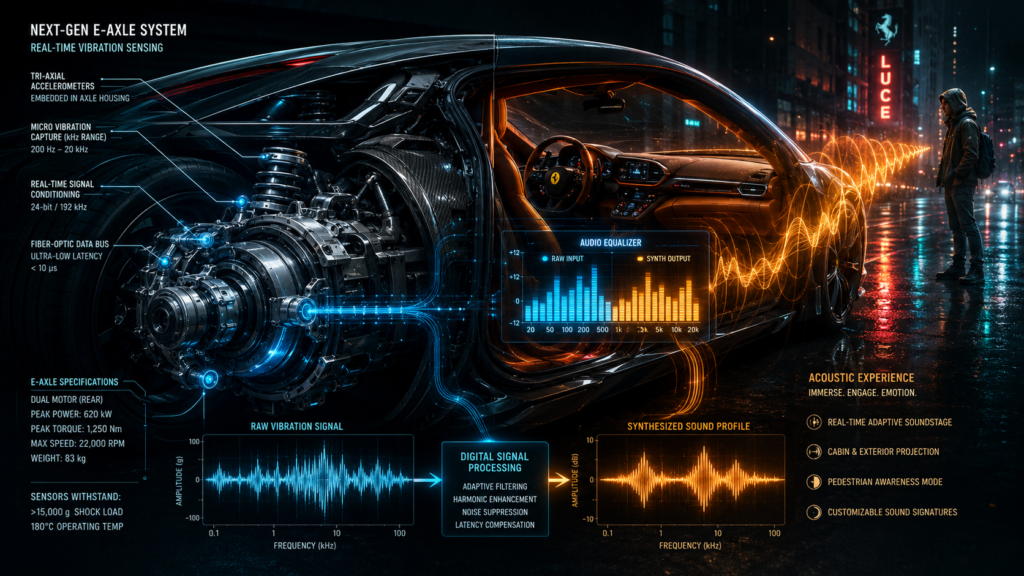
This brilliant audio solution works exactly like how an electric guitar pickup catches the physical vibration of a steel string and sends it screaming through a high-powered amplifier stage. The actual tone and volume of this acoustic feedback change instantly based on which mode you have clicked via the e-manettino dial on the steering wheel. In full Performance mode, the system opens up completely, blasting a raw, mechanical, futuristic wail that builds to a wild crescendo as the electric motors approach their 30,000 RPM redline. In Tour mode, the sound drops back into a smooth, sophisticated background hum, while Range mode silences the system completely for peaceful highway road trips. By keeping the car’s acoustic voice anchored in real, physical mechanical movements, Ferrari has built an authentic, communicative connection that helps bridge the emotional gap between old gas engines and the digital future.
The Financial Earthquake and Cultural Shockwaves
The immediate fallout from the Ferrari Luce reveal sent heavy shockwaves rolling through both the international financial markets and the ultra-exclusive global community of serious Ferrari collectors. For decades, Ferrari has enjoyed a totally bulletproof, gold-plated reputation on Wall Street, with its stock trading more like an elite luxury fashion empire than a low-margin industrial car builder. Investors have always been ecstatic to pay a premium for the company’s stock because of its legendary pricing power, multi-year customer waiting lists, and incredibly reliable profit margins. But the pure, unadulterated polarization of the Luce’s design and its sharp pivot away from gas power caused an immediate wave of panic across trading floors. This sudden financial friction served as a cold reminder that even the most powerful luxury brand on earth can bleed if it messes with its core history too violently.
Outside the cold, calculated numbers of the stock market, the cultural damage inside the tight community of actual Ferrari owners has been incredibly deep and personal. For these individuals, a Ferrari isn’t just a fast vehicle or a flashy piece of jewelry; it is a sacred piece of high art that represents the absolute peak of Italian romance, mechanical complexity, and screaming sound. The sudden arrival of a quiet, five-seat vehicle with a sterile, tech-industry aesthetic felt to many like an intentional pipe bomb thrown at the very foundation of the factory. Across elite track clubs and private online collector groups, an aggressive civil war has broken out between tech-forward investors who love the electric future and traditional purists who view the car as an insult. This bitter cultural split shows the terrifying tightrope that heritage brands have to walk as they try to modernize without killing the emotional magic that makes them worth millions.
How Wall Street Vaporized $4 Billion in 24 Hours
The international financial markets wasted absolutely no time delivering a swift, incredibly brutal verdict the morning after Maranello unveiled its controversial electric creation to the world. By the time the closing bells rang, Ferrari’s stock had collapsed by a painful 8% on the Milan stock exchange and dropped 5.3% in New York, instantly wiping out roughly $4 billion in total market value. This sudden, violent drop goes down as one of the sharpest, most severe stock market punishments ever triggered by a new car design launch in modern history. Big institutional investors and Wall Street analysts were caught completely flat-footed by the scale of the design backlash, terrified that the unconventional looks would cause elite buyers to cancel their orders. The sharp stock sell-off perfectly showed how incredibly fragile a high-margin luxury brand can be when it takes a massive creative and technological risk that turns off its core fanbase.
Financial firms rushed to update their client reports, with several big-name analysts expressing deep worry about where this new styling direction will lead the company over the long haul. High-profile equity analysts noted that the Luce represents the single furthest deviation from the brand’s core DNA that the automotive world has ever seen. Wall Street’s main panic isn’t actually the high-voltage electric drivetrain itself, but the serious risk that this polarizing, non-traditional look will permanently hurt the vehicle’s long-term investment value and collectibility. Ferrari’s entire economic machine depends completely on artificial scarcity and intense, emotional consumer desire, where their cars actually go up in value over time instead of losing money like normal commuter vehicles. If multi-millionaire collectors refuse to buy the Luce because it looks like a high-end piece of consumer tech, it could permanently break the supply-and-demand loop that keeps Maranello’s profit margins sky-high.
Why Purists Want the Prancing Horse Badge Removed
The most devastating, soul-crushing criticism of the Ferrari Luce didn’t come from short-selling stock traders or anonymous internet commenters, but from the iconic legends who built and protected the brand’s history. Former Ferrari Chairman Luca Cordero di Montezemolo, the legendary figure who ran the company through its most dominant Formula 1 eras, delivered a stinging public quote that echoed across Italy. He expressed absolute disgust with the final car, stating bluntly that if he said what he actually thought, it would be highly unpleasant, before demanding that the factory should consider stripping the sacred Prancing Horse logo off the car entirely. This heavy sentiment was immediately backed up by elite owners’ clubs in Italy, who publicly stated that the design had shaken the very core of the legendary marque. To these traditionalists, slapping the personal badge of Enzo Ferrari onto a silent, bulbous, five-seater electric capsule is nothing short of absolute cultural sacrilege.
“I hope that they take off the prancing horse logo from that car.” — Luca Cordero di Montezemolo, Former Ferrari Chairman
This intense, emotional purist backlash exposes a deep-seated fear that Maranello is slowly killing its unique, passion-driven soul just to chase corporate green points and tech-industry trends. To a true fan, a real Ferrari needs to have a mean, dangerous, intimidating edge—a violent combination of mechanical noise and predatory lines that makes your heart race when you look at it sitting still. The Luce, with its silent motors, friendly rounded glass canopy, and ultra-sanatized interior layout, feels entirely too safe, clean, and completely stripped of the mechanical danger that makes a supercar special. Traditionalists argue that by selling out to a new crowd of tech-obsessed buyers who care more about zero-emissions than racing history, the factory is permanently watering down its brand value. This loud fight over whether the Luce even deserves to wear the horse badge shows an unyielding cultural conflict that will likely haunt the company’s identity for decades to come.
The Great Italian Civil War: Ferrari vs. Lamborghini
The rolling controversy around the Ferrari Luce has blasted a giant spotlight onto a fundamental strategic canyon that is currently splitting the exotic supercar world completely in half. While the executives in Maranello chose to dive headfirst into the pure electric future by engineering a bespoke battery grand tourer, their ultimate rivals across town have done the exact opposite. Lamborghini has been watching the unfolding disaster around the Luce with intense satisfaction, using the exact same week to publicly double down on their commitment to internal combustion and hybrid tech. This massive corporate split represents a fascinating, high-stakes chess match between two automotive superpowers, with each side placing billions of dollars on completely opposite visions of what the super-rich will want to buy. It is a direct fight between Ferrari’s belief that electronic engineering can discover a new form of speed and Lamborghini’s absolute conviction that the raw theater of burning gas can never be replaced.
This deep corporate split is being heavily driven by a massive, industry-wide slowdown in high-end electric vehicle sales that has plagued the global car market over the last twenty-four months. Ultra-wealthy buyers all over the planet have suddenly shown an incredibly stubborn, sentimental attachment to the traditional, noisy experience of internal combustion engines. While early-adopting tech millionaires were quick to buy up the first high-performance EVs, the core base of old-school supercar collectors is flat-out refusing to give up the sound and fury of gas power. This heavy consumer resistance has forced executive boardrooms across Europe to completely tear up their long-term product plans, creating a wild contrast in how these companies are behaving. As Ferrari pushes forward with its ultra-expensive, multi-patent electric roadmap, other luxury builders are happily stepping back, completely content to let Maranello test these incredibly volatile, angry waters completely on its own.
The Real Story Behind the Lanzador’s Sudden Death
In an incredibly telling power move that perfectly illustrates this deep industry divide, Lamborghini CEO Stephan Winkelmann recently announced the absolute cancellation of their highly anticipated Lanzador all-electric project. The Lanzador had been hyped up for months as Lamborghini’s big, brave opening shot in the electric wars, engineered to capture the attention of a new generation of eco-conscious billionaires. But as the luxury EV market began to hit a massive wall and elite buyers continued to voice their deep hesitation, the high-level leadership team in Sant’Agata officially pulled the plug on the car. Winkelmann stated openly that their core clients are still deeply, emotionally hooked on the unmistakable sound and visceral energy of traditional internal combustion. Instead of burning billions of dollars building a pure electric car that their best customers might completely ignore, Lamborghini made the sharp strategic pivot to dump those resources back into high-performance plug-in hybrids.
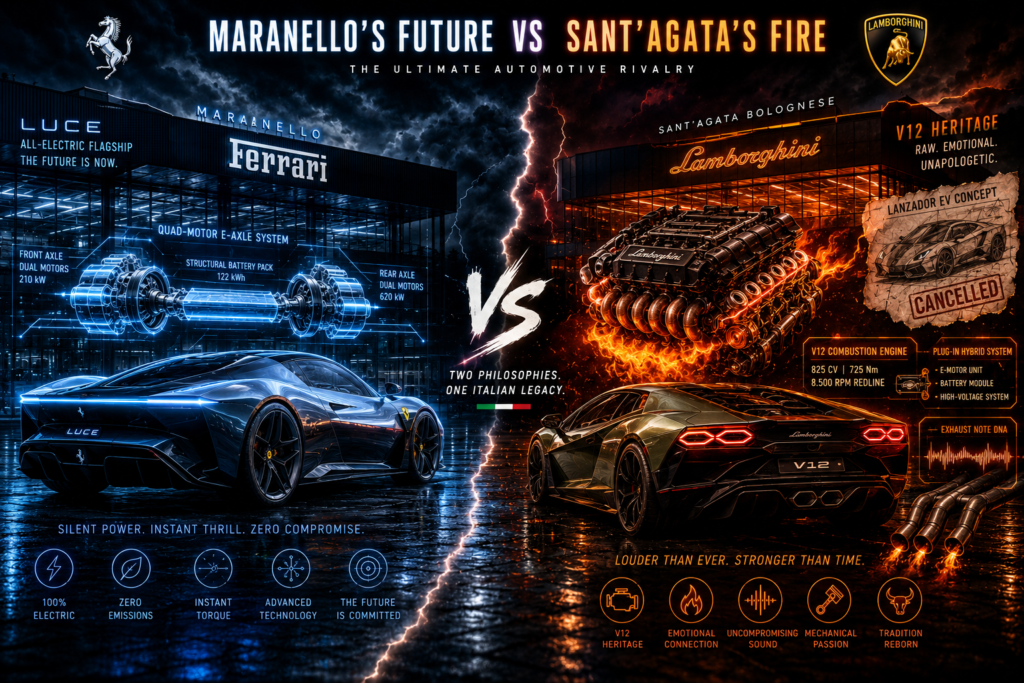
This sudden retreat from pure electric drivetrains allowed Lamborghini to instantly position itself as the ultimate global defender of traditional automotive passion and mechanical romance. By focusing all their energy on advanced plug-in hybrids (PHEVs) that pair high-tech electric motors with screaming, high-octane V8 and V12 gas engines, they give buyers a setup that beats emissions laws without killing the sound. This tactical move stands in total, glaring contrast to Ferrari’s all-in gamble with the Luce, setting up a real-world corporate showdown of epic proportions. If the Luce fails to sell and starts rotting on dealership lots, Lamborghini will look like absolute geniuses who understood the souls of their buyers perfectly. On the flip side, if Ferrari successfully convinces the ultra-wealthy that pure electric performance is the future, Lamborghini could find themselves left completely in the dust in a zero-emission landscape.
Decoding the Ultra-Rich Resistance to EVs
The cold financial reality that triggered Lamborghini’s pivot—and now seriously threatens the future of the Ferrari Luce—is the incredibly flat acceptance curve among the world’s wealthiest car buyers. For years, Silicon Valley tech evangelists and corporate futurists told us that the instant, brutal torque advantages of electric motors would cause a lightning-fast shift in the exotic car world. But real-world sales data has shown that while rich people are totally fine buying an electric SUV for their boring daily office commute, they are incredibly conservative when it comes to their weekend toys. A supercar or high-end exotic grand tourer is a completely emotional, irrational purchase, bought specifically to provide a wild, soul-stirring escape from our highly digitized, screen-obsessed daily lives. When you completely strip away the mechanical theater of manual gear changes, vibrating exhaust systems, and mechanical feedback, wealthy buyers feel the experience becomes way too clinical and uniform.
This massive psychological wall is an incredibly difficult hurdle for a car like the Luce, which has to prove it deserves a spot in a garage next to legendary classic sports cars that appreciate every single year. A multi-millionaire standing on a showroom floor isn’t looking at a spreadsheet or a spec sheet; they are looking for a machine that gives them goosebumps and hooks them into a rich history of racing heroes. If a super-expensive electric exotic gives you a driving sensation that feels fundamentally similar to a high-end Tesla or a fast Chinese EV, it completely loses the hand-crafted mystique that justifies its insane price tag. Ferrari’s engineering department has thrown everything they have at this emotional puzzle, inventing axle accelerometers and progressive power delivery, but changing human psychology is an uphill battle. This deep resistance proves that breaking through the emotional walls of the world’s most elite car buyers requires a whole lot more than just crazy acceleration numbers.
Where Does the Prancing Horse Go From Here?
Let’s look straight ahead at what is coming down the pavement for Maranello’s electrified future. Despite the massive online storm of design hate, the brutal media reviews, and the scary volatility of the stock market, Ferrari’s roadmap for electrification is completely locked in stone. The high-level executive team in Maranello has made it crystal clear to investors that the Luce is absolutely not a one-off marketing trick, but the literal foundation of their entire multi-energy future. Full assembly lines are scheduled to spin up in late 2026 inside their brand-new, top-secret “e-building” facility, which has been meticulously engineered for zero-emission manufacturing. Ferrari has already dropped hundreds of millions of dollars securing tight corporate control over rare-earth mineral chains and engineering custom battery chemistries designed to take non-stop racetrack beatings. This relentless forward drive shows an iron-clad corporate determination to dominate the electric era, no matter how loud the purists scream right now.
To ensure this new vehicle doesn’t tank financially, Ferrari is almost certainly going to use their legendary, highly aggressive dealership allocation system to force initial sales. Historically, the factory has forced collectors to buy less popular or mainstream models just to earn a coveted spot on the waiting list for their limited-edition hypercars and special-series track weapons. It is highly likely that signing a purchase contract for a new Ferrari Luce will become an absolute, mandatory requirement for any collector who wants to get their hands on future gas-powered special editions. This brilliant, incredibly ruthless business trick guarantees a non-stop stream of orders from the brand’s most loyal clients, giving the electric platform plenty of time to prove its real-world dynamic worth on the road. As the first customer cars start hitting public streets in late 2026 and early 2027, the conversation will finally shift away from Jony Ive’s polarizing body shapes and straight toward the record-breaking lap times of its high-tech engineering.
Conclusion: Finding the Balance Between Voltage and Visceral Passion
When you step back and look at the whole picture, the Ferrari Luce stands out as one of the most fascinating, terrifyingly high-stakes corporate experiments in the entire history of industrial design and automotive culture. It represents a bold, deeply courageous attempt to balance the cold, unyielding environmental mandates of tomorrow with the warm, emotional history of an irreplaceable Italian icon. By stepping outside their comfort zone and teaming up with Jony Ive’s LoveFrom, Ferrari intentionally chose to blow up their traditional design molds, forcing the world to face a radical new vision of what an exotic car can look like. The resulting financial panic and intense cultural backlash serve as a loud reminder that true innovation is always an incredibly painful, chaotic process that shakes the very roots of tradition. Maranello has boldly thrown down a massive gauntlet, flat-out refusing to stay safely hidden in the past while the rest of history marches forward into an electrified world.
Only time will truly tell if the Luce will be remembered as a brilliant, visionary masterstroke that saved Ferrari’s cultural relevance for the next hundred years, or as a clinical, over-engineered misstep that totally misjudged what makes its fanbase tick. What is completely beyond debate is the absolute genius of the mechanical engineering and software brains hidden underneath that highly controversial, smooth glass dome. Ferrari didn’t just take the lazy path and slap electric motors into an old chassis; they completely tore down and rebuilt vehicle dynamics, acoustics, and interior luxury from a clean slate to build something truly unique under the sun. As the initial internet shockwaves begin to quiet down and the world slowly gets used to its silent, fluid shape, the Luce will keep driving the most important conversations about the true meaning of automotive passion. In the end, Enzo Ferrari’s legendary company has always been about pushing past the boundaries of what people thought was possible, and the Luce proves that that exact spirit of wild experimentation is still burning bright.
Frequently Asked Questions
1. What is the exact purpose of the accelerometer in the Ferrari Luce’s sound system?
The high-precision, motorsport-grade accelerometer is bolted directly to the center of the rear axle housing to catch the real, physical mechanical frequencies generated by the spinning electric motors and drivetrain components. Instead of playing fake, pre-recorded audio tracks through the interior speakers, Ferrari’s digital system equalizes and amplifies these live, authentic vibrations—working exactly like an electric guitar pickup—to deliver an organic soundscape that shifts dynamically based on real motor speed.
2. Why did Ferrari choose to collaborate with Jony Ive’s LoveFrom instead of their in-house design team?
Ferrari brought in Sir Jony Ive and Marc Newson’s creative agency, LoveFrom, to infuse a completely fresh, uncompromised minimalist perspective from the high-end industrial tech world into the automotive space. The main goal was to seamlessly marry the packaging freedoms of an electric vehicle platform with an incredibly clean, seamless design language that ties the bodywork, interior materials, and user interface together while breaking away from traditional supercar styling rules.
3. How does the weight of the Ferrari Luce affect its handling compared to traditional gas models?
Weighing in at a heavy 4,982 pounds (2,260 kg), the Luce carries a lot more mass than traditional gas models due to its massive 122 kWh battery pack. To wipe out this weight penalty, engineers packed 85% of the battery modules into the lowest section of the floor, dropping the center of gravity by 95 mm compared to the Purosangue. This package is tied to a 15% reduction in yaw inertia, active suspension from the F80, and four-wheel steering, giving the car a highly agile, sharp handling feel that completely tricks your senses.
4. What triggered the immediate $4 billion stock market drop after the Luce’s reveal?
The sharp 8% drop in Milan and the 5.3% drop in New York were directly caused by intense investor panic over the highly controversial, non-traditional design language created by LoveFrom. Wall Street was terrified that the extreme visual shift away from Ferrari’s signature aggressive, predatory lines would cause elite collectors to reject the car, permanently damaging long-term resale values, collectibility, and the brand’s historic profit margins.
5. How does the interior of the Ferrari Luce differ from mainstream luxury electric vehicles?
Unlike almost every modern luxury EV that features massive, distracting central touchscreen tablets, the Luce embraces a “screen-lite” dashboard focused entirely on real tactile interaction. It uses physical, custom-engineered mechanical buttons, dials, and switches paired with high-end, honest materials like recycled anodized aluminum and heavy Corning Gorilla Glass, keeping the driver completely focused on the road without digital sensory overload.









Leave a Reply