

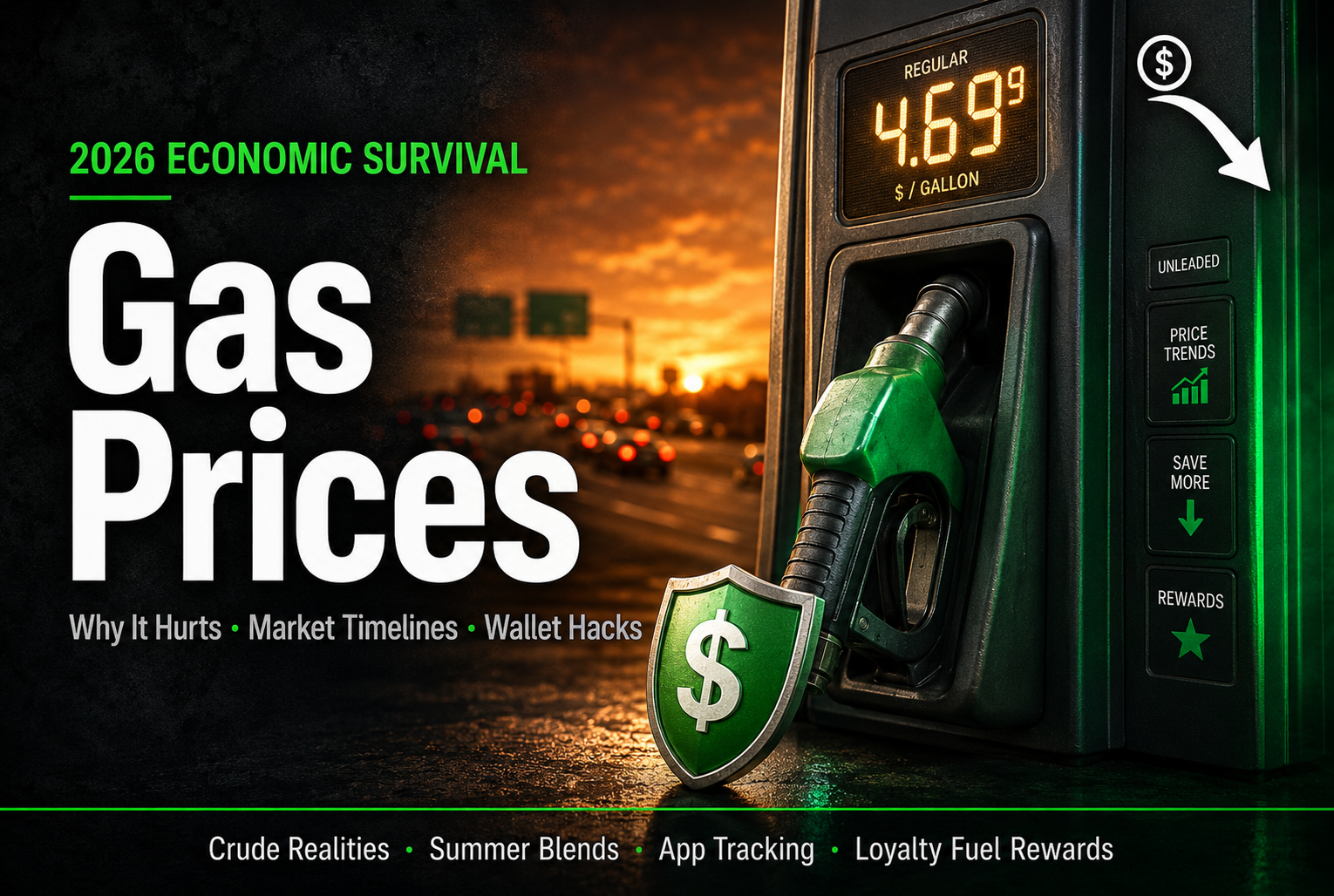
The Ultimate Guide to Surviving 2026 Gas Prices: Why the Pump Hurts, What’s Changing, and How to Save Your Wallet (A Complete Deep Dive)
I will never forget the exact afternoon I stood at pump number four and seriously considered abandoning my car in the parking lot and walking home.
I spend an absolute diagnostic amount of time driving. Whether I am commuting to the office, running endless errands, or trying to escape the city for a weekend road trip, my car is effectively my second living room. So, earlier this year, when I pulled into my local station, mindlessly swiped my card, and watched the digital counter absolutely hemorrhage money until it hit $75 for a standard tank of regular unleaded, my stomach completely dropped.
Let’s just be honest about something first: paying for gas in the summer of 2026 feels like a deeply personal attack on our bank accounts. Every time we watch the news, the narrative changes. One week, prices are dropping because of “surplus inventory.” The next week, they skyrocket by 40 cents overnight because of a geopolitical crisis on the other side of the planet. It is completely exhausting, and for most of us, driving isn’t a luxury we can just cut back on—it is a mandatory requirement to survive and get to work.
If you have been watching the massive, flashing numbers on your local gas station sign fluctuate wildly over the last few months, you are not alone, and you are not going crazy. The spring and summer of 2026 have brought some of the most volatile, unpredictable price swings we have seen at the pump in years. Just last month, the national average for a gallon of regular peaked at a brutal $4.56. Today, we are seeing some relief as it drops back down closer to $4.12, but the anxiety remains.
Because the oil market is inherently shrouded in complex corporate jargon, international politics, and economic theories, I wanted to create a single, definitive pillar of content for you. No confusing Wall Street terminology, no political spin. This is your complete, deeply human guide to exactly why gas prices are doing what they are doing right now, where your money actually goes, and most importantly, how you can start fighting back and keeping cash in your pocket.
Grab a cup of coffee (because you probably can’t afford to drive to a coffee shop right now), settle in, and let’s break this down together.
The 2026 Rollercoaster: What Exactly Is Happening Right Now?
To understand why you are paying over four dollars a gallon this week, we have to look at the bizarre rollercoaster that has been the first half of 2026.
If you remember January and February, things were actually looking relatively okay. The national average was sitting comfortably under $3.00. But then, the global market completely shattered. In late February and March, severe geopolitical conflicts erupted in the Middle East, specifically involving Iran and the tightening of control over the Strait of Hormuz—a massive, critical oceanic chokepoint where roughly a fifth of the world’s global oil supply passes through daily.
When the market panics, speculators drive up the price of crude oil. Almost instantly, crude shot past $100 a barrel, and those costs were immediately passed down to you at the pump. By May, we hit a painful peak of $4.56 per gallon nationally, with states like California blowing right past $5.80.
The Good News: The Summer Cooldown
However, as we push through June 2026, we are finally seeing a downward trend. For the last three straight weeks, the national average has dropped, currently hovering around $4.12 per gallon.
Why the sudden relief?
- Cooling Global Tensions: Recent news of potential diplomatic resolutions and peace agreements in the Middle East has calmed the global oil markets, bringing crude oil back down below that terrifying $100-per-barrel threshold.
- Increased Domestic Production: Refineries in the US have ramped up their output, averaging around 9.7 million barrels of gasoline per day, slightly outpacing the massive summer demand.
But even with this relief, $4.12 is still incredibly high compared to historical averages. To understand why it won’t drop back to two dollars anytime soon, we need to look under the hood of how gasoline is actually priced.
The Anatomy of a Gallon: Where Your Money Actually Goes
When you hand over $4.12 for a single gallon of gas, it is easy to assume that the guy standing behind the cash register at the local station is getting rich. That could not be further from the truth. Your local gas station owner makes an incredibly small margin on the actual fuel (often just a few pennies per gallon). They make their real money when you walk inside and buy an overpriced energy drink and a bag of chips.
So, where is the money actually going? According to the U.S. Energy Information Administration (EIA), a single gallon of gas is divided into four main buckets:
1. Crude Oil (Roughly 51% of the Cost)
This is the absolute biggest slice of the pie. Gasoline is refined from crude oil, meaning the price of a barrel of crude on the global market dictates over half of what you pay at the pump. Because oil is a globally traded commodity, it is fiercely susceptible to supply and demand. If a hurricane shuts down offshore rigs in the Gulf of Mexico, or if a war breaks out in an oil-producing nation, the global supply drops, the price of a barrel spikes, and your local pump price shoots up within days.
2. Refining Costs (Roughly 20% of the Cost)
Crude oil straight out of the ground is useless to your Honda Civic. It has to be shipped to a massive industrial refinery, boiled, chemically cracked, and transformed into usable gasoline. Refining costs fluctuate based on the season, the type of fuel being produced, and how many refineries are actually operational. If a major refinery has to go offline for unexpected maintenance, local prices in that region will spike due to the sudden bottleneck.
3. Taxes (Roughly 18% of the Cost)
This is the part that makes everyone angry, but it is completely unavoidable. You are paying both federal and state excise taxes on every single gallon. The federal tax on gasoline is 18.4 cents per gallon, a number that hasn’t changed in decades. However, state taxes vary wildly. If you live in California, Pennsylvania, or Illinois, you are paying significantly higher state taxes per gallon than someone living in Texas or Mississippi. This money is primarily used to fund highway maintenance and infrastructure projects.
4. Distribution and Marketing (Roughly 11% of the Cost)
Once the gasoline is refined, it doesn’t magically teleport to your neighborhood pump. It has to be pumped through massive pipelines, loaded onto enormous tanker trucks, and driven to individual stations. This slice covers the logistics of moving the fuel, the marketing budgets of major brands like Shell or Chevron, and the razor-thin profit margin of the local station owner.
The “Summer Blend” Conspiracy: Why June Always Hurts
If you have been driving for a few years, you have probably noticed a distinct, frustrating pattern: gas prices almost always go up between May and August, even if the world is completely at peace. It feels like a conspiracy. It feels like the oil companies know we want to go on summer road trips, so they artificially hike the prices.
While demand does increase in the summer as people take vacations, there is actually a very real, federally mandated scientific reason why summer gas costs more. It all comes down to the Reid Vapor Pressure (RVP) of the fuel.
The Science of Evaporation
Gasoline isn’t just a simple liquid; it is a complex mixture of hydrocarbons that loves to evaporate. When gasoline evaporates, it releases Volatile Organic Compounds (VOCs) into the atmosphere. In the blistering heat of the summer, these VOCs bake in the sunlight and react with nitrogen oxides to create ground-level ozone, more commonly known as smog.
The EPA Mandate
To prevent our major cities from looking like dystopian smog-scapes during the hottest months of the year, the Environmental Protection Agency (EPA) requires refineries to completely change their recipe starting in the spring.
- Winter Blend Gas: Cheaper to produce. It contains more butane, which makes it highly volatile (meaning it ignites very easily in a freezing cold engine block).
- Summer Blend Gas: Refineries must strip out the cheap butane and replace it with more expensive, less volatile compounds so that the gas doesn’t instantly evaporate inside your hot fuel tank.
Switching the massive, multi-billion-dollar refineries over to this specialized summer blend recipe takes time and requires completely shutting down production lines. Furthermore, the ingredients for summer gas are objectively more expensive. This transition process alone usually adds anywhere from 10 to 15 cents per gallon to your bill, completely independent of global crude oil prices.
The Big Question: Are Electric Vehicles (EVs) Actually Cheaper Right Now?
With gas prices fluctuating so wildly, it is completely natural to look at the Tesla or Ford Mustang Mach-E in the lane next to you and wonder, “Are they laughing at me right now?”
The short answer is: yes, “filling up” an electric vehicle is currently cheaper than buying liquid gasoline. However, the economics of EV charging are entirely dependent on where you plug in.
- Charging at Home: If you have a driveway and can charge your EV overnight using your home’s standard electrical grid, you are paying a fraction of what gas costs. Depending on your local utility rates, completely “filling” a 300-mile EV battery at home might cost you between $10 and $15.
- Public Fast Charging: This is where the narrative shifts. If you are on a road trip and rely on public DC Fast Charging stations (like Electrify America or the Tesla Supercharger network), the cost goes up significantly. As of June 2026, the national average for a kilowatt-hour (kWh) at a public charging station is about 42 cents. Charging a large EV battery from 10% to 80% at those rates can easily cost $25 to $35. It is still cheaper than a $75 tank of gas, but the gap is narrowing.
Actionable Advice: How to Actually Save Money at the Pump
Okay, enough doom and gloom. We cannot control the geopolitics of the Strait of Hormuz, and we cannot force the EPA to stop mandating summer-blend fuel. But we can control how we spend our money. Here are the absolute best, battle-tested strategies to stop bleeding cash every time you need to refuel.
1. Weaponize Gas-Tracking Apps
If you are just pulling into the first gas station you see off the highway exit, you are actively choosing to lose money. Prices can vary by up to 40 cents a gallon within a single two-mile radius. You absolutely must download an app like GasBuddy or Waze. These apps use crowd-sourced data to show you the exact prices of every station around you in real-time. Taking an extra three minutes to drive one block off the main road to find the cheaper station can save you five to ten dollars per fill-up.
2. Ditch the Premium Delusion
There is a massive, persistent myth that putting Premium (91 or 93 octane) gas into a standard car will somehow “clean” the engine or make it run faster. This is completely false. Unless you are driving a high-performance sports car, a turbocharged luxury vehicle, or a car whose owner’s manual specifically states “Premium Fuel Required,” you are throwing money into a literal fire. Modern computer-controlled engines designed for regular 87 octane gas do not benefit at all from premium fuel. Stop buying it.
3. Join the Grocery Store Loyalty Cult
Almost every major grocery chain in the country (Kroger, Safeway, Stop & Shop) has a fuel rewards program. If you are already spending $200 a week feeding your family, you need to make sure those points are linking to a gas discount. By actively utilizing grocery store fuel points, you can frequently shave anywhere from 10 cents to a full $1.00 off per gallon at participating stations.
4. Optimize Your Driving Habits
You have heard this a million times, but the physics are undeniable: the way you drive dictates how much gas you burn.
- Stop Speeding: Aerodynamic drag increases exponentially the faster you go. Driving at 80 mph on the highway burns significantly more fuel than cruising at 65 mph.
- Check Your Tires: Driving on under-inflated tires creates rolling resistance, forcing your engine to work harder to move the car. Keeping your tires inflated to the correct PSI listed inside your driver-side door jamb can improve your fuel economy by up to 3%.
- Empty the Trunk: Stop using your car as a mobile storage unit. An extra 100 pounds of golf clubs, old clothes, and heavy tools sitting in your trunk actively reduces your miles per gallon.
Final Thoughts: Riding Out the Storm
The truth about the global gasoline market is that it is a massive, incredibly fragile machine. A geopolitical tremor in one hemisphere instantly ripples out and drains your wallet in the other.
While the relief we are seeing in June 2026 is a welcome break from the brutal peaks of the spring, the era of consistently cheap, $2.00 gas is likely a relic of the past. As long as the global demand for oil remains high and geopolitical tensions continue to simmer beneath the surface, volatility is the new normal.
All we can do is play defense. Keep your tires inflated, use the tracking apps, stop paying for premium unless you absolutely have to, and remember that every time you ease your foot off the accelerator, you are keeping a few extra cents in your own pocket. We might not be able to control the price on the big flashing sign, but we can absolutely control how often we have to look at it.
Frequently Asked Questions (FAQs) About Gas Prices
Because the oil market is inherently confusing, we have compiled the absolute most common questions our readers ask regarding fuel costs to ensure you have the facts.
Q: Why do gas prices vary so much from state to state?
A: The biggest factor is state excise taxes. As of 2026, states like California, Illinois, and Pennsylvania have incredibly high state taxes on fuel to fund infrastructure. Additionally, states located further away from major refining hubs (like the Gulf Coast) pay more in distribution and transportation costs. Finally, California requires a very specific, highly refined environmental blend of gasoline that is more expensive to produce than fuel used in the rest of the country.
Q: Is it actually cheaper to buy gas early in the morning?
A: Technically, yes, but the savings are microscopic. Gasoline expands when it is warm and becomes denser when it is cold. Because gas pumps measure by volume, buying gas in the cool morning theoretically gets you a slightly denser, more energy-packed gallon. However, modern gas stations store their fuel in massive, temperature-controlled underground tanks, meaning the temperature fluctuation at the pump is minimal. You might save a few pennies a year.
Q: Does using the AC burn more gas than rolling down the windows?
A: It depends entirely on how fast you are driving. At low speeds (like city driving under 40 mph), rolling down the windows is more fuel-efficient than running the air conditioning compressor. However, at highway speeds (over 55 mph), having the windows down creates massive aerodynamic drag, which forces the engine to work harder and burns more gas than simply rolling the windows up and running the AC.
Q: Why does diesel usually cost more than regular gasoline?
A: Even though diesel is technically easier to refine than gasoline, it is subject to higher federal taxes (24.4 cents per gallon for diesel vs. 18.4 cents for gasoline). Furthermore, diesel is the lifeblood of the global economy—it fuels commercial trucks, cargo ships, tractors, and trains. Because global commercial demand for diesel is so incredibly high and constant, the price stays elevated.
Q: Should I let my gas tank drop to empty before refilling it?
A: No, this is actually a terrible idea for your car’s mechanical health. The fuel pump inside your gas tank relies on the surrounding liquid gasoline to keep it cool and lubricated. If you consistently drive with the tank near empty, the fuel pump can overheat, leading to a catastrophic and incredibly expensive mechanical failure. You should always try to refill when you hit the quarter-tank mark.
Q: Are gas prices expected to drop further in late 2026?
A: Current projections from the U.S. Energy Information Administration (EIA) suggest that if crude oil production continues to outpace demand and geopolitical stability holds, we could see retail gas prices continue a slow, downward trend into the fall and winter months of 2026. However, any sudden hurricane disrupting the Gulf Coast refineries or a resurgence of global conflict could instantly reverse that trend.














Leave a Reply