
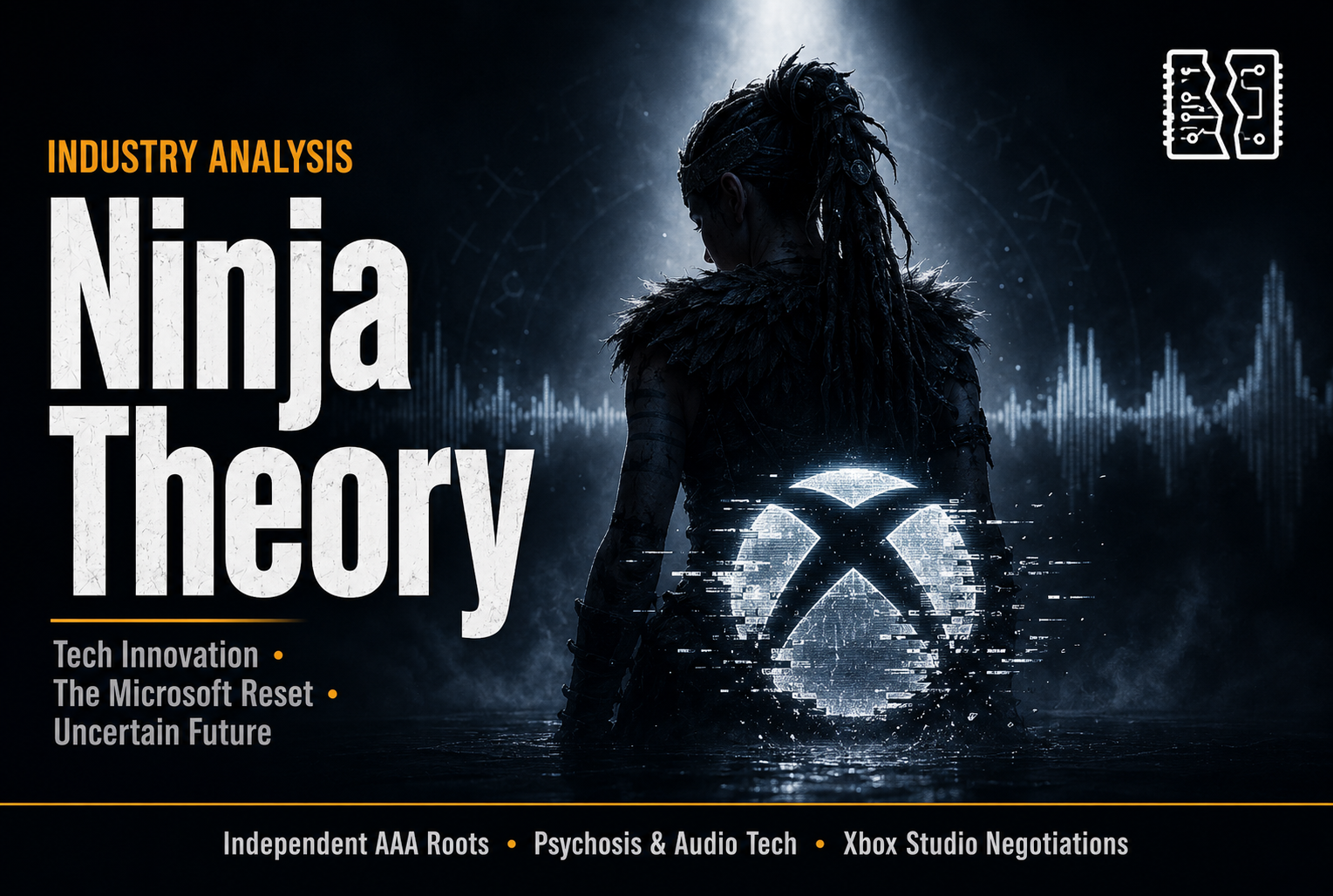
The End of an Era: The Rise, Tech-Pinnacle, and Uncertain Future of Ninja Theory
I vividly remember the exact afternoon I first stepped into the shoes of Senua.
I spend a borderline unhealthy amount of time analyzing the mechanics of game design, dissecting the latest developments in motion capture, and debating the future of storytelling in the gaming industry. Back in 2017, when Hellblade: Senua’s Sacrifice dropped, it didn’t just feel like another action-adventure title. It felt like a fundamental shift in what a “AAA-feeling” game could be. It was dark, it was visceral, and it used audio technology to simulate psychosis in a way that had never been seen before. It wasn’t just a game; it was a psychological experience.
For those of us in the tech and gaming scene, Ninja Theory has always been the “odd one out” in the best way possible. They weren’t interested in just churning out loot-box-filled shooters or open-world maps that took 200 hours to clear. They were interested in the craft. They pushed the boundaries of performance capture, they collaborated with neuroscientists to portray mental health accurately, and they proved that a smaller, “Independent AAA” team could produce visuals that rivaled the biggest studios on the planet.
But let’s be completely real for a second: the gaming industry is currently undergoing a violent, systemic “reset,” and Ninja Theory—the studio we’ve held up as the gold standard for artistic and technological ambition—is caught in the crossfire.
As of June 15, 2026, reports have surfaced that Microsoft is preparing to shutter the Cambridge-based studio. Just days after the Xbox Games Showcase revealed the next entry in the Senua franchise, the studio is now reportedly fighting for its life in buyout negotiations.
It’s a brutal, jarring reminder of how the “prestige” of a studio doesn’t always translate into the “spreadsheets” of a multi-trillion-dollar corporation. Because the story of Ninja Theory is the story of how modern gaming tech evolved, I wanted to create a single, definitive guide for you. No corporate PR fluff, no hollow optimism—just the reality of why this studio matters, how they changed the technology of storytelling, and why their potential closure feels like a punch to the gut for anyone who cares about the future of games.
Part 1: The “Independent AAA” Philosophy
To understand Ninja Theory, you have to understand where they started. They weren’t always a first-party Xbox giant. They began as “Just Add Monsters,” a tiny three-person outfit in Cambridge, England, operating with £3,000 and a lot of ambition.
Their early history is a study in surviving the “publisher trap.” They made Heavenly Sword for the PS3, a game that was technically years ahead of its time but financially shackled by the exorbitant costs of early performance capture and an exclusive deal with Sony that ultimately left the studio IP-poor. They did contract work on DmC: Devil May Cry, proving they could handle big-budget action mechanics, but the studio heads realized something crucial: if they wanted to own their destiny, they had to own their IP.
This led to their masterstroke: Hellblade: Senua’s Sacrifice. They coined the term “Independent AAA.” The idea was simple: keep the team small (fewer than 20 people), keep the budget focused, but don’t compromise on the visual fidelity or the narrative depth.
It was a gamble that paid off. Hellblade became a cult classic and a commercial success, proving that you didn’t need 500 developers to make a world-class game. You just needed a clear vision and a willingness to use technology in smarter ways.
Part 2: The Tech Behind the Magic
Ninja Theory isn’t just a group of game designers; they are arguably one of the most innovative motion-capture and performance-capture outfits in the world. Their “tech-first” approach is exactly why this potential closure is sending ripples through the gaming community.
Psychosis and the “Binaural” Breakthrough
The most famous technical achievement of Hellblade was its audio. They didn’t just record voice lines; they collaborated with psychiatrists and people who actually live with psychosis to ensure the “voices” Senua heard were accurate. They used binaural recording—placing microphones in a way that simulated how human ears hear sound—so that when you played with headphones, those voices felt like they were literally inside your head. It was an industry-first use of audio tech to influence the player’s mental state.
Real-Time Performance Capture
While other studios were spending months “cleaning up” motion capture data by hand, Ninja Theory was obsessed with real-time capture. They developed systems to allow actors to see themselves as their characters in-engine while the performance was happening. This allowed for a level of raw, unrehearsed emotion in Hellblade II that simply isn’t possible when you’re acting in a vacuum. They bridged the gap between film-grade performance and game-grade interactivity.
VR for Mental Health
The studio’s impact even drifted into academia. They collaborated with researchers at the University of Cambridge, using their VR expertise to help study and treat anxiety. They weren’t just making games; they were showing how the tools of “prestige gaming” could be applied to mental health research.
Part 3: The Marriage That Went Sour
In 2018, Microsoft acquired Ninja Theory as part of its massive push to bolster the Xbox Game Studios portfolio. At the time, it felt like a dream scenario. Ninja Theory would finally have the “unlimited” resources of a trillion-dollar company to build their masterpiece.
But looking back in June 2026, we have to ask: was it a trap?
The “AAA” Expectation vs. Reality
The narrative around Ninja Theory shifted after the acquisition. When you become a first-party studio for a company like Microsoft, you are no longer making “Independent AAA” games. You are making products. You are expected to deliver massive engagement metrics, live-service loops, or prestige blockbuster hits that justify the subscription price of Xbox Game Pass.
The reports coming out in June 2026 indicate a “reset.” Xbox, under current leadership, is struggling with a component crisis and content investments that haven’t yielded the return on investment (ROI) investors demanded. One analyst put it perfectly: Ninja Theory’s studios are “brilliant for prestige and rotten for the spreadsheet.”
They are the definition of “prestige.” They create beautiful, award-winning, narrative experiences. But in an industry currently obsessed with infinite monetization, battle passes, and massive engagement metrics, a 5-hour long, high-fidelity narrative game—no matter how beautiful—is a hard sell to an executive looking at a quarterly revenue report.
Part 4: The June 2026 “Bloodbath”
It’s been a whirlwind of tonal whiplash. Just over a week ago, at the Xbox Games Showcase, Microsoft was proudly showing off the next entry in the Senua franchise. The crowd was hyped. The positivity for the Xbox brand was at an all-time high.
Fast forward seven days, and those same developers are reportedly being told their studio is on the chopping block.
According to The Verge and Bloomberg, the studio is currently in active negotiations to find a buyer or potentially spin off as an independent entity. It’s a desperate attempt to save the team and the Senua IP.
But the reality is grim. Microsoft’s internal memo, penned by Xbox leadership, warns of an “accountability margin” and a staggering $20 billion spent on content and hardware over five years without sufficient revenue return. When a company spends $20 billion and sees its annual revenue decline, the accountants stop caring about how good your motion capture technology is. They care about the bottom line.
Part 5: Why This Matters to You
You might be thinking, “It’s just one studio. Why does this impact me as a tech and gaming enthusiast?”
It matters because we are reaching a tipping point. We are seeing a shift where “mid-sized” prestige studios are becoming an endangered species.
If we move to a world where only the absolute largest blockbusters (like Call of Duty or Halo) or the smallest mobile-style games are “economically viable,” we lose the middle ground. We lose the games that are beautiful, weird, and deeply human. We lose the games that take risks with technology to explore the human condition.
Ninja Theory proved that you could make games that are art. If they go under—or if they are forced into a “corporate reset” that mandates they make boring, cookie-cutter games—we all lose. We lose the evolution of the medium itself.
Part 6: Final Thoughts: The High Price of Innovation
Ninja Theory’s story is a mirror for the entire gaming industry in 2026. We are seeing the result of an era of “unlimited investment” finally colliding with the cold, hard reality of stagnant growth.
We loved Ninja Theory because they didn’t play by the rules. They pushed for better audio, they pushed for better facial capture, and they treated their subject matter with a level of intellectual honesty that you rarely see in a “product.”
Whether the studio is shuttered, sold, or spun off, the impact they had is already baked into the DNA of modern gaming. They showed us what was possible. They showed us that a game could be a psychological journey. They showed us that technology should serve the story, not the other way around.
If this is indeed the end of their run under the Xbox banner, it’s a massive loss—not just for the fans, but for the medium. We can only hope that wherever these developers land, they take that obsession with craftsmanship with them. Because the industry needs them. The industry needs studios that care more about the art than the spreadsheet.
Frequently Asked Questions (FAQs)
Q: Is Ninja Theory officially closed?
A: As of June 16, 2026, reports confirm the studio is in active negotiations to spin off or find a buyer to avoid total closure. Employees have been informed of the situation, but the studio’s fate is still in flux.
Q: What is the “Hellblade” franchise?
A: It’s their flagship series following Senua, a Celtic warrior battling psychosis. The games are famous for their high-fidelity graphics, binaural audio, and deep narrative themes.
Q: Why does Microsoft want to shut them down?
A: Financials. Microsoft’s gaming division revenue has declined while costs have skyrocketed. They are looking to “reset” and prioritize only the most profitable franchises, and Ninja Theory’s prestige games aren’t hitting the high-engagement, high-revenue targets the company now demands.
Q: What does “Independent AAA” mean?
A: It’s a term Ninja Theory coined to describe making top-tier quality games with a small, focused team and budget—avoiding the bloat of traditional big-publisher development.
Q: Did Microsoft buy Ninja Theory?
A: Yes, they acquired them in 2018. This made them a first-party Xbox studio, meaning their games were exclusive to the Xbox ecosystem.
Q: Will the next “Senua” game be released?
A: It’s highly uncertain. The project was revealed just over a week ago, but the studio’s current status puts all upcoming development in jeopardy. If a buyer is found, the game likely continues; if the studio closes, the IP could be shelved.
Q: Is there any hope for the employees?
A: While the studio brand is in trouble, the developers themselves are world-class talent. Many are hopeful for a spin-off, though industry layoffs have been brutal, and job security is far from guaranteed for anyone involved











Leave a Reply