

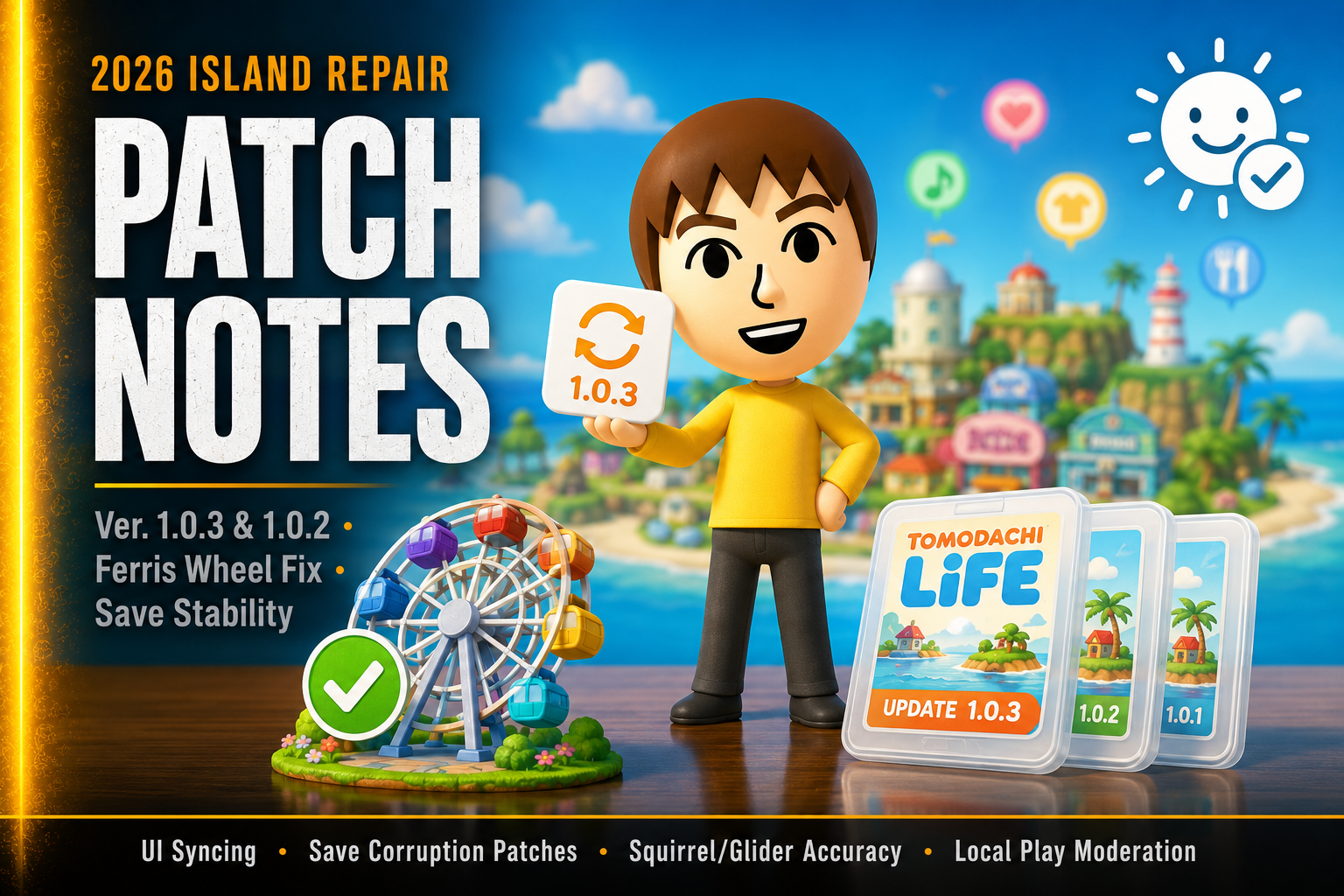
The Ultimate Guide to the Latest Tomodachi Life Update Patch Notes: Everything You Need to Know About Version 1.0.3 (and 1.0.2!)
I vividly remember the exact moment my game froze. I had just spent two excruciating, hilarious hours trying to get my Mii lookalike to finally confess to his crush. The setup was perfect, the outfit was right, and the location was set. But just as I went to check on another islander, the screen locked up. All that progress, gone in an instant.
If you’ve been playing Tomodachi Life: Living the Dream on your Nintendo Switch over the last few months, you probably have a similar story. We invest a borderline unhealthy amount of time into managing these chaotic, unpredictable little digital lives. We build relationships, we decorate the Palette House, we feed them an endless supply of bizarre foods just to see their reactions. So, when a game-breaking bug rears its ugly head, it doesn’t just feel like a technical glitch—it feels like a personal attack on our carefully curated island soap opera.
But let’s be completely real for a second: game development is hard, and life simulators with thousands of intersecting AI variables are even harder. Nintendo has been actively listening to the community, and the recent rollouts of patches have been absolute lifesavers.
If you’ve been searching for the complete Tomodachi Life update patch notes, you’ve come to the right place. We aren’t just going to copy and paste a list of bullet points and call it a day. We are going to do a deep, humanized, gearhead-level breakdown of exactly what went wrong, how Nintendo fixed it in Version 1.0.3 (released June 25, 2026), and look back at the massive Version 1.0.2 update from May that saved our islands from total corruption.
Grab a coffee, settle in, and let’s pull back the curtain on the digital mechanics of your favorite island.
Part 1: The June 2026 Lifesaver (Breaking Down Version 1.0.3)
On June 25, 2026, Nintendo dropped Version 1.0.3. This wasn’t a massive content drop adding new islands or features; this was a surgical strike against some of the most infuriating progression blockers that have been haunting players since launch.
When you read through the Tomodachi Life update patch notes, you realize just how specific and bizarre some of these bugs were. Here is a detailed breakdown of exactly what was breaking, and how the patch has smoothed out your daily island management.
The Ferris Wheel Progression Blocker
If there is one thing Tomodachi Life players love, it’s the Ferris wheel. It’s the ultimate date spot, the place where relationships are solidified, and one of the best locations to take screenshots of your Miis interacting.
However, Version 1.0.3 addressed a massive, game-freezing bug tied directly to this iconic ride. According to the official patch notes, if a player attempted to open the Mii List and visit a Mii at the exact millisecond that the character was entering or exiting a Ferris wheel car, the game’s logic would essentially trip over itself. The game couldn’t decide if the Mii was supposed to be in your direct interaction view or locked into the Ferris wheel animation.
The result? The game would freeze. You couldn’t back out, you couldn’t save, and you had to hard-reset the console. This was a nightmare for players who obsessively check their Mii List to manage hunger and happiness. Version 1.0.3 completely rewrote the interaction hierarchy here. Now, if a Mii is boarding a ride, the game safely queues your visit request or gently blocks the menu transition until the animation is complete. No more frozen dates.
The Money Display Glitch
The economy of Living the Dream is vital. You need money to buy new interiors, snag that high-end clothing item before the shop rotates, or purchase expensive food items to level up your islanders.
Before this patch, there was a rare but terrifying bug regarding how funds were displayed. Occasionally, when a player received a large sum of money (either from a Mii leveling up, winning a minigame, or collecting daily donations at the fountain), the UI would fail to update the total balance correctly. But it wasn’t just a visual glitch—it was a progression blocker. The game’s internal math would conflict with the displayed math, causing the shop menus to lock up because the system couldn’t verify if you actually had enough money to buy an item.
The latest Tomodachi Life update patch notes confirm this has been entirely eradicated. The rendering engine for the UI and the internal bank logic have been properly synced. Your hard-earned island cash is finally safe.
The Satisfaction Level Crash
This one hurt. The entire core loop of Tomodachi Life revolves around raising your Miis’ satisfaction levels. You feed them their favorite foods, give them new clothes, and watch the meter fill up. When they level up, you get to give them a gift, a song, or a new catchphrase.
However, some players love to hoard food and spam-feed their Miis to level them up multiple times in a single session. Prior to Version 1.0.3, repeatedly raising a Mii’s satisfaction level in rapid succession could cause a memory leak that triggered a hard error, forcing the game to close entirely. Imagine spending twenty minutes perfectly curating a Mii’s aesthetic, feeding them ten times, leveling them up, and then the software crashes before an auto-save triggers. It was brutal.
Nintendo has now optimized the memory allocation during the “Level Up” animation sequence, meaning you can spam-feed your islanders as much roast beef and caviar as your wallet allows without fear of a crash.
Quality of Life Tweaks: Head Rubs, Outfits, and Lingo
Not all bugs are game-breaking; some are just wildly annoying. Version 1.0.3 took a lot of these minor irritations and squashed them.
- The Aggressive Camera Zoom: Giving your Mii a head rub is supposed to be a cute, calming interaction that builds their affection. But a bug was causing the camera to zoom in so closely that you were essentially staring at the individual pixels of your Mii’s nose. It was terrifying rather than endearing. The camera distance has now been properly calibrated.
- The Amnesiac Wardrobe: You know the feeling when you finally collect all the necessary items to complete a specific themed outfit (like the full pirate costume or the astronaut suit)? The game is supposed to recognize this and trigger a special reaction or log it in your collection. A frustrating bug was causing the game to completely ignore the fact that your Mii owned the full set. The patch has fixed the inventory check system.
- Lingo Interruptions: Half the fun of this game is making your Miis say ridiculous things. You teach them a catchphrase, and they use it. But sometimes, they would just trail off or not speak the phrase aloud fully, breaking the immersion and ruining the joke. The text-to-speech engine has been updated to ensure full playback of custom lingo.
- Relationship Milestones: The game tracks how many days two Miis have been sweethearts or married. A counting error was causing this number to display incorrectly (sometimes showing negative days, or thousands of days for a brand new couple). The internal calendar sync has been patched.
The Local Play Moderation Update
The only non-bug fix in Version 1.0.3 involves local play. If your island name or your player name contains numbers or text that flags Nintendo’s display restrictions (profanity, inappropriate terms, etc.), you can no longer send Miis or creations via local play.
This is standard Nintendo moderation. It doesn’t affect your single-player game, but it acts as a firewall to prevent restricted, user-generated content from spreading to other consoles in the real world. If you use a normal, clean name for your island, you won’t even notice this change.
Part 2: Looking Back at the May 2026 Miracle (Version 1.0.2)
To truly appreciate the stability of Version 1.0.3, we have to look back at the absolute chaos that was the launch window, and how the Version 1.0.2 update saved the game from disaster.
When you dive into the historical Tomodachi Life update patch notes, the May 14, 2026 update (Version 1.0.2) is widely considered the most important patch in the game’s lifespan. It addressed massive, heart-stopping save corruption bugs.
The Terrifying Save Corruptions
There is nothing more gut-wrenching for a gamer than the phrase “Your save data is corrupted.” In a life simulator, where your progress is measured in weeks and months of daily check-ins, a corrupted save is the ultimate tragedy.
In version 1.0.1, there were two specific triggers that were destroying save files:
- The Confession Save Trap: If a Mii successfully confessed their love to another Mii, and the player immediately tried to save the game right after the cutscene ended, the save file would occasionally corrupt. The game was trying to write the massive relationship status change to the hard drive at the exact same time it was loading the overworld island map.
- The Cohabitation Crash: Similarly, when multiple Miis started to live together (like moving into a shared house after marriage), attempting to save the game right after the transition could corrupt the data.
Version 1.0.2 completely rewrote how the game handles save states during major relationship milestones. The system now forces a brief, invisible buffer period after these cutscenes, ensuring the data structure is fully finalized in the system’s RAM before it writes to your Switch’s internal storage. If you held off on letting your Miis date or get married because you were terrified of losing your island, you are now completely safe to let the romance blossom.
The Palette House Freeze
The Palette House is one of the best new features in Living the Dream, allowing you to deeply customize the exterior and interior of homes. However, a nasty bug in the early weeks of the game meant that if you switched a Mii’s house exterior to a custom one you built at the Palette House, the game would occasionally just… stop. It wouldn’t crash to the Switch home menu; it would just freeze on a static frame of the island. Version 1.0.2 fixed the texture loading pipeline that was causing this freeze.
The Wishing Fountain Trap
The Island Builder feature is fantastic because it lets you move structures around. Naturally, players were taking the Wishing Fountain, storing it in their inventory, and trying to place it somewhere else to optimize their island layout.
The problem? Due to a coding oversight, once you stored the Wishing Fountain, the game wouldn’t let you place it back down. It was just gone. And because the fountain is the primary way to grant island-wide wishes and collect daily donations, players were effectively locking themselves out of a major gameplay mechanic simply by trying to redecorate. The patch restored normal placement behavior, saving thousands of islands from eternal, wish-less purgatory.
The Emotional Baggage Bug
Miis are emotional creatures. They get into fights, they get sad, and it is your job to cheer them up. But Version 1.0.1 had a bug where a Mii’s “Sadness” stat would simply refuse to clear. Even if you fed them, bought them a new hat, and their Sadness meter completely ran out, the Mii would still walk around with a raincloud over their head, refusing to participate in fun activities.
Furthermore, if a Mii got into a fight with a friend and failed to patch things up, a completely unrelated bug would cause their romantic crush on a different Mii to suddenly disappear. It was as if the trauma of a lost friendship gave them total romantic amnesia. Both of these bizarre emotional logic errors were patched out in Version 1.0.2.
The Hilarious “Squirrel vs. Glider” Controversy
We have to talk about the funniest thing in the Tomodachi Life update patch notes.
In the game, you can collect “treasures” to sell at the pawn shop or gift to Miis. One of these treasures is a “Sugar Glider.” However, an eagle-eyed player noticed early on that the image the game was using for the Sugar Glider was actually a photograph of a Southern Flying Squirrel.
Both are small, adorable, gliding mammals, but the internet being the internet, a massive, hilarious debate sparked on Reddit about Nintendo’s lack of zoological accuracy. Nintendo actually addressed this in the Version 1.0.2 patch notes, officially stating: “Since the game was incorrectly using the image of the southern flying squirrel for the image of the treasure ‘sugar glider,’ it was changed to the correct image.”
It’s small details like this that show the developers are actually paying attention to the community.
Part 3: How to Properly Update Your Game
If you are reading through these Tomodachi Life update patch notes and panicking because your camera still aggressively zooms into your Mii’s nostrils when you rub their head, it means you haven’t updated your game to Version 1.0.3 yet.
Here is the foolproof, step-by-step guide to ensuring your island is running on the latest, safest software.
Step 1: Check Your Connection
Ensure your Nintendo Switch (or Switch 2, if you are lucky enough to have made the upgrade) is securely connected to your Wi-Fi network.
Step 2: Close the Software
Do not try to update the game while it is suspended in the background. Go to your Switch Home Menu, highlight the Tomodachi Life: Living the Dream icon, press “X”, and select “Close Software.”
Step 3: Force the Update
While still highlighting the game icon on the Home Menu, press the “+” or “-” button on your controller. This will open the software options menu.
Step 4: Download via the Internet
Scroll down to the “Software Update” tab on the left side of the screen. Select “Via the Internet.” The console will check Nintendo’s servers, realize Version 1.0.3 is available, and begin the download.
Step 5: Verify the Version
Once the download is complete, launch the game. Look closely at the title screen. In the bottom corner, it should clearly display “Ver. 1.0.3”. If you see that, you are fully protected against the Ferris wheel bug, the satisfaction crash, and all the other nasty glitches we’ve discussed. Your save data is perfectly preserved during this process.
Part 4: The Community Reaction (Why We Love This Game)
If you spend any time on the r/tomodachilife subreddit or scrolling through gaming forums, the reaction to these updates has been overwhelmingly positive.
When a game like this launches with bugs—especially bugs that affect save data—the community can turn toxic very quickly. But the transparency of the Tomodachi Life update patch notes has earned Nintendo a lot of goodwill. Instead of just pushing a patch that says “General stability improvements,” they explicitly detailed the exact bugs they were fixing.
Players on Reddit were openly celebrating the fix to the Ferris wheel progression blocker. As one highly upvoted comment stated, “I thought my Switch was dying because it froze three times on dates. I was about to ban my Miis from ever looking at the Ferris wheel again. So glad this is fixed.”
And of course, the Southern Flying Squirrel meme has become a permanent part of the community lore. Players are now jokingly demanding to know if the cylindrical plates used for serving food in the game are anatomically correct for the year 2026. It’s a testament to how deeply the fanbase engages with every tiny detail of the island.
Part 5: Best Practices for Keeping Your Save File Safe
Even with the brilliant fixes in Version 1.0.2 and 1.0.3, Tomodachi Life: Living the Dream is an incredibly complex game running a massive amount of background AI logic. To ensure you never lose your progress, you should adopt a few “best practices” as an island manager.
- The “Three-Action” Save Rule: Do not play for four hours straight without saving. The game relies on auto-saves, but manual saves are your best friend. A good rule of thumb is the “Three-Action” rule. If you do three major things—like leveling up a Mii, editing a house, and completing a relationship event—pause and manually save your game.
- Avoid Suspending During Cutscenes: The Nintendo Switch is famous for its “sleep mode,” allowing you to pause a game instantly. However, suspending the console right in the middle of a complex cutscene (like a Mii wedding or a Mii News broadcast) can sometimes cause audio desyncs or minor glitches when you wake the console back up. Try to put the console to sleep when you are viewing the static overworld map.
- Keep Your Console Updated: A game update is only as good as the operating system it runs on. Ensure your Nintendo Switch firmware is fully updated (the latest version as of mid-2026 is 20.5.0). Sometimes, game crashes are actually caused by an outdated console OS failing to allocate memory properly to the newly updated game software.
Part 6: What’s Next? (The Future of Living the Dream)
Now that the critical progression blockers and save corruption bugs have been eradicated, what does the future hold for Tomodachi Life: Living the Dream?
The community is already looking past the Tomodachi Life update patch notes and starting to draft wishlists for Version 1.1.0 or potential DLC.
1. Expanded Minigames
While the current roster of minigames (like catching the falling item or the silhouette quiz) are charming, players who have logged over 100 hours are starting to feel the repetition. The community is begging for the return of some classic 3DS minigames, or entirely new multiplayer minigames that take advantage of the Switch’s Joy-Con controllers.
2. More In-Depth Relationships
The relationship mechanics are better than ever, but players want more nuance. The ability to intervene in arguments more directly, or to set up “blind dates” at specific locations (like the newly fixed Ferris wheel) without waiting for the random RNG prompt, is highly requested.
3. Online Island Visits
Currently, sharing creations is largely limited to local play (which, as noted in the Version 1.0.3 patch, is now strictly moderated for inappropriate names). Players desperately want an “Animal Crossing: New Horizons” style online dream suite, where you can upload your island to the cloud and allow friends from across the world to walk around and interact with your Miis in an asynchronous online mode.
4. More Bizarre Items
The core of the Tomodachi experience is the weirdness. Give us more strange hats. Give us more baffling food items. If we can have a debate over a Sugar Glider versus a Flying Squirrel, we need more obscure treasures to collect.
Final Thoughts: The Digital Soap Opera Continues
At the end of the day, Tomodachi Life: Living the Dream is a beautifully strange, utterly captivating game. It is a game where your high school math teacher can marry a pop star, and their child can grow up to live in a house made entirely of cardboard boxes.
It is a game that relies entirely on immersion. When a bug shatters that immersion—when the Ferris wheel freezes, or the money glitches out, or a Mii gets permanently depressed—it ruins the magic.
The extensive, detailed Tomodachi Life update patch notes for Versions 1.0.2 and 1.0.3 prove that the developers understand exactly why we play this game. They didn’t just fix the code; they protected the digital ecosystem we’ve all spent so much time building.
So, go update your game right now. Check on your Miis. Feed them a hamburger, give them a head rub (without the camera invading their personal space), and send them on a date to the Ferris wheel. The island is safe again, the bugs have been squashed, and your completely absurd digital soap opera is ready for its next season.
Happy island building!
Frequently Asked Questions (FAQs) About Tomodachi Life Updates
Because managing a virtual island can be complicated, we’ve compiled the absolute most common questions regarding the recent patches, bug fixes, and update procedures for Tomodachi Life: Living the Dream in 2026.
Q: Do I have to pay for Version 1.0.3 or 1.0.2?
A: Absolutely not. All numbered patch updates that fix bugs, improve stability, or add quality-of-life adjustments are completely free to all owners of the game. Your console will download them at no additional charge as long as you are connected to the internet.
Q: If my game froze on the Ferris wheel before the 1.0.3 patch, is my save file ruined?
A: No. The Ferris wheel progression blocker in version 1.0.2 was a “soft lock,” meaning the game simply froze on the current frame, but it did not permanently corrupt the save file data on your hard drive. Once you hard-reset the console and download the 1.0.3 patch, you will load into your last auto-save and the game will function normally.
Q: Why can’t I send my Mii to my friend via Local Play anymore?
A: If you are experiencing this issue after the Version 1.0.3 update, check your Island Name or your Player Name. Nintendo implemented a new moderation filter. If your names contain numbers or text that violate Nintendo’s profanity or restricted content guidelines, the game will automatically block you from sharing creations via local play to prevent the spread of inappropriate content. Change your island name to something clean, and the feature will unlock.
Q: Did the new update fix the issue where Miis ask to change their hair too often?
A: No, this is not considered a “bug” by the developers; it is an intended gameplay mechanic. While many players find it annoying that Miis constantly ask for hair dye, it is part of their random request pool. As a tip, if you accidentally agree to change their hair, simply don’t confirm the final color in the editor, or wait a day and it will usually revert back.
Q: Will updating the game delete my custom Palette House designs?
A: No. Your save data, including your Mii relationships, your inventory, your money, and your custom Palette House designs, are all perfectly preserved during the software update process. The update only changes the core engine code, not your personal save file.
Q: What was the “Sugar Glider” bug in Version 1.0.2?
A: It was a hilarious graphical oversight. The game features a collectible treasure called a “Sugar Glider,” but the developers accidentally used a stock photo of a “Southern Flying Squirrel” for the item’s icon. The internet noticed, complained jokingly, and Nintendo actually took the time to swap the image to a biologically correct Sugar Glider in the 1.0.2 patch.
Q: Is there any way to recover a save file that was corrupted before Version 1.0.2?
A: If your save file was completely corrupted by the “Confession” or “Cohabitation” bugs before you updated to 1.0.2, it is highly unlikely you can recover it locally. However, if you are a Nintendo Switch Online subscriber, you should immediately check to see if your console uploaded a healthy, uncorrupted version of your save file to the Cloud Backup system prior to the crash. You can download the backup and overwrite the corrupted local file.
Q: How do I know if my game is fully updated?
A: Launch the game and look at the main title screen (before you select your save file). In the bottom corner, it will display the current software version. As of late June 2026, it should read “Ver. 1.0.3”.
Q: Will there be more updates in the future?
A: While Nintendo has not officially announced a roadmap for future content (like DLC), it is highly likely we will see a Version 1.0.4 and beyond to continue addressing minor bugs, optimizing performance, and potentially adding small quality-of-life features requested by the community. Always keep “Auto-Update Software” enabled in your Switch system settings.














Leave a Reply