

The Historic Evolution of a British Icon
When you look back at the legendary history of Gaydon’s most revered nameplate, you realize that the aston martin vantage has always carried a heavy burden. The moniker originally emerged all the way back in 1950 as a high-output engine package for the classic DB2, signaling to the world that Aston Martin was never content with mere luxury. It eventually evolved into a standalone model line in 1977, earning the title of Britain’s first true supercar with a muscular, aggressive stance that struck absolute fear into contemporary Italian exotics. Through several generations, including the gorgeous but mechanically quirky cars of the early 2000s, this specific model line has stood for a very distinct ethos: a front-mounted engine, rear-wheel drive, and an uncompromising dedication to visual drama. The previous generation, while incredibly beautiful, often felt like it was hiding in the shadows of its senior grand touring siblings or fighting a losing battle against the cold, calculated precision of German track weapons. With the release of the heavily revised modern iteration, that lingering identity crisis has been completely obliterated. This latest machine honors decades of British racing pedigree while stepping boldly into a digital age where raw emotion and high-tech engineering finally shake hands.
Why the New Aston Martin Vantage Redefines Modern Performance
Have you ever driven a sports car that felt almost too polite for its own good? The older model was occasionally accused of that very sin, lacking the raw visceral punch needed to truly worry the engineers over in Stuttgart. The new aston martin vantage tears up that polite script completely and throws it into the nearest hedgerow. Aston Martin has consciously shifted the positioning of this car away from a standard entry-level grand tourer and dropped it directly into the ruthless arena of high-end super-sports cars. They have engineered a machine that values driver involvement above all else, ensuring that every single stab of the throttle delivers an immediate, neck-snapping response. By completely rethinking the vehicle’s structural rigidity, track width, and electronic architecture, they have created a platform that refuses to compromise on theater or capability. It no longer sits in the shadow of the larger DB12, instead choosing to act as the sharpest, most aggressive point of the brand’s performance spear. This car represents a massive paradigm shift for the British automaker, proving that they can build a sports car that is not only devastatingly fast on paper but also deeply intoxicating to pilot on a challenging ribbon of asphalt.
Under the Sculpted Hood: A Masterclass in V8 Engineering
Lifting the long, hand-sculpted aluminum hood of this British thoroughbred reveals a mechanical landscape that will make any pure automotive enthusiast look on in absolute awe. The engine bay is a gorgeous testament to tight packaging and optimal weight distribution, with the massive powerplant slung back as far as humanly possible behind the front axle line. This front mid-mounted orientation is entirely deliberate, laying the foundation for a perfect 50/50 front-to-rear weight balance that dictates how the car behaves when pushed to its absolute limits. Every single engine is hand-assembled by a master technician who proudly signs their work upon completion, injecting a rare sense of old-world craftsmanship into a vehicle overflowing with state-of-the-art modern electronics. You can immediately feel this meticulous attention to detail the second you press the pulsing glass start button in the center console. The entire vehicle shudders with a deep, baritone growl that instantly clears its throat, signaling that this is not a sterile, muted modern engine built to satisfy boardrooms. It is an unapologetic celebration of traditional internal combustion, refined through advanced engineering to deliver an incredibly broad, muscular power band that feels completely endless from idle all the way up to the redline.
Sourcing and Custom Tuning the Mercedes-AMG Heart
It is no secret within the automotive community that the foundational block of this phenomenal engine begins life in Germany, courtesy of the performance wizards at Mercedes-AMG. However, thinking that the aston martin vantage simply utilizes an off-the-shelf German motor would be an absolute insult to the engineering team led by vehicle performance director Simon Newton. Aston Martin treats this 4.0-liter twin-turbocharged V8 as a completely blank canvas, systematically replacing or redesigning critical internal components to give the engine a thoroughly British soul. They bolted on significantly larger, high-flow twin-scroll turbochargers and completely thoroughly revised the cylinder heads to optimize flow characteristics. New, aggressive camshaft profiles were implemented alongside an optimized compression ratio to completely transform how the engine breathes and delivers its torque. The entire electronic calibration was written from scratch in-house at Gaydon, resulting in a progressive, lightning-fast throttle map that completely eliminates any hint of old-school turbo lag. When you bury your right foot into the carpet, the engine does not feel like a typical modern turbocharged unit that delivers a sudden, artificial spike of boost before falling flat. Instead, it builds power with the linear, relentless ferocity of a massive, naturally aspirated engine, shouting its glorious song through a custom stainless-steel exhaust system.
Dissecting the Massive 656-Horsepower Performance Leap
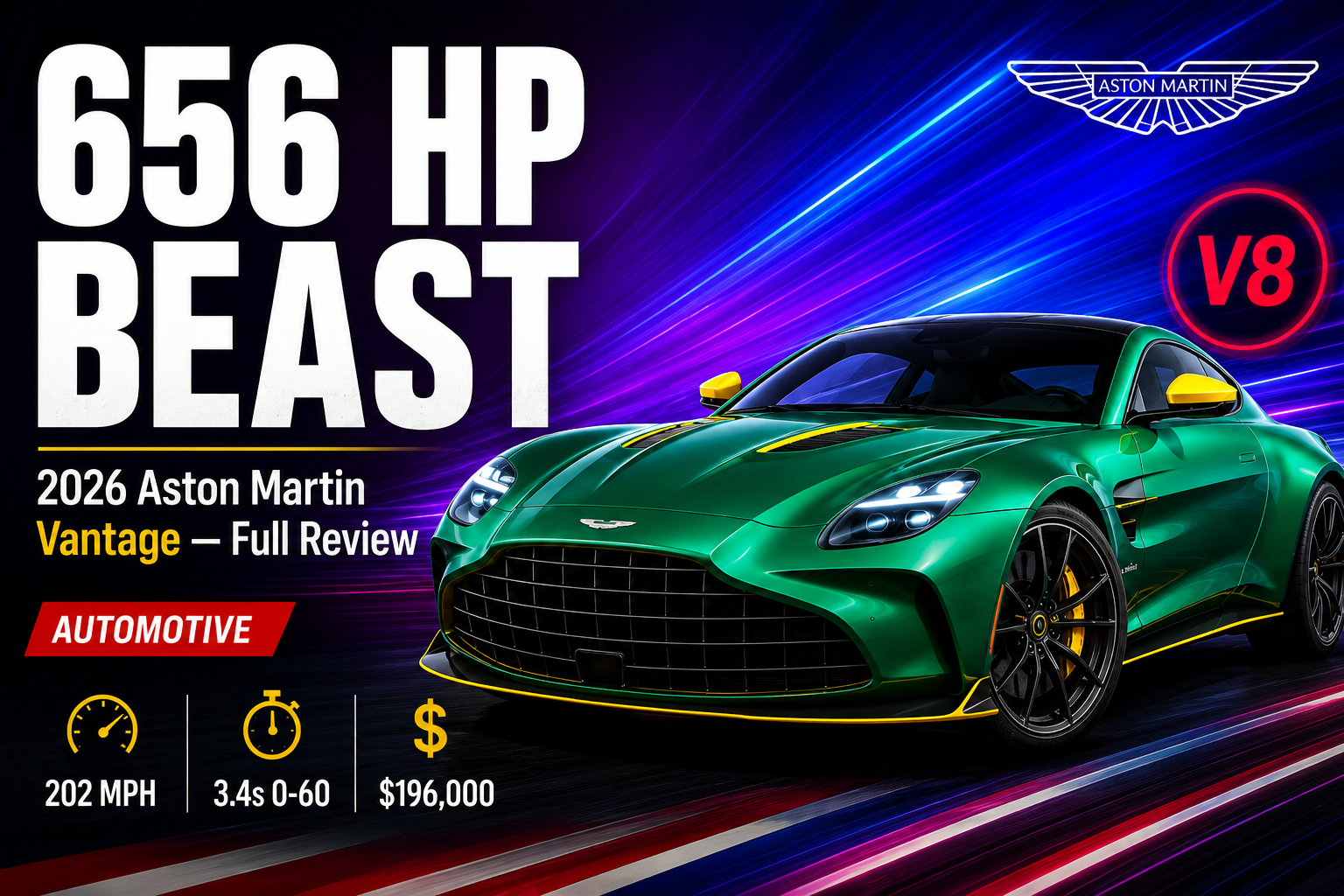
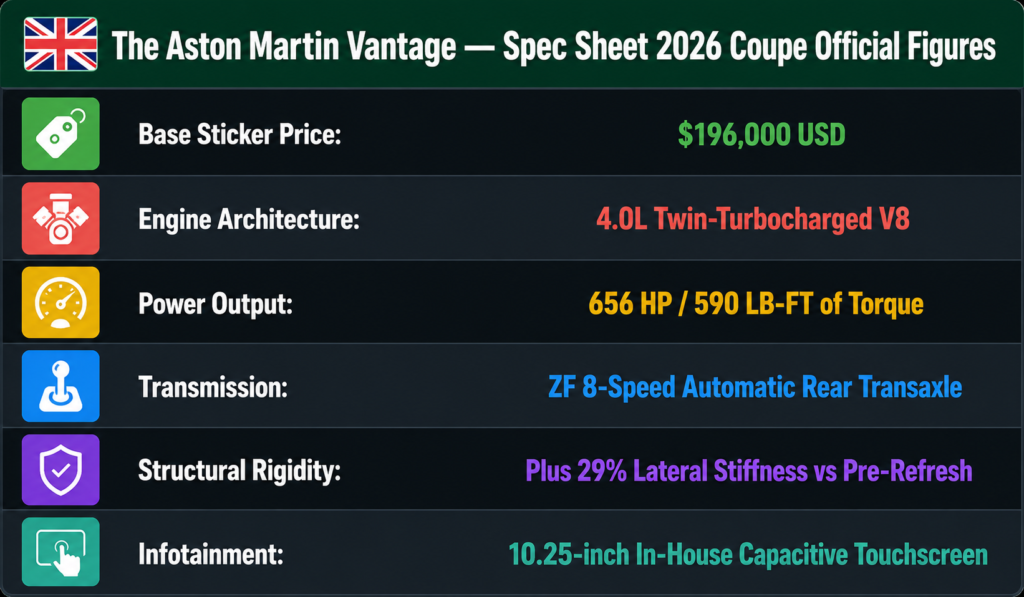
The sheer numbers associated with this mechanical overhaul are nothing short of staggering, representing one of the largest generational leaps in performance the sports car world has seen in years. The standard V8 engine now throws down an astronomical 656 horsepower (665 PS) and a monumental 590 lb-ft of torque, representing an eye-watering increase of 153 horsepower over the model it replaces. If you step up to the specialized 2026 Vantage S Coupe, that power figure climbs even higher to a wicked 670 horsepower at 6,000 RPM. This gargantuan influx of muscle alters the power-to-weight ratio to a supercar-shaming 393 horsepower per ton, putting it within striking distance of older flagship hypercars. When you deploy the integrated launch control system, the car hooks up its massive rear tires and rockets from 0 to 60 mph in a blistering 3.2 to 3.4 seconds, depending on the road surface and ambient conditions. Keep your foot pinned, and it will dispatch the quarter-mile mark in a mere 11.2 seconds at a trap speed crossing 130 mph. This relentless acceleration does not taper off as the digital speedometer climbs, pushing the muscular body forward until it breaches an incredible top speed of 202 mph.
| Performance Metric | Standard Vantage Coupe | Vantage S Coupe (2026 Spec) |
| Engine Configuration | 4.0L Twin-Turbo V8 | 4.0L Twin-Turbo V8 |
| Peak Horsepower | 656 hp @ 6,000 RPM | 670 hp @ 6,000 RPM |
| Peak Torque | 590 lb-ft @ 2,000-5,000 RPM | 590 lb-ft @ 2,000 RPM |
| 0-60 mph Sprint | 3.4 Seconds | 3.3 Seconds |
| Maximum Top Speed | 202 mph | 202 mph |
The Thermal Management Challenge of a Hot V Setup
Generating that level of ferocious horsepower within a tightly confined, front-mid engine layout presents an absolute nightmare for thermal engineers, especially when dealing with a “Hot V” configuration. In this specific layout, the massive turbochargers are nestled directly inside the valley of the cylinder banks, creating an intense concentration of heat right at the center of the engine block. To prevent this mechanical furnace from cooking itself during track sessions or spirited canyon drives, the cooling apparatus had to be increased by a substantial 30%. The design team completely reshaped the front fascia, creating a massive opening to force immense volumes of cool air across the water-to-air charge coolers. They also integrated highly functional, gloss-black or twill carbon-fiber hood blades that act as low-pressure extractors, actively pulling blistering air out of the engine bay while the vehicle is in motion. This constant thermal evacuation ensures that the intake air temperatures remain remarkably low, protecting the engine from pulling timing or losing power during extended periods of hard driving. It is a highly complex ballet of aerodynamics and thermodynamics working behind the scenes, allowing you to enjoy consistent, unrelenting performance whether you are laps deep into a track day or stuck in summer traffic.
Transmission and Drivetrain Dynamics
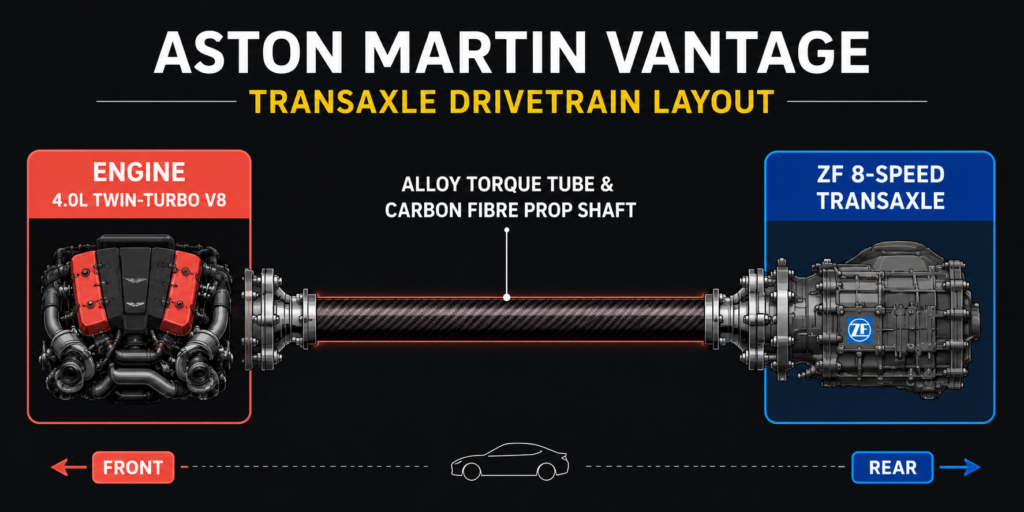
To properly harness such a massive mountain of torque without instantly turning the rear tires into expensive clouds of smoke, a truly exceptional drivetrain was required. The aston martin vantage uses a layout where the transmission is completely separated from the engine block, sending its power down an incredibly rigid alloy torque tube. Inside this protective structural tunnel spins a lightweight, ultra-strong carbon fiber propeller shaft that minimizes rotational inertia and sharpens throttle response. This direct mechanical link ensures that every single input from your right foot is communicated to the rear axle with zero latency or flexing under heavy load. By packaging the gearbox at the rear axle rather than bolting it directly to the engine, the engineers successfully pulled a massive amount of weight away from the nose of the car. This clever packaging plays a monumental role in how the vehicle shifts its weight during quick, consecutive directional changes, giving the driver an incredibly clear picture of exactly how much grip is left at each corner.
The Transaxle Architecture and Shorter ZF Calibration
The rear-mounted weapon of choice is the highly revered ZF eight-speed automatic transaxle, a gearbox known across the automotive industry for its supreme versatility and bulletproof reliability under immense power. For this specific application, the engineering team threw out the old gear maps and completely recalibrated the shift software to deliver an incredibly snappy, dual-clutch-like experience. They shortened the final drive ratio by 5% to a sharp 3.083:1, a deliberate choice that maximizes mechanical leverage and keeps the V8 engine spinning directly in the meat of its power band. When you pull the beautifully weighted steering-column-mounted paddles, the transmission executes lightning-fast upshifts that click home with a satisfying mechanical thump in Sport Plus mode. Conversely, when you are simply cruising down the interstate in the default GT mode, the gearbox transforms into an incredibly smooth, civilized companion that skips effortlessly into higher gears to maximize efficiency. It is this dual-personality calibration that makes the car so uniquely appealing, providing violent, race-car-quick gear changes when you want them, and imperceptible, silky shifts when you just want to relax on a long road trip.
How the Electronic Rear Differential Dictates Corner Traction
Managing the delivery of 590 lb-ft of torque to just two driven rear wheels requires an incredibly smart, lightning-fast piece of hardware acting as the final arbiter of traction. The car relies on an advanced, electronically controlled limited-slip rear differential, commonly referred to as the E-Diff, which is deeply integrated into the car’s central stability computer. This system continuously monitors wheel speed, steering angle, throttle position, and lateral g-forces, making micro-adjustments to the clutch packs inside the differential in a matter of milliseconds. When you first pitch the car into a sharp corner, the E-Diff opens up completely, allowing the inner and outer rear wheels to spin at completely different speeds to deliver a crisp, uncompromised front-end bite. The moment you clip the apex and begin to feed in the power, the computer locks down the differential with absolute authority, ensuring that torque is sent evenly to both rear tires to launch you down the straightaway. It gives the car an incredibly predictable, confidence-inspiring behavior on corner exit, effectively eliminating the sudden, snappy oversteer characteristics that plagued high-horsepower sports cars of the past.
Designing a Visual Masterpiece: Muscularity Meets Aerodynamics
When you first encounter the aston martin vantage in the metal, its sheer physical presence is enough to make you stop dead in your tracks. The exterior design team managed to pull off a spectacular balancing act, blending the traditional, elegant proportions of a classic British grand tourer with the raw, menacing muscle of a modern track car. The bodywork looks as though it has been stretched tightly over a highly athletic skeletal frame, with crisp, clean lines that draw your eyes from the low nose back to the beautifully flared rear hips. It retains the classic sports car silhouette featuring short front and rear overhangs, a sleek arching roofline, and massive wheels that completely fill out the arches with zero unsightly gap. Every single line, intake, and curve on this car serves a very real aerodynamic or mechanical purpose, completely avoiding the tacky, non-functional plastic vents that clutter lesser performance cars. It is a stunning visual achievement that honors the brand’s historic design language while injecting a healthy dose of modern aggression that demands your undivided attention from every single angle.
The Domineering Vane Grille and Widened Track Stance
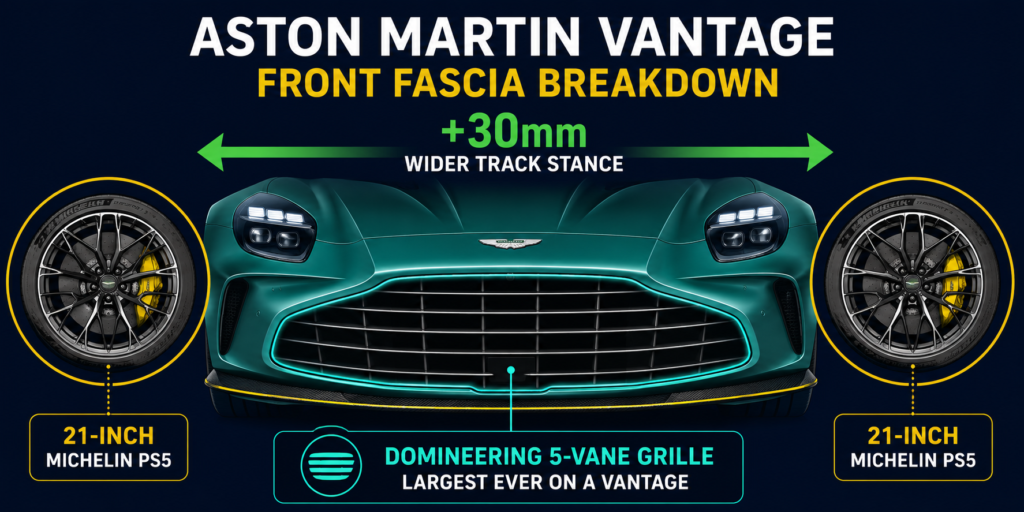
The most immediate change you will notice when viewing the car from the front is the massive, domineering 5-vane metal grille, which stands as the largest and most assertive intake ever fitted to a Vantage. This bold design choice was driven entirely by the engine’s immense cooling requirements, but it also pays a beautiful visual homage to the legendary One-77 hypercar. To match this aggressive face, the entire body was widened by a substantial 30 millimeters, giving the car a remarkably planted, low-slung stance that looks incredibly wide in your rearview mirror. This wider body allowed the engineers to push the wheels further out to the edges of the chassis, creating a significantly larger contact patch on the asphalt that pays massive dividends in mechanical grip. Framed by striking Matrix LED headlights that cut through the darkness with mathematical precision, the front end looks absolutely predatory. The muscular theme continues along the sides, where the classic “swan wing” doors open slightly upward to prevent scraping against high curbs, a brilliantly practical touch that adds a wonderful sense of supercar theater every time you step inside.
Downforce Engineering and Integrated Aero Upgrades
As you move around to the rear of the vehicle, you begin to appreciate the extensive aerodynamic work that was conducted inside the wind tunnel to keep this 202-mph machine safely glued to the earth. The front lip features intricate biplane splitters at its outer edges that cleanly manage incoming airflow, directing a portion under the flat belly pan while utilizing venturi vanes to tune high-speed stability. At the rear, an integrated decklid spoiler works in perfect harmony with a massive, redesigned lower diffuser to control the clean separation of air from the back of the car. On high-spec models or versions equipped with the specialized Upper and Lower Black Packs, these components are rendered in gorgeous 2×2 twill carbon fiber, adding a menacing contrast to the vibrant paintwork. This careful aerodynamic shaping generates up to 97 pounds of functional downforce at high velocities, preventing the rear end from becoming light or nervous when you are flat-out down a straightaway. It is a masterclass in aerodynamic efficiency, managing high-speed stability and cooling requirements without resorting to an enormous, unsightly fixed rear wing that would ruin the car’s timeless lines.
Inside the Cockpit: A Shift in Luxury and Ergonomics
For several years, the single biggest criticism leveled against Aston Martin cars was directed squarely at their interior cabins, which frequently relied on outdated, hand-me-down technology that felt old the day it launched. Stepping into the cockpit of the new aston martin vantage reveals that those dark days are officially over, replaced by an ultra-luxury sanctuary that is completely breathtaking. The design team completely gutted the old dashboard layout, starting with a clean sheet of paper to create an environment that places the driver at the absolute center of the universe. The seating position is remarkably low and sporty, placing your hips close to the car’s center of gravity so you can feel exactly what the chassis is doing underneath you. Every single surface your hands touch is wrapped in premium materials, creating an overwhelming sensation of substance and bespoke craftsmanship that makes it incredibly hard to take this cabin for granted. It is a magnificent place to spend time, masterfully balancing the high-tech requirements of the modern world with the rich, tactile luxury expected of a car carrying the famous wings emblem.
Banishing Ancient Mercedes Infotainment for Bespoke Tech
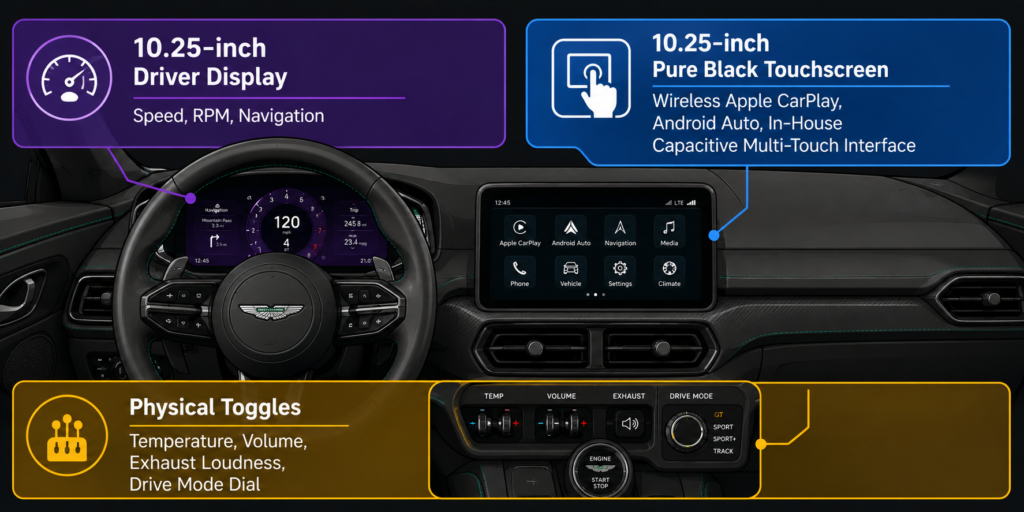
The absolute crown jewel of this interior transformation is the total banishment of the prehistoric, non-touch Mercedes infotainment system that relied on an infuriatingly clunky rotary trackpad. In its place sits a gorgeous, highly advanced 10.25-inch Pure Black touchscreen system that was meticulously developed completely in-house by Aston Martin’s dedicated technology division. This state-of-the-art display features full capacitive single and multi-finger gesture controls, reacting to your inputs with the fluid, instantaneous speed of a flagship modern smartphone. It comes standard with wireless Apple CarPlay Ultra and Android Auto integration, rendering high-resolution navigation maps and menus with absolute clarity across its vibrant screen. Thankfully, the engineers resisted the lazy modern trend of burying vital vehicle settings deep inside digital menus, choosing instead to surround the screen with crisp physical controls. You still get satisfyingly clicky metal toggles for temperature adjustments, fan speeds, and exhaust loudness, clustered around a beautifully machined rotary drive mode dial. It is a masterclass in ergonomic layout, giving you cutting-edge digital connectivity without sacrificing the muscle-memory ease of physical buttons.
Materials, Stitches, and Spatial Seating Accommodations
The sheer level of material artistry on display inside this cabin is enough to make an Italian fashion house nod in appreciation. The entire space is upholstered using a flawless combination of supple leather and rich Alcantara, brought together with roughly 2,500 individual stitches and over 16 meters of high-strength thread. There are absolutely no cheap, scratchy plastics to be found anywhere; even the lower door cards and hidden footwells are swathed in premium materials that feel incredibly substantial to the touch. Despite its compact, aggressive sports car exterior dimensions, the cabin is remarkably accommodating for larger frames. Writers standing over six-foot-one report that they can set the highly supportive sports seats back much further and lower than necessary, leaving plenty of elbow room to spare. The car also hides a practical secret behind its passenger compartment: it is a true hatchback. The entire rear glass decklid lifts up to reveal a cargo area offering up to 12.2 cubic feet of storage space when the parcel shelf is removed, providing more than enough room for a multi-week road trip for two.
Driving Dynamics: Track Weapon and Grand Tourer
An epic engine and a gorgeous interior mean absolutely nothing if a sports car falls apart the moment you throw it down a challenging piece of tarmac. Fortunately, the driving dynamics of the aston martin vantage are where the machine truly stamps its authority on the automotive world. This car possesses a fascinating dual personality that allows it to adapt seamlessly to whatever mood you happen to be in. In its baseline GT mode, it is an incredibly civilized, cosseting cruiser that mutes the outside world, allowing you to cross entire continents without a single hint of fatigue or lower back pain. However, a quick twist of the heavy metal drive mode selector into Sport or Sport Plus completely strips away that civilized veneer. The entire car instantly tenses up like a Bengal tiger on the hunt, sharpening its reflexes and demanding that you find the nearest twisty mountain pass. It is an incredibly rewarding, confidence-inspiring machine to pilot hard, delivering an intense level of driver engagement that will have you giggling like a schoolchild with every single corner you attack.
Bilstein Adaptive Dampers and Torsional Rigidity Upgrades
The foundational secret behind this breathtaking handling capability lies deep within the car’s heavily revised bonded aluminum structure. The engineering team systematically reinforced the chassis, adding a repositioned front crossmember and a significantly stiffer but lighter front cross brace over the top of the V8 engine block. These extensive structural reinforcements resulted in a massive 29% increase in torsional rigidity under heavy cornering loads, creating an incredibly solid, flex-free platform. This ultra-rigid foundation allowed Aston Martin to install state-of-the-art Bilstein DTX adaptive dampers, which boast an incredible five times the force-distribution bandwidth of the previous generation’s suspension. These skyhook-calibrated dampers continuously read the road surface thousands of times per second, managing compression and rebound strokes with absolute precision. Through long, sweeping corners, the suspension eliminates body roll entirely, keeping the chassis perfectly flat and stable while the massive 21-inch Michelin Pilot Sport S 5 tires claw into the asphalt. Yet, when you smash over a mid-corner pothole, the dampers absorb the harsh impact instantly, preventing the car from getting deflected off your chosen line.
Adjustable Traction Control and Driver Confidence
For drivers who love to explore the absolute limits of rear-wheel-drive performance, Aston Martin has integrated a motorsport-derived adjustable traction control system that is nothing short of revolutionary. When you completely deactivate the main Electronic Stability Control, you are granted access to nine distinct levels of traction intervention, controlled via a dedicated dial on the center console. Level nine acts as a tight safety net that steps in the moment the rear tires lose even a fraction of traction, making it perfect for cold, damp mornings or unfamiliar roads. As you click down through the lower settings, the computer gradually backs off, allowing the rear end to step out into beautiful, controlled power slides before gently catching you at a predetermined slip angle. This highly advanced system serves as an incredible coaching tool, allowing you to safely build your confidence and learn the exact limits of the 656-horsepower chassis without fearing a catastrophic spin into a stone wall. It makes the immense power of the V8 engine remarkably accessible, turning what could have been an intimidating, unmanageable brute into a beautifully cooperative partner in speed.
Final Verdict: Price, Options, and the V8 Paradigm
When you sit back and analyze the complete package that Aston Martin has delivered with this thoroughbred, it becomes blindingly obvious that they have built something truly special. The aston martin vantage is no longer just a pretty face that relies on its British charm to secure a spot in a wealthy enthusiast’s garage; it is a genuinely world-class sports car that earns its place through pure, unadulterated capability. It successfully pairs the emotional, thunderous theater of an old-school V8 muscle car with the razor-sharp handling dynamics and cutting-edge digital technology demanded by the modern luxury market. With a starting price kicking off around $196,000 for the Coupe and climbing past $210,000 for the glorious open-air Roadster, it represents a substantial financial investment that sits firmly in supercar territory. However, when you look at its breathtaking performance figures, flawless interior craftsmanship, and sheer road presence, it represents a far more emotional and exclusive proposition than its more clinical German competitors.
Navigating the ordering process requires a steady hand, as the brand’s extensive Q bespoke personalization program can quickly send the final window sticker deep into the stratosphere. Desirable exterior finishes like the stunning, heritage-soaked Podium Green paint will easily set you back an additional $9,700, while stepping up to full carbon-ceramic brakes saves 60 pounds of critical unsprung mass but commands a hefty premium. There are extensive carbon-fiber exterior packs, custom interior stitch configurations, and a mind-blowing 1,170-watt, 15-speaker Bowers & Wilkins ultra-luxury audio system that can easily add $100,000 to the baseline figure. Yet, even when fully optioned towards the $300,000 mark, the car delivers an experience that feels entirely justified. It represents a beautiful, roaring defiance against an increasingly sanitized automotive landscape, standing tall as one of the finest front-engine, rear-wheel-drive sports cars ever created by human hands.
Frequently Asked Questions Regarding the Vantage Lineup
Is the engine in the Aston Martin Vantage completely made by Mercedes?
While the foundational 4.0-liter twin-turbo V8 engine block is sourced through a strategic technical partnership with Mercedes-AMG, it undergoes extensive internal modifications before ever being dropped into the British sports car. The engineering team at Gaydon installs custom high-flow twin-scroll turbochargers, entirely revised cylinder heads, bespoke camshaft profiles, and a completely unique compression ratio. Furthermore, the electronic engine management software and throttle maps are completely written in-house by Aston Martin, giving the engine a highly progressive power delivery and a unique, thunderous exhaust note that is completely distinct from any product built in Germany.
How fast is the convertible roof on the Vantage Roadster?
The engineering team managed to design one of the most advanced, highly efficient fabric convertible mechanisms ever fitted to a luxury sports car. The Z-fold fabric roof on the Roadster variant is capable of fully retracting in a blistering 6.7 seconds and raising back into place in just 6.8 seconds, making it one of the fastest operating convertible tops on the global market. This lightning-fast mechanism can be fully operated at vehicle speeds up to 31 mph, ensuring that you can quickly adapt to a sudden downpour without being forced to come to a complete, unsafe stop on the side of the road.
What are the main visual differences on the 2026 Vantage S Coupe?
The newly introduced 2026 Vantage S Coupe features several highly functional aerodynamic and styling upgrades over the standard model to signify its elevated performance status. Up front, it sports a unique dual-element biplane front splitter that aggressively manages underbody airflow to maximize high-speed front-end stability. The hood features centrally mounted dual blades finished in high-gloss black or lightweight 2×2 twill carbon fiber to evacuate intense engine heat, while the rear decklid is fitted with a specialized fixed spoiler that generates up to 97 pounds of functional downforce across the rear axle.
Does the revised infotainment system feature physical buttons or is it entirely touch?
Aston Martin hit an absolute home run with the ergonomic design of their new interior, masterfully blending cutting-edge screen technology with traditional tactile switchgear. While the car features a beautiful, ultra-responsive 10.25-inch capacitive touchscreen for navigation and media, it completely rejects the trend of hiding basic climate controls inside digital submenus. The center console features physical, knurled metal roller switches for temperature and fan speed adjustments, dedicated buttons for safety systems and exhaust loudness, and a heavy mechanical rotary dial to seamlessly cycle through the different drive modes.
Are carbon-ceramic brakes standard equipment on the new model?
On the standard model coupe and roadster variants, carbon-ceramic brakes remain an expensive optional upgrade over the standard cast-iron ventilated discs, though they are highly recommended for drivers who plan to frequently exploit the car’s 202-mph top speed on a racetrack. However, if you step up to the specialized, high-performance 2026 Vantage S variant, the massive carbon-ceramic braking system is included as standard equipment from the factory. This high-end braking setup provides absolutely zero brake fade under extreme thermal load while shedding an incredible 60 pounds of unsprung mass from the suspension, allowing the adaptive dampers to react to road imperfections with even greater speed and precision.
Custom Message: This comprehensive analysis of the Aston Martin Vantage was meticulously crafted to deliver expert insights into its mechanical engineering, aerodynamic downforce updates, and interior technology transformation.












Dain vestim
Wow it’s amazing I really like it