

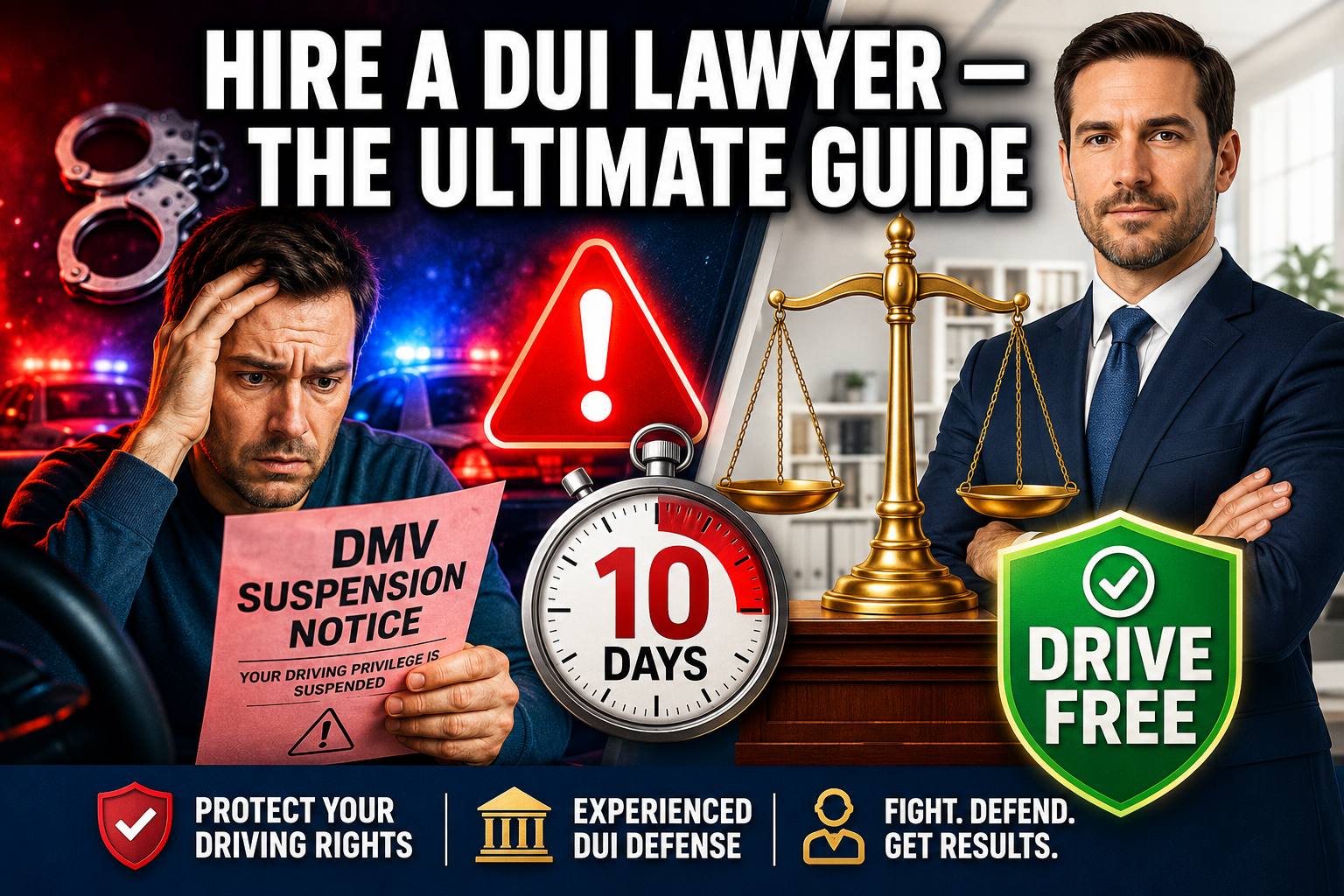
The Ultimate Guide to Hiring a DUI Defense Attorney: What Every Driver Should Know
The Shock of the Siren: Demystifying the Post-Arrest Panic
Think of a DUI arrest like a sudden, violent thunderstorm that rips through an otherwise calm afternoon of driving. One minute you are listening to the radio, navigating familiar streets, and the next you are staring at a blinding wall of flashing red and blue lights in your rearview mirror, your heart hammering against your ribs like a trapped bird. The cold click of steel handcuffs around your wrists acts as a psychological line in the sand, plunging you into a dizzying vortex of booking rooms, fingerprints, and sobering cells. It is completely natural to feel an overwhelming wave of panic, shame, and absolute terror about what this single event means for your career, your family, and your fundamental freedom. But here is the raw truth that you need to anchor yourself to right now: an arrest is merely an accusation, not an unassailable final verdict. The legal system is incredibly complex, mechanical, and highly prone to human error, meaning that you are far from powerless in this situation. By turning that paralyzing fear into structured, tactical action, you can begin to dismantle the prosecution’s case block by block, protecting your future before the cement even has a chance to dry. Securing an experienced dui defense attorney is the single most critical countermeasure you can deploy during this time of intense vulnerability.
The Immediate Clock: Critical Windows of Action After Handcuffs
When the police release you from custody with a citation in hand, the ticking clock becomes your fiercest adversary. Many drivers mistakenly believe they can simply sit back and wait for their initial court date to roll around, but this passive approach is a recipe for administrative disaster. Behind the scenes, independent bureaucratic machines are already moving to strip away your driving privileges before you ever step foot inside a criminal courtroom. The National Highway Traffic Safety Administration (NHTSA) reports that nearly 12,000 alcohol-impaired driving traffic fatalities occur annually, forcing state governments to implement swift, aggressive administrative license suspension protocols immediately following an arrest. This means you often have only a handful of days to formally request a specialized administrative hearing to contest the automatic suspension of your driver’s license. Failing to act within this hyper-compressed window results in an automatic forfeiture of your right to drive, completely independent of whether you are ultimately found guilty or innocent by a judge. By putting a knowledgeable dui attorney on your side immediately, you construct an instant shield that can halt these automatic suspensions, preserve your mobility, and secure early access to vital police reports before they are modified or lost.
What Does a DUI Defense Attorney Do Behind Closed Doors?
A common misconception among drivers is that legal defense is a performative art restricted entirely to dramatic arguments delivered inside a crowded courtroom. In reality, the true combat occurs far from the public eye, deep within the quiet confines of an attorney’s office through meticulous analytical labor. A truly skilled dui defense attorney operates like a master watchmaker, carefully taking apart every single piece of the prosecution’s case to find the tiny, hidden gears that are broken, misaligned, or improperly maintained. They spend hours poreing over dense police narratives, cross-referencing officer timelines, and dissecting the chemical processes used to establish your blood alcohol concentration (BAC). This invisible groundwork is where cases are genuinely won or lost, as a single procedural deviation by law enforcement can bring down an entire mountain of incriminating evidence. Your legal representative acts as a dedicated investigator, objective legal advisor, and aggressive negotiator all rolled into one highly focused professional. They look past the scary labels on your charging documents to evaluate the physical realities of your traffic stop, ensuring that your constitutional rights are fiercely protected against overzealous state actors.
Deconstructing the Technical Evidence: Breathalyzers and Blood Draws
The state wants you to believe that chemical testing equipment is infallible, operating with the absolute certainty of a divine mathematical truth. However, a seasoned dui attorney knows that breathalyzers and gas chromatography machines are merely human inventions prone to constant calibration drift, software glitches, and mechanical wear. Evidentiary breath testing devices rely on complex infrared spectroscopy or fuel cell technology, both of which require rigorous, documented maintenance schedules, routine cleanings, and precise field testing before and after every single breath sample is gathered. If a technician skips a single scheduled validation check, or if the officer fails to observe you continuously for a full fifteen to twenty minutes prior to testing, the entire chemical result becomes legally suspect. Furthermore, human biology introduces massive variables; factors like gastroesophageal reflux disease (GERD), low-carb diets, dental work, or specific medical conditions can trap alcohol vapors in the oral cavity, artificially inflating breathalyzer readings far beyond your actual systemic blood levels. Blood tests are equally vulnerable to human error, frequently suffering from chain-of-custody failures, improper sample refrigeration that allows fermentation to occur inside the vial, or the utilize of expired chemical preservatives that ruin the integrity of the specimen.
Pre-Trial Motions: The Art of Getting Evidence Thrown Out
Before a case can ever advance to a formal trial, your legal counsel can utilize a powerful suite of procedural maneuvers known as pre-trial motions to cripple the prosecution’s strategy. Think of these motions as tactical strikes designed to permanently erase the state’s most damaging pieces of evidence before a jury ever has the opportunity to look at them. The most common tool in this arsenal is a motion to suppress evidence based on a distinct lack of reasonable suspicion for the initial traffic stop, rooted firmly in your Fourth Amendment protections against unreasonable searches and seizures. If an officer pulled you over simply because they had a vague hunch, rather than a clear, articulable traffic violation like a broken taillight or reckless weaving, all subsequent evidence gathered after that stop becomes “fruit of the poisonous tree.” This means your field sobriety tests, breath samples, and any statements you made while sitting in the back of the cruiser are instantly wiped from the record. Your legal champion will also aggressively analyze whether law enforcement violated your Miranda rights by interrogating you while in custody without providing the mandatory constitutional warnings. When a defense layer successfully strips away the chemical tests and officer observations through these formal motions, the state is frequently left with an empty shell of a case, forcing prosecutors to completely dismiss the charges.
The Plea Bargain Arena: Negotiating for Lesser Charges
In situations where the underlying evidence is legally solid and cannot be thrown out through pre-trial motions, the battlefield shifts directly into the realm of strategic plea negotiations. This arena requires a delicate blend of deep legal prestige, established local reputation, and an intricate understanding of human psychology to sway the prosecutor’s perspective. A masterful dui defense attorney does not simply beg for mercy; they leverage the weaknesses they uncovered during discovery to convince the state that a conviction at trial is far from a guaranteed certainty. They construct a comprehensive narrative that highlights your clean record, professional standing, and proactive steps toward alcohol education, reframing you as a responsible citizen who made an isolated mistake rather than a chronic threat to public safety. Through this calculated positioning, your counsel can frequently secure a reduction of the charges down to lesser offenses such as “wet reckless” (reckless driving involving alcohol), standard reckless driving, or simple speed exhibitions. These reduced charges carry immensely lighter burdens, allowing you to avoid the devastating stigma of a drunk driving conviction, bypass mandatory jail sentences, and shield your automotive insurance premiums from catastrophic escalations that could last for years.
Public Defender vs. Private DUI Counsel: An Objective Analysis
When you find yourself standing at this critical legal crossroad, one of the most agonizing decisions you will face is choosing between a court-appointed public defender or investing in private legal representation. Public defenders are licensed, fully qualified attorneys who often possess an incredible wealth of courtroom experience and intimate familiarity with local judges and prosecutors. However, the tragic flaw of the public defense system is not a lack of talent or passion, but rather an absolute crisis of excessive volume and severely restricted structural resources. A typical public defender is frequently forced to manage dozens of complex cases simultaneously, leaving them with only a fraction of the time required to deep-dive into the technical calibration logs of a specific breathalyzer machine. Private counsel, by distinct contrast, purposefully limits their active caseload to ensure that your defense receives the exhaustive, personalized analysis it truly deserves to succeed. They possess the dedicated operational bandwidth to answer your late-night phone calls, thoroughly interview arresting officers, and hire independent forensic experts to challenge the state’s scientific assertions.
| Legal Representation Metrics | Court-Appointed Public Defender | Private DUI Defense Attorney |
| Average Caseload Volume | High (Often 50-100+ active files) | Controlled (Selectively limited by firm) |
| Time Allocation Per Client | Restricted to brief court appearances | Comprehensive consultations and phone access |
| Forensic Expert Accessibility | Requires complex, rare court approval | Immediately available through private networks |
| DMV Hearing Representation | Strictly excluded from administrative cases | Fully integrated into the overall defense strategy |
| Case Customization Level | Standardized programmatic processing | Bespoke, individualized tactical blueprints |
Specialized Warfare: Why DUI Defense Requires Tech-Savvy Representation
Driving impairment cases have evolved far beyond basic debates over whether an individual was weaving across a white line or slurring their speech during a brief roadside chat. Today, this field of law represents a highly specialized form of technological and scientific warfare that sits at the intersection of human physiology, organic chemistry, and advanced software engineering. A general practice attorney who handles divorces, simple wills, and basic slip-and-fall claims is simply not equipped with the hyper-specific tools required to cross-examine a state forensic scientist on the inner workings of gas chromatography. A elite dui attorney spends thousands of dollars attending specialized national seminars, studying advanced blood-vial preservation techniques, and earning formal certifications in the administration of standardized field sobriety tests. They know exactly how to read a breathalyzer’s internal diagnostic printout to identify subtle radio frequency interference or temperature fluctuations that skew the sample results. Entrusting your entire future to a legal generalist is very much like asking a general family doctor to perform intricate, high-stakes open-heart surgery on you—it is an unnecessary risk when specialized expertise exists.
California DUI Laws: Surviving the Golden State’s Cold Realities
Operating a motor vehicle in California under the suspicion of impairment drops you directly into one of the most punitive, highly automated legal frameworks in the entire nation. The Golden State views driving not as an inherent constitutional right, but as a strictly regulated privilege that can be suspended with striking speed by the Department of Motor Vehicles (DMV). Recent legislative updates, including the extension of the Statewide Ignition Interlock Device (IID) Pilot Program through AB 366 up to January 1, 2033, signal that California is doubling down on its aggressive tech-based enforcement initiatives. If you are convicted or face administrative action, you are looking at mandatory out-of-pocket fines, costly multi-month alcohol education programs, and the immediate installation of an IID at your own expense just to maintain basic driving privileges. The financial shock alone can easily climb into thousands of dollars, completely independent of the severe spikes in your mandatory auto insurance rates. Navigating this vast labyrinth of criminal courts and bureaucratic administrative offices requires the steady, experienced hand of a localized dui attorney california who understands the distinct nuances of West Coast justice.
The Crucial 10-Day DMV Hearing Rule Exploded
The moment you are processed for a driving offense in California, the arresting officer will seize your physical plastic driver’s license and hand you a easily overlooked, pink piece of paper. This document is not just a citation; it is your official Notice of Suspension and a highly restrictive temporary license that expires exactly 30 days from the date of your arrest. Nestled deep within the fine print of that pink form is an unforgiving legal trap: you have exactly 10 calendar days from the date of your initial arrest to contact the California DMV Driver Safety Office to formally request an Administrative Per Se (APS) hearing. If you allow this brief ten-day window to slam shut without taking action, your right to an administrative review is permanently waived, and your license will be automatically suspended the moment the 30-day temporary permit expires. When you or your specialized dui attorney california make this formal request on time, it triggers an immediate “stay” on the suspension, keeping your full driving privileges completely active for months while your case is thoroughly reviewed. This critical pause provides your legal defense team with invaluable extra time to subpoena the state’s initial discovery packet, allowing them to dissect breathalyzer maintenance records long before your first criminal court date.
Navigating the Vehicle Code Blocks: VC 23152(a) and VC 23152(b)
A standard California impairment arrest almost always results in a driver being formally charged with two completely distinct misdemeanor counts on their criminal complaint: Vehicle Code 23152(a) and Vehicle Code 23152(b). This dual-pronged prosecutorial strategy is designed to give the state two separate paths to secure a conviction based on the exact same driving incident. VC 23152(a) is the subjective portion of the law, making it entirely illegal to operate a vehicle while under the actual influence of alcohol or drugs to a degree that your physical or mental capabilities are impaired. This means the prosecutor can theoretically convict you under subsection (a) even if your blood alcohol level was well below the legal threshold, relying entirely on officer observations of bloodshot eyes, unsteady balance, or minor driving errors. Conversely, VC 23152(b) is the objective, or per se, portion of the statute, stating that it is a crime to drive with a blood alcohol concentration of 0.08% or higher, regardless of how sober, alert, and perfectly controlled you actually appeared to be behind the wheel. A truly proficient defense advocate understands how to attack both fronts simultaneously, aggressively undermining the officer’s subjective physical descriptions while using scientific data to challenge the objective validity of the chemical test.
Washington State DUI Framework: Strict Minimums and the 15-Year Trap
Driving through the Pacific Northwest under the cloud of an impairment charge exposes you to an unyielding statutory environment where judicial discretion is severely restricted by law. Washington State has long maintained some of the absolute toughest mandatory sentencing minimums in the country, leaving judges with zero authority to waive jail time or eliminate fines, even for individuals with completely spotless criminal histories. The legal landscape shifted into an even more severe era on January 1, 2026, when sweeping legislative updates officially went into effect across the state, drastically altering how cases are prosecuted. The most revolutionary change introduced by lawmakers is the permanent expansion of the felony look-back window from a ten-year period to an incredibly long fifteen-year timeframe. This means that if you have an old, decades-old offense on your record that you thought was buried in the past, a new arrest in 2026 can instantly skyrocket your case into a felony prosecution, exposing you to multi-year prison terms and permanent loss of civil rights. Confronting this newly amplified legal risk makes it an absolute necessity to secure a seasoned dui attorney washington state who is fully versed in these recent statutory overhauls.
Implied Consent Laws and the Treatment-Focused Options
Washington operates under a strict “implied consent” doctrine, meaning that by the simple act of operating a motor vehicle on public roadways, you have legally agreed to submit to a breath test if an officer has probable cause to suspect impairment. If you choose to refuse this evidentiary test at the police station, the state will punish your non-compliance with a mandatory, long-term revocation of your license and significantly harsher criminal penalties if you are ultimately convicted. For a first-time offense with a BAC below 0.15%, you are facing a mandatory minimum of 24 consecutive hours in jail or 15 days of intensive electronic home monitoring, alongside fines that easily approach one thousand dollars. However, the 2026 statutory updates have thankfully expanded and clarified eligibility for the state’s intensive “deferred prosecution” program for individuals wrestling with genuine, underlying substance use disorders. This complex pathway allows a driver to petition the court to completely pause the criminal charges in exchange for entering into a rigorous, highly structured two-year treatment regimen. If you successfully complete every phase of this demanding program and maintain total compliance with strict probation monitoring, the underlying criminal charges are completely dismissed, offering a lifesaving alternative to traditional incarceration that a skilled dui attorney washington state can help you secure.
Phoenix and Maricopa County: Surviving Arizona’s Extreme Frameworks
If you are arrested for impaired driving within the sun-scorched boundaries of Maricopa County, you are entering what is widely recognized as a zero-tolerance legal environment. Arizona law enforcement agencies and municipal courts operate with an uncompromising philosophy, treating even low-level, first-time offenses with a level of severity that other states reserve for repeat felons. In the city of Phoenix, prosecutors are strictly forbidden from offering standard plea down reductions unless there are glaring, fatal flaws in the arresting officer’s initial evidence packet. This means that from the very moment the handcuffs click shut, you are facing a mandatory stay in jail, steep financial assessments, and an immediate requirement to install a costly breath-testing device in your car dashboard. The Phoenix Municipal Court system is highly optimized to process these cases with rapid, machine-like efficiency, frequently overwhelming unrepresented drivers before they even understand their core options. To survive this meat-grinder of a legal system without having your life completely upended, you absolutely must enlist a relentless dui attorney in phoenix who knows how to spot the tiny operational cracks in Maricopa County’s rigid enforcement protocols.
Decoding the Extreme and Super Extreme Thresholds
Arizona does not just punish standard drunk driving; the state has pioneered highly aggressive statutory tiers based on the specific concentration of alcohol discovered in your system under Arizona Revised Statutes § 28-1382. If your chemical test reveals a blood alcohol level between 0.15% and 0.199%, you are not facing a standard misdemeanor; you are formally charged with an “Extreme DUI,” which triggers a mandatory minimum sentence of 30 consecutive days in jail for a first offense. If your chemical reading climbs to 0.20% or higher, the state reclassifies your charge into the terrifying category of a “Super Extreme DUI,” amplifying the mandatory initial jail stay to an unyielding 45 consecutive days, accompanied by thousands of dollars in mandatory prison construction fund assessments. These extreme classifications operate under a strict liability framework, meaning the state does not have to prove you were driving erratically or showing outward signs of visible drunkenness; the raw number on the machine alone triggers the crushing penalties. A masterful dui attorney in phoenix must deploy highly sophisticated scientific defenses to combat these numbers, frequently auditing the laboratory’s chemical storage temperatures, testing for systemic blood fermentation, or demonstrating that your BAC was actually rising and was much lower at the precise moment you were driving.
Finding the Right Shield: Vetting a DUI Defense Attorney Near Me
When you sit down at your computer or look at your phone to search for a qualified dui defense attorney near me, you will instantly be hit with an overwhelming tidal wave of flashy websites, bold promises, and slick marketing slogans. It can feel a lot like trying to choose a safe life raft while being tossed about in the middle of a chaotic shipwreck. To cut through the corporate noise and find a genuine legal shield who will fight for your future, you must look far past simple online advertisements and focus on verified, localized courtroom experience. You need a legal champion who regularly walks the specific hallways of the courthouse where your case will be heard, someone who knows the unique habits of the local judges and the specific formatting preferences of the prosecuting team. Avoid massive, multi-state legal factories that treat clients like a collection of case numbers on a spreadsheet, passing your files down to inexperienced junior associates who have never cross-examined a state breath specialist. Your future demands an authentic, dedicated specialist who has spent years perfecting the highly complex art of localized scientific defense.
Essential Questions to Ask Before Signing a Retainer
Before you write a single check or sign a formal retainer agreement with any legal representative, you must treat your initial consultation as a rigorous, high-stakes interview process. Do not be afraid to lean across the desk and ask the tough, direct questions that will reveal whether the person sitting across from you is a battle-tested advocate or a simple plea-bargain broker. Ask them exactly how many driving impairment cases they have taken completely to a jury trial over the past twelve months, and have them break down their specific strategic approach to managing your upcoming DMV administrative hearing. Demand absolute clarity regarding their professional fee structure; you need to know if their quote is a transparent, all-inclusive flat fee or if you will be constantly nickel-and-dimed with hidden charges for paralegal hours, photocopy costs, and expert witness retainers. If an attorney looks you in the eye and guarantees a perfect, flawless outcome or promises that they can easily get your case dismissed without even looking at the police report, pick up your bags and walk out the door immediately. A truly honorable and effective dui defense attorney near me will always provide you with a candid, clear assessment of your situation, outlining both the severe risks and the tactical paths forward without relying on empty marketing fluff.
Protecting Your Future: A Strategic Way Forward
Standing strong in the face of an impairment charge requires a profound shift in perspective, moving your mindset away from paralyzing despair and turning it directly toward aggressive, structured defense preparation. It is incredibly easy to let the weight of an arrest make you feel like your story has already been completely written by the state. But remember: the prosecution’s evidence is merely a one-sided narrative constructed by an officer who is human, fallible, and operating under intense pressure to close files. By pairing your resolve with the scientific prestige and tactical experience of a dedicated legal champion, you can actively rewrite that narrative, exposing the hidden technical flaws and constitutional overreaches that can turn the tide of battle completely in your favor. Whether you are fighting a strict 10-day rule on the coast of California, navigating the newly expanded 15-year look-back windows of Washington State, or standing up to the harsh extreme tiers of downtown Phoenix, your path to freedom begins with a single step of decisive action. Protect your career, preserve your daily mobility, and reclaim your peace of mind by putting a proven legal advocate in your corner today.
Frequently Asked Questions Regarding DUI Defense
What happens if I completely refuse to perform the roadside field sobriety tests requested by the officer?
In the vast majority of jurisdictions, standard roadside physical exercises—such as the one-leg stand, the walk-and-turn, or the follow-the-pen eye test—are completely voluntary, meaning you have a legal right to politely decline them without facing automatic administrative penalties. Officers utilize these subjective coordination tests to gather damning physical evidence to build a probable cause framework for your arrest, using any minor sway or misstep to justify putting you in handcuffs. However, you must carefully distinguish these voluntary roadside physical exercises from the mandatory chemical breath or blood tests that occur later at the police station after an arrest has been made. Refusing the post-arrest station chemical test triggers immediate, severe statutory license revocations under state implied consent laws, whereas declining the initial roadside coordination tests simply deprives the officer of the subjective evidence they want to use against you.
Can I still be convicted of driving under the influence if my blood alcohol concentration was verified to be below the legal 0.08% limit?
Yes, you can absolutely still face a formal conviction even if your chemical test results reveal a blood alcohol concentration that sits comfortably below the standard 0.08% legal threshold. Most states maintain dual-track impairment statutes that allow prosecutors to convict a driver under a subjective theory of impairment, proving that alcohol or drugs had compromised your mental and physical faculties to a degree that you could no longer operate a vehicle safely. The state will build this subjective case by leaning heavily on the arresting officer’s personal observations of your driving behavior, your physical appearance, your speech patterns, and your performance on field coordination tests. Having a tech-savvy legal representative is incredibly vital in these below-the-limit cases, as they can effectively demonstrate to a jury that your driving variations or physical fatigue were caused by everyday factors like exhaustion, poor weather conditions, or minor medical issues rather than actual intoxication.
How long will a standard driving impairment conviction remain visible on my public criminal record?
Unlike standard traffic citations or minor speeding tickets that automatically drop off your public driving record after a handful of years, an impairment conviction is a formal criminal offense that can remain permanently etched onto your public record for decades. Certain states explicitly prohibit the expungement, sealing, or removal of driving under the influence convictions, meaning they will permanently show up on comprehensive background checks performed by future employers, corporate landlords, and professional licensing boards. Furthermore, states use long-term statutory look-back windows—which have recently expanded to fifteen years in places like Washington State—to count prior offenses against you if you are ever arrested again in the future. Securing the services of an aggressive legal team is the most effective way to prevent this permanent stain from attaching to your name, as they work to get charges dismissed or reduced to non-alcohol offenses that can eventually be wiped clean.
Will I automatically lose my job and my professional career licenses if I am convicted of a misdemeanor driving offense?
While a misdemeanor conviction does not automatically guarantee immediate termination for every single worker, it poses an immense, direct threat to anyone holding specialized professional licenses or working in corporate corporate environments. Educators, healthcare professionals, commercial drivers, and financial advisors are frequently bound by strict ethical reporting requirements, forcing them to formally disclose any criminal convictions to their respective state licensing boards within a handful of days. A conviction can trigger intensive disciplinary reviews, mandatory probation periods, or complete suspension of your professional credentials, while anyone required to drive a company vehicle will likely be dropped from corporate insurance policies instantly. By putting an experienced legal advocate on your case early, you can aggressively pursue alternative resolutions or reduced charges that do not trigger these catastrophic career-ending professional board disclosures.
What is the overall average financial cost of a first-time driving impairment conviction when adding up all fees and expenses?
The true financial burden of a conviction is vastly higher than the initial bail money or the simple fine written on the bottom of your court citation, frequently stacking up to a staggering total between ten thousand and twenty thousand dollars out of pocket. You are required to pay statutory court fees, mandatory assessments for state prison construction funds, costly monthly fees for supervised probation, and hundreds of dollars to complete mandatory alcohol education courses. Furthermore, you must cover the daily rental and calibration costs of an ignition interlock device for your car, alongside absorbing catastrophic auto insurance rate spikes that frequently triple your monthly premiums for three to five continuous years. Investing in an elite legal representative is often the most financially sound decision you can make, as a successful defense can completely shield you from these crushing, long-term economic drains.











Leave a Reply