

WisDOT Wholesale Dealer License Revocations: How to Protect Your Auto Business and Titles
Inside the Crackdown: Why the WisDOT DMV Dealer and Agent Section is Pulling Licenses
Think of the automotive commercial ecosystem in Wisconsin as a high-stakes highway where compliance acts as your seatbelt. When the state decides to tighten its grip on corporate regulations, independent operators face immediate risk if they fail to keep pace with changing standards. The Wisconsin department of transportation recently sent shockwaves through the local automotive industry by executing an aggressive wave of business closures targeting non-compliant wholesale operators. This synchronized administrative enforcement campaign points to a massive structural shift in how the state monitors independent corporate entities. If you operate a small dealership, act as an independent auto broker, or routinely source your inventory from regional automotive auctions, you cannot afford to ignore these heavy regulatory actions. The state is no longer issuing simple warnings or granting lengthy grace periods for administrative mistakes; instead, they are permanently shutting down businesses to protect the broader commercial marketplace.
This aggressive approach highlights why understanding the inner workings of state government enforcement matters to your bottom line. The wisconsin dmv dealer license revocation campaign serves as a stark reminder that administrative oversight carries massive consequences for local operators. When state regulators identify systematic compliance gaps, they move with striking speed to suspend operating authority, lock down dealer portals, and nullify active dealer plates. This leaves affected business owners stranded with thousands of dollars in frozen inventory, cancelled auction access, and a severely damaged professional reputation. Navigating this hyper-sensitive environment requires a clear, objective view of why state agencies are shifting their posture from passive gatekeepers to aggressive industry watchdogs. By examining the precise legal triggers behind these sudden enforcement actions, you can construct an effective compliance shield that keeps your company safe from corporate ruin.
The Statutory Role of the Mandatory Dealer Bond
The cornerstone of an auto dealer’s operational legitimacy rests upon a single, vital financial instrument known as a continuous surety bond. State regulators require every active wholesaler to secure a specialized wholesale dealer bond wi to serve as a reliable financial safety net for corporate partners and consumers alike. Think of this bond as an official insurance policy that promises you will play by the rules, deliver clean vehicle titles on time, and completely avoid deceptive trading habits. When a wholesale entity fails to pay their annual bond premiums or has their coverage cancelled by a surety provider, the state treats the situation as an immediate, major threat to the integrity of the marketplace. Without a valid bond in place, a wholesaler is operating completely out of bounds, stripping away the core financial protections that shield commercial buyers from titles errors, odometer manipulation, and hidden structural fraud.
During the latest enforcement sweep that finalized on May 17, 2026, state regulators targeted eight specific operations for dropping this mandatory financial shield. The dmv dealer and agent section determined that entities like Alpha Motorworks Inc. and Slick One Auto Sales LLC completely violated state law by failing to maintain active bonding requirements. When a hearing examiner officially affirmed these systematic violations on April 17, 2026, it triggered an unyielding 30-day countdown that ultimately made the revocations permanent. This bold administrative maneuver shows that state officials view bonding lapses as a zero-tolerance issue rather than a minor paperwork delay. If your business relies on seamless wholesale transactions, you must realize that a partner’s missing bond can instantly turn your newly purchased auction inventory into an expensive, legally locked liability.
The “Arlington Hotspot”: Why Multiple Virtual Offices are Getting Shut Down
If you look closely at the physical addresses listed on recent state enforcement documents, a fascinating and problematic pattern immediately jumps out at you. A single commercial building located at 101 Skyline Drive in Arlington, Wisconsin, has become the epicenter of a massive regulatory storm. Why would dozens of independent vehicle wholesale operations from all across the country choose to register their corporate entities inside this exact same small-town location? The answer lies in the rapid rise of virtual office packages designed to help out-of-state operators bypass strict localized business laws. Many entrepreneurs mistakenly believed they could utilize a cheap mailbox rental to secure a Wisconsin wholesale credential, allowing them to flip cars at nationwide dealer-only auctions without ever setting foot inside the state.
The state has completely dismantled this popular virtual office loophole by deploying field investigators to verify physical facility compliance. State regulators are explicitly targeting “shell” operations that maintain zero physical footprint, lack dedicated office spaces, or fail to keep regular, public business hours. In fact, preceding sweeps saw the state revoke the operating authority of 46 separate operations clustered inside that exact same Arlington facility for failing to maintain a legitimate, staffed business structure. “Maintaining a real, verifiable base of operations is a non-negotiable pillar of automotive commerce in our state,” noted an industry compliance specialist during a recent regulatory board meeting. When you buy inventory from an operator using a shared virtual space, you are exposing your business to massive title disruption the second an investigator realizes that address is an empty room.
The Mechanics of a WisDOT Administrative License Suspension
Moving away from corporate business compliance, the state exercises an equally unyielding parallel authority when monitoring the behavior of everyday motorists on public roadways. Many drivers do not realize that an OWI arrest sets off a dual-track legal process that attacks your lifestyle from two completely different angles. Long before you ever stand in front of a criminal judge to enter a formal plea, the state launch an independent administrative assault against your driving privileges. This process moves forward under a separate framework managed by the Division of Motor Vehicles, operating completely independent of your eventual criminal guilt or innocence. The moment an officer claims you failed a breath test or refused a blood draw, an automated bureaucratic machine roars to life with the sole intent of taking away your right to drive.
This administrative process hits you with a mandatory wisconsin department of transportation license suspension that takes effect automatically unless you mount a timely defense. This independent penalty lasts for a flat six-month block, acting as a swift, pre-emptive punishment designed to remove suspected impaired drivers from the road immediately. How can the state suspend your driver’s license before you have been formally convicted of a crime in a traditional court of law? They utilize a legal doctrine known as administrative per se, arguing that operating a motor vehicle is a regulated privilege rather than an absolute constitutional right. This means the standard for taking away your license in an administrative setting is significantly lower than the burden of proof required to lock you in a jail cell.
Dissecting the 10-Day vs. 13-Day Filing Rules under Wis. Stat. § 343.305
When an officer processes you for an OWI and records a blood alcohol concentration of 0.08% or higher, they will hand you a bright pink document titled “Notice of Intent to Suspend.” This paper serves as your temporary driving permit for exactly 30 days, but it also contains an unforgiving, hidden trap that trips up thousands of motorists every single year. Under the strict text of Wisconsin Statute § 343.305(8), you have a razor-thin window to protect your mobility by filing a formal request for a review. If the officer hands you that notice directly in person at the police station, you have exactly 10 business days from that precise date to deliver a completed request to the state. However, if your chemical sample requires laboratory processing and the state delivers the results to your home via standard mail, the timeline expands slightly to 13 business days from the postmarked date.
Failing to submit your request within this hyper-compressed timeframe results in an immediate, absolute waiver of your right to challenge the upcoming suspension. This is why you must understand how to execute a precise wisdot administrative review filing before the countdown clock hits zero. When you or your retained legal counsel submit Form MV3530 on time, it places an instant, mandatory hold on the pending suspension, keeping your driving privileges fully active while your hearing date is scheduled. This crucial procedural delay provides your defense team with extra time to demand the state’s full evidence packet, including police cruiser videos and breathalyzer calibration logs. Allowing this brief deadline to slip by without a fight ensures that your license will vanish on the 31st day post-arrest, regardless of how strong your underlying case might be.
What Happens at an Informal Administrative Review Hearing?
If you manage to file your paperwork on time, you will find yourself scheduled for an administrative review hearing, which feels vastly different from a traditional courtroom environment. These proceedings are remarkably informal, typically occurring over a recorded telephone conference or inside a quiet, sterile conference room at a regional DMV service center. There is no robes-wearing judge or formal jury panel present; instead, your case is evaluated and decided by a single, highly specialized DMV hearing examiner. The rules of evidence are relaxed, and the entire process operates with machine-like efficiency, rarely lasting more than fifteen to twenty minutes from start to finish. Do not mistake this casual atmosphere for a lack of danger, as the examiner possesses the absolute authority to uphold or overturn your suspension on the spot.
To win this confrontation, you must realize that the hearing examiner is legally restricted to reviewing a very narrow checklist of specific statutory issues. They do not care about your clean driving record, your pressing family obligations, or how much you desperately need to drive to keep your job. Instead, a successful wisdot administrative hearing request strategy must focus heavily on the following core operational questions:
- Did the arresting officer possess a valid, articulable reason to pull your vehicle over in the first place?
- Was the formal “Informing the Accused” statement read aloud to you verbatim prior to the chemical test request?
- Did your actual blood alcohol concentration test register at or above the legal limit of 0.08% at the precise time of operation?
- Was the chemical testing equipment maintained, calibrated, and operated in strict compliance with state administrative codes?
Wisconsin Occupational Licenses: Keeping Your Fleet and Drivers on the Road
If the hearing examiner ultimately rules against you and upholds the administrative suspension, your daily life does not have to grind to a complete halt. The state provides an essential regulatory escape hatch designed to help responsible individuals maintain their employment and keep their households running smoothly. You can petition the state for a specialized conditional credential known as an occupational driver’s license. This unique permit does not grant you total freedom to cruise around whenever you want; rather, it acts as a highly restrictive, legally monitored bridge back to standard driving status. Securing this credential requires navigating a complex set of eligibility requirements and providing ironclad proof of financial responsibility directly to state regulators.
To get started on this pathway, you must understand how to properly establish a wisconsin department of transportation occupational license file. The state will not even look at your application unless you successfully secure an active SR-22 insurance certificate from an authorized regional provider. This certificate serves as a direct digital link between your insurance company and the DMV database, providing the state with immediate notification if your coverage ever lapses for a single day. If you are a commercial business owner whose employees rely on clean driving records, keeping a close eye on their occupational eligibility status is an absolute necessity for protecting your company’s operational capacity and lowering your overall commercial liability.
The Strict Boundaries of the 12/60 Limitation Rule
The moment you receive your physical occupational permit, you must understand that you are driving under a legal microscope with zero margin for error. The state places a rigid restriction on your mobility known across the local legal landscape as the “12/60 rule.” This strict framework dictates that you are legally permitted to drive for a absolute maximum of 12 hours per day, and a total cumulative maximum of 60 hours per week. On top of these tight hourly limits, your driving must be restricted to specific, pre-approved geographic routes and precise windows of time that align directly with your job duties, educational classes, church services, or essential household grocery trips. You are required to write your exact driving schedules directly onto a paper log sheet that must remain inside your vehicle at all times.
If a local police officer pulls you over and discovers you are driving even five minutes outside of your logged hours, or if you are caught on a route that deviates from your official workplace path, the consequences are incredibly severe. The state treats a single violation of these boundaries as a criminal offense, resulting in an immediate revocation of the occupational permit, a heavy fine, and potential jail time for operating while revoked. For corporate managers running commercial fleets, this means you must maintain absolute clarity regarding your drivers’ wisdot occupational license eligibility limits. You cannot simply instruct a restricted employee to pull an unexpected double shift or take an alternate delivery route without exposing your entire corporate enterprise to extreme legal and financial jeopardy.
Step-by-Step Application Guide via the WisDOT Portal
Navigating the actual application process has become significantly more streamlined thanks to the state’s investment in modern, cloud-based digital infrastructure. You no longer have to spend an entire afternoon waiting in a crowded physical DMV lobby to submit your core paperwork and pay your processing fees. Instead, you can execute the entire process from the comfort of your home office by utilizing the secure online driver services portal. This centralized system runs real-time checks against your driving history, instantly letting you know if you have cleared any mandatory waiting periods or if outstanding traffic tickets are blocking your progress. Following a structured, orderly process ensures that your conditional driving permit is approved without experiencing costly administrative delays.
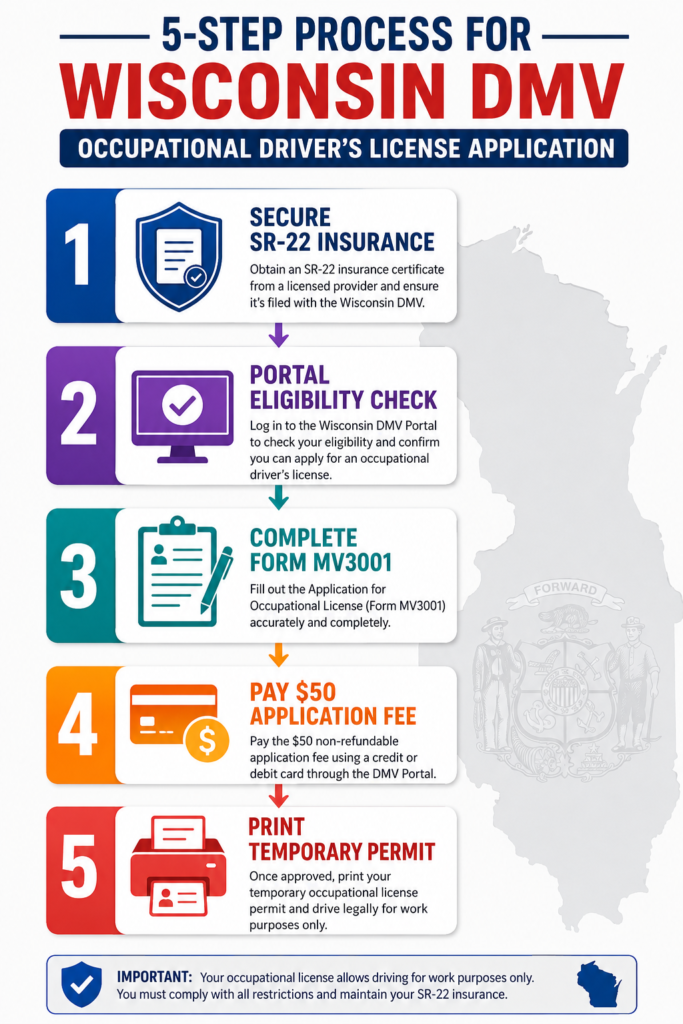
Once you have completed these steps, the system generates a temporary digital document that you must keep printed and placed inside your vehicle alongside your official hours log. This digital modernization has drastically reduced the turnaround time for restricted drivers, allowing them to return to the road in days rather than weeks. However, you must always double-check that your insurance company has successfully transmitted the SR-22 data before you click submit on the web portal. If the DMV database cannot locate a valid, active financial responsibility certificate matching your exact social security number, the automated system will instantly reject your file, forcing you to restart the entire application process from scratch.
The Demerit Point Trap and Habitual Traffic Offender Status
Many drivers operating throughout the state treat individual traffic citations like minor, annoying business expenses that can be paid off and forgotten. This casual perspective is a dangerous misconception that can quietly lead your driving career directly into a massive administrative ambush. The state employs an aggressive, highly automated demerit monitoring system designed to track your behavioral patterns over a rolling 12-month calendar window. Every single time you pay a ticket or are found guilty of a moving violation, a specific number of points is permanently attached to your master record inside the wisconsin department of transportation point system database. Minor infractions like driving slightly over the speed limit or failing to fasten your seatbelt will hit you with 3 points, while mid-tier violations like inattentive driving add 4 points to your file.
The real danger explodes when you pick up major violations like reckless driving or an OWI, both of which carry an immediate, crushing penalty of 6 demerit points. If you happen to hold a restricted probationary license or a temporary instruction permit, the state implements a brutal multiplier rule: points are automatically doubled for your second and all subsequent moving violations. The magic number that triggers an immediate crisis is 12 points; the exact second your cumulative point total reaches or exceeds 12 points within a rolling 12-month window, the system automatically suspends your driving privileges without human intervention. This suspension length scales aggressively based on your exact point volume, ranging from a 2-month timeout all the way up to a full 12-month total lockdown for severe accumulations.
How Minor Violations Explode Into 5-Year HTO Revocations
If you believe a standard 12-point suspension is a difficult hurdle to clear, you must prepare yourself for the absolute nuclear option contained within the state’s regulatory playbook. Tucked deep inside the administrative code sits an incredibly harsh mechanism known as the wisconsin habitual traffic offender law, governed strictly by Wisconsin Statute Chapter 351. This law is an uncompromising corporate safety valve designed to permanently remove persistent violators from public roadways by executing a mandatory, flat five-year license revocation. The system uses a rolling five-year monitoring window, calculating your violation dates rather than your eventual conviction dates to prevent drivers from using lengthy court delays to escape the trap.
An individual or commercial driver drops directly into this terrifying five-year HTO classification the moment they hit either of the following historical violation benchmarks:
- Accumulating 4 or more major convictions (such as OWI, reckless driving, operating while suspended, or hit-and-run) within a rolling 5-year block.
- Accumulating 12 or more minor moving violations (including standard speeding, failure to yield, or equipment defects) within that same 5-year window.
When the automated system tags you as an HTO violator, your driving privileges are completely vaporized for half a decade, and you are barred from applying for any type of occupational license for a minimum of two full years. This means a commercial delivery driver who treats minor speeding tickets as standard costs of doing business can suddenly find themselves legally prohibited from working for five years.
What Happens If You Bought Inventory From a Revoked Wisconsin Wholesaler?
When the state drops the administrative hammer on a major wholesale operations hub like the one located at 101 Skyline Drive in Arlington, the collateral damage ripples out across the entire automotive industry. Many independent retail dealers suddenly wake up to find that a wholesale partner they have been trading with for years has vanished overnight due to a state closure. If you recently purchased a block of inventory from an entity that faced a sudden license revocation, you are immediately dropped into a complex, high-stakes legal nightmare. The vehicles sitting on your lot cannot be sold to retail consumers until you clear the massive paperwork jams caused by the state’s sudden intervention.
The immediate operational crisis revolves around the total freeze of the revoked wholesaler’s access to the state’s centralized titling databases and online processing queues. Because their commercial privileges have been wiped out, any title transfers that were midway through processing are instantly halted, leaving your business holding thousands of dollars in unmarketable steel assets. Auctions will frequently refuse to process your arbitration claims once a dealer’s license is officially revoked, leaving you caught in a frustrating standoff between state regulators and corporate auction houses. Surviving this commercial crossfire requires executing a highly structured, aggressive title recovery plan before your retail customers begin demanding full refunds.
How to Track, Validate, and Secure Missing Vehicle Titles
Your first critical line of defense when caught in a wholesale dealer shutdown is to establish immediate, direct communication with the state’s internal investigative teams. You must bypass the standard public DMV helpdesk lines and route your inquiries straight to the dedicated specialists working inside the dmv dealer and agent section. This specialized team maintains the actual investigative files, handles outstanding dealer complaints, and possesses the administrative power to manually override title blocks caused by a partner’s corporate closure. You must gather every single scrap of transactional evidence you possess, including physical auction purchase receipts, cancelled checks, bank wire confirmations, and original bills of sale.
When you submit this comprehensive evidence packet to the state, you are building an undeniable paper trail that proves you are an innocent, good-faith commercial purchaser caught in the crossfire. The state investigators will meticulously review your documentation to verify that the underlying transaction occurred prior to the official final date of the wholesaler’s license revocation. Once the state validates the legitimacy of your purchase, they can manually clear the administrative holds on the vehicles, allowing you to secure clean, marketable titles that can be legally transferred to your retail buyers. This proactive tracking strategy is the only way to prevent your valuable lot inventory from turning into permanent, unresolvable legal liabilities.
Filing a Legal Claim Against a Forfeited Dealer Bond
If your tracking efforts run into an absolute brick wall because the revoked wholesaler committed actual fraud, rolled back an odometer, or completely failed to deliver titles, your final path to financial recovery runs directly through their surety provider. Because the state strictly mandates that all active wholesalers carry a valid wholesale dealer bond wi, there is a dedicated pool of money specifically set aside to compensate victims of dealer malpractice. You must use the state’s public licensing portal to identify the exact surety company that issued the bond for the revoked dealer during the timeframe of your transaction. Once you locate the carrier, you must immediately file a formal, detailed written claim against that bond to demand full financial restitution for your losses.
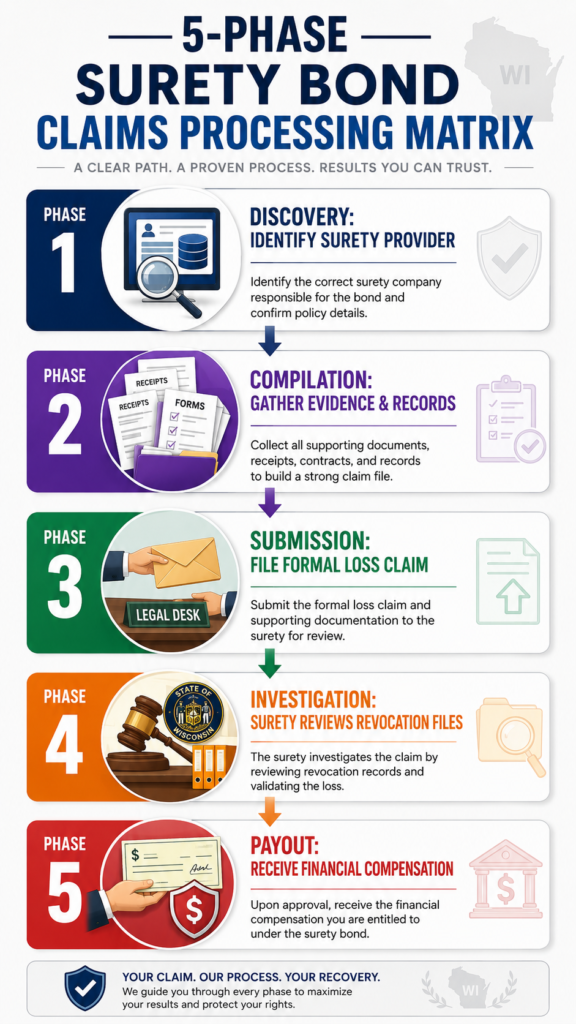
The surety company will launch their own internal investigation, reviewing the state’s official revocation findings to determine if the dealer’s behavior violated the explicit terms of the bond agreement. If your claim is validated, the surety provider is legally required to issue a direct financial payout to cover your actual out-of-pocket losses up to the maximum face value of the bond. However, you must move with extreme urgency when filing these bond claims, as multiple injured dealers are often competing for the exact same limited pool of bond funds. If you delay your filing and allow other affected operators to exhaust the bond’s maximum financial cap before your paperwork arrives, you will be left completely empty-handed.
Strategic Defense: Navigating Parallel Administrative and Court Systems
The absolute biggest mistake an individual or business owner can make when dealing with state enforcement actions is treating the administrative system and the criminal court system as if they are the same entity. They operate as two completely separate, parallel universes that do not speak to each other, do not share evidence automatically, and follow completely different playbooks. A skilled defense plan requires you to fight a coordinated war on both fronts simultaneously, deploying unique strategies tailored to the distinct rules of each independent system. Winning a battle in the criminal courtroom provides zero protection if you completely ignore your upcoming administrative deadlines managed by the DMV.
To effectively protect your commercial assets and personal mobility, you must integrate your defense plans across both tracks from day one. You must realize that the DMV operates under a strict, unyielding timeline focused entirely on swift regulatory compliance and public safety management. The criminal courts, by distinct contrast, move at a much slower pace, focusing on constitutional rights, rules of criminal procedure, and establishing guilt beyond a reasonable doubt. Understanding how these parallel tracks interact allows you to use victories in one arena to create powerful leverage in the other.
| Legal System Attributes | Wisconsin Administrative DMV Track | Wisconsin Criminal Court Track |
| Primary Governing Agency | Wisconsin Department of Transportation | Local District Attorney / Circuit Court |
| Standard of Legal Proof | Preponderance of the Evidence (Low) | Beyond a Reasonable Doubt (Highest) |
| Core Penalty Focus | Swift License Suspensions & Revocations | Jail Sentences, Criminal Fines, Probation |
| Procedural Timelines | Hyper-Compressed (10 to 13 Business Days) | Extended (Multi-Month Trial Windows) |
| Operational Scope | Broad Regulatory & Public Safety Mandates | Strict Constitutional Evidentiary Audits |
Why a Criminal Court Dismissal Won’t Erase an Administrative Suspension
It sounds completely backwards to the average citizen, but it is a cold, hard legal reality in the state of Wisconsin: you can have your criminal OWI charges completely dismissed by a judge, walk out of court a free person, and still remain completely prohibited from driving due to an active administrative suspension. This frustrating situation occurs because the DMV’s administrative per se action is legally independent of the criminal charging system. The administrative suspension is triggered solely by the physical measurement of your BAC or your refusal to take a test at the scene, not by an ultimate finding of criminal guilt in a court of law.
“I have seen countless clients throw away their right to an administrative review because they assumed a good defense lawyer would eventually get their criminal charges dropped anyway,” explains a leading regional defense expert. If you skip your wisdot administrative review opportunity, that independent six-month suspension locks into place automatically on the 31st day post-arrest. Even if your lawyer later proves that the police officer executed an illegal traffic stop and forces the judge to dismiss the criminal case entirely, the DMV will routinely refuse to lift the administrative penalty. You must aggressively contest the administrative track on its own merits if you want to keep your driver’s license active.
Immediate Steps to Protect Your Commercial Assets
If your commercial business or individual livelihood is facing an immediate threat due to an active state enforcement action, you must execute a rapid, disciplined containment strategy to limit the damage. First, you must pull down your comprehensive driving records or business registration status via the state’s online portal to verify exactly where your compliance profile stands. Second, you must secure seasoned, tech-savvy legal counsel who specializes specifically in administrative law and regulatory defense rather than hiring a generic local generalist. Do not speak to state investigators or submit formal statements until your legal team has thoroughly reviewed your entire file and structured an official response.
Additionally, you must immediately audit your active corporate insurance policies and financial bonds to ensure that your coverage remains completely unbroken and fully paid up. If you identify any potential gaps or pending cancellations, you must move with extreme speed to secure alternative coverage before state automated systems flag your account for an immediate revocation. For fleet operators, you must implement strict internal monitoring systems that run automated checks against your employees’ driving records every single month to catch point accumulations before they trigger an unexpected 5-year HTO shutdown. Taking these decisive, preventative steps is the only way to insulate your company from the devastating impacts of a sudden state crackdown.
Final Takeaways for Wisconsin Motorists and Auto Professionals
Surviving and thriving within the state’s modern regulatory environment demands an unwavering commitment to proactive compliance and an acute awareness of administrative deadlines. The era of passive enforcement is officially over, as evidenced by the unyielding actions executed by the state’s specialized dealer enforcement teams and automated demerit monitoring systems. Whether you are an independent auto dealer protecting your inventory titles from a wholesale partner’s sudden closure, or a motorist fighting to preserve your license after a roadside arrest, you must treat administrative laws with the utmost seriousness. By understanding that the DMV operates on a hyper-compressed timeline completely independent of the traditional court systems, you can take the necessary tactical actions to shield your business, your family, and your future from sudden disruption. Stay alert, monitor your records through the official digital portals, and never hesitate to deploy experienced legal protection the moment a state deadline begins ticking down.
Frequently Asked Questions Regarding WisDOT Rules and OWI Laws
What is the exact difference between a standard wholesale auto dealer license and a traditional retail dealer license in Wisconsin?
A standard wholesale dealer credential allows a business entity to purchase, trade, and sell motor vehicles exclusively between other licensed automotive dealers, commercial auto auctions, and industrial brokers. Wholesalers are strictly prohibited by state law from ever offering vehicles for sale directly to the general public, and they are not required to maintain a traditional consumer-facing car lot or an expensive public showroom. A retail auto dealer license, conversely, grants a business full legal authority to market, finance, and sell vehicles directly to everyday retail consumers. Retailers must comply with significantly more intense consumer protection laws, maintain distinct physical facility requirements, and undergo routine vehicle safety inspection protocols managed by the state.
If my Wisconsin driving privileges are suspended due to a point accumulation, can I secure an occupational license to drive out of state?
No, a specialized occupational driver’s permit issued by the state is strictly valid for operation only within the geographic borders of Wisconsin and along specific, pre-approved transit routes detailed on your physical hours log. The state possesses zero legal authority to grant you driving privileges that cross over into neighboring jurisdictions like Illinois, Minnesota, or Iowa, as those states do not recognize conditional Wisconsin credentials for suspended motorists. If you are caught driving a motor vehicle outside of the state while your primary license is suspended, you can be instantly arrested and charged with operating without a valid license under that specific state’s local statutes.
How exactly can a motorist check their active demerit point total and current license eligibility status without visiting a physical DMV branch?
The state provides a highly secure, completely free online driver services portal that allows any motorist to instantly audit their driving record from any computer or smartphone. To use this digital tool, you must navigate to the official portal and input your full legal name, date of birth, complete social security number, and physical driver’s license number. The system will instantly generate a comprehensive, real-time read-out displaying your active demerit point total, a detailed history of your past traffic citations, and an explicit declaration of your current license eligibility status. If your license is currently facing a suspension or revocation, the portal will explicitly detail the exact dates of the penalty and outline the precise structural steps required to achieve full reinstatement.
What specific type of auto insurance policy must I maintain to fulfill the state’s mandatory SR-22 financial responsibility certificate requirement?
An SR-22 is not actually a separate type of auto insurance policy, but rather a specialized legal certificate that your existing auto insurance provider must digitally file directly with the state’s central database. This certificate serves as an official financial guarantee proving that you are maintaining at least the absolute minimum statutory liability insurance coverage required by state law. The key feature of an SR-22 policy is its mandatory real-time digital tracking mechanism; if you ever miss a premium payment or allow your core insurance coverage to lapse for a single day, the provider is legally required to instantly notify the DMV database, which triggers an automated, immediate suspension of your driver’s license.
Can a business owner file a single, unified claim against a wholesale dealer bond to recover financial losses for multiple vehicles?
Yes, an injured business owner or independent commercial operator can absolutely file a single, comprehensive claim with a surety provider to seek financial restitution for multiple fraudulent vehicle transactions tied to the same dealer. You must meticulously detail the specific financial losses incurred for each individual vehicle, providing independent bills of sale, auction invoices, and title rejection forms for every single asset listed in your claim. However, you must keep in mind that the surety provider’s total financial liability is strictly capped at the absolute maximum face value of that specific wholesale bond, which is typically $25,000 in Wisconsin. If the cumulative losses from your multiple vehicles—combined with the claims of other defrauded operators—exceed that maximum bond threshold, the available funds will be distributed proportionally among all validated victims, meaning you may only recover a fraction of your total out-of-pocket losses.










Leave a Reply