

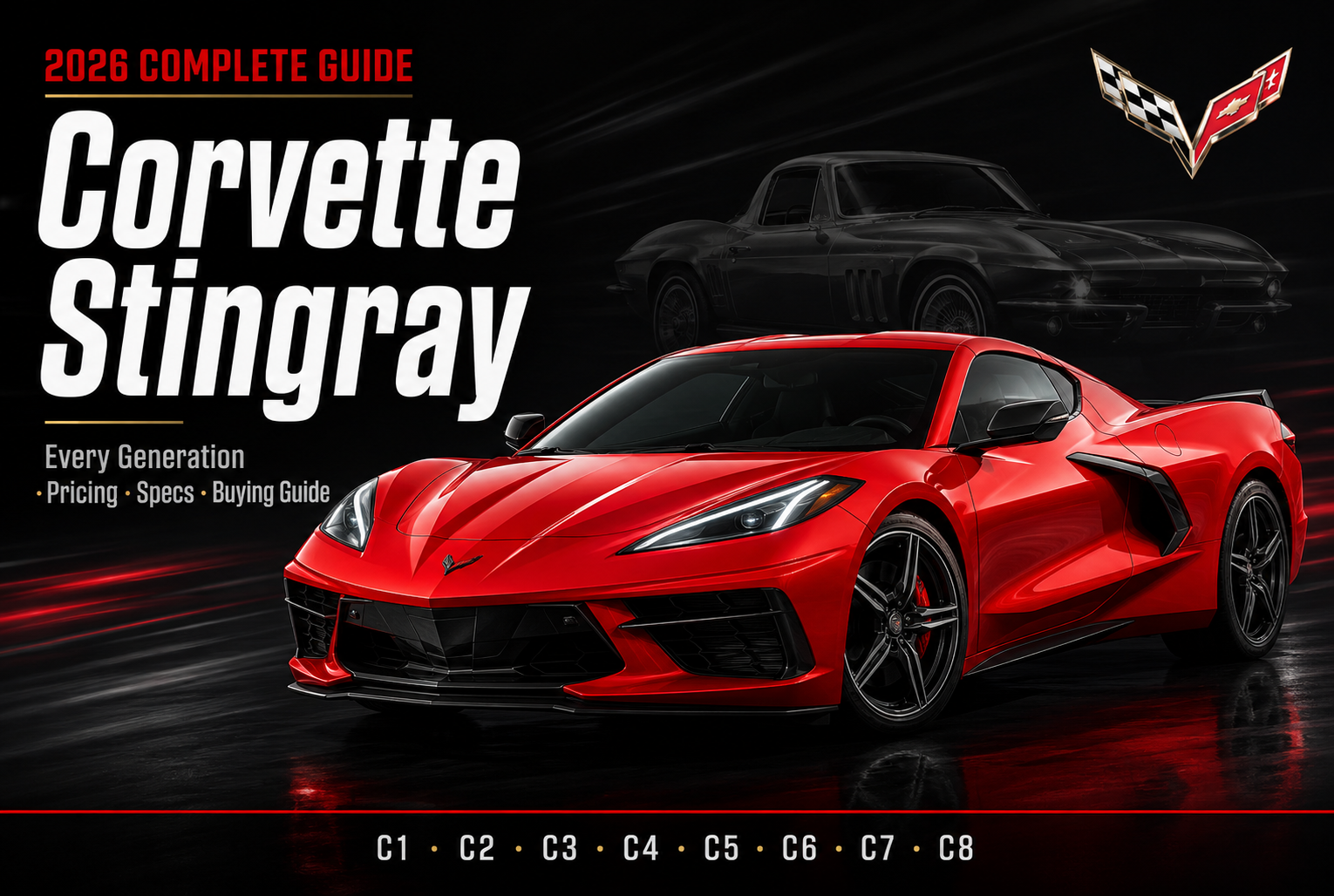
Corvette Stingray: The Complete Guide to Every Generation, Price, and Everything You Need to Know
There are cars and then there are icons. The Corvette Stingray sits firmly in the second category — has done for over six decades — and yet it somehow manages to feel relevant and exciting in a way that most automotive legends stopped feeling a long time ago. I grew up with a poster of a 1969 Corvette Stingray on my bedroom wall. My neighbor had a C5 that he kept in his garage like a museum piece and only took out on Sunday mornings. And last year I sat in a C8 Stingray at a dealership just to see what all the fuss was about and walked out forty minutes later having had a genuine conversation with the salesperson about whether I could actually justify the payments.
That is what the Corvette Stingray does to people. It gets under your skin regardless of which generation you encounter first.
This guide covers all of it — the history, the generations from C1 through C8, the pricing old and new, what to look for when buying used, and everything about the current model that makes it one of the most remarkable performance cars available at any price point in 2026.
What Is the Corvette Stingray and Where Did the Name Come From
The Corvette Stingray name has a history that most people do not know and it is worth understanding because it explains why the nameplate carries so much weight.
The Stingray name first appeared in 1959 on a Corvette racing concept designed by Bill Mitchell. The car was sleek, aggressive, and visually unlike anything else on American roads at the time. When the production Corvette adopted the Stingray name for the 1963 model year it was a signal that something significant had changed — and it had. The 1963 Corvette Stingray introduced the split rear window coupe body style that remains one of the most visually distinctive designs in automotive history.
The name was dropped after 1976 as Corvette went through a difficult period in the late 1970s and 1980s dealing with emissions regulations and performance compromises that the market was not particularly kind about. It returned for the C7 generation in 2014 and has stayed through the current C8 era — a deliberate signal from Chevrolet that the Stingray name belongs on their best work.
The Corvette Stingray by Generation: A Complete History
Understanding the Corvette Stingray means understanding its generations because each one is genuinely its own distinct vehicle rather than just an update of what came before.
C1 — The Original 1953 to 1962
The first generation Corvette was not called the Stingray — that name came later — but it established everything the nameplate would become. A fiberglass body when fiberglass was genuinely revolutionary. A sports car identity in a market dominated by large American sedans. And from 1957 onward, fuel injection that made it genuinely fast rather than just good looking.
C2 — The Stingray Era 1963 to 1967
This is the generation that defined the Corvette Stingray for generations of enthusiasts. The 1963 split window coupe is the most collectible and most discussed, with the divided rear window creating a visual signature that was actually discontinued after one year because it restricted rear visibility. The irony is that the split window cars are now among the most valuable Corvettes ever produced — a one-year production quirk that became an enduring legend.
The 1963 Corvette Stingray through 1967 models represent the peak of the classic era. Available engines ranged from the base 327 cubic inch V8 through the legendary 427 big block options. The 1967 model is widely considered the best of the C2 generation — refined enough to address the issues of earlier cars while still carrying all the raw character that makes these vehicles so sought after.
C3 — The Long Run 1968 to 1982
The C3 generation ran for fifteen years which is an extraordinary production span for any sports car. The early C3 models from 1968 through the early 1970s carry significant horsepower numbers — the 1970 Corvette Stingray LT1 and the big block options from this era are genuine muscle car royalty. The 1969 Corvette Stingray is particularly popular with collectors and the 1969 price for good examples has climbed substantially as the market for classic American performance cars has strengthened.
The mid-1970s cars — the 1972, 1973, 1974, 1975, and 1976 models — represent the emissions era compromises that affected the entire American performance car market. Power dropped, character softened, and the Stingray name was quietly retired after 1976. The late C3 cars from 1977 through 1982 are the least celebrated of the generation though they have their advocates among collectors who appreciate the T-top body style and the relative affordability compared to earlier C3 examples.
C4 — The Rebuilding Years 1984 to 1996
The C4 generation does not get the respect it deserves. After the difficult late C3 era, Chevrolet used the C4 to rebuild the Corvette’s performance credibility. The 1990 Corvette Stingray — actually marketed as the ZR-1 in its highest performance form — reestablished the Corvette as a genuine world-class supercar rather than a domestic performance car that happened to look good. The C4 generation also introduced electronic fuel injection across the lineup and gradually increased power outputs toward numbers that the C3 era only achieved in its earliest years.
C5 — The Platform That Changed Everything 1997 to 2004
The C5 generation arrived in 1997 as one of the most completely reconsidered redesigns in Corvette history. The LS1 V8 engine was a revelation — powerful, efficient, and far more reliable than the engines it replaced. The hydroformed frame gave the C5 structural rigidity that transformed how it handled. The fixed roof coupe, convertible, and Z06 body styles gave buyers genuine choices. The C5 is now one of the most popular used Corvette purchases because the combination of performance, reliability, and relatively accessible pricing makes it genuinely exceptional value.
C6 — Refinement and the Return to Stingray’s Spirit 2005 to 2013
The C6 brought exposed headlights back after nearly two decades and a more aggressive overall design that felt like a genuine step toward the classic proportions of the C2 era. The LS2 and later LS3 engines continued the tradition of enormous naturally aspirated V8 performance at a price that compared favorably to European sports cars making similar power numbers. The C6 Z06 with its dry-sump 7.0 liter LS7 engine producing 505 horsepower remains one of the great drivers’ cars of its era.
C7 — The Stingray Name Returns 2014 to 2019
The C7 brought the Stingray name back and it earned it. The new LT1 6.2 liter V8 produced 455 horsepower in standard form and the design — angular, aggressive, clearly inspired by the C2 without copying it — was universally praised. The C7 Z06 with its supercharged LT4 engine producing 650 horsepower represented the most extreme factory Corvette up to that point. The C7 generation also introduced the Grand Sport and the ZR1 with its 755 horsepower supercharged LT5 engine.
The 2014 through 2019 Corvette Stingray used market has been an interesting one — strong enough that prices held well but not so inflated that good examples are out of reach for enthusiast buyers with realistic budgets.
C8 — The Mid-Engine Revolution 2020 to Present
The 2020 Corvette Stingray changed everything and the automotive world is still processing what Chevrolet did. Moving the engine behind the driver — the mid-engine layout that European supercars had used for decades but that traditionalists swore the Corvette would never adopt — transformed the handling balance and performance capability of the car in ways that the front-engine layout could never match regardless of how good the engineering was.
The base C8 Stingray with its 6.2 liter LT2 V8 producing 490 horsepower in standard form and 495 with the performance exhaust covers zero to sixty in under three seconds. The Z51 performance package pushes capability further with upgraded cooling, brakes, suspension, and a performance exhaust. These are supercar numbers at a starting price that remains — remarkable as this sounds — under seventy thousand dollars in base form.
Corvette Stingray C8: The Current Generation in Detail
The C8 Corvette Stingray deserves its own section because it represents such a significant departure from everything that came before it.
The mid-engine layout is the headline but the details underneath it are equally impressive. The dual-clutch eight-speed automatic transmission — there is no manual option on the C8 — has been a point of controversy among traditionalists but the reality is that it shifts faster than any human driver could manage with a clutch pedal and the performance numbers reflect that. The transmission is genuinely one of the best in any sports car at any price point.
The interior of the C8 represents another leap forward for a nameplate that was historically criticized for interior quality that did not match the performance on offer. The cockpit-focused design puts the driver at the center with a pronounced center console that separates driver and passenger more dramatically than any previous Corvette. The 12-inch diagonal display and 8-inch center touchscreen give the C8 a genuinely modern technology presence.
Available trim levels on the C8 include the base Stingray, the 1LT, 2LT, and 3LT configurations with progressively more equipment, and the Z51 performance package that can be combined with any trim level. The convertible is available across the range and uses a folding hardtop rather than a fabric roof — a significant engineering achievement that preserves structural rigidity while delivering open-air driving.
Corvette Stingray Price: What It Costs New and Used
The Corvette Stingray price story is one of the most compelling in the automotive world because the performance per dollar equation is genuinely extraordinary.
The C8 Corvette Stingray starts at around $67,000 for a base 1LT coupe in 2026. A fully optioned 3LT with the Z51 package, Magnetic Ride Control, and popular options climbs into the mid-to-upper eighties. The convertible adds approximately $7,000 to the coupe price at equivalent trim levels.
For context on what that buys you — a Porsche 911 starts around $115,000. A Ferrari entry point is around $250,000. The Corvette Stingray produces comparable or superior performance numbers in most measurable categories at a fraction of those prices. The value proposition is not subtle.
The used Corvette Stingray market covers an enormous price range depending on generation and condition. A solid driver-quality C5 can be found for under $20,000. Good C6 examples range from the mid-twenties to the low thirties for standard Stingray models. C7 Stingrays in good condition with reasonable mileage are in the thirty to forty-five thousand dollar range. Early C8 examples are holding their value strongly given demand.
Classic Corvette Stingray pricing is a different conversation entirely. A 1963 split window in excellent condition commands six figures from serious collectors. A 1969 Corvette Stingray in documented original condition with numbers-matching drivetrain can approach that range as well depending on engine specification. The early C2 cars have appreciated substantially over the past decade and show no signs of softening.
Corvette Stingray Colors: How to Choose
The Corvette Stingray has always offered an expressive color palette and the C8 continues that tradition with options that suit the car’s dramatic lines well.
Corvette Stingray in black is the most popular single color choice — it suits the aggressive body lines and photographs exceptionally well. Corvette Stingray in white offers a cleaner, more classic look that references the racing history of the nameplate. Corvette Stingray in red remains the emotionally resonant choice for buyers who want a color that matches the personality of the car.
For buyers who want something more distinctive, Corvette Stingray in blue — particularly Elkhart Lake Blue — is one of the most visually striking options in the current palette. Yellow is a traditional Corvette color that works especially well on the C8’s more angular body. Grey and silver options appeal to buyers who want the performance statement without the color statement. Green has returned to the palette in recent years and suits the car surprisingly well given how rarely green appears on American sports cars.
Corvette Stingray vs Z06 and ZR1: Understanding the Lineup
The Stingray is the entry point to the C8 family but it sits alongside increasingly extreme variants that use the same mid-engine platform to deliver escalating levels of performance.
The Corvette Stingray Z06 uses a flat-plane crank 5.5 liter V8 producing 670 horsepower — an engine more closely related to race car technology than road car convention. It revs to 8600 RPM and sounds unlike any other American production car engine in history. The Z06 starts around $110,000 and represents a genuinely different driving experience from the Stingray rather than just more of the same.
The ZR1 pushes further still with forced induction bringing output to figures that were previously unimaginable on a production Corvette. The ZR1 occupies genuine supercar territory in both performance and price.
The Stingray sits at the accessible end of this range and despite being the base model is a complete, satisfying sports car rather than a compromised entry point. The performance gap between the Stingray and Z06 is real but the Stingray gives up nothing in terms of everyday usability and character.
Buying a Used Corvette Stingray: What to Look For
The used Corvette Stingray market is one of the most active in the collector and enthusiast car world and navigating it requires some specific knowledge.
For C5 and C6 generation cars, the LS engine family is extraordinarily reliable but these cars are now old enough that deferred maintenance is a real issue. Look specifically at cooling system condition — these engines run hot when the cooling system is not properly maintained and head gasket issues follow. Check for any signs of track use which accelerates wear on suspension components and brakes. A pre-purchase inspection from a Corvette specialist is worth every penny.
For C7 generation cars, the LT1 engine has a strong reliability record but the electronics are more complex than C5 and C6 cars. Ensure all systems work correctly and be aware that some early C7 production had quality control issues that were addressed in later model years. The 2016 and 2017 model years are considered among the most sorted of the C7 generation.
For early C8 cars, mileage is still relatively low across the used market and the cars are recent enough that most issues are covered under the remaining factory warranty. The dual-clutch transmission has been a point of attention — ensure it operates smoothly through all ranges and shifts without hesitation or juddering.
Corvette Stingray Top Speed and Performance Numbers
The performance specifications of the Corvette Stingray across generations tell the story of how dramatically the nameplate has evolved.
The C8 Corvette Stingray top speed is electronically limited to 194 mph in standard form with the Z51 package. Zero to sixty comes in at 2.9 seconds with the performance exhaust and Z51 package — a number that was exotic supercar territory just a decade ago.
The C7 Stingray managed zero to sixty in around four seconds in standard form and around three and a half with the Z51 package. The C6 Z06 with its LS7 engine was similarly capable. The C5 Z06 — a car that cost around $50,000 new — was clocking zero to sixty times that embarrassed European sports cars costing three times as much.
Corvette Stingray fuel economy on the C8 is surprisingly reasonable given the performance numbers — around 15 city and 27 highway in standard driving conditions, though enthusiastic driving drops those figures considerably.
Conclusion
The Corvette Stingray is one of those rare things in the automotive world — a car with genuine heritage that actually lives up to it rather than just trading on a famous name. Every generation has had its advocates and its critics and every generation has contributed something meaningful to the story of what an American sports car can be.
The C8 represents the most dramatic reinvention in the nameplate’s history and the verdict from drivers, journalists, and the market is consistent — it is the best Corvette ever made and one of the best sports cars in the world at any price. The fact that it starts under seventy thousand dollars while delivering performance that rivals cars costing three times as much is not a marketing claim. It is a measurable, documented reality that makes the current Corvette Stingray one of the most compelling automotive purchases in 2026.
Whether you are chasing a 1963 split window for your collection, looking for an affordable entry into Corvette ownership through a clean C5, or considering a new C8 as your next car — the Corvette Stingray rewards the attention you give it.
Frequently Asked Questions
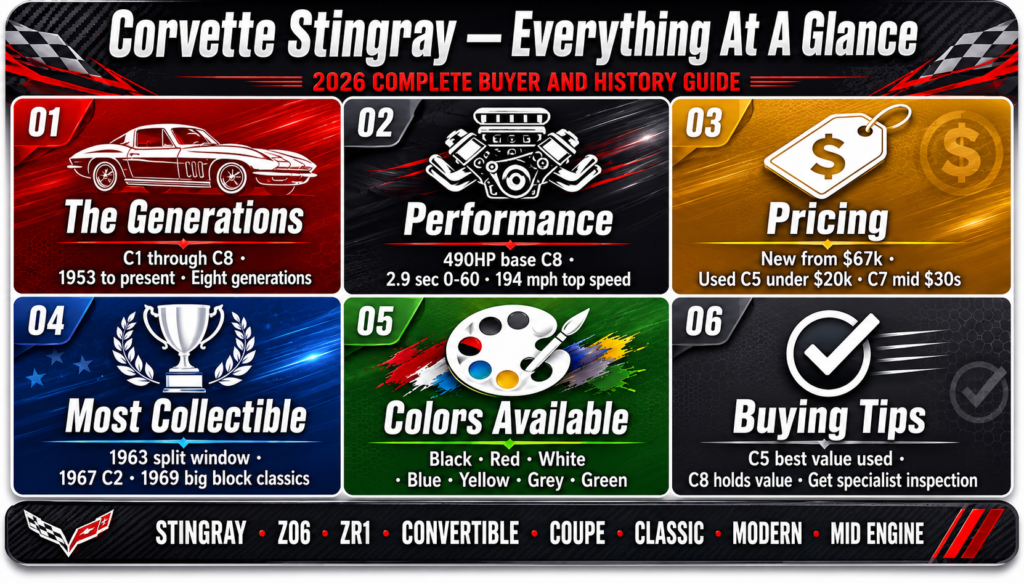
What is the current Corvette Stingray price? The 2026 Corvette Stingray starts at approximately $67,000 for the base 1LT coupe. A fully optioned 3LT with Z51 package climbs into the mid-to-upper eighties. The convertible adds around $7,000 over equivalent coupe pricing.
What is the difference between the Corvette Stingray and the Z06? The Stingray uses a 6.2 liter pushrod V8 producing 490 to 495 horsepower. The Z06 uses a flat-plane crank 5.5 liter V8 producing 670 horsepower that revs to 8600 RPM. The Z06 is a significantly more track-focused vehicle at a significantly higher price point.
Is the C8 Corvette Stingray mid-engine? Yes. The C8 generation introduced a mid-engine layout for the first time in Corvette production history, placing the LT2 V8 behind the driver rather than in front. This transformed the handling balance and performance capability of the car.
What is the top speed of the Corvette Stingray? The C8 Corvette Stingray is electronically limited to 194 mph with the Z51 performance package. Standard models have a lower limit.
Which year Corvette Stingray is most collectible? The 1963 split window coupe is the most discussed and typically most valuable single model year. The 1967 is considered the finest of the C2 generation overall. The 1969 is the most popular C3 among collectors.
Is the Corvette Stingray available as a convertible? Yes. The C8 Corvette Stingray convertible uses a folding hardtop that preserves structural rigidity. It is available across trim levels at approximately $7,000 over the equivalent coupe price.
What colors are available on the Corvette Stingray? Current options include black, white, red, blue, yellow, grey, silver, and green among others. The full palette changes with model years and special editions.
How reliable is the used Corvette Stingray? The LS and LT engine families used across C5 through C7 generations have strong reliability records when properly maintained. A pre-purchase inspection from a Corvette specialist is recommended for any used example.












Leave a Reply