
Multifuel: The Complete Guide to Multi-Fuel Stoves, Engines & Camping Gear
Let’s Just Be Honest About Something First
When most people type “multifuel” into a search engine, they’re usually standing in front of some kind of heating problem. Maybe their gas bill arrived and made their stomach drop. Maybe they’ve been using a wood-burning stove for years and someone told them a multifuel stove would be “better.” Maybe they’re planning a solo hiking trip through Scandinavia and need a stove that won’t let them down at minus twenty degrees.
The word “multifuel” shows up across a surprisingly wide range of contexts — home heating, outdoor adventure gear, military vehicles, flexible-fuel cars — and that breadth is actually what makes it worth writing about properly. Because depending on what you’re looking for, the answer is genuinely different.
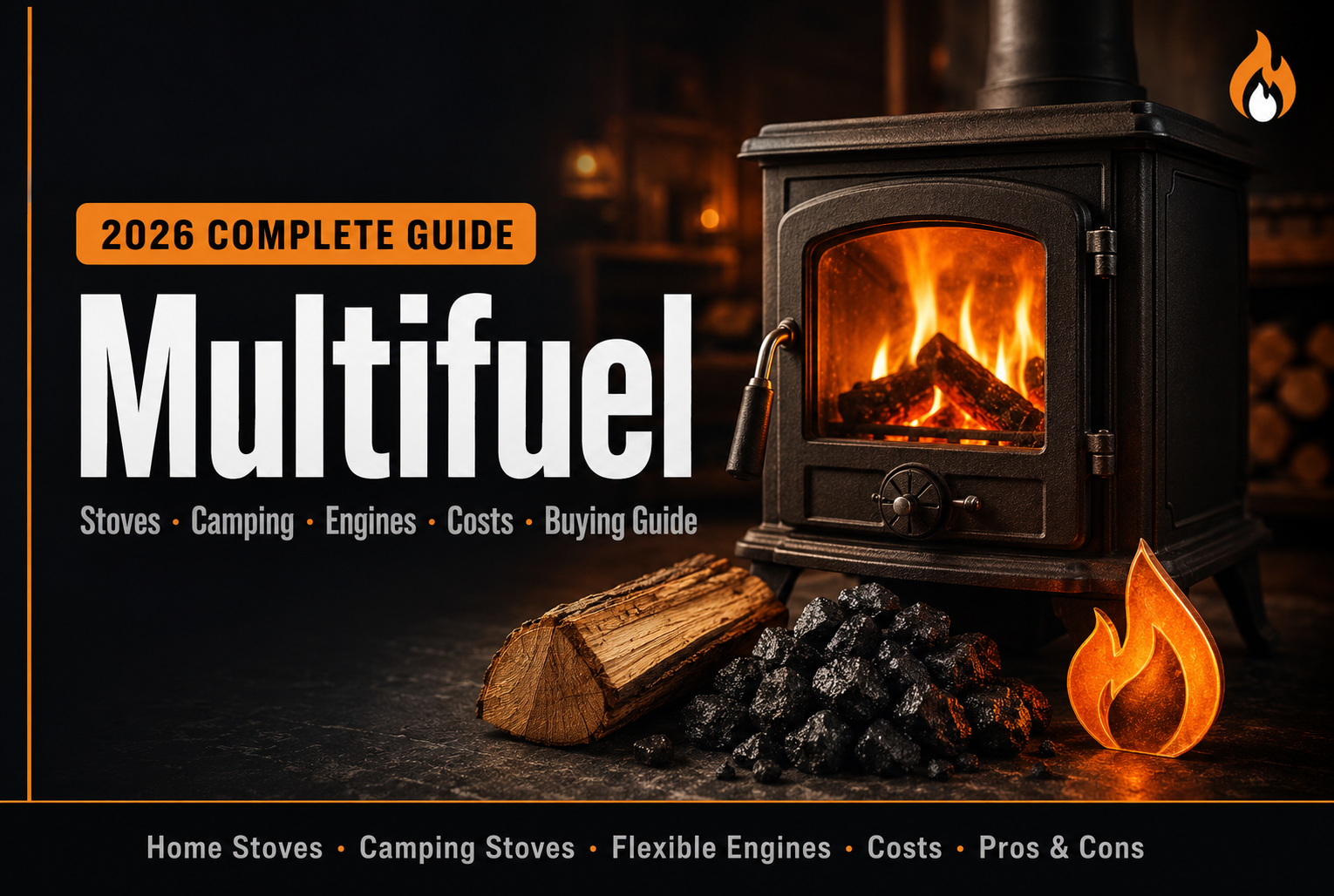
This guide covers all of it. Home heating multifuel stoves, camping and expedition multifuel stoves, multifuel engines in vehicles, how they all work, what they cost, what the real pros and cons are, and whether a multifuel setup is actually worth it for your specific situation.
No fluff. No vague advice. Just the honest version.
What Does “Multifuel” Actually Mean?
At its most basic, multifuel — sometimes written multi-fuel or multi fuel — refers to any engine, heater, stove, boiler, or fuel-burning device that is designed to run on more than one type of fuel.
That sounds simple, but the implications of that flexibility are enormous depending on the context.
A multifuel home stove can burn wood logs on Monday, smokeless coal on Tuesday, and peat briquettes on the weekend. A multifuel camping stove can run on the white gas you bought at the outdoor shop, or the unleaded petrol from the garage down the road, or aviation fuel if you happen to be near an airfield. A multifuel engine in a military tank — like the ones used in the Russian T-72 — can run on diesel, aviation kerosene, and petrol without needing major mechanical adjustments.
The common thread is fuel flexibility. The ability to adapt to whatever is available, wherever you are, without being locked into a single energy source.
That flexibility has genuine real-world value. When fuel prices spike, when supply chains get disrupted, when you’re three weeks into a backcountry expedition and your usual fuel canisters ran out four days ago — multifuel capability stops being a nice-to-have feature and starts being genuinely important.
Part One: Multifuel Stoves for Home Heating
This is the most common context in which people in the UK and Ireland encounter the word multifuel. And it’s also where there’s the most confusion, because multifuel stoves look almost identical to wood-burning stoves and many people assume they’re interchangeable.
They’re not. Let’s get into why.
What Is a Multifuel Stove?
A multifuel stove is a solid fuel heating appliance designed to burn more than one type of solid fuel. In the UK, this typically means it can burn:
- Wood logs
- Smokeless coal
- Anthracite
- Peat or turf briquettes
- Wood pellets (on some models)
The key design feature that makes a stove “multifuel” rather than “wood only” is the raised grate system. Smokeless coal and anthracite require air to be fed from underneath the fuel load for effective combustion — this is called primary air. Wood, on the other hand, burns better with air coming from above — secondary air.
A dedicated wood-burning stove has no grate. The wood sits on a flat base of accumulated ash, and the combustion air comes in from above. Simple, effective for wood, but useless for coal.
A multifuel stove has an open or raised grate in the base of the fire chamber, often with a riddling mechanism, that lets primary air flow upward through the fuel bed. Below the grate is an ash pan that catches the residue and makes cleaning easier. This design lets the stove handle both wood and solid mineral fuels.
The riddling mechanism deserves a mention. Coal ash can block the air passages in the grate over time, starving the fire of oxygen and reducing burn efficiency. Riddling — shaking or rotating the grate — breaks up the ash and lets it fall through into the pan below. Some stoves have an external riddler so you can do this without opening the door. Others require you to open up and do it manually. If you plan to burn a lot of coal or anthracite, an external riddler is worth paying extra for.
Multifuel Stoves vs Wood-Burning Stoves: The Real Comparison
This is probably the most searched comparison in the solid fuel heating world, and the answer is more nuanced than most people expect.
Wood-burning stoves are generally considered slightly more efficient when burning wood specifically. The reason is straightforward — they’re optimised for exactly that one job. The flat base, the absence of a grate, the airflow design — all of it is tuned for wood combustion. A dedicated woodburner also tends to have a larger glass window because there’s no grate structure in the way, which gives you a better view of the flame. If watching a fire is part of the appeal (and for most people it absolutely is), a woodburner can be more visually satisfying.
Multifuel stoves are more versatile. If you live in an area where wood is expensive or hard to source in bulk, or if your local suppliers primarily stock smokeless coal, or if you simply want the option to switch fuels depending on what’s cheapest that month, a multifuel stove gives you that flexibility. You’re not locked into one supplier, one fuel type, or one price point.
There’s also a practical geographic consideration. In the UK, homes in smoke control zones — which generally covers most urban and suburban areas — have restrictions on what fuels can be burned. In these areas, burning standard wood is only permitted on DEFRA-approved appliances (also called Ecodesign stoves). If you don’t have a DEFRA-approved stove, you’re limited to approved smokeless fuels. A multifuel stove in a smoke control zone gives you more options than a wood-only stove.
One thing worth knowing: you should never burn wood and smokeless coal simultaneously in a multifuel stove. The combination is problematic. The moisture in wood can mix with the sulphur in smokeless coal to create a caustic chemical that can damage the stove’s internal components and cause premature deterioration of the flue liner. If you want to use both fuels, use them separately — one fuel type per burn session.
How Much Do Multifuel Stoves Cost?
Let’s put real numbers on this because the range is wide and vague advice isn’t helpful.
The stove itself typically costs between £430 and £2,200 for a standard residential model, with most decent mid-range multifuel stoves sitting in the £600 to £1,200 bracket. Premium cast iron models from established manufacturers can push higher, but you’re paying for build quality, aesthetics, and longevity.
Installation is the bigger variable. If your home already has a chimney that only needs sweeping and lining, you’re looking at an additional £150 to £600 for chimney preparation plus £500 to £1,500 for a flue liner. If you need a completely new chimney or a twin-wall flue system built from scratch, costs rise substantially — often to £1,800 to £5,500 just for the flue, before the stove cost is added.
Total installed cost for a typical multifuel stove installation with an existing chimney usually lands somewhere between £1,500 and £3,500. New chimney or twin-wall flue system scenarios can reach £5,000 to £8,000 or more depending on the complexity of the job.
You’ll also need a non-combustible hearth if you don’t already have one, a carbon monoxide alarm (legally required for all solid fuel installations), and potentially a heat-proof register plate to seal the chimney breast. These are smaller costs but they add up.
Ongoing running costs depend heavily on what fuel you’re burning and where you source it. Well-seasoned hardwood typically costs around 6p to 10p per kWh. For context, mains gas is currently around 5.93p per kWh under the Ofgem price cap. On those numbers, wood isn’t dramatically cheaper than gas, but it’s in the same ballpark — and for many people the appeal of a real fire goes beyond the pure economics.
How to Choose the Right Multifuel Stove: The kW Question
One of the most important decisions you’ll make when choosing a multifuel stove is the heat output, measured in kilowatts (kW). Getting this wrong is a common and expensive mistake.
A stove that’s too small won’t heat the room properly. A stove that’s too large will overheat the space, force you to dampen it down constantly, and burn fuel less efficiently — because a partially suppressed fire produces more particulates and creosote than a well-regulated one.
A simple formula to estimate what you need: multiply the room’s width, length, and height in metres, then divide by 14. The result is your approximate required kW output.
For most standard UK living rooms, a 4 to 6 kW stove is appropriate. Open-plan spaces or rooms with high ceilings may need 7 to 10 kW or more. If you’re heating multiple rooms through an open doorway or a partially open plan, err on the higher side.
Always look for models that are DEFRA-approved and Ecodesign-ready. These meet current emissions standards, burn more cleanly, and are more fuel efficient in practice. SIA Ecodesign certification is the current benchmark in the UK industry for clean combustion.
Part Two: Multifuel Stoves for Camping and Expeditions
This is a completely different product category with a completely different purpose, and it’s important not to conflate the two. A camping multifuel stove is a small, portable cooking appliance designed for outdoor use — not a home heating unit.
What Makes a Camping Stove “Multifuel”?
In the camping and expedition context, multifuel refers to the ability to burn different types of liquid fuel. The most common options are:
- White gas (also called Coleman fuel or naphtha) — the cleanest burning option, available at most outdoor retailers
- Unleaded petrol/gasoline — widely available everywhere, useful when you’re travelling internationally
- Kerosene — inexpensive, widely available in developing countries, slightly messier to use
- Diesel — available almost everywhere, requires careful priming
- Aviation fuel — available near airfields, rarely needed but occasionally useful on remote expeditions
- Isobutane/propane canister gas — on hybrid models that support both liquid and canister fuels
The practical value here is significant. If you’re trekking through remote parts of Central Asia or crossing a desert route in Africa, you cannot guarantee that the specific fuel canister your stove requires will be on sale at the nearest settlement. But there will almost certainly be a petrol station somewhere. A multifuel camping stove means you’re never completely stuck.
Multifuel vs Single-Fuel Gas Stoves for Camping
Standard canister gas stoves are simpler, faster to set up, and easier to use. You screw on a gas canister, light the burner, and cook. There’s no priming involved, no adjusting jets, no pre-heating the fuel line. For casual camping in well-served areas, they’re excellent.
The two areas where multifuel camping stoves genuinely outperform canister stoves are cold performance and remote versatility.
At temperatures below around 10°C, and especially below freezing, canister gas stoves lose performance significantly. The gas in the canister doesn’t vaporise as readily in the cold, leading to weak, flickering flames that take forever to boil water. On a high-altitude expedition or a winter camping trip, this isn’t an inconvenience — it’s a safety issue. Liquid fuel multifuel stoves don’t have this problem. They perform reliably in extreme cold and are the standard choice for polar and high-altitude expeditions.
On international trips where you can’t guarantee fuel canister availability, the ability to fill up from any petrol station is invaluable. Many experienced long-distance travellers and expedition teams use multifuel stoves as their default precisely for this reason.
The trade-off is complexity. Liquid fuel stoves require priming — briefly burning a small amount of fuel in a cup below the burner to heat the fuel line — before full operation. They need periodic maintenance, jet cleaning, and occasional pump cup replacement. They’re not difficult to manage once you’ve done it a few times, but they’re not as grab-and-go as canister stoves.
Popular Multifuel Camping Stoves Worth Knowing
A few names come up consistently in the expedition community:
The MSR Dragonfly is one of the most versatile multifuel stoves available, capable of burning white gas, kerosene, unleaded auto fuel, diesel, and jet fuel. It has a simmering capability that many liquid fuel stoves lack, making it genuinely useful for cooking rather than just boiling water.
The MSR WhisperLite Universal bridges the gap between canister and liquid fuel by supporting both — isobutane canisters as well as white gas, kerosene, and unleaded gasoline. For someone who wants the simplicity of canister gas at home and the resilience of liquid fuel on expedition, it’s a compelling option.
The Primus MultiFuel and OmniLite Ti are expedition-grade stoves engineered for demanding environments. The OmniLite Ti is titanium-framed for weight savings and runs on gas, gasoline, diesel, kerosene, and aviation fuel. Multiple clearly marked jet nipples mean there’s no confusion when switching between fuel types.
Part Three: Multifuel in Vehicles and Engines
The original application of multifuel technology — and still one of the most important — is in vehicle engines and industrial machinery. This is less directly relevant to most consumers but worth understanding if you’re researching the full picture.
Multifuel Engines: How They Work
A multifuel engine is built so its compression ratio can accommodate the lowest-octane fuel among its accepted alternatives. Because different fuels have different energy densities, octane ratings, and combustion characteristics, building an engine to handle all of them requires structural reinforcement and carefully tuned compression.
Some multifuel engines have manual switch settings that adjust timing and fuel delivery for different fuel types. Others are more broadly tolerant and can handle a range of fuels without adjustment.
Military Applications
Multifuel technology has historically been most developed for military use, where fuel supply chains during combat operations are unpredictable. The logic is simple: an army that can only run its vehicles on one specific fuel type is vulnerable to supply disruption. A vehicle fleet that can run on whatever fuel is captured, sourced locally, or airlifted in is far more resilient.
The Russian T-72 main battle tank runs a multifuel diesel engine. The T-80 uses a multifuel gas turbine. NATO has historically been interested in multifuel engines for similar reasons. When your logistics chain gets cut, the ability to run a vehicle on locally sourced kerosene or aviation fuel can be the difference between operational capacity and a field full of useless machines.
Flexible-Fuel Vehicles for Civilians
The civilian equivalent of multifuel engines is the flexible-fuel vehicle (FFV), which can run on different blends of petrol and ethanol — typically anywhere from standard E10 unleaded petrol to E85 (85% ethanol). These are common in Brazil, where sugar cane-derived ethanol is widely available, and exist in smaller numbers in the United States and parts of Europe.
Bi-fuel vehicles, which can switch between petrol and LPG (liquefied petroleum gas), are another civilian multifuel application. LPG is significantly cheaper per litre than petrol in many markets, and bi-fuel conversion kits allow drivers to switch between the two at the touch of a button.
Part Four: Is Multifuel Right for You?
After all of that, the honest question is whether any of this actually applies to your situation. Let’s break it down clearly.
Get a Multifuel Home Stove If:
You live in or near a smoke control zone and want fuel flexibility within the permitted options. You want the ability to switch between wood and smokeless coal depending on price and availability. You don’t already have an existing wood-burning stove — because if you’re starting from scratch, a multifuel stove gives you more options for roughly the same price. You want the practical security of not being locked to a single fuel supplier.
Stick With a Dedicated Wood Burner If:
Your primary fuel will always be logs, and you don’t anticipate burning coal or smokeless fuel. You want maximum efficiency when burning wood specifically. You’re particularly focused on flame aesthetics — woodburners tend to have larger viewing windows and a more dramatic flame display.
Get a Multifuel Camping Stove If:
You’re going on international expeditions or long-distance travel where fuel canister availability is uncertain. You’re camping or mountaineering in cold weather where canister gas performance is unreliable. You’re an experienced camper who doesn’t mind the small additional complexity of liquid fuel operation.
Stick With a Canister Gas Stove If:
You’re doing weekend camping in well-served areas. You prioritize convenience and speed over versatility. You’re a casual camper who wants to spend time around the fire rather than priming stoves.
Maintenance, Safety & What Nobody Tells You
A few practical realities that don’t always make it into the marketing materials:
Chimney sweeping is not optional. For any solid fuel appliance — multifuel or wood-only — the flue should be swept at least once a year, and more often if you burn frequently. Creosote and tar deposits build up in flues and can ignite, causing chimney fires. A sweep costs around £50 to £80 and is cheap insurance compared to the cost of chimney fire damage.
Fuel moisture matters more than most people realise. Burning wet or “green” wood in a multifuel stove dramatically reduces efficiency, increases particulate emissions, and accelerates tar buildup in the flue. Kiln-dried wood or well-seasoned wood with a moisture content below 20% burns completely differently to freshly cut logs. The difference isn’t marginal — it’s fundamental.
Carbon monoxide alarms are legally required for all solid fuel stove installations in the UK. Don’t skip this. CO is colourless and odourless. You won’t know it’s there until you’re unconscious.
Only burn one fuel at a time in a multifuel stove. As mentioned earlier, mixing wood and coal in the same burn session creates corrosive byproducts that damage your stove and flue liner. Alternate between fuels across different sessions, not within the same one.
Frequently Asked Questions
What fuels can a multifuel stove burn? A home multifuel stove can typically burn wood logs, smokeless coal, anthracite, and peat or turf briquettes. Some models also accept wood pellets. Always check the manufacturer’s approved fuel list for your specific stove.
Is a multifuel stove more expensive than a woodburner? Not significantly. Prices overlap considerably, and the additional cost of the grate mechanism in a multifuel stove is generally minor. Expect to pay anywhere from £430 to £2,200 for the stove itself, with total installation costs typically between £1,500 and £3,500.
Can I burn coal in a multifuel stove? You can burn approved smokeless coal and anthracite. Standard house coal is no longer permitted for domestic use in the UK under the Clean Air Strategy regulations that came into effect in 2023. Always use approved smokeless fuels.
Is a multifuel stove better than a wood burner? Neither is universally better. A multifuel stove is more versatile; a wood burner is slightly more optimised for burning wood. The right choice depends on your fuel access, location, and priorities.
Can I use a camping multifuel stove indoors? No. Camping stoves are designed for outdoor or well-ventilated use only. Using one in a confined indoor space creates serious carbon monoxide risk.
What kW multifuel stove do I need? Calculate using room dimensions: width × length × height (in metres) ÷ 14 = required kW. Most UK living rooms need a 4 to 6 kW stove.
Are multifuel stoves allowed in smoke control zones? Yes, provided the stove is DEFRA-approved and you burn only approved smokeless fuels. Check your local council’s smoke control zone map if you’re unsure whether your property is in a designated area.
Conclusion
Multifuel isn’t a single product or a single technology — it’s a design philosophy built around one very practical idea: flexibility in the face of uncertainty. Whether that uncertainty is fuel prices, supply availability, remote geography, or extreme weather, the ability to use whatever fuel is at hand is genuinely valuable.
For home heating, a multifuel stove is an excellent choice for anyone who wants options without being locked into a single fuel source. It’s not meaningfully more expensive than a woodburner, it handles everything a woodburner does and more, and in areas with smoke control restrictions it gives you a practical path through the regulations.
For camping and expedition use, a multifuel stove is the serious choice for cold-weather and international travel, where canister gas either underperforms or simply isn’t available.
For vehicles, multifuel technology underpins both military logistics resilience and the growing civilian flexible-fuel and bi-fuel market.
Wherever you’re coming at this from, the core principle holds: don’t paint yourself into a corner with a single fuel dependency when you don’t have to. That’s what multifuel is really about.








Leave a Reply