

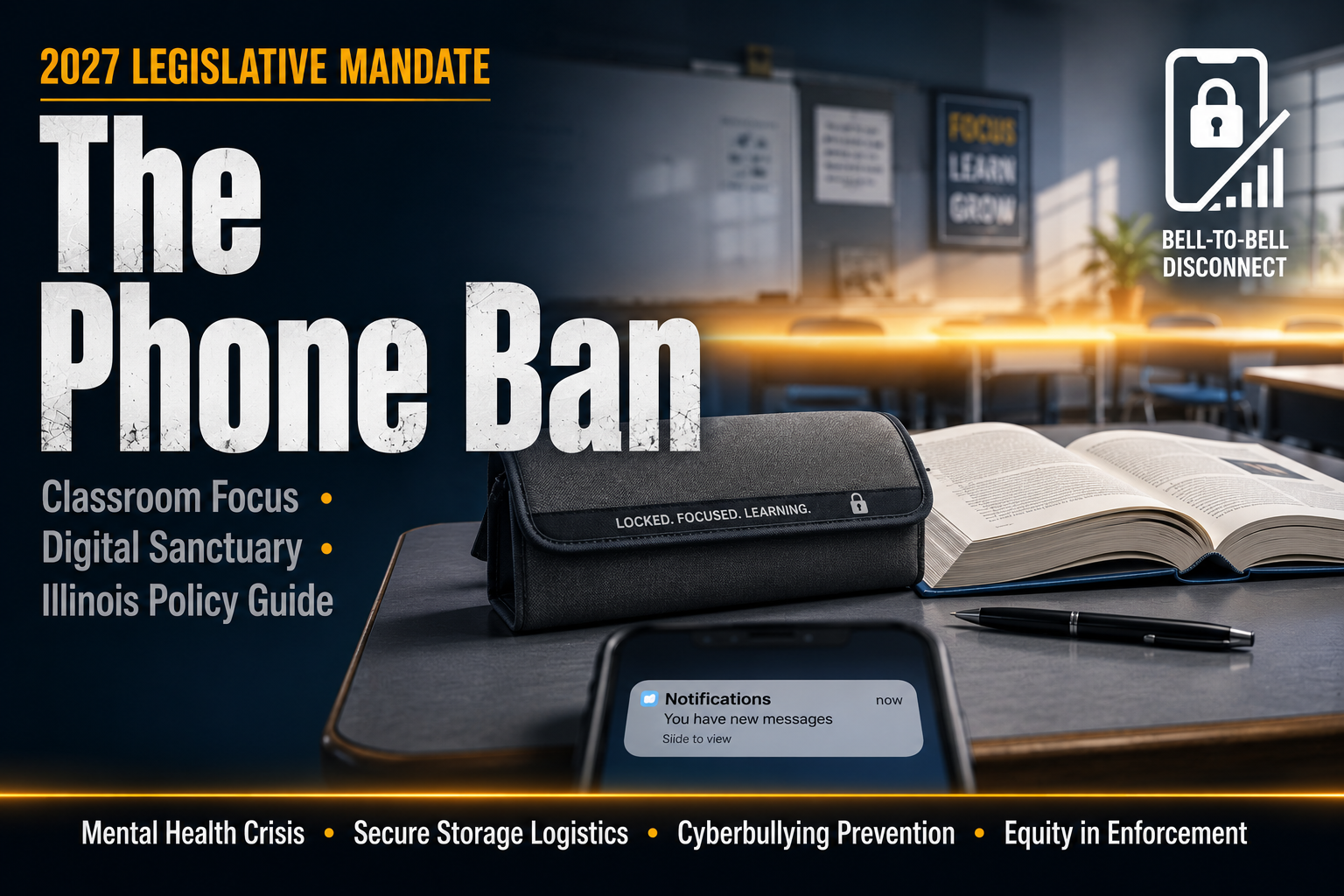
The Great Disconnect: Illinois’ New School Phone Ban and Why Your Classroom Experience Is About to Change Forever
I vividly remember the exact moment I realized that my own smartphone was slowly destroying my ability to concentrate.
I spend an absolute diagnostic amount of time scrolling through social media, managing endless notifications, and trying to focus on deep work. A few years ago, I was sitting in a quiet room trying to finish a complex project. I had my phone sitting right next to my laptop. Every time it buzzed, even if I didn’t pick it up, my eyes flicked toward it. My heart rate jumped. My train of thought shattered. I realized then that I wasn’t the one using the phone—the phone was using me.
Now, imagine trying to learn high-level chemistry, dissecting a complex piece of literature, or solving a quadratic equation while that exact same physiological pull is happening. You’re trying to listen to your teacher, but a notification from Snapchat or a buzzing thread in a group chat is screaming for your attention.
Let’s just be completely real for a second: the American classroom has become a battlefield for attention. For the last decade, we have watched as smartphones and social media algorithms have systematically eroded the ability of our students to focus, interact, and genuinely engage with their peers. Teachers are exhausted. Parents are worried. And the data—as painful as it is to look at—is undeniable.
Illinois is finally drawing a line in the sand.
By the 2027-2028 school year, every public and charter school district in the state of Illinois will be legally required to adopt and implement a “wireless communication device policy.” This isn’t just a suggestion; it’s a legislative mandate born out of the frustrations of educators, the pleas of mental health experts, and a bipartisan consensus in Springfield that things simply cannot continue the way they have been.
Because the landscape of this new policy is incredibly dense, filled with nuances about “bell-to-bell” bans, medical exceptions, and the future of educational technology, I wanted to create a single, definitive pillar of content for you. No corporate PR spin, no confusing legislative jargon, and no tech-bro gatekeeping. This is your complete, deeply human guide to exactly what is happening in Illinois classrooms, why this shift is happening, how districts are handling the logistics of “secure storage,” and whether this is the magic bullet for student success that we are all hoping for.
Grab a cup of coffee, settle in, and let’s break down the most significant change to the Illinois school day in a generation.
The “Why”: Deconstructing the Mental Health and Focus Crisis
To understand why Springfield is forcing these changes, you have to look at the “why” behind the policy. This isn’t about teachers being “anti-tech” or “old school.” It’s about a measurable, objective crisis in the classroom.
The Cognitive Cost of the “Buzz”
According to the Pew Research Center, roughly 72% of high school teachers identify phone distraction as a “major problem” in their classroom today. When your phone is in your pocket, or sitting face-down on your desk, your brain is still partially occupied by it. You are constantly anticipating the “reward” of a notification.
Even if you aren’t looking at the screen, that anticipation triggers a dopamine loop that makes sustained concentration on a boring, difficult task—like reading a textbook or solving a physics problem—nearly impossible. We are effectively training a generation to be incapable of deep, sustained thought. When the teacher is talking, the student isn’t just listening; they are fighting an invisible, high-tech tug-of-war for their own attention.
Cyberbullying: The 24/7 School Day
One of the most horrific realities of modern schooling is that bullying no longer stops when the final bell rings. It doesn’t stop at the locker. Because every student carries a recording studio and a global broadcasting station in their pocket, tiny conflicts are escalated into viral chaos in seconds.
Teachers across Illinois have reported that students now use phones to record fights in the hallways, share private videos via AirDrop, and orchestrate group chats that exclude and isolate classmates. By removing these devices from the instructional day, Illinois is aiming to create a “digital sanctuary”—a few hours a day where a student can just be a kid, where they can fail a test or have a bad conversation without it being recorded, edited, and posted to a social media account for their entire school to see.
The Anatomy of the Policy: What Does “Bell-to-Bell” Actually Mean?
The legislation in Illinois doesn’t just mandate a “ban.” It mandates a policy that each district must craft. However, the state has provided a framework that effectively makes the classroom a phone-free zone.
Instructional Time vs. Bell-to-Bell
The law requires schools to prohibit phone use during “instructional time.” But districts have the authority to decide if they want to go further.
- The Floor: No phones during class.
- The Ceiling: A “bell-to-bell” ban, meaning the phone is turned off and stored away from the moment the first morning bell rings until the final dismissal bell of the day.
Many Illinois school districts are opting for the bell-to-bell approach. Why? Because the “in-between” times—passing periods and lunch—are where the most intense social chaos occurs. It’s where cyberbullying is coordinated and where fights are filmed. By removing the phone for the entire day, the school essentially hits the “reset” button on the social pressures that dominate a teenager’s life.
The Logistics of “Secure Storage”
The million-dollar question that has every administrator, teacher, and parent in the state stressed out is: Where do the phones go?
The law requires that schools provide “secure and accessible storage.” This has led to a massive, state-wide experiment in logistics.
- Yondr Pouches: Peoria’s District 150 has been a pioneer in this. Students are issued a magnetic locking pouch at the start of the year. They drop their phone in, snap it shut, and the pouch stays with them all day. It only unlocks when they tap it against a specialized magnetic base at the end of the day. It’s effective, it’s secure, but it’s an investment—costing roughly $20 to $30 per student.
- Wall-Mounted Cubbies: Many high schools are opting for numbered, hanging pockets on the classroom wall. It’s simple, it’s cheap, and it keeps the device in the teacher’s line of sight.
- Lockers: Some districts are returning to the old-school locker system, requiring students to leave their devices in their hallway lockers before they even enter the classroom.
The state is not providing extra funding for these storage solutions, which has led to significant concern from teachers’ unions regarding both the cost and the added responsibility of “babysitting” thousands of dollars’ worth of electronics every single day.
The Exceptions: Balancing Safety with Sanity
One of the biggest arguments against a phone ban—and it’s a valid one—is parental anxiety. We live in a world where school safety is a constant concern. Parents want to know that if something goes wrong, they can reach their child.
The Illinois law is carefully written to ensure that the “nuclear option” is available when needed:
- The Emergency Carve-out: If there is an emergency or an imminent threat to the school, the ban is immediately lifted.
- Medical Necessity: If a student has a medical condition (e.g., a continuous glucose monitor for diabetes) that requires a phone or tablet to track, the policy must accommodate it.
- IEP/504 Plans: If a student’s Individualized Education Program (IEP) or Section 504 plan explicitly requires technology for accommodations, that takes legal precedence over the phone ban.
- Translation Services: For English Language Learners, the policy cannot prohibit the use of a device if it is being used to translate learning materials.
This isn’t a state-wide mandate to rip the device out of a kid’s hands if they genuinely need it to manage their health or education. It is about removing the choice to use the device for social media, gaming, and distraction during the school day.
The Cultural Pushback: Why Some Parents Are Angry
If you jump on any local Facebook community page or school board forum in Illinois right now, you will see fierce, sometimes angry, opposition to these bans. It is important to acknowledge why.
The “Overreach” Argument
Many parents view this as a government overreach. They argue that a parent should have the right to decide whether or not their child carries a phone, and that the school’s job is to teach, not to regulate personal property. There is a deep, underlying distrust of school administration. If you take my child’s phone, and you lose it, or it gets stolen, or a teacher snoops through it, who is liable? (The law actually provides immunity for school personnel who store devices in “good faith,” but that hasn’t calmed all fears).
The Emergency Anxiety
This is the heart of the resistance. For many parents, the phone is a direct line to their child in the event of a school shooting or a violent threat. To them, taking the phone away feels like stripping the child of their last line of defense.
Educators generally respond to this by pointing out that during active emergencies, the “information” students get from their phones is often dead wrong—rumors spread, incorrect locations are shared, and students focused on their screens are less likely to follow direct safety instructions from teachers. Furthermore, the goal is to keep the focus on the actual, professional safety protocols of the school, not on the chaos of hundreds of uncontrolled devices.
The Implementation Roadmap: What to Expect in 2026-2027
If you have a student in an Illinois public school, the next two years are going to be a transition period.
The 2026-2027 School Year: This is the “Planning Year.” The State Board of Education is required to post a model template for school policies by September 2026. Districts across the state will be holding town halls, surveying parents, and testing different storage solutions. If your district doesn’t have a policy yet, they are likely drafting one right now.
The 2027-2028 School Year: This is the “Launch Year.” By the time the first bell rings in the fall of 2027, every school in the state is required to have a fully adopted, implemented, and publicly posted policy on their website.
The Equity Trap: Why We Must Watch the Discipline Data
There is one aspect of this legislation that educators and social researchers are watching with extreme caution: Equitable Enforcement.
Whenever we introduce “punitive” policies into schools, the data almost always shows that they are not applied equally. A student from an affluent suburban district might have a phone ban treated as a “gentle reminder,” while a student from a minority or lower-income district might face harsher, exclusionary discipline—like suspension—for the exact same behavior.
The Illinois law is very specific here: Districts cannot enforce the ban through fees, fines, or law enforcement action (School Resource Officers).
This is a massive win for civil rights advocates. It prevents the ban from becoming a pipeline to the juvenile justice system. However, it still leaves the door open for districts to create their own “administrative responses.” If School A decides that the third time you have your phone, you get a three-day suspension, and School B decides you get an after-school detention, we are going to see massive disparities in how kids are treated.
The success of these bans won’t be measured by how many phones are collected in a pouch. It will be measured by whether the school culture actually gets better, or if the ban simply becomes another way to pull students out of the classroom and into the principal’s office.
The Verdict: Will It Actually Work?
There is no data yet on how this specific Illinois mandate will affect test scores. But we have data from other states—like Florida and Indiana—that have experimented with similar bans.
The results are, frankly, encouraging.
Teachers report a sudden, dramatic drop in hall traffic, a noticeable decrease in recorded fights, and—most importantly—an increase in “analog” social interaction. When kids aren’t looking at their phones, they actually talk to each other. They engage with their teachers. They have to confront the “boredom” of a 50-minute class, which is exactly where creativity, reflection, and deep learning actually happen.
We have spent twenty years trying to “out-tech” the problem of student distraction. We thought if we gave every kid a tablet, they would learn better. We thought if we put a smart board in every room, they would be engaged.
We were wrong.
The 2026-2027 school year in Illinois is the start of a massive, state-wide experiment in human interaction. It is an acknowledgment that sometimes, the most sophisticated piece of educational technology in the room isn’t a digital device—it’s the human brain, and it needs a little bit of silence, a little bit of focus, and a lot less screen time to do its job.
Frequently Asked Questions (FAQs) About the Illinois Phone Ban
Because this policy is complex and varies by district, we have compiled the absolute most common questions parents and students are asking to ensure you have the facts.
Q: Am I legally allowed to send my child to school with a phone?
A: Yes. The legislation does not prohibit the possession of a phone, only the use of it during instructional time (and potentially during the entire school day, depending on your district’s specific policy). You can send your child to school with their phone in their pocket, provided they are willing to store it in a secure location as required by the school’s policy.
Q: Can a teacher legally take my child’s phone away?
A: Yes. If the device is being used in violation of the district’s policy, the teacher can require the student to store the device in the designated secure location. The law specifically protects school personnel from liability for damage to the device as long as it is stored in good faith and in accordance with the school’s policy.
Q: Does this ban include smartwatches and headphones?
A: The language of the bill is broad. It covers “wireless communication devices,” which includes cellphones, tablets, laptops, gaming devices, and smartwatches. If your child’s smartwatch can be used for communication or distraction, it is likely subject to the same policy as a cellphone.
Q: What if I need to reach my child during an emergency?
A: Every school in Illinois has a dedicated, staffed office line for exactly this purpose. If you have an urgent family matter, call the front office. They have the staff and the protocols to locate your child and get them the information they need immediately. This is the same way parents communicated with their children for over a century before smartphones existed.
Q: Will this improve student mental health?
A: That is the primary goal. By removing the “always-on” connectivity of social media during school hours, the state aims to reduce the anxiety, cyberbullying, and FOMO (fear of missing out) that contribute to the current adolescent mental health crisis. Reducing the noise of the digital world for seven hours a day is a significant intervention for student wellbeing.
Q: Can a school fine me or call the police if my child breaks the rule?
A: No. The Illinois law explicitly prohibits school districts from enforcing these policies through fees, fines, tickets, or by involving law enforcement (School Resource Officers). The enforcement must be administrative—meaning it stays within the school’s code of conduct and discipline system (e.g., detention, loss of privileges).
Q: Do charter schools have to follow this law?
A: Yes. The mandate applies to all public and charter schools across the state. They all have until the beginning of the 2027-2028 school year to have their policies fully adopted and implemented.
Q: How do I know if my specific school district has already passed a ban?
A: Many districts (like Peoria, Champaign, and Springfield) have already implemented their own restrictions. The best way to know is to check your district’s official website for their current “Student Code of Conduct” or “Technology Use Policy.” If you cannot find it online, contact your school’s main office directly.













Leave a Reply