
The Ultimate Guide to School Choice in 2026: Empowering Parents and Reshaping K-12 Education
Have you ever stopped to wonder why we quietly accept an educational system that treats our children like identical packages on a conveyor belt? For generations, traditional K-12 public education operated on a rigid geographic assignment model, effectively locking your kids into specific classrooms based entirely on where you could afford to buy a home or rent an apartment. This outdated assembly-line approach is facing an unprecedented, nationwide mutiny as a massive groundswell of parental advocacy fundamentally rewrites the rules of the game. School choice has officially transitioned from a niche policy debate into a roaring cultural movement that shifts our entire educational perspective away from protecting legacy institutional monopolies and toward funding individual human beings. We are living through an era defined by hyper-personalized technology, AI-driven workspaces, and a growing realization that every single child possesses a uniquely distinct learning blueprint that a one-size-fits-all factory setup will continuously fail to develop. When you unlock public educational dollars and allow families to direct them toward private schools, customized micro-schooling environments, online academies, or specialized therapies, you completely redefine the meaning of structural learning for the modern age.
Striking Down the Zip-Code Monopoly
The Gray Tracksuit Dilemma of Modern Education
Imagine walking into a local clothing store where the manager looks at your driver’s license and forces you to buy a single, identical gray tracksuit, completely regardless of your unique size, style preferences, or daily comfort needs. It sounds entirely absurd, yet this is the exact institutional arrangement that millions of American families tolerated for over a century within their local neighborhood public school districts. This system creates what top policy analysts call a profound gray tracksuit dilemma, where diverse children with wildly varying cognitive gifts, artistic talents, and neurodivergent needs are forced to squeeze into a standardized pedagogical mold. If your child happens to be a highly accelerated visual learner who gets utterly bored by slow-paced lectures, or a struggling reader who requires intensive phonetic intervention, the geographic monopoly simply tells you to deal with whatever your assigned building happens to offer. By dismantling this restrictive framework, the modern push for educational freedom declares that your family’s hard-earned tax dollars should serve as a portable passport to build a custom learning ecosystem instead of acting as a guaranteed revenue stream for a legacy institution that refuses to adapt to a changing world.
The deep frustration fueling this movement isn’t born out of an inherent hatred for public schools, but rather out of a shared, undeniable realization that the traditional system is drowning under its own bureaucratic weight. Parents are looking at their kids, looking at the systemic cracks that have widened into massive canyons over the last decade, and deciding they can no longer afford to wait for sluggish, top-down bureaucratic fixes that take decades to implement. This collective realization has transformed parental choices from an exclusive luxury reserved solely for the wealthy elite into a burning, cross-demographic demand for educational self-determination and hyper-personalized learning environments. As we navigate the complex economic realities of 2026, the old geographic system looks less like a beloved civic anchor and more like an archaic economic monopoly that actively prevents working-class families from accessing the specialized resources their children need to survive.
From the Margins to the Mainstream: A Civil Rights Shift
What started out decades ago as a handful of small, highly restricted pilot programs designed solely for low-income urban districts has suddenly transformed into a full-blown nationwide revolution that is sweeping through state capitols with stunning speed. If you look closely at the legislative history of the early 2000s, voucher experiments were routinely treated by mainstream commentators like fragile policy anomalies destined to collapse under practical operational strain. Fast forward to the present day, and the narrative has shifted so dramatically that access to alternative schooling models is increasingly recognized as a fundamental civil right for everyday American families who want an escape hatch from struggling districts. This historic policy transformation didn’t happen by accident; it was catalyzed by an aggressive combination of parental frustration, severe academic declines, and a wave of legislative updates that effectively dismantled long-standing state educational monopolies. By explicitly focusing state funding formulas on absolute student portability, lawmakers are discarding old compromise frameworks and establishing permanent legal structures that place parents in the primary steward position of their child’s intellectual journey.
This mainstream shift has completely upended the traditional political alignments surrounding educational policy, creating surprising coalitions of parents from every imaginable socio-economic background who all want the same basic freedom. When a local school district fails to deliver baseline literacy skills or tolerate a safe, distraction-free environment, families naturally begin to view their state education dollars as personal capital meant to secure their child’s actual future rather than property belonging to a school board. The institutional complacency that tolerated stagnant student outcomes for years has finally broken the contract of trust between local communities and their school administrators, sparking an unprecedented urgency to seek viable alternatives. This momentum means that state-level policy is no longer stuck debating whether families deserve choices, but rather how rapidly those choices can be scaled to cover every single child from kindergarten through graduation.
The Financial Engines Under the Hood of Educational Freedom
Education Savings Accounts: Your Child’s Personalized Learning Debit Card
If traditional school vouchers are comparable to a rigid, store-specific coupon, then Education Savings Accounts (ESAs) represent a fully loaded, flexible debit card tailored exclusively for your child’s developmental blueprint. ESAs are widely celebrated as the absolute gold standard of the modern educational freedom movement because they offer an unparalleled level of custom administrative control directly to the household. Instead of sending public tax revenues directly to a school building, the state deposits your child’s per-pupil allocation straight into a secure, government-managed digital account that you oversee through an intuitive online portal. What can you actually buy with these flexible public funds to optimize your child’s daily intellectual enrichment? You can seamlessly divide the capital to pay for private school tuition, purchase comprehensive home education curriculums, contract private certified academic tutors, or secure expensive neurodivergent speech therapies.
Recent updates to existing legislation, such as South Carolina’s expanded framework, even allow families to utilize these accounts for critical ancillary expenses like required school uniforms, textbooks, and specialized technological hardware. This high degree of financial agility empowers you to assemble a completely customized, multi-provider learning experience that shifts dynamically as your child grows and develops new academic interests. By moving the focus of state education spending from protecting physical infrastructure to directly funding individual human beings, ESAs have initiated an unprecedented free-market experiment that is rapidly dismantling the century-old geographic monopoly of traditional public districts.
School Vouchers: Traditional Direct Tuition Support
While ESAs represent the modern, multi-faceted evolution of education funding, traditional school vouchers remain the dependable, time-tested workhorse of direct tuition assistance across several states. This mechanism functions through a relatively straightforward financial transaction: the state provides a dedicated public scholarship certificate that parents hand directly to an accredited private or parochial institution of their choice to offset costs. Have you ever wondered why this specific structural model has managed to maintain such an enduring presence in state legislative battles for over thirty consecutive years? The reality is that vouchers provide an immediate, clean escape hatch for families trapped in low-performing local schools who want a seamless transition into classical private academies without navigating complex spending line-items or digital portals.
States like Indiana have recently pushed this model to near-universal scale by raising their income eligibility limits to a staggering 400 percent of the Federal Poverty Level, effectively opening elite private institutions to the working class. By stripping away the restrictive economic barriers that historically reserved private schooling for the wealthy elite, traditional vouchers continue to act as a powerful equalizer that levels the playing field for ordinary neighborhood families. This direct approach eliminates the financial anxiety of purchasing an alternative education, ensuring that any student can claim their share of state education funding regardless of their family’s income brackets or their specific neighborhood boundary lines.
Tax-Credit Scholarships: Unleashing Private Wealth for Public Good
Stepping away from direct state appropriations brings us into the ingenious world of tax-credit scholarships, a mechanism that uses smart tax incentives to generate vast pools of private educational capital. Under this brilliantly engineered framework, state governments encourage private corporations and individual taxpayers to donate money directly to independent, non-profit Scholarship Granting Organizations (SGOs). In exchange for these charitable financial contributions, the state rewards the donors with a dollar-for-dollar reduction in their state tax liabilities, making it an incredibly attractive financial move for local businesses. These heavily funded SGOs then turn around and distribute those accumulated millions of dollars as private school scholarships to thousands of eager students who are desperately seeking alternative learning environments.
Nationally, there are currently 126 active SGOs working tirelessly behind the scenes to process these massive funding streams and expand localized educational access for families. This clever financial architecture bypasses the direct public treasury, creating a robust shield against standard constitutional legal challenges while fostering deep community-wide financial investment in local student outcomes. By leveraging private capital to bypass traditional legislative budget battles, tax-credit scholarships create a parallel funding pipeline for alternative education without pulling money directly out of the state’s existing public school line-item budget.
Section 25F and the $25.9 Billion Federal Cash Infusion
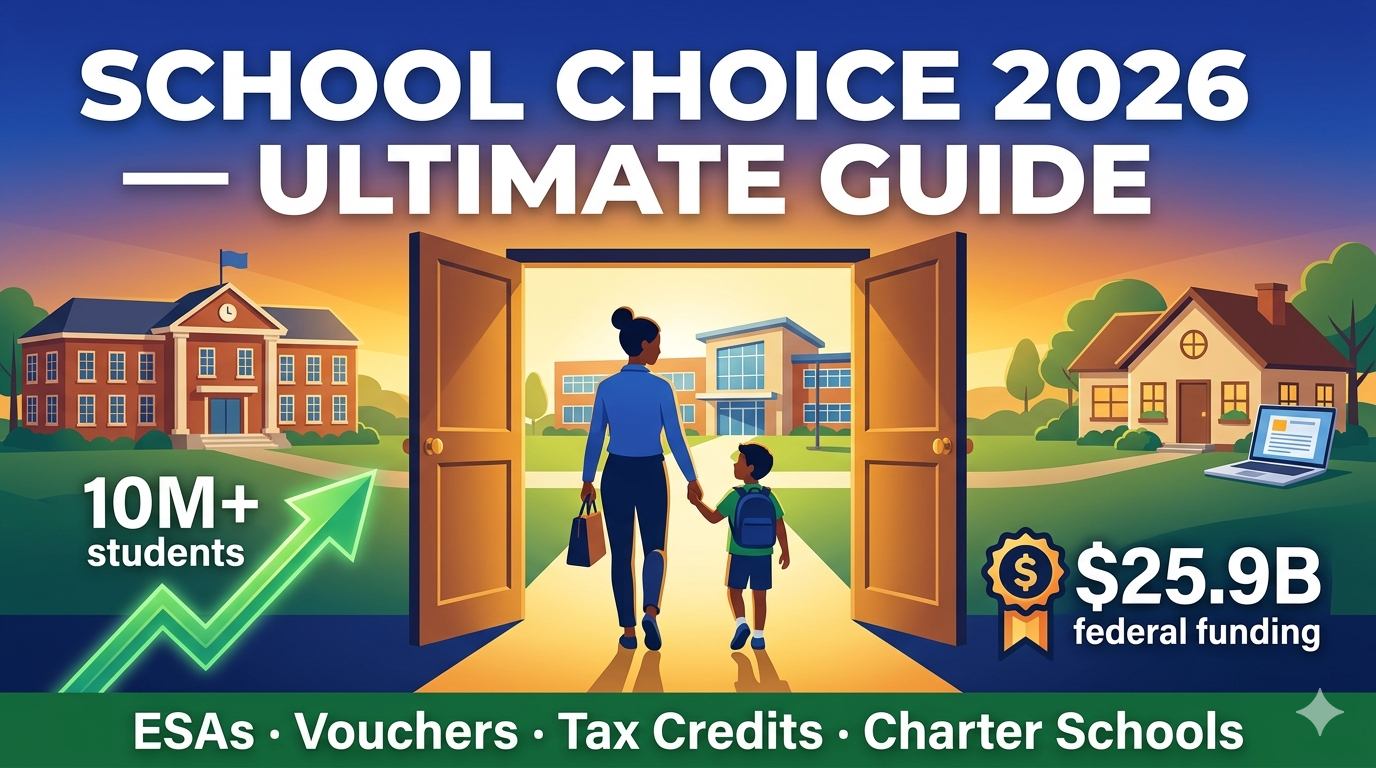
The entire financial architecture of local school choice experienced a massive cosmic shift when the historic “One Big Beautiful Bill” officially introduced the federal Education Freedom Tax Credit under Section 25F. This sweeping national mandate injects an estimated $25.9 billion over the next ten years into the alternative schooling infrastructure by allowing federal taxpayers to dramatically offset what they owe the government through SGO contributions. How will this top-down federal tax shift fundamentally alter the day-to-day educational options available in your local hometown over the coming decade? Federal analysts project that this massive injection of capital will completely supercharge the financial capacity of local SGOs, allowing them to scale their scholarship distributions to heights never before imagined.
So far, a resounding 31 states have actively moved to fully integrate their state education operations with this brand-new federal tax credit framework to maximize their available funding. While a couple of dissenting states have explicitly chosen to opt out of this specific federal program due to local political gridlock, the vast majority of the country is rushing to position themselves at the forefront of this monumental national cash infusion. This historic federal intervention proves that school choice is no longer just a series of disconnected state-level experiments, but a comprehensive national strategy designed to introduce free-market dynamics into the K-12 landscape.
Public Charters and Magnets: Innovation Within the System
It is a common misconception to assume that the school choice movement is exclusively focused on private academies, because public charter schools and specialized magnet programs form a critical pillar of public-sector innovation. Charter schools are uniquely designed public institutions that operate under a specific charter agreement that grants them immense organizational flexibility in exchange for meeting strict academic performance accountability standards. Think of them as nimbler, highly adaptable laboratories of learning that are completely free from the rigid red tape and suffocating bureaucratic mandates that so often paralyze traditional school districts. Roughly one in twelve public school students across the United States now attends a charter school, reflecting a massive cultural appetite for specialized public education options that do not require private tuition.
Magnet schools complement this dynamic ecosystem by offering highly focused, theme-based curricula built directly around science, technology, engineering, mathematics, or the performing arts to attract talented students across traditional district boundary lines. These public-choice vehicles ensure that even if you choose to remain entirely within the public school system, you still have the power to break free from standard factory-model education. By introducing healthy competition within the public framework itself, charters and magnets push traditional districts to upgrade their curricula, improve their communication with families, and actively demonstrate their value to the local community.
Ground Zero of the Choice Explosion: Analyzing the 2026 Landscape
The Lone Star Surge: How Texas HB 1 Upended the Market
The true scale of this movement became undeniably clear when Texas officially launched its long-awaited Texas Education Freedom Accounts (TEFA) program under HB 1, instantly creating the largest day-one school choice marketplace in the history of American education. The sheer administrative velocity of the Texas rollout stunned both supporters and critics alike, racking up an overwhelming wave of applications from families eager to claim their educational freedom. Administered directly through the Texas Comptroller’s office to ensure rigorous fiscal oversight and prevent fraudulent spending, the TEFA program allocates a substantial sum of over $10,800 per student annually for those choosing approved private schools, while offering up to $30,000 for students with documented disabilities.
The demand was so intense that the state’s secure online portal was flooded with applications within the first few hours of opening, demonstrating a massive, pent-up appetite for alternative educational models across the Lone Star State. This rollout proves that school choice is no longer an abstract academic theory; it is a massive, operational logistical reality that is actively reshaping how hundreds of thousands of children experience their formative learning years. By setting the single most generous universal ESA baseline in the nation, Texas has effectively fired a warning shot that is forcing neighboring states to rapidly accelerate their own school choice timelines.
The Sunshine State Standard: Florida’s Universal Playbook
While Texas is making major waves with its massive new rollout, Florida continues to serve as the undisputed executive blueprint for how to successfully run a universal choice marketplace at scale. The state has aggressively expanded its highly successful Family Empowerment Scholarship program to achieve full universal eligibility, completely eliminating old income caps and offering families between $8,000 and $9,500 depending on the student’s specific grade level. Arizona closely mirrors this aggressive expansion strategy, maintaining a robust universal ESA framework that provides an average of $7,200 per student to over seventy thousand participating children across the desert southwest. To see how these variations play out across different regions, we can examine how several leading states have structured their universal and expansive private school choice frameworks in 2026.
| State | Primary Program Type | Eligible Student Population | Key Allowable Expenses | Average Funding Amount |
| Texas | Education Freedom Accounts (TEFA) | Universal with Priority Tiers | Private tuition, homeschool supplies, specialized therapies | $10,800 per student |
| Florida | Family Empowerment Scholarship | Universal (All K-12 Residents) | Private tuition, tutoring, curriculum, technology, therapies | $8,750 per student |
| Arizona | Empowerment Scholarship Account | Universal (All K-12 Residents) | Private tuition, homeschooling materials, college prep exams | $7,200 per student |
| Iowa | Education Savings Account (ESA) | Universal (All K-12 Residents) | Accredited private school tuition, mandatory fees | $7,600 per student |
The Grand Tally: National Dollars and Enrollment Tragedies
When you step back and look at the raw numbers defining the educational landscape, the sheer scale of the school choice movement becomes absolutely undeniable. Across the nation, total public investment flowing directly through ESAs, vouchers, and tax-credit scholarships has shattered records to exceed $10.8 billion annually. This mind-boggling figure has roughly doubled since 2023, representing one of the fastest reallocations of public infrastructure capital in modern American history. Because of this massive legislative push, more than 10 million students nationwide are now fully eligible to apply for and receive alternative educational funding.
This explosive growth is occurring at a time when the National Center for Education Statistics projects that 40 out of 50 states will experience steady public school enrollment declines over the next five years. Meanwhile, states that have embraced universal educational savings accounts are seeing jaw-dropping average growth rates of 25 percent in program participation between year one and year two. These numbers clearly demonstrate that parent demand is not just a passing trend, but a permanent realignment of educational economics that is forcing traditional districts to completely rethink their operational strategies.
Embracing the Tug-of-War: The Hard Truths, Pros, and Cons
Why Families are Winning the Personalization Game
The primary reason why families are overwhelmingly celebrating the expansion of school choice is the profound opportunity for radical academic personalization that it introduces into their homes. When you possess the financial freedom to choose, you are no longer forcing a brilliant, artistic child into a rigid, test-heavy environment, nor are you trapping a struggling reader in an under-resourced classroom. Instead, you can intentionally seek out specialized private schools, multi-age microschools, or custom hybrid learning models that match your child’s unique cognitive wavelength.
Furthermore, classical economic theory suggests that healthy marketplace competition naturally forces every single participant to improve their overall product quality to survive. As the renowned education scholar Dr. Patrick J. Wolf noted at a recent Harvard research conference, public schools frequently respond to choice policies by actively modernizing their offerings and working harder to retain families. When traditional public schools are forced to compete for their funding, they are naturally incentivized to improve communication, upgrade technologies, and address systemic teacher burnout. Ultimately, this competitive dynamic elevates the educational baseline for the entire community, ensuring that every child benefits regardless of where they choose to learn.
The Fiscal Cliff: Are Public School Budgets Facing a Death Spiral?
Despite the clear benefits experienced by participating families, the rapid expansion of universal school choice has triggered intense pushback regarding long-term fiscal sustainability. Critics and public education advocates frequently argue that siphoning away per-pupil funding creates severe financial instability for traditional public school districts. The core issue is that when a student leaves a neighborhood school with their funding, the fixed operational costs of running that building do not magically disappear. The district still has to pay to heat the entire structure, maintain the extensive bus fleet, and compensate the salaried administrative staff, even if the classrooms are only three-quarters full.
This sudden drop in variable funding can leave traditional districts facing tough budgetary decisions, occasionally resulting in reduced elective offerings, larger class sizes, or localized school closures. Opponents also worry that private academies lack the rigorous state-mandated testing accountability and comprehensive special education infrastructure required of public systems. This ongoing tension highlights a deep structural debate over whether public tax revenues should be used to support independent private entities that operate outside of direct democratic oversight.
The Accountability Trap: Who Inspects the Private Marketplace?
Another massive vulnerability that gives policy analysts serious pause is the complete lack of standardized academic accountability and state-level oversight that characterizes the vast majority of universal private school choice programs. In an overwhelming majority of states that have passed universal legislation, participating private schools and homeschool families are completely exempt from taking the rigorous, standardized state tests that public schools are forced to administer every single spring. This lack of data creates a dangerous, non-transparent accountability black hole, making it virtually impossible for taxpayers or researchers to accurately measure whether billions of dollars in public funds are actually producing positive academic outcomes or just subsidizing substandard instruction.
Without clear, standardized diagnostic metrics to compare performance across sectors, parents are forced to rely on slick marketing brochures and anecdotal reviews when choosing a school. This complete absence of rigorous state inspection raises the uncomfortable possibility that public funds could be funneled into unaccredited academies that provide an inferior education compared to the public districts they replaced. To balance this system, forward-thinking policy frameworks must focus on creating healthy, transparent ecosystems where both public districts and private models are held to clear baseline standards while enjoying the flexibility needed to truly innovate.
The Parent’s Playbook: Navigating Your State’s System Today
Navigating the various state-level application systems can initially feel like climbing a massive mountain of paperwork, but breaking the process down into deliberate steps makes it incredibly manageable. Your very first objective is to visit your specific state department of education website to thoroughly verify your current eligibility status and review the strict annual application deadlines. Once you confirm that your state offers an active ESA or voucher program, you will need to gather critical documentation, including official proof of state residency, birth certificates, and recent public school enrollment records. Collect your state-issued photo identification, your child’s certified birth certificate, and official utility bills to establish undeniable proof of local state residency before creating a secure user profile on your state’s official scholarship management portal, such as the Utah Fits All or Louisiana Gator online application systems.
After uploading your clean documentation, you must carefully navigate the expense pre-approval process to ensure that your intended purchases align perfectly with your state’s strict regulatory guidelines. Submit detailed requests for your intended private tuition or customized curriculum items to the state framework to guarantee compliance before spending any capital. Finally, it is absolutely imperative that you maintain an incredibly organized physical or digital ledger of every single educational transaction. State agencies are increasingly utilizing aggressive, randomized financial audits to actively combat fraud and verify that public funds are being used exclusively for valid instructional materials. Maintain an impeccably organized digital archive of every single receipt and invoice to smoothly clear the mandatory financial audits required by state regulators, ensuring your child’s uninterrupted access to educational liberty.
Frequently Asked Questions About School Choice
How exactly do Education Savings Accounts differ from traditional school vouchers?
The primary operational difference between these two school choice mechanisms lies in their overall spending flexibility and financial architecture. A traditional school voucher functions exactly like a direct, single-use scholarship certificate that is legally restricted to paying for tuition at an accredited private or parochial school. Once you select an eligible private school, the state sends the voucher funds directly to that specific institution to cover your child’s classroom seat. In stark contrast, an Education Savings Account operates like a highly flexible, multi-purpose digital debit card that deposits your child’s public per-pupil funding into a secure online account. As a parent, you maintain complete administrative control over these funds and can customize your child’s education by splitting the capital across multiple approved providers. This means you can use an ESA to pay for partial private tuition, hire specialized private tutors, purchase certified homeschool curricula, or fund critical therapies for neurodivergent conditions.
Will participating in a private school choice program impact my child’s legal special education rights?
When you choose to transition your child from a traditional public school to a private learning environment using a voucher or ESA, a significant legal shift occurs regarding special education protections. In the public school system, students with disabilities are strictly protected by the federal Individuals with Disabilities Education Act (IDEA), which legally mandates a Free Appropriate Public Education (FAPE) and an enforceable Individualized Education Program (IEP). When you voluntarily accept a private scholarship program, you are generally choosing to waive these specific federal entitlement rights under IDEA. Private schools are not legally bound by the same strict federal mandates to provide identical IEP accommodations, meaning they operate under different institutional standards. However, many universal states are intentionally designing modern ESA programs to provide significantly higher funding amounts for students with documented special needs to help families directly afford elite, specialized private therapies.
How are state governments working to prevent financial fraud within universal ESA systems?
To safeguard public tax revenues and maintain deep public trust, state lawmakers are implementing highly sophisticated, multi-layered financial oversight measures. Most universal states contract with major independent financial technology companies to manage their online scholarship portals, creating an automated system where funds can only be spent with pre-approved vendors. This digital architecture makes it virtually impossible for a parent to accidentally or intentionally spend education dollars on unauthorized personal retail items. Furthermore, states like Utah and Florida have recently enacted strict legislative updates that mandate comprehensive pre-approval processes for all custom expenses, alongside rigorous customer service benchmarks. State departments of education also conduct regular, randomized financial audits that require participating families to upload detailed itemized invoices and receipts for every transaction. Families found to be intentionally misusing their funds face immediate expulsion from the program, full financial restitution mandates, and potential criminal prosecution.
Can families use universal school choice funds to fully support a traditional homeschooling curriculum?
The ability to use public school choice funds for home education depends entirely on the specific legal definitions and regulatory structures written into your state’s legislation. In many progressive universal ESA states, such as Texas, Arizona, and Oklahoma, home education expenses are fully recognized as an approved use of public scholarship funds. Parents in these states can seamlessly use their accounts to purchase comprehensive textbook series, digital learning subscriptions, laboratory equipment, and specialized instructional supplies. However, some states legally distinguish between a standard independent homeschooler and an ESA recipient who teaches their child at home, requiring ESA users to agree to minimal testing or curriculum reporting standards. It is absolutely vital to research your local state guidelines, as states like West Virginia require specific program applications, while other regions completely bar traditional independent homeschoolers from receiving public financial assistance.
Does the expansion of universal school choice completely destroy the local public school system?
The intense claim that school choice policies will cause the immediate and total destruction of traditional public education is largely disproven by real-world empirical data. Rather than completely destroying public districts, the presence of choice and market competition typically acts as a powerful catalyst that forces public systems to actively improve. When faced with the potential loss of per-pupil funding, many forward-thinking public school districts respond by launching innovative new programs, expanding magnet options, and working harder to satisfy parental demands. Data from long-running programs in Florida and Arizona shows that traditional public schools can successfully adapt and maintain stable operations alongside a thriving private option marketplace. While districts must undoubtedly navigate real operational challenges relating to shifting student enrollment, the overall outcome is a more diverse and resilient educational ecosystem that raises the academic performance baseline for all students.





Leave a Reply