

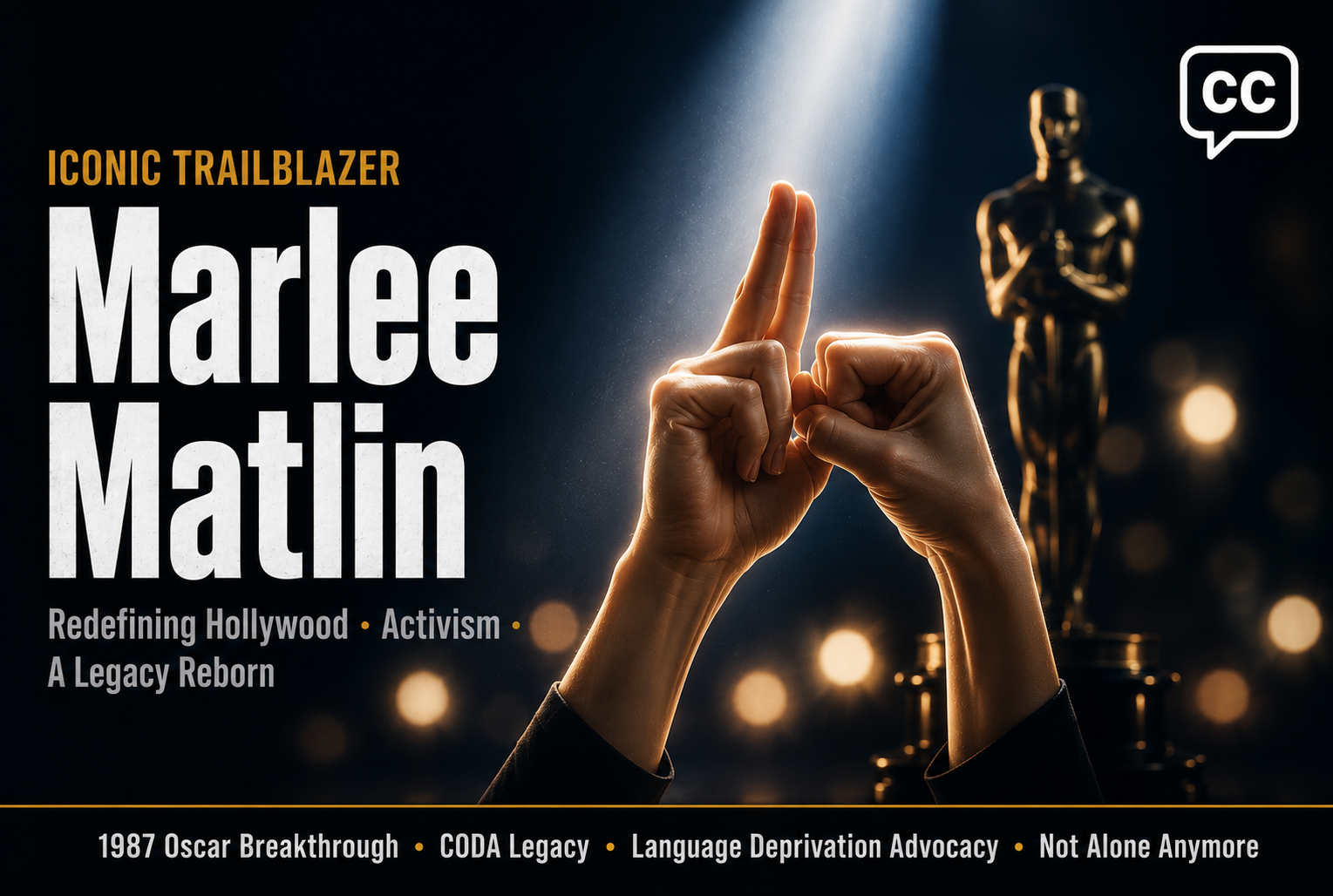
The Unstoppable Force: How Marlee Matlin Redefined Hollywood and Why Her Fight Is Just Getting Started
I vividly remember the exact afternoon I saw a clip of the 1987 Academy Awards ceremony.
I spend an absolute diagnostic amount of time analyzing the mechanics of power, cultural shifts, and how individual icons move the needle on global social justice. So, I was watching the footage of a 21-year-old Marlee Matlin stepping onto that stage to accept the Oscar for Best Actress. She was young, she was Deaf, and she was stepping into an industry that was almost entirely unprepared for her presence. When she stood there, signing her acceptance speech in front of a global audience, she wasn’t just accepting a gold trophy; she was shattering the foundation of a Hollywood that had spent its entire history pretending that Deaf actors didn’t exist, or worse, that their stories weren’t “marketable” enough to tell.
Let’s just be completely real for a second: the history of Hollywood is a history of erasure. For decades, the industry relied on hearing actors to “perform” deafness, treating a complex, beautiful, and vibrant culture like a costume. Then came Matlin. And she didn’t just break the door down; she stood in the hallway and refused to let anyone else close it again.
Fast forward to 2026. The documentary Marlee Matlin: Not Alone Anymore has just premiered, and it’s reigniting a conversation that is as relevant today as it was in the late 80s. Nearly 40 years after that Oscar win, Marlee Matlin isn’t just an “actress.” She is a titan, an activist, a producer, and a beacon of hope for a generation of Deaf and hard-of-hearing talent who now have a path forward because she spent four decades clearing the brush.
Because the narrative of Marlee Matlin is so often reduced to “the girl who won the Oscar,” I wanted to create a single, definitive pillar of content for you. No corporate marketing fluff, no shallow “feel-good” biography, and no bias. This is your complete, deeply human guide to exactly what Marlee Matlin actually accomplished, why her impact goes far beyond the silver screen, and how she turned an industry’s “pity” into an activist’s platform.
Grab a cup of coffee, settle in, and let’s break down the legacy of a woman who proved that the only thing she couldn’t do was hear—the rest was hers for the taking.
Part 1: The “Not Alone Anymore” Narrative (A Look at 2026)
If you have been keeping an eye on the film festival circuit this year, you’ve likely seen the buzz surrounding Marlee Matlin: Not Alone Anymore. Directed by the brilliant Deaf filmmaker Shoshannah Stern, this isn’t your standard, sanitized celebrity documentary.
It’s an intimate, raw, and at times brutal look at the human cost of being a pioneer. The film pulls no punches. It explores the trauma of language deprivation in childhood, the shadows of a tumultuous, high-profile early relationship, the battle with substance abuse, and the constant, soul-crushing weight of being told by Hollywood executives for years that she was just a “fluke.”
But the film’s title, Not Alone Anymore, is the crucial takeaway for our current era. When Matlin won in 1987, she was effectively the only Deaf person in the room. There was no support network. There were no Deaf directors, producers, or writers to lean on. When she walked onto the set of Children of a Lesser God, she was surrounded by a world that thought of her as “handicapped” rather than talented.
Today, she’s part of a thriving, vocal, and talented community that she helped birth. As she famously signed when her CODA co-star Troy Kotsur won his Oscar in 2022—becoming only the second Deaf actor to win an Academy Award—”I’m not alone anymore.”
Part 2: The Activist Titan (Beyond the Screen)
One of the most persistent myths about Matlin is that she just rode the wave of her Oscar win into a quiet, comfortable acting career. That couldn’t be further from the truth.
Matlin realized very early that if she wanted the world to change, she had to stop waiting for Hollywood to change it for her. She had to become the force of nature that demanded it.
The Television Decoder Circuitry Act of 1990
This is her single greatest, most tangible legacy. If you have ever hit the “CC” button on your television, you are utilizing a law that exists because Marlee Matlin sat in front of the U.S. Senate and refused to be ignored.
In 1990, she didn’t just advocate; she organized. She pressured. She sat in front of the Senate panel and demanded that every television sold in America be equipped with a decoder chip for closed captioning. It was passed into law three years later. Before that, for millions of Deaf and hard-of-hearing Americans, television was a completely inaccessible medium. Today, it’s a standard feature. That is the definition of “industry impact.”
Disability Advocacy as a Second Career
She has been appointed by two different presidents—Bill Clinton and Barack Obama—to serve on the Corporation for National Service and the Americans with Disabilities Act anniversary ceremonies. She doesn’t just attend these events to look good; she’s in the room, fighting for funding for the arts, disability access, and humanitarian causes like the American Red Cross.
She turned the “pity” that the media tried to heap on her in 1987 into a mandate for legislative change. She realized that while an Oscar gets you into the room, it’s your voice—your real voice, signed or spoken—that gets the bill passed.
Part 3: Challenging the “Pity” Industry
In the 1987 awards season, the media was often cruel. They framed her as a “handicapped” actress, a “pity vote,” or a “fluke.”
Matlin spent years being forced to defend her talent. In the documentary Not Alone Anymore, she is finally able to speak (through ASL) about the toll that took. Imagine being 21, winning the highest honor in your profession, and having to listen to the media call it a “pity win” instead of a masterpiece of acting.
She eventually stopped caring what the critics thought and started caring about what the community needed. She pivoted to television, where she found roles that allowed her to demonstrate her range—from the political intensity of The West Wing to the emotional complexity of The L Word.
She proved that Deaf actors can be detectives, political aides, professors, and complex anti-heroes. By doing this, she essentially forced Hollywood to expand its imagination. She didn’t just take “Deaf roles”; she took human roles and insisted that the character’s deafness was just one part of their humanity, not the entirety of their existence.
Part 4: The “CODA” Renaissance
In 2021, CODA arrived and did the unthinkable: it won Best Picture. And Matlin was the anchor of that film.
For the Deaf community, CODA wasn’t just a movie; it was a watershed moment. It featured three Deaf characters in a lead capacity. It wasn’t about a Deaf person “learning to hear” or being “fixed.” It was about a family that communicated in their own language, lived their own life, and were the protagonists of their own story.
Matlin’s role in CODA was the culmination of everything she fought for in 1987. She was no longer the “only one” on set. She was a co-star, a partner, and a mentor. She was finally in a place where the hearing world was actually listening, rather than just waiting for their turn to speak.
Part 5: The “Language Deprivation” Crisis
While we celebrate her success, Not Alone Anymore brings up a crucial, painful topic that Marlee has championed: Language Deprivation.
Roughly 95% of Deaf children are born to hearing parents. Many of these parents, terrified by the diagnosis, immediately prioritize speech therapy or cochlear implants over sign language. The result is often “language deprivation”—where a child grows up without a fluent, native language during their most critical years of development.
Marlee’s life story is an indictment of how we treat Deaf children. She uses her platform to advocate for early ASL exposure, fighting the medical-model bias that says being Deaf is a “disorder to be cured” rather than a “culture to be nurtured.” By speaking out about this, she is influencing how the next generation of Deaf kids will grow up—hopefully with a language, a community, and a self-worth that isn’t dependent on their ability to “pass” as hearing.
Part 6: Why the Target Audience Matters
When we talk about “target audiences” for Marlee Matlin’s work, it’s a dual-pronged approach.
First, there is the Deaf and Hard-of-Hearing audience. For them, she isn’t just an actress—she is the baseline. She is the person who fought so they wouldn’t have to scream for subtitles. She is the person who made it possible for a young filmmaker like Shoshannah Stern to envision a career where she could direct a documentary about her idol.
Second, there is the Hollywood Executive/Creative audience. For them, Marlee is the recurring alarm clock. Every time the industry tries to fall back into the lazy habit of casting a hearing person to play a Deaf role, Marlee is there to point out why that’s not just offensive—it’s bad storytelling. She is the constant reminder that “authentic” casting isn’t just a diversity checkbox; it’s the key to better art.
Part 7: Final Thoughts: The Unstoppable Force
So, why does Marlee Matlin matter in 2026?
She matters because she represents the triumph of the individual over a system that wasn’t built for them. When people say “Hollywood is changing,” they aren’t just talking about digital effects or streaming services. They are talking about inclusion. They are talking about the reality that the “default” human experience shouldn’t be defined by sound, color, or ability.
Marlee Matlin spent four decades turning herself into a powerhouse so that the next generation wouldn’t have to be quite as lonely as she was.
As she herself said: “The only thing I can’t do is hear. The rest is there for the taking.”
Frequently Asked Questions (FAQs) About Marlee Matlin
Because Marlee Matlin’s career has spanned four decades, across film, TV, Broadway, and activism, we have compiled the absolute most common questions regarding her career, impact, and recent projects to ensure you have the facts.
Q: Did Marlee Matlin win an Oscar?
A: Yes. She won the Academy Award for Best Actress in 1987 for her debut role in Children of a Lesser God. She remains the first and only Deaf performer to win in the Best Actress category and was the youngest winner in that category at the time (21 years old).
Q: Is Marlee Matlin currently acting?
A: Yes. Marlee continues to act and is also branching out into directing and executive production. She directed an episode for the series Accused in 2022, becoming the first Deaf network television director.
Q: What is the documentary “Marlee Matlin: Not Alone Anymore”?
A: Released in 2025, this documentary is an intimate profile of her life and career. It focuses on the personal and professional struggles of a trailblazing actor, including her activism, her personal life, and the evolution of the Deaf community’s representation in the entertainment industry.
Q: How did Marlee Matlin become an advocate for closed captioning?
A: After her Oscar win, she used her newfound platform to lobby for accessibility. She sat before the U.S. Senate and successfully pushed for the Television Decoder Circuitry Act of 1990, which mandated that all televisions sold in the U.S. must contain a chip capable of displaying closed captioning.
Q: Was Marlee Matlin in the movie “CODA”?
A: Yes, she played Jackie Rossi, the mother in the family. CODA went on to win the Academy Award for Best Picture in 2022. It is considered a historic film for the Deaf community because it featured a majority-Deaf cast in lead roles.
Q: How long has Marlee Matlin been Deaf?
A: Marlee lost the majority of her hearing when she was 18 months old. She has had no hearing in one ear and roughly 20 percent hearing in the other since early childhood. She was raised in mainstream schools rather than being sent to a residential school for the deaf, which shaped her unique experience of moving between the hearing and Deaf worlds.
Q: What is Marlee Matlin’s biggest impact on Hollywood?
A: Her impact is multifaceted. Beyond her acting, she forced Hollywood to take Deaf actors seriously by proving they could carry a major film. Furthermore, her lifelong activism regarding closed captioning, ASL interpretation, and hiring practices has forced the industry to move from treating accessibility as an “optional” accommodation to an industry-standard requirement.
Q: What has she said about the “CODA” legacy?
A: She has emphasized that the most important legacy of CODA is that it proved you can tell universal stories with Deaf actors. She believes it finally disproved the long-held industry myth that Deaf stories aren’t “commercially viable” for mainstream global audiences.
Q: How does she feel about her title as the “first” Deaf actor to win an Oscar?
A: She has expressed pride in being a pioneer but has also been vocal about the pressure that comes with it. In recent interviews, she has highlighted that for 36 years, she was the “only one,” which was an isolating experience. Her recent comments focus on how thrilled she is to see others like Troy Kotsur joining her in the winner’s circle, confirming that she is “not alone anymore.”
Q: Is Marlee Matlin still working with the National Association of the Deaf (NAD)?
A: Yes, she remains a prominent member and vocal supporter of the NAD. She frequently uses her public platform to amplify their campaigns, such as the push for on-screen interpreters during White House press briefings and improved accuracy for real-time captioning in digital media.
Q: How can I see “Not Alone Anymore”?
A: The documentary was released in 2025 and has been making rounds at film festivals like Sundance. It is distributed by Dogwoof. You can check your local independent cinema listings or the official Actual Films website to see if there are screenings or digital release dates in your area.











Leave a Reply