
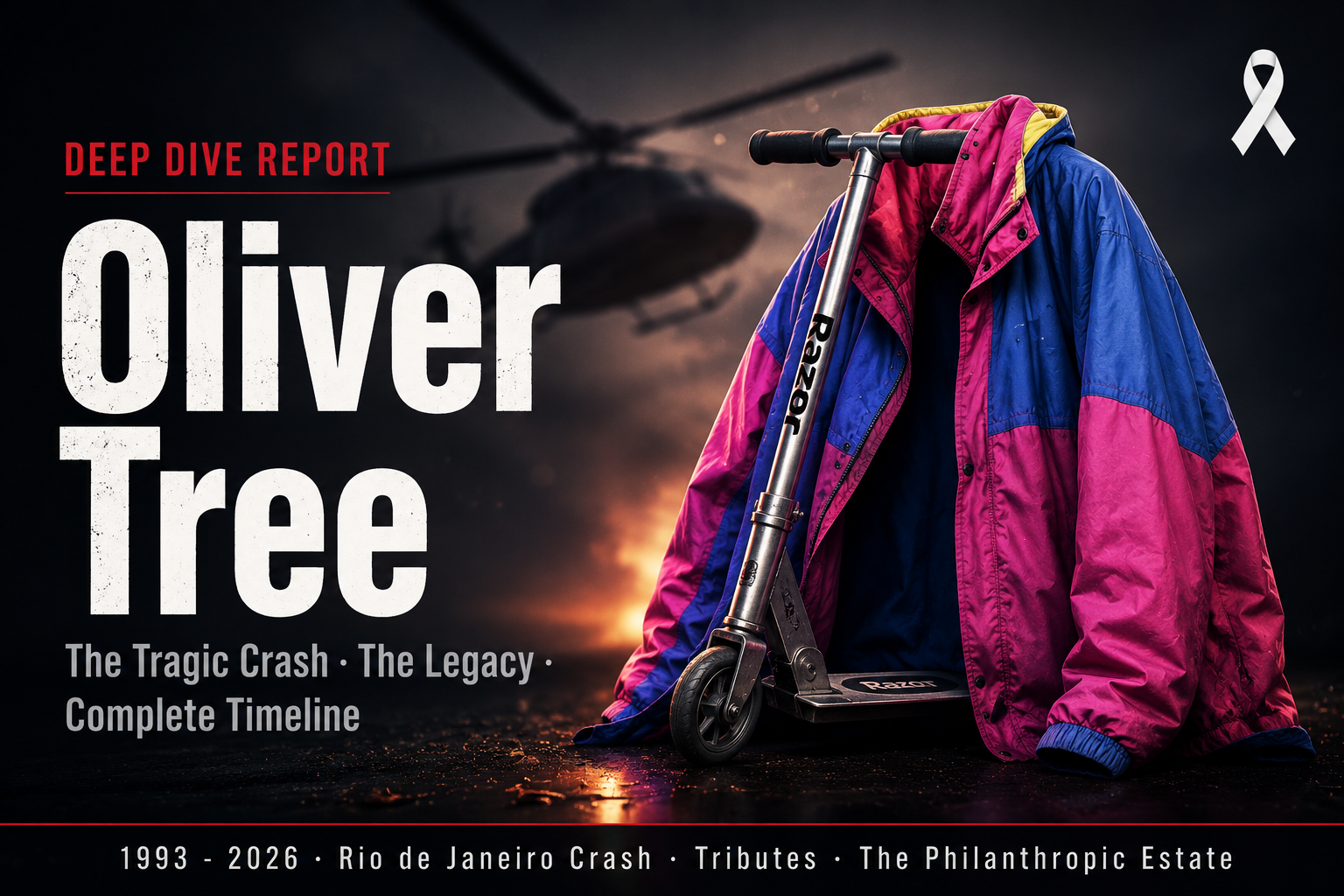
The Tragic Death of Oliver Tree: Everything We Know About the Brazil Helicopter Crash (A Complete Deep Dive)
I will never forget the exact afternoon the news broke.
I spend an absolute diagnostic amount of time scrolling through social media, analyzing internet culture, and keeping up with the music industry. So, when the first vague rumors started popping up on X (formerly Twitter) and Reddit on Sunday, June 14, 2026, I completely brushed them off. If you know anything about Oliver Tree, you know that the man practically invented the modern internet hoax. He has “retired” from music a dozen times. He has faked his own demise in music videos. He was the ultimate troll, a performance artist who lived in a constant state of irony.
So, when the phrase “Oliver Tree Death” started trending, my immediate thought was: Okay, what is he promoting this time? Is there a deluxe version of his new album coming out?
But as the hours ticked by, the tone on my timeline shifted. The official news outlets started picking it up. CNN Brasil reported it. The Associated Press confirmed it. Tributes from devastated peers like Diplo, T-Pain, and Steve-O began flooding Instagram. My heart completely sank. It wasn’t a PR stunt. It wasn’t a music video rollout.
Oliver Tree Nickell, the 32-year-old visionary artist who turned an absurd bowl cut and oversized JNCO jeans into a multi-platinum, globally beloved musical empire, had tragically died in a mid-air helicopter collision over Rio de Janeiro.
Let’s just be honest about something first: losing an artist always hurts, but losing an artist like Oliver Tree—someone who radiated so much chaotic joy, weirdness, and absolute authenticity—leaves a uniquely massive void in the culture. He was right in the middle of his World’s First World Tour, promoting his brilliant 2026 album, Love You Madly Hate You Badly. He was at the absolute peak of his creative powers.
Because we are dealing with a flood of information right now, I wanted to create a single, definitive pillar of content for you. No clickbait, no confusing timelines. This is the complete guide to exactly what happened in Rio de Janeiro, the heartbreaking details surrounding the crash, the tributes pouring in, and a deep-dive retrospective into the wildly inspiring, rule-breaking life of Oliver Tree.
Grab a cup of coffee, settle in, and let’s break this down together.
What Exactly Happened? The Timeline of the Rio de Janeiro Crash
When dealing with breaking news of this magnitude, misinformation spreads like wildfire. Here is the verified, chronological breakdown of the tragic events that unfolded on the morning of June 14, 2026.
The Mid-Air Collision
According to the Civil Police of Rio de Janeiro and reports from local news, the incident took place on Sunday morning over Recreio dos Bandeirantes, a coastal neighborhood in the western zone of Rio de Janeiro.
Oliver Tree was a passenger in a helicopter that was carrying five people in total—including the pilot, Alexandre Souza, and three other passengers. Tragically, one of the other passengers identified in the crash was Gaspar Prim Diaz, widely known on the internet as “Gaspi,” a massive Argentinian content creator and YouTuber with nearly 3 million followers. The group was traveling through the airspace when a catastrophic mid-air collision occurred with a second helicopter, which was being flown solely by its pilot, Charles Marsillac.
The Aftermath on the Ground
The mechanics of how two helicopters could collide in open airspace are currently the subject of a massive, ongoing investigation by Brazilian aviation authorities. However, the immediate aftermath on the ground was nothing short of horrific.
The Rio de Janeiro Military Fire Department reported that following the collision, one of the helicopters plummeted directly into the parking lot of a local car dealership. The dealership was heavily stocked with electric vehicles. The impact caused a massive, immediate fire that quickly spread among the parked cars. Local workers and eyewitnesses were left in absolute shock. One eyewitness, a tire repair worker named Fernandes de Freitas, told the Associated Press that he watched the helicopter become engulfed in flames after the collision, describing the scene as “absolutely horrifying.”
Emergency responders and firefighters rushed to the scene to extinguish the blaze, but it was too late. Local authorities confirmed that the collision claimed the lives of all six people aboard the two aircraft. There were zero survivors.
The Pending Investigation
As of right now, we do not have the final black box data or the definitive aviation report on why the flight paths of these two helicopters crossed so disastrously. Aviation experts have noted that mid-air collisions, while statistically incredibly rare, often occur due to a mix of blind spots, air traffic control miscommunications, or sudden, unpredictable changes in weather or altitude. The Brazilian authorities are expected to release a preliminary report in the coming weeks, but for now, the families, friends, and fans of the six victims are left grappling with the sheer senselessness of the accident.
The Final Days: Football, Fans, and The World Tour
What makes this tragedy so deeply difficult to process is how visibly happy and active Oliver was in the days leading up to it. This wasn’t an artist who was in hiding; he was actively touring the globe and soaking in the culture of South America.
Oliver was in the middle of his highly ambitious World’s First World Tour, an extensive run of over 70 shows spanning 30 countries to support his fourth studio album, Love You Madly Hate You Badly, which dropped in April 2026.
Just over a week prior, on June 4, he played a massive, high-energy set in Buenos Aires, Argentina. Two days later, on June 6, he performed to an ecstatic crowd in São Paulo, Brazil. Fans who attended those shows reported that Oliver was in absolute peak form—riding his signature oversized scooters on stage, wearing his outrageous outfits, and delivering vocals with a raw, punk-rock energy that defied the polished, highly-choreographed pop landscape.
But it’s the quiet, behind-the-scenes moments that are breaking the internet’s heart right now. Just 24 hours before the fatal crash, Oliver uploaded a video to his Instagram. He wasn’t promoting anything in the video. He wasn’t doing a bit. It was just a raw, handheld clip of him playing street football in a local Brazilian neighborhood, laughing, goofing around with friends, and completely immersing himself in the local culture.
He looked so alive. He looked so happy.
In hindsight, a quote of his that recently resurfaced online feels devastatingly poignant. He once said: “No matter how strange you look, no matter how ugly you feel, you are beautiful. Life is sweet like a pineapple pizza.” That was Oliver in a nutshell. He embraced the weird, the ugly, and the unconventional, and he begged his audience to do the same.
Tributes Pour In: The Music Industry Reacts
If you want to understand the true impact of an artist, look at the people who mourn them. The outpouring of love for Oliver Tree hasn’t just come from his millions of TikTok followers or his subreddit; it has come from the very top tiers of the music and entertainment industry.
Diplo’s Heartbreaking Letter
DJ and mega-producer Diplo (Thomas Pentz Jr.), who recently collaborated with Oliver on the track “Ultraman” for a Netflix superhero film, penned a devastatingly beautiful tribute on Instagram. Alongside a carousel of behind-the-scenes photos of the two of them, Diplo wrote:
“He was like a brother I never had. If we weren’t always on the grind, traveling, learning, and trying to make the craziest music we’d ever heard, we probably would’ve spent more time together just because we were on the exact same wavelength. I don’t think we’ll ever have another human like this again. No rules. No apologies. He was 1000% himself and on a mission to add more joy to this music scene. I’ve never experienced anyone with this high a level of vibration.”
Diplo echoed exactly what all of us at home were feeling, adding that he initially hoped the news was “some elaborate, painstakingly insane way to drop a new song.”
T-Pain, KSI, and Steve-O
T-Pain, the legendary R&B singer and producer, took to social media to share clips of Oliver appearing on his Nappy Boy Radio podcast. In the clips, Oliver speaks passionately about the importance of making music for yourself rather than bowing to the pressures of record labels or algorithmic trends. T-Pain praised him as a true original.
British YouTuber and musician KSI, who previously collaborated with Oliver on the hit track “Voices”, also expressed his deep shock and sorrow, paying tribute to Oliver’s undeniable talent.
Even Steve-O from Jackass—a man who knows a thing or two about pushing boundaries, performing wild stunts, and weaponizing humor—paid his respects. It makes perfect sense that Steve-O would resonate with Oliver; after all, Oliver spent five months practicing freestyle monster truck jumping just so he could do his own stunts in the “All That x Alien Boy” double music video. They were kindred spirits in their fearless pursuit of entertainment.
Who Was Oliver Tree? A Generational Disruptor
To truly honor Oliver Tree, we have to talk about the art. We have to talk about how a kid from Santa Cruz, California, managed to completely hack the music industry matrix and become a global superstar without ever compromising his deeply weird, deeply specific vision.
The Early Days: Dubstep, Radiohead, and College
Born Oliver Tree Nickell on June 29, 1993, in Santa Cruz, his musical journey didn’t start with bowl cuts and scooters. It started in the mid-2010s on SoundCloud under the pseudonym ‘Kryph.’ He was producing dubstep tracks and mingling with artists like Getter in the Bay Area underground scene.
By the time he was 20, he had dropped the dubstep moniker, signed with the legendary London-based indie label R&S Records, and released his debut EP, Demons. He even caught the attention of Radiohead’s Thom Yorke, who personally approved of Oliver’s haunting cover of “Karma Police.” But in a move that showed his incredible groundedness, Oliver actually put his music career on hiatus to go back to school, studying music technology at the prestigious California Institute of the Arts (CalArts).
The Birth of “Turbo” and Mainstream Explosions
Oliver returned to the scene in 2016, making his television debut on Last Call with Carson Daly. This was the era where the visual persona of “Turbo” was born—the iconic bowl cut, the retro ski jackets, the incredibly wide-leg jeans, and the Razor scooters.
He released “When I’m Down”, an infectious, bouncy alt-pop track that went massively viral. This led to a major deal with Atlantic Records. What made Oliver brilliant wasn’t just that he had a funny outfit; it was that the music was undeniably good. If the music was bad, the joke would have lasted 15 seconds. But beneath the memes, the fake feuds, and the comedy sketches, Oliver was a master pop songwriter. He understood melody, hook structure, and production better than almost anyone in his class.
His 2018 EP, Alien Boy, exploded his fanbase. He started directing his own wildly ambitious music videos. He performed at Coachella, getting named on “Best and Weirdest Fashion” lists. He was a rapper, a singer, a director, and a stuntman all at once.
The Discography: A Four-Album Run of Genius
Oliver’s output was relentless, and his albums serve as a map of his evolving psyche.
1. Ugly Is Beautiful (2020)
Released during the height of the COVID-19 pandemic (after being respectfully delayed by Oliver to allow space for the Black Lives Matter movement), this debut album was a masterpiece of genre-blending. It gave us the global mega-hit “Life Goes On,” a track that practically defined TikTok for an entire year. The album explored themes of not fitting in, heartbreak, and internet alienation.
2. Cowboy Tears (2022)
Oliver pivoted perfectly. He leaned into a bizarre, emo-country-pop aesthetic. It was campy, it was hilarious, but tracks like “Cowboys Don’t Cry” featured legitimately gorgeous acoustic guitar work and deeply catchy vocal melodies.
3. Alone in a Crowd (2023)
Following the astronomical success of tracks like “Miss You”, Oliver delivered his third album, exploring the deep isolation that comes with massive internet fame. He was playing sold-out arenas, yet writing songs about feeling completely disconnected from humanity. It was his most mature songwriting effort to date.
4. Love You Madly Hate You Badly (April 2026)
His final release. Released just two months before his passing, this album was supposed to be his magnum opus. It felt incredibly refined, blending all the eras of Oliver—the electronic drops, the acoustic ballads, the rap verses—into one cohesive project. Knowing that he died while touring this specific album adds an incredibly heavy layer of grief to listening to it today.
The Ultimate Secret: He Planned to Give It All Away
As fans dig through his recent interviews looking for closure, one specific clip has gone incredibly viral in the days since the crash, and it completely changes how we should view his legacy.
In April 2026, just two months before his death, Oliver sat down with Zach Sang on the Zach Sang Show podcast. Amidst the usual jokes and banter, Oliver got uncharacteristically serious about his wealth and his future.
He revealed that he had already legally set up his estate to ensure that all his money would be donated upon his death.
“I don’t believe that any of the wealth or the things that get made from [music] is mine,” Oliver told Zach. He explained that the interest generated from his music catalog, as well as the residuals that would inevitably increase in value after his passing, were set up in a trust.
“I have basically a committee that I’ve set up when I pass… where basically everyone will vote on who the money goes to each year… and it will be in the spirit of the Oliver Tree Project.”
Take a second to process that. The guy who built a persona around being a loud, obnoxious, materialistic internet troll was, behind closed doors, quietly organizing a massive philanthropic foundation to ensure his life’s work would fund charities and artistic grants forever. It is the ultimate testament to who Oliver Tree Nickell actually was. The “Turbo” persona was a shield; the man underneath was incredibly thoughtful, radically generous, and deeply aware of his place in the world.
Why This Loss Hits Our Generation So Hard
I’ve been thinking a lot about why the internet is mourning Oliver in a way that feels so deeply personal. I think it comes down to the relationship we have with the artists who grew up alongside us on the internet.
We didn’t just listen to Oliver Tree on the radio; we interacted with him. We watched his six-second Vines. We saw him beefing with Ethan Klein on the H3 Podcast. We watched him set the Guinness World Record for the world’s largest kick scooter in 2020. We made TikToks to his songs in our bedrooms during the darkest days of the 2020 lockdowns.
He was an “internet kid” who proved that you could take your weirdest, most niche inside jokes and project them onto the biggest stages in the world without having to sell out to a corporate boardroom. He showed an entire generation of digital natives that you don’t have to be perfect to be a pop star. You can have a horrible haircut. You can be awkward. You can be a little abrasive. As long as you are authentically yourself, there is a place for you in this world.
Losing him at 32 feels entirely unfair. He had decades of creativity left. He had so many more stunts to pull, so many more fake retirements to announce, and so much more music to give us.
Final Thoughts
As the investigation in Rio de Janeiro continues, and as his family and team navigate this unimaginable loss, all we can do as fans is honor the art he left behind.
Stream Ugly is Beautiful. Watch the “All That x Alien Boy” music video and appreciate the fact that he actually learned how to jump a monster truck just to make you smile for three minutes. Remember the joy he brought to a world that so often takes itself way too seriously.
Rest in peace, Oliver Tree Nickell (1993 – 2026). The internet will never be the same without you. Life goes on, but it’s going to be a lot less colorful without you here.
Frequently Asked Questions (FAQs) About Oliver Tree
Because there is so much information swirling around, we have compiled the most frequently asked questions regarding Oliver Tree, the tragic accident, and his legacy to ensure you have all the facts in one place.
Q: When did Oliver Tree die?
A: Oliver Tree passed away on the morning of Sunday, June 14, 2026.
Q: How did Oliver Tree die?
A: He died in a fatal mid-air collision between two helicopters over the Recreio dos Bandeirantes neighborhood in Rio de Janeiro, Brazil. One helicopter crashed into a car dealership, resulting in a large fire.
Q: Who else died in the helicopter crash?
A: Local authorities confirmed a total of six fatalities. Alongside Oliver Tree, the victims included the pilots (Alexandre Souza and Charles Marsillac), and passengers Lucas Vignale, Lucas Brito Chaves, and Gaspar Prim Diaz (a popular Argentinian YouTuber known as “Gaspi”).
Q: How old was Oliver Tree?
A: He was 32 years old at the time of his death. (Born June 29, 1993).
Q: Why was Oliver Tree in Brazil?
A: He was traveling through South America as part of his highly anticipated “World’s First World Tour,” supporting his fourth studio album, Love You Madly Hate You Badly. He had just performed in São Paulo on June 6.
Q: Did Oliver Tree really leave all his money to charity?
A: Yes. In an April 2026 interview on the Zach Sang Show, Oliver revealed he had set up a committee to handle his estate upon his death. He arranged it so that the interest and residuals generated by his music catalog would be voted on annually and distributed to various causes under “The Oliver Tree Project.”
Q: What was Oliver Tree’s biggest song?
A: While he had multiple massive hits, “Life Goes On” (2021) and “Miss You” (2022) were arguably his biggest global, chart-topping successes, largely due to their massive viral popularity on TikTok. His breakthrough hit, however, was “When I’m Down” (2016).
Q: Was “Turbo” his real personality?
A: No, “Turbo” (the bowl cut, the oversized ski jackets, the scooter-riding persona) was a highly exaggerated, satirical character created by Oliver to critique internet culture and pop stardom. While elements of his real personality were in it, it was largely a comedic performance art piece.
Q: What is the status of the crash investigation?
A: As of mid-June 2026, the Civil Police of Rio de Janeiro and Brazilian aviation authorities are actively investigating the exact cause of the mid-air collision. The findings have not yet been released to the public.
Q: How many albums did Oliver Tree release?
A: He released four major-label studio albums during his lifetime: Ugly Is Beautiful (2020), Cowboy Tears (2022), Alone in a Crowd (2023), and Love You Madly Hate You Badly (2026). He also released earlier independent work under his own name and the pseudonym “Kryph.”









Leave a Reply