
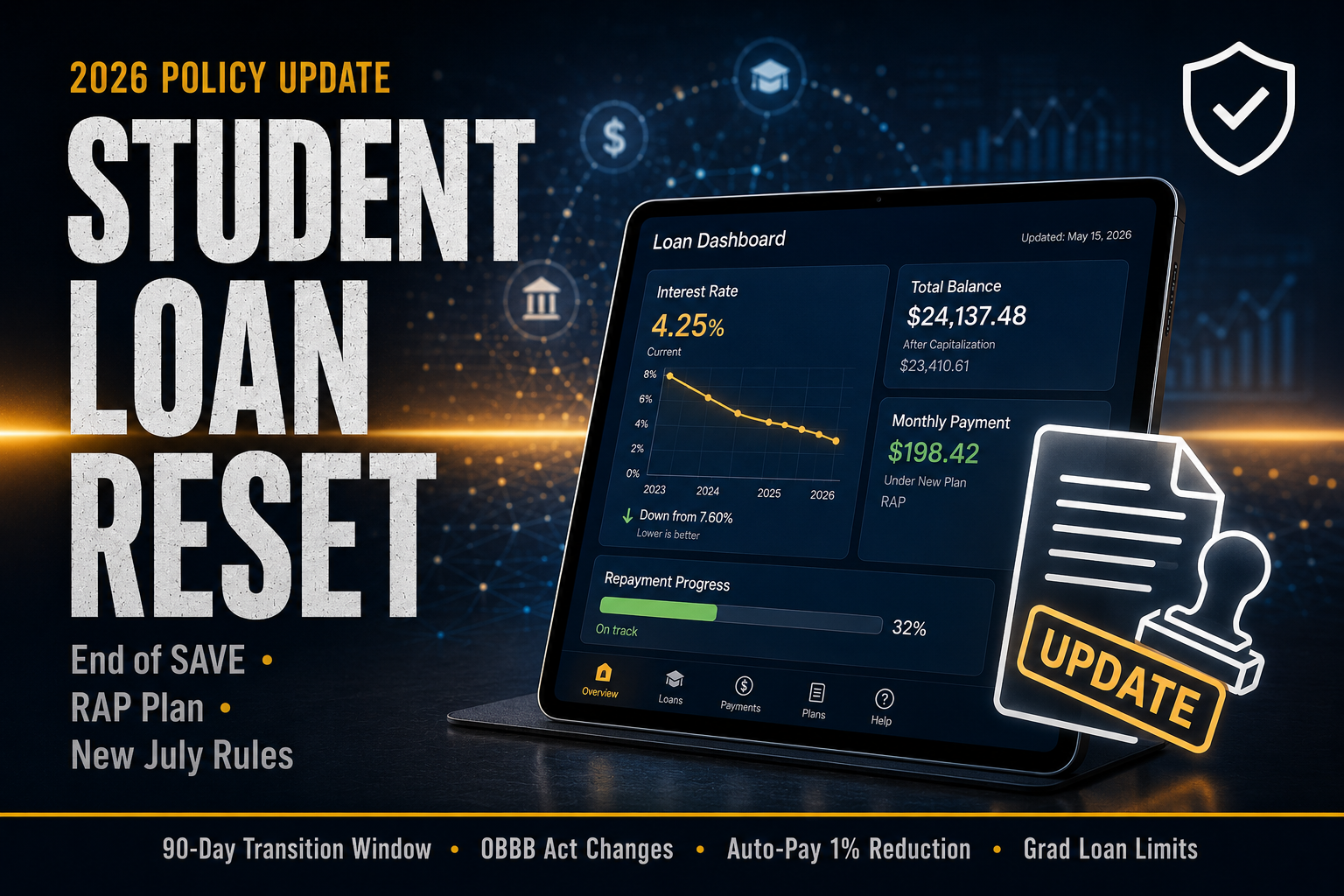
Student Loan Reset: Everything You Need to Know About the End of SAVE and the New Rules for 2026
I vividly remember the exact afternoon I realized how much the student loan landscape was about to change. I was helping a younger relative sort through their dashboard on StudentAid.gov, trying to decipher the latest notification from their servicer. We were looking at a confusing mix of “SAVE plan” status updates and vague warnings about upcoming deadlines. It felt like trying to read a map while the terrain was being actively bulldozed.
I spend a borderline unhealthy amount of time deep-diving into federal policy changes, tracking the progress of major court cases, and translating bureaucratic jargon into plain, actionable advice. Usually, I’m digging through white papers or legal rulings, but lately, the focus has been on one thing: the massive, once-in-a-generation overhaul of the U.S. federal student loan system taking effect this summer.
Let’s be completely real for a second: if you have federal student loans, you are likely feeling a mix of frustration and confusion. You’ve been hearing about the “SAVE plan” for years, only to watch it get tied up in court battles and eventually dismantled. Now, as we hit July 2026, the goalposts have moved again.
Because the reality of the student loan system is currently shrouded in legal confusion, shifting deadlines, and new legislation like the One Big Beautiful Bill Act (OBBB), I wanted to create a single, definitive guide for you. This is your no-nonsense, human-centric breakdown of what is actually happening right now, why the SAVE plan is officially a thing of the past, and exactly what steps you need to take to keep your financial life on track.
Grab a coffee, settle in, and let’s decode the new rules.
Part 1: The End of an Era (The SAVE Plan is Officially History)
If you have been waiting for the SAVE plan to be “restored,” I have some direct, albeit difficult, news: The Saving on a Valuable Education (SAVE) plan is dead.
Following a lengthy and brutal series of court battles, the federal appeals court officially ended the SAVE plan in March 2026. This wasn’t just a temporary pause; it was the final nail in the coffin. Congress and the courts have moved on, and the Department of Education is now actively transitioning millions of borrowers out of that program.
Why does this matter to you?
If you were previously enrolled in SAVE, you are in a “transition” phase. As of June 2026, the Department of Education has begun notifying borrowers that they must choose a new repayment plan.
Here is the critical “90-day rule” you need to know:
Starting July 1, 2026, if you are currently in the SAVE plan forbearance or transition period, your loan servicer will send you a notice. You have 90 days from the receipt of that notice to select a new repayment plan. If you don’t take any action within that window, the system will automatically dump you into the 10-year Standard Repayment Plan. For many borrowers, that could mean a massive, unexpected jump in their monthly payment.
Part 2: The July 1, 2026 “New World” Order
July 1, 2026, marks the single biggest shift in federal student loan policy in years. These changes are largely driven by the One Big Beautiful Bill (OBBB) Act. Whether you are a brand-new borrower or someone who has been paying for a decade, you need to understand these shifts.
1. The New Repayment Options: RAP and Tiered Standard
For new borrowers (those taking out their first federal loan on or after July 1), the menu of repayment plans has been simplified—and in some ways, restricted. You will generally be choosing between:
- The Repayment Assistance Plan (RAP): This is the new primary income-driven repayment (IDR) option. It’s designed to be more “predictable” than old plans, aiming to protect borrowers from runaway interest while ensuring steady progress toward paying off the principal.
- The Tiered Standard Plan: This offers fixed repayment terms of 10, 15, 20, or 25 years based on your total debt. It’s meant to give borrowers with higher balances more breathing room by lowering the monthly requirement, albeit at the cost of a longer repayment period.
2. The Sunset of Old Plans
Existing plans like PAYE (Pay As You Earn) and ICR (Income-Contingent Repayment) are officially being phased out. If you are currently on one of these plans, you have until July 1, 2028, to transition to a new one. While you aren’t forced to move today, it’s worth reviewing your strategy now so you aren’t caught off guard by the 2028 deadline.
Part 3: What You Need to Do Right Now (Your Action Plan)
Do not let the “wait and see” approach put you in a financial hole. Here is your proactive to-do list for the summer of 2026.
Step 1: Log in and Verify Everything
Go to StudentAid.gov immediately. Check three things:
- Your Contact Info: Ensure your email and phone number are up to date. The Department of Education will be sending out transition notices via email. If that goes to an old address, you might miss the 90-day window to switch plans.
- Your Loan Servicer: Know exactly who owns your debt. If you are with MOHELA, Nelnet, or another servicer, make sure you can log into their specific portal.
- Your Current Plan: Verify exactly which plan you are currently in. If you are in SAVE, start researching your alternatives today.
Step 2: Compare Your Alternatives
Don’t wait for your servicer to put you on the Standard Plan by default. Use the “Loan Simulator” tool on StudentAid.gov. It allows you to input your income, family size, and loan balance to see what your monthly payment would look like under the new RAP plan, the Tiered Standard plan, or older plans like IBR (Income-Based Repayment) if you are still eligible for them.
Step 3: Enroll in Auto Pay (The 1% Interest Bonus)
Here is a small piece of good news. Starting July 1, 2026, the Department of Education is increasing the auto-pay interest rate reduction from 0.25% to 1.00%.
If you are worried about interest rates, enrolling in auto-pay is the easiest way to save a little bit of money every month. If you are already enrolled, you don’t need to do anything; your servicer will automatically apply the new, deeper discount.
Part 4: The Graduate Student Crisis
If you are currently a graduate or professional student (law, medicine, etc.), the rules have changed significantly. Beginning July 1, 2026, new borrowing limits are taking effect:
- Graduate/Professional Programs: Up to $20,500/year, with an aggregate limit of $100,000.
- Medical/Law/Specific Professional Programs: Up to $50,000/year, with an aggregate limit of $200,000.
The Grad PLUS Loan is also being phased out for new borrowers starting July 1, 2026. If you are already in a program, you may be “grandfathered” in for a period, but you need to talk to your university’s financial aid office today to understand if your specific degree path is affected.
Part 5: Staying Safe During the Transition
There is a lot of noise out there right now. Scammers know that when systems are in flux, people are scared and vulnerable.
- Beware of “Debt Relief” Scams: Anyone who calls you, emails you, or texts you promising to “forgive your loans” for a fee is a scammer. The government will never charge you to enroll in a repayment plan. If a website asks for your FSA ID and password to “process” your forgiveness, leave immediately.
- Document Everything: As the system transitions, administrative errors happen. Save PDF copies of your loan records, your current repayment plan details, and any correspondence you receive from your servicer. If you get placed on the wrong plan by mistake in three months, you will need that documentation to fight the error.
- Use Free Resources: The Department of Education and official sites like TISLA (The Institute of Student Loan Advisors) are your best friends. They offer free, expert, and non-commercial advice. You don’t need to pay a private company to help you fill out a form that is available for free on the government website.
Final Thoughts: Taking Control
The end of the SAVE plan is undeniably a major blow for millions of borrowers, and the new rules taking effect this July are going to require some serious adjustments. But feeling like a victim of the system won’t lower your monthly bill.
The strategy for 2026 is simple: Be the one who drives the process. Do not wait for a letter in the mail. Log in today, see where you stand, and compare your new options. The student loan system is currently a “work in progress,” and the borrowers who take the time to learn the new rules are the ones who will protect their wallets.
You’ve got this. Take a deep breath, go to StudentAid.gov, and get your plan in order before the July 1 deadline hits.
Frequently Asked Questions (FAQs) About Student Loans in 2026
Because the federal student loan system is changing rapidly, here are the answers to the most common questions from borrowers right now.
Q: Is the SAVE plan forbearance counted toward PSLF?
A: Yes. Even though the plan itself has been legally terminated, the periods you spent in the “SAVE forbearance” still count toward your 120 payments for Public Service Loan Forgiveness (PSLF). Keep your employment certification forms on file!
Q: I didn’t get a notice to switch plans. What should I do?
A: Do not wait for the mail. If you were on the SAVE plan, log into your loan servicer’s portal today. Many servicers are overwhelmed with traffic, and emails can easily end up in spam folders. If you see no information, call your servicer directly to ask, “I was on the SAVE plan; what is my current transition status?”
Q: Is the Repayment Assistance Plan (RAP) better than the old IBR plan?
A: It depends on your income and debt load. RAP is designed to be more “predictable,” but old plans like IBR (Income-Based Repayment) might be more beneficial for some borrowers depending on their specific loan types. Use the official Loan Simulator at StudentAid.gov to compare them side-by-side using your actual numbers.
Q: Are my Parent PLUS loans affected by the new July 2026 rules?
A: Parent PLUS borrowers who have borrowed before July 1, 2026, generally get a three-year “grandfathering” period under current rules. However, you should confirm this status with your university financial aid office, as the rules for new borrowing after July 1 are quite strict.
Q: Can I consolidate my loans to avoid these changes?
A: Consolidation can sometimes be a strategic move, but it’s not a magic bullet. Consolidating into a “Direct Consolidation Loan” can sometimes open up different repayment plan options, but it can also reset your progress toward PSLF if you aren’t careful. Always speak to an advisor before consolidating if you are pursuing forgiveness.
Q: Is there any way to stay on the SAVE plan?
A: No. The plan has been struck down by federal courts and effectively ended by new legislation. Attempting to “stay” on a defunct plan isn’t possible; the system will force a transition regardless of your preference.
Q: How do I know if I qualify for the 1% interest rate reduction?
A: If you have Direct Loans disbursed after July 1, 2012, and you are enrolled in auto-pay, you qualify. If you were already on auto-pay, the rate reduction is being applied automatically by your servicer. You don’t need to do anything extra.
Q: I have FFEL loans. Are they affected?
A: Many FFEL loans are already ineligible for most income-driven plans. If you are on an older, commercially held FFEL loan, you may need to consolidate into a Direct Consolidation Loan to access modern repayment plans like RAP or PSLF benefits.
Q: Where can I get free help?
A: Stick to official .gov websites or highly reputable, non-profit sources like The Institute of Student Loan Advisors (TISLA). Avoid any website that asks for a credit card number or promises “secret” forgiveness programs.
Q: Is July 1, 2026, the deadline for everyone to switch plans?
A: No. July 1 is the date the new rules go into effect for borrowing and for the new RAP plan. SAVE borrowers specifically have a 90-day window starting from the date they receive their transition notice from their servicer, which may arrive anytime after July 1. Don’t panic on July 1; watch your email for your specific notice.







Leave a Reply