

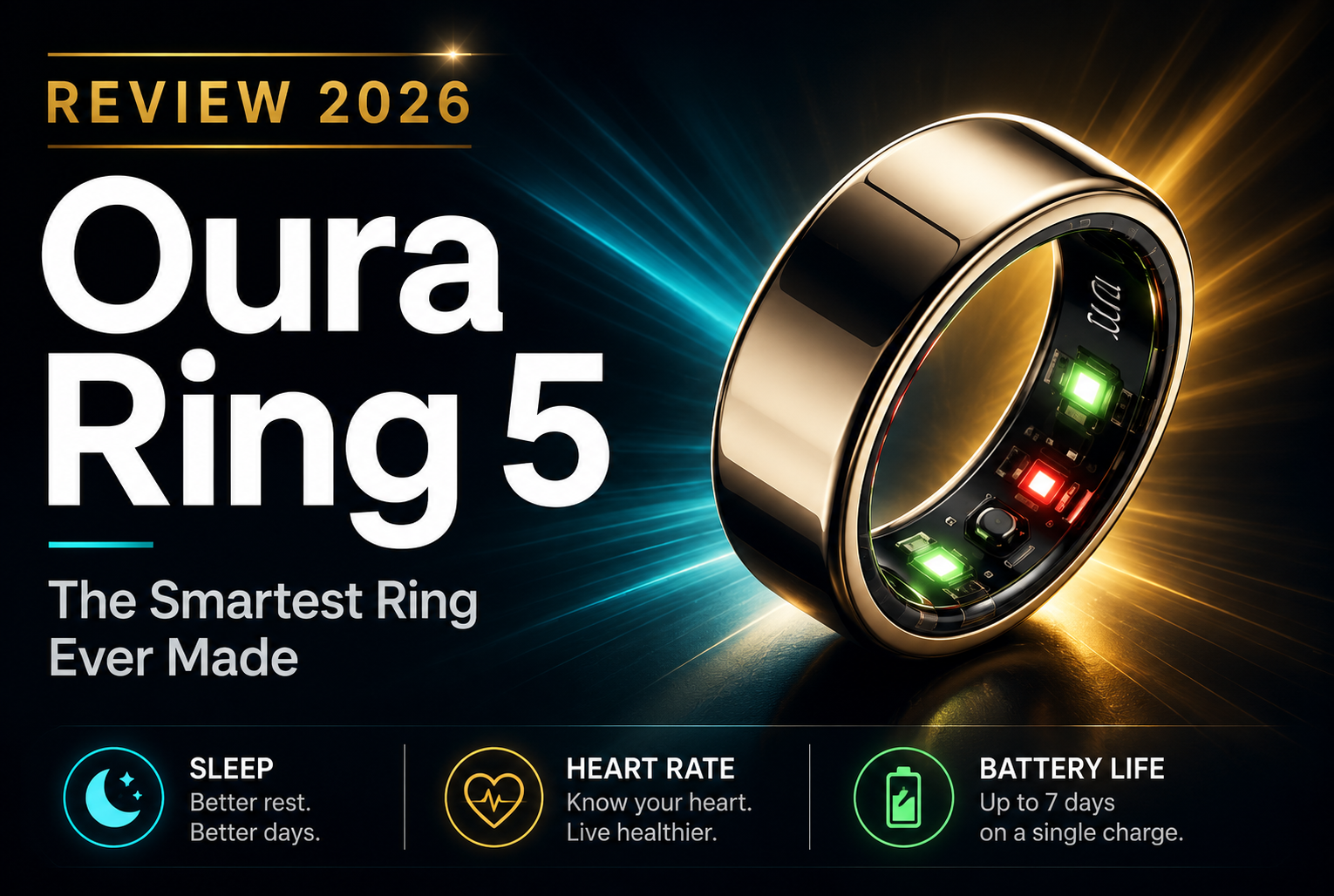
Oura Ring 5 Review (2026): The Smartest Smart Ring You Can Buy Right Now
I’ve been wearing smart rings since the original Oura days — back when they were chunky, a little clunky, and felt like you were walking around with a USB drive on your finger. So when the Oura Ring 5 landed on my desk, I’ll be honest: I didn’t expect to be floored. I expected an incremental update. What I got instead was something genuinely different.
This thing changed my mornings. That sounds dramatic, I know, but let me explain. For the past three weeks, I’ve woken up and immediately glanced not at my phone, but at the Oura app. The data doesn’t just tell me I slept seven hours — it tells me how well I used those hours, whether my body is ready to push hard at the gym, and lately, it’s been quietly flagging something about my cardiovascular trends that I’ve started paying real attention to. At 38, that’s not a notification I take lightly.
But before we get into all of that, let’s talk about the hardware — because the Oura Ring 5 represents one of the most significant leaps in wearable miniaturization we’ve seen in years, and it deserves proper attention.
The Hardware: A Genuine Engineering Miracle
Let me give you a sense of the scale of what Oura has pulled off here. Shrinking a device by 40% when that device already contains a battery, optical sensors, a Bluetooth antenna, and processing hardware is not like resizing an image in Photoshop. Every component has to be rethought, remanufactured, and re-validated. The engineering team described this as a “domino effect” — you shrink one part, and suddenly eight other things need to change.
The result? At 2.28mm thick, the Oura Ring 5 is something I genuinely forget I’m wearing. My old Gen 4 caught on keyboard edges, snagged on my gym gloves, and sometimes woke me up at night because of its presence. This one? It slips on like a band you’d see in a jeweler’s window display. My partner actually thought it was just a new fashion piece at first. That is the highest compliment a piece of wearable tech can receive.
The sensor architecture inside
The miniaturization story isn’t just about comfort — it’s about capability too. Oura redesigned the sensor domes to sit closer to the skin, which means better and more consistent biometric contact. They also packed in 12 signal pathways using stronger LEDs in a tighter space. What this translates to in real terms is better accuracy across different finger types and skin tones — a genuinely meaningful improvement that previous generations struggled with, particularly for users with deeper skin tones.
The scratch-resistant PVD (physical vapor deposition) coating is another underrated upgrade. After three weeks of wear that included cooking, cleaning, rock climbing, and a kayaking trip, my Ring 5 looks brand new. The coating visibly outperforms what I put the Gen 4 through in the same timeframe.
Battery life sits at six to nine days depending on your ring size and usage intensity. In my testing with a size 8 ring and active tracking, I’m consistently hitting 7.5 days before I need to reach for the charger. That’s real-world useful. I charge it over a Sunday morning coffee and forget about it for the week.
The Software: From Passive Tracker to Proactive Health Partner
Here’s where the Oura Ring 5 story gets genuinely interesting — and also a little philosophically complex. Because Oura isn’t really selling a ring anymore. They’re selling a health platform that happens to come in ring form.
The new software suite, which rolls out alongside the Ring 5 but is also being pushed to Gen 3 and Gen 4 devices, represents a significant shift in what a wearable is supposed to do for you. Instead of handing you a pile of numbers and wishing you luck, the Oura Ring 5 ecosystem now actively tries to interpret those numbers and nudge you toward better decisions.
Health Radar: The feature I didn’t know I needed
I want to spend some real time on Health Radar because it’s the feature that most changes the day-to-day value proposition of the Oura Ring 5. This isn’t a blood pressure cuff. Let’s be clear about that. It doesn’t give you a reading in mmHg that you’d take to your GP and have them nod approvingly at. What it does instead is use optical LED sensors to detect shifts in blood flow patterns and artery stiffness over time — the kind of gradual changes that correlate with cardiovascular risk.
Think of it like a canary in a coal mine rather than a clinical diagnostic. On two occasions in my three weeks of testing, Health Radar sent me a gentle “worth discussing with a professional” nudge. I’m not panicking — the tool is explicitly designed as a wellness flag, not a diagnosis — but it did push me to book a GP appointment I’d been procrastinating on for three months. That alone, for me, is worth a significant chunk of the $399 price tag.
It monitors your cardiovascular trends over a rolling 30-day window, looking for meaningful shifts rather than day-to-day noise. That’s the right approach. Any wearable can tell you your heart rate spiked after your espresso. Health Radar is trying to spot something slower-moving and potentially more important.
Oura Advisor: Your AI health concierge
I’ll be upfront: I was skeptical of Oura Advisor before using it. Another AI chatbot that just rephrases your data back at you, I assumed. But after three weeks, I’ve changed my view considerably. The key difference is context. When I had two poor sleep nights in a row, Advisor didn’t just show me low scores — it connected those nights to a spike in my resting heart rate, flagged that my activity load that week was higher than my three-week average, and suggested I build in a recovery day. That’s actionable. That’s the kind of thing a good sports medicine doctor does in a $300 appointment.
Is it perfect? No. Some of the suggestions are a bit generic — “try limiting screen time before bed” is advice that’s been recycled since 2015. But the trend-spotting, particularly around how your weekly stress load affects your next-morning readiness score, is genuinely insightful and gets better the longer you wear the ring.
GLP-1 Tracking and Health Records
Two features I haven’t seen get enough coverage: the GLP-1 tracking insights and the Health Records integration. The former provides longitudinal views for users on GLP-1 medications, showing how treatment correlates with your metabolic markers and lifestyle data over time. As these medications become increasingly mainstream, having a wearable that actually speaks to that experience feels like a long-overdue addition.
The Health Records and Lab Uploads feature lets you import blood biomarker results directly into the app, creating a unified picture that bridges your wearable data with your actual clinical history. Your doctor can see your sleep trends. You can see how your ferritin levels correlate with your energy scores. It’s the kind of joined-up health thinking that the industry has been talking about for years and Oura is actually starting to deliver.
The Elephant in the Room: Why Upgrade?
Here’s the conversation I kept having in my own head during this review period: if most of the exciting new software features — Health Radar, Oura Advisor, the GLP-1 tracking — are rolling out to existing Gen 3 and Gen 4 devices anyway, what exactly are you paying $399 for?
It’s an honest question, and Oura deserves credit for being upfront about it. This is fundamentally an ergonomics-first upgrade. You’re paying for the physical transformation — the 40% size reduction, the improved coating, the refined sensor architecture — not for software exclusivity. If that trade-off bothers you, it should. But if you’re someone who hasn’t worn their existing Oura ring consistently because it felt bulky or conspicuous, the Ring 5 genuinely resolves that problem in a way that no software update ever can.
I’ve spoken to several Gen 3 users who told me they wore their ring maybe four nights out of seven because comfort was a barrier. That’s a problem because continuity is everything with biometric data. A ring you wear inconsistently gives you inconsistent insights. The Ring 5 removes that friction entirely. For those people, the upgrade isn’t about features. It’s about finally getting the data they paid for in the first place.
Who Should Buy the Oura Ring 5?
Let me be direct about this, because I think a lot of reviews hedge too much.
Buy the Ring 5 if:
You found the Gen 3 or Gen 4 too chunky to wear 24/7 — this finally solves that problem for good. You’re a first-time smart ring buyer looking for the best available hardware to pair with Oura’s expanding health platform. You want the most durable, scratch-resistant smart ring on the market right now. You travel frequently and value week-long battery life. You work in a professional environment where a chunky tracker would look out of place, and you want your health device to double as something you’re proud to wear.
Keep your current ring if:
You’re already happy with how your Gen 3 or Gen 4 fits and feels — the software upgrades will reach you regardless. You’re budget-conscious and $399 feels steep for a comfort upgrade. You were hoping for Ring 5-exclusive health features that would leave older generations behind — they don’t exist.
The Charging Case: A Genuinely Great Accessory
I want to give proper recognition to the $99 Oura Ring Charging Case because in my three weeks of testing, it became something I reached for without thinking — which is the highest praise for an accessory.
Made from recycled aluminum, it holds up to a month of battery life for the ring. For anyone who travels frequently, this is the piece that transforms the Ring 5 from “great wearable” to “perfect travel companion.” No cable hunting in hotel rooms. No anxious battery-checking before red-eye flights. Just top it up, toss it in your bag, and live your life.
At $99 it’s not cheap. But for the use case it solves, I found myself considering it practically essential after my second week. If you’re buying the Ring 5, at least try one trip without it first and see how you feel. My suspicion is you’ll order it on the way home.
Understanding the Membership Model
No review of the Oura Ring 5 would be complete without talking honestly about the subscription. The hardware costs $399, but Oura’s full value is locked behind a $5.99/month membership. Without it, you get basic daily readiness and sleep scores — enough to know you’re a human who sleeps, but not enough to justify the price of the device.
With the membership, you unlock everything: Oura Advisor, deep-trend analysis, Health Radar, GLP-1 tracking, Health Records integration, and the full AI-powered coaching suite. For most users, this is a non-negotiable addition to the purchase.
Annualized, that’s roughly $72/year on top of the $399 hardware — about $471 for your first year of full access. For context, that’s less than two months of a premium gym membership in most cities, and the data the Ring 5 ecosystem provides has materially changed how I approach my training, recovery, and preventive health conversations with my doctor. I consider it reasonable value. Your mileage may vary depending on how deeply you engage with health data, but go in with eyes open — the ring and the membership are effectively a package deal.
How Does It Compare to the Competition?
The smart ring space is no longer Oura’s exclusive playground. Samsung has been pushing its Galaxy Ring hard, and Whoop remains a formidable competitor on the wrist. So where does the Oura Ring 5 sit in this landscape?
Against Samsung’s Galaxy Ring, the Oura Ring 5 wins on sensor sophistication, health platform depth, and subscription value. Samsung’s ring integrates more tightly with Galaxy devices, which makes it a natural choice if you’re deep in that ecosystem, but the Oura platform is more advanced when it comes to sleep staging, recovery science, and the breadth of health insights available.
Against Whoop 5.0 on the wrist, the comparison gets more interesting. Whoop’s heart rate monitoring during vigorous exercise is arguably still the gold standard for serious athletes. But Oura’s finger-based sensors win decisively during sleep, where wrist movement causes more noise and inaccurate readings. And the fact that the Ring 5 is ring-based rather than wrist-based makes it more socially invisible in professional and social settings — no one at a board meeting is giving your finger a second glance.
If you’re a serious athlete training multiple times a day, Whoop might edge ahead for in-workout data. If you’re a professional or anyone who wants round-the-clock health insight without wearing something that announces itself, the Ring 5 wins.
The Bigger Picture: What Oura Is Really Building
It’s worth stepping back and acknowledging what Oura is clearly constructing here. With an anticipated IPO on the horizon, the company is making increasingly confident moves into the preventive healthcare space. The Health Records and Lab Uploads feature, the GLP-1 integration, the clinical-adjacent framing of Health Radar — these aren’t just product features. They’re signals to investors and healthcare systems that Oura intends to be a platform, not just a gadget maker.
Features like Health Records create genuine long-term stickiness. The longer you use Oura, the more valuable your historical data becomes, and the harder it is to switch to a competitor. Nobody else has five-plus years of your continuous biometric data organized into a coherent health narrative. That’s a real competitive moat, and it’s the kind of thing that pure hardware competitors struggle to replicate.
As a consumer, this trajectory is broadly positive — with one important caveat. The more medical-adjacent these features become, the more important it is that Oura communicates clearly about what they are and aren’t. Health Radar is a wellness flag, not a diagnosis. Oura is admirably clear about this in their disclaimers. Hold that distinction front of mind, and use the platform the way it’s designed to be used: as a prompt for better conversations with your doctor, not as a replacement for clinical care.
Frequently Asked Questions
Does the Oura Ring 5 actually measure blood pressure? Not clinically. It uses optical sensors to detect trends and shifts in blood flow patterns that correlate with cardiovascular strain — think of it as a trend monitor rather than a BP cuff. If Health Radar flags something, treat it as a prompt to book a proper clinical check-up, not as a diagnosis.
Are the new AI features exclusive to the Ring 5? No. Health Radar, Oura Advisor, and GLP-1 Tracking are rolling out to Gen 3 and Gen 4 devices. If you own a Gen 4 and you’re happy with how it fits, you’ll get most of the new software without upgrading.
Is the Oura membership really necessary? For most people, yes. The free tier gives you very basic scores. The $5.99/month membership unlocks everything that makes the Ring 5 worth its price — the AI advisor, trend analysis, health records integration, and the full depth of sleep and recovery coaching.
How durable is the Ring 5 compared to the Ring 4? Noticeably more durable. The upgraded PVD coating is a real improvement. After three weeks of fairly aggressive daily use — including rock climbing and kayaking — mine shows zero visible scratches. My Gen 4 had visible wear marks within the first week.
What’s the real-world battery life like? In my testing, I’m consistently hitting 7 to 7.5 days on a size 8 ring with typical usage. Heavy users might see 6 days; lighter users could stretch to 9. Either way, it’s a weekly charging cadence, which feels genuinely sustainable.
Is the charging case worth $99? If you travel frequently, yes. It holds a month of charge for the ring, looks great, and eliminates cable anxiety on the road. For a home-only user who charges at their desk, you can safely skip it.
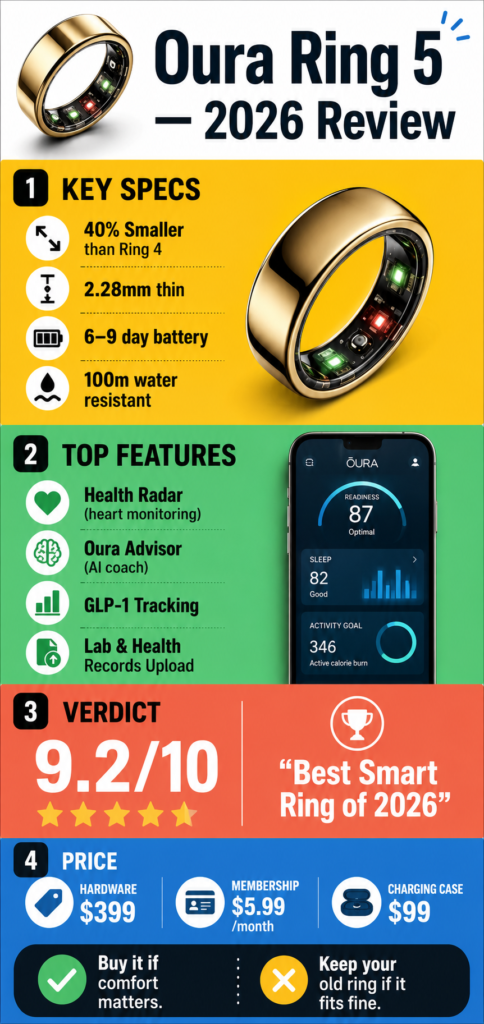
Final Verdict
The Oura Ring 5 isn’t perfect. The fact that its most exciting software features are being backported to older devices makes the upgrade decision a personal one rather than an obvious one. If your Gen 3 or Gen 4 fits well and you wear it consistently, you can wait.
But for everyone else — for first-time buyers, for people who abandoned their previous Oura ring because it felt like a speed bump on their finger, for anyone who wants their health tracker to disappear into their jewelry collection rather than announce itself — the Ring 5 is the most compelling wearable released in 2026. Full stop.
It manages to be simultaneously the most technologically sophisticated ring Oura has ever made and the one that requires the least amount of thinking about. That combination — profound capability, invisible presence — is the hardest thing to achieve in hardware design. The Oura Ring 5 achieves it.
If you’re ready to take health tracking seriously without sacrificing comfort or style, this is the ring you’ve been waiting for. Just don’t forget to budget for the membership. The hardware is the body, but the software is the soul.
Disclaimer: Oura’s Health Radar and Blood Pressure Signals are intended for wellness insights and are not medical diagnostic tools. Always consult your healthcare provider about significant changes in your health metrics.











Leave a Reply